Blog Archives
Navigating Expectations

Broken Alliance follows the Venture’s crew as they uncover a conspiracy tied to black-market thetic technology, corporate power grabs, and the lingering ghost of Sovereign. How did your goals for this book differ from the first installment?
While Tracer was about introducing the crew and establishing the stakes of their world, Broken Alliance shifts the focus to the ‘aftermath.’ I wanted to explore the consequences of their initial decisions—not just for the Venture crew, but for the Settled Systems at large. In many ways, this second book was easier to write because the characters’ voices were already established; however, the challenge lay in ensuring their growth felt organic. My goal was to navigate the expectations set in Book 1, sometimes fulfilling them and other times intentionally subverting them.
Characters are often forced to make imperfect choices. Are you more interested in right answers or honest ones?
Most of us go into heroic stories expecting the characters to make the ‘right’ choice. It’s an expectation built by the books and movies we’ve grown up with. To me, that’s why literature is so vital—it teaches us what it means to be human on this tiny planet. Even when authors ‘flip the script,’ we still have that core desire to see good triumph over evil. I try to lean into honest answers wherever possible, but leading my heroes toward a morally right conclusion is ultimately how I share my own values through my work.
What makes chosen family such a powerful counterweight to failing institutions?
We’ve all been told that you can’t choose your family—that ‘blood is thicker than water.’ Personally, I believe that’s a falsehood. There is no greater bond than one forged in a close-knit circle of friends who have proven, time and again, that they have your best interests at heart. These are not always the people who share our blood, but they are often the ones who have bled with us. We can no more choose our relatives than we can choose the systemic world we were born into, but we can choose who to accept as our true family—just as we can choose to speak up against tyranny and corruption.
The ending offers a pause rather than closure. What threads from Broken Alliance are you most excited to explore next?
My goal was to provide a sense of closure for this specific arc while hinting at the larger story still to come. Each character has changed so much, but for me, the most exciting part is knowing they have much further to go. We’ve only scratched the surface of the Tracer universe in these first two books. I’m looking forward to expanding the scope of the series and perhaps even stepping outside the current saga to explore these characters from new perspectives.
Author Links: GoodReads | X | Facebook | Website
The crew of The Venture—Andre, Bex, Bishop, and Caleb—are now Alliance Tracers, tasked with hunting down those who seek to capitalize in the wake of Sovereign’s defeat. But loyalty is a fragile thing in a universe still reeling from the brink of destruction. Meanwhile, General Katherine Mallory navigates a treacherous new battlefield, facing enemies as formidable in the Council Chambers as any on the front lines. And deep within Trelin Base, Commander Bryton guards the galaxy’s most dangerous secret: Sovereign, whose unnatural power remains an ominous threat.
Old wounds fester and new forces rise, all vying to unlock Sovereign’s power. As the fragile peace threatens to unravel, these heroes must choose where their allegiances lie. Will the Alliance endure this new era, or is it doomed to collapse and shatter into a Broken Alliance?
Broken Alliance


Broken Alliance is a character-driven science fiction adventure that picks up right where Tracer leaves off. We follow Bex, Andre, Kat, and the rest of the Venture’s crew as they uncover a conspiracy tied to black-market thetic technology, corporate power grabs, and the lingering ghost of Sovereign. The stakes scale from street-level desperation to full political upheaval, with personal loyalty binding the whole thing together. By the time the dust settles, alliances shift, institutions crack, and the characters have to decide who they want to be in the systems they’ve helped reshape.
Author David Graham writes with a steady rhythm: some moments hit hard and fast, like the firefight in the Paramor or Bex racing across rooftops; others stretch out with quieter emotional beats, especially in the aftermath scenes near the end of the story. What I appreciated most is how the book doesn’t rush the characters’ inner shifts. Bex’s relationship with identity and agency, Andre’s weariness and stubborn hope, Kat’s complicated sense of duty, these all felt grounded. Even when the plot leaned into big sci-fi spectacle, the emotional center stayed human.
The author also makes some interesting choices about power structures and responsibility. The political hearings, the scramble over the Trelin Base project, and the moral ambiguity of the Alliance add a sharper edge to the adventure (the council scenes show this well). Sometimes the villains are overt, like Davenport, but more often the danger feels systemic, which makes the world feel authentic and messy. I liked that the story refuses a clean resolution. Even the epilogue acknowledges the work still ahead while nudging us toward future threads in the Settled Systems.
By the time I turned the last page, I felt satisfied but also curious. The ending gives the characters a breather, a moment of found-family warmth, and a hint that their fight isn’t done. It’s a good tone to leave on: hopeful but honest. If you enjoy sci-fi that balances action with character, especially stories about crews who choose each other again and again even when the galaxy keeps breaking around them, this one will land well. Fans of The Expanse, Mass Effect, or any tight-knit-crew narrative will feel right at home.
Pages: 418 | ASIN : B0DYVSVTML

Arcanoforge: Midnight Metropolis

Arcanoforge: Midnight Metropolis is a feverish plunge into the neon-choked streets of Noctara City, a dystopian sprawl where humans and husks, ghosts and hemo magicians blur into a single, strange pulse. The story follows Tattie, a blood seer who’s fled her dying homeworld, and Brax, the man who tracks her across galaxies as their shared past claws its way back into the present. Around them spin a chorus of restless lives, skaterats, dealers, dreamers, all caught in the thrumming heart of a city that feels alive and dying at once. It’s part cyberpunk, part occult noir, and part heartbreak.
The writing is gritty, poetic, and weirdly tender. Author Caroline Barnard-Smith doesn’t just describe Noctara, she burns it into your head with words. Every street and shadow has its own personality, every conversation crackles like static. I loved how the world felt handmade, patched together with old wires and bad memories. The characters stumble through it broken and fierce, never really heroes, just people trying to stay one step ahead of decay. The prose leans heavily on texture, smells, lights, and sounds, and it builds a rhythm that makes the whole book feel like a song played through busted speakers. Sometimes it’s overwhelming, but in the best way.
There’s this deep ache about survival, about what we lose when the world stops caring. I kept thinking about the husks, these half-human enforcers who’ve traded pain for obedience, and how much that says about our own craving for numbness. And Tattie, she’s messy, angry, brilliant. I believed every choice she made, even when it hurt to watch. The story toys with power, guilt, and the ghosts that cling to love long after it’s gone.
Arcanoforge: Midnight Metropolis reads like Blade Runner crashed into The City & The City with a shot of Neuromancer’s grit and the bruised heart of a Becky Chambers story. I’d recommend it to anyone who loves science fiction that’s soaked in mood and grit. Fans of Gibson and VanderMeer will feel right at home. If you like your futures dark and your magic dirty, if you want to taste the metal in the air, this book’s for you.
Pages: 278 | ASIN : B0FFH6BS5L
Infernal Wonderland


When I first cracked open Infernal Wonderland, I wasn’t sure what to expect. What I found was a sprawling, neon-drenched fever dream of a story. It follows Jadecan, an akiko, who stumbles into the submerged Amber City, a broken metropolis that feels alive and dead all at once. From the very first chapter, the world is suffocating, strange, and brimming with danger. Automatons sell people for parts, reptilian gangs lurk in the shadows, and a drug called Ichor twists minds and bodies. The book unfolds in five parts, each one pushing Jadecan deeper into madness, violence, and strange alliances, while the PA system keeps whispering about revolution like a ghost that refuses to die.
This is a unique book. Sometimes thrilling, sometimes disorienting, and often unsettling. Killam has this way of painting a scene that engages your senses. There were moments where I wanted the story to breathe, to let the horror and beauty of Amber City sit with me instead of racing ahead to the next grotesque fight or cryptic exchange. Still, the book’s voice stuck with me. It’s sarcastic, it’s grim, and it doesn’t let you forget that the world is cruel. I found myself both grinning at the dark humor and wincing at the relentless blood and guts.
What really hooked me, though, was the mix of philosophy and pulp. Amidst all the gore and chaos, characters stop to talk about the meaning of life, about want versus need, about existing without actually wanting to exist. Those conversations gave the book an odd tenderness that surprised me. I could feel the author reaching for something bigger.
Infernal Wonderland is haunting and oddly beautiful. It’s not a book for someone looking for a straightforward plot or a clean arc. It’s for readers who want to sink into a unique atmosphere, who don’t mind being jarred, and who can handle equal parts gore and poetry. If you’ve ever loved stories like Bioshock or Blade Runner but wished they were darker and stranger, this book will feel like home.
Pages: 421 | ISBN: 978-1-957195-18-6
Anticipation Day

Anticipation Day follows Dr. Joshua Lee, an Australian computer scientist who becomes the unlikely leader of a groundbreaking U.S. government initiative to allow citizens to experience fully immersive simulations of past historical eras or even specific days in their own lives. At the heart of the novel is the concept of “Anticipation Day,” an annual event during which eligible citizens can experience a vivid alternate reality. Through political maneuvering, technical innovation, ethical debates, and deeply personal moments, Michelson crafts a narrative that spans continents, emotional landscapes, and big philosophical questions about memory, identity, and the power of longing.
What struck me first was how real the characters felt. Joshua isn’t a stereotypical genius or a cold bureaucrat. He’s a loving father, a tired husband, and a man caught between ambition and regret. The writing is informal but polished, with a strong conversational voice. Michelson uses humor with a deft hand, not too much, but enough to ground the high-concept tech in everyday moments. This book is packed with big ideas about simulated realities, but it never forgets to be relatable.
Some parts felt like a detailed journal, more than a novel, especially in the first third. The world-building around the simulations is dense, but I appreciated the scientific depth. That said, once Part 2 hits, when we experience individual simulation stories from different characters, it absolutely soars. These sections gave the concept heart, showing not just the tech, but what it means to people: closure, adventure, peace, sometimes even sorrow. The vignettes felt like short stories inside a larger novel, and I enjoyed that structure. It gave the book emotional highs that made me reflect on my own life and what day I might choose to relive.
By the end, I felt something rare: hope. That’s not to say the book is rosy, it deals with trauma, loss, politics, and the ethics of tech, but it never loses sight of the value of memory and imagination. Michelson writes with warmth and sincerity. I’d recommend Anticipation Day to fans of thoughtful science fiction, especially those who enjoy character-driven stories with a speculative edge. If you liked Black Mirror episodes that tug at the heart or enjoyed the moral dilemmas of The Midnight Library, this book might be for you.
Pages: 544 | ASIN : B0DPJB1PMB

KRIS PR

KRIS PR is a wild, heart-thumping ride through a neon-soaked Manchester of the future, where genetic editing and cybernetic mods clash with old-school policing and gritty human instinct. The book centers around Kris, an “Edit” police officer, genetically enhanced but fiercely clinging to human values, who stumbles across a mysterious girl named Aimee. She’s young, scared, possibly modded beyond anything he’s seen, and very much in danger. From that moment on, everything goes sideways. The novel blends cyberpunk dystopia with raw character introspection, combining action, ideology, and just the right splash of existential dread.
G.S. Morgan doesn’t just describe a futuristic Manchester; he drops you into it with both boots on the cobbles. The prose is rich and textured, almost poetic at times, but then whips around into sharp, no-nonsense grit. Take the opening scene: Kris cruising through the night, haunted by doubt, the streets “held together with rusting – yet unyielding – steel wire.” There’s this beautiful, ugly honesty to the world. I found myself rereading lines just to soak them in. And then, the action kicks off hard. The alleyway scene where Kris finds Aimee is utterly gripping and I didn’t blink for three pages.
The ideas packed into this story go way deeper than cool tech and shootouts. Kris wrestles constantly with what it means to be “better,” as an Edit, as a man, as a protector. His Nietzschean upbringing and loyalty to “The 8” code make for some intense inner dialogue. It’s not subtle, but it doesn’t try to be. He’s torn up about fear, strength, and failure. When Kris is ambushed and chooses to flee, only to later wrestle with profound shame and guilt in the wreckage of his overturned patrol car, the moment lands with striking emotional weight. It’s raw, honest, and deeply human. He isn’t portrayed as an invincible figure; he’s someone navigating fear and survival in a world that demands perfection. That kind of vulnerability, especially within a narrative dominated by enhanced beings, feels both rare and powerful.
Then there is Aimee, a character cloaked in enigma, her presence both unsettling and compelling. She appears to be an ordinary child, yet her connection to advanced biotechnology, including a remarkable ability to quite literally vanish, sets her apart in ways that challenge both the reader and Kris himself. Despite the extraordinary nature of her abilities, she is never reduced to a mere plot device. She is perceptive, composed, and retains a quiet innocence that contrasts sharply with the chaos around her. The relationship between Kris and Aimee is layered with unease and quiet empathy, complex, unfinished, and refreshingly ambiguous. What stands out is that Kris doesn’t fully understand his own drive to protect her. There is no grand revelation or heroic rationale, only instinct, and a deeply human impulse to act in the face of uncertainty. It’s this restrained, unresolved tension that gives the story emotional depth beyond the conventions of typical science fiction.
KRIS PR blew me away. It’s a genre-bending, brain-scrambling mix of noir, sci-fi, and psychological drama with a sharp philosophical edge. The writing’s bold. The world is cracked and humming. The characters, especially Kris, are deeply flawed and alive. If you like your stories with tension, tech, and a soul, this one’s for you. I’d recommend it to fans of Blade Runner, Altered Carbon, or anyone who’s into thoughtful action stories with bite.
Pages: 395 | ASIN : B0F3Y1HRJV
Sol Accords: Starbourne
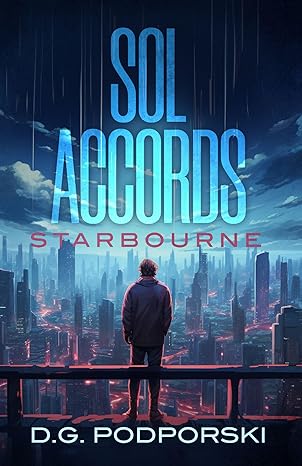
D.G. Podporski’s Sol Accords: Starbourne is a gripping journey into a future where humanity’s reach extends across the stars, but old struggles—corporate greed, personal identity, and survival—remain stubbornly present. At its heart is Jaeden Starbourne, a man recovering from cryogenic sleep and grappling with amnesia, debt, and the harsh realities of a universe dominated by bureaucracy and exploitation. The book seamlessly blends high-stakes space adventures with raw human emotions, creating a world that feels as vast and cold as the space Jaeden inhabits.
The opening prologue, with its dim lights and encroaching darkness, had me hooked instantly. Podporski masterfully sets the scene, like when the derelict ship first awakens with “sparks blowing through the door unabated.” The tension is palpable, and the descriptions are so vivid I could almost hear the hissing of machinery as the ship slowly came back to life. However, the pacing can feel uneven; moments of technical description occasionally bog down the flow. That said, the immersive world-building more than makes up for it. I also appreciated the deeply flawed and relatable characters. Jaeden’s struggle with anger, debt, and his loss of memory felt painfully real. His irritability, as highlighted in the scene where he fights with the AI assistant “Lexi,” reflects the weight he carries daily. Yet, there’s a quiet resilience in him that makes you root for his survival. Supporting characters like Joanna Stokley add depth and camaraderie, though some secondary figures felt underexplored—Sylvie, for example, seemed more like a trope than a fully realized individual. The story raises thought-provoking questions about identity and second chances. Jaeden, labeled with the surname “Starbourne” to denote his orphaned status in space, embodies this struggle. The societal disdain he faces for his name mirrors real-world biases, and his journey to reclaim purpose resonates deeply. The corporate backdrop, meanwhile, critiques unchecked capitalism in a way that feels uncomfortably close to our present-day realities.
Sol Accords: Starbourne is a rich, character-driven space opera that rewards patience. Fans of slow-burn science fiction with a focus on survival and human complexity will find much to love. While the story’s pacing might challenge those looking for constant action, its emotional depth and detailed world-building make it worth the ride. I’d recommend it to readers who enjoyed The Expanse or Dark Matter and anyone who’s ever pondered the price of progress and the resilience of the human spirit.
Pages: 445 | ASIN : B0D4FBRCTH
What’s On the Data Cube?

Accidental Intelligence follows a detective who teams up with a manipulative AI to unravel a conspiracy of rogue AIs planning a catastrophic endgame threatening humanity’s survival. What was the inspiration for the setup of your story?
This book came about because I couldn’t let go of the question, “what’s on the data cube?” That’s the data cube found by Subcommander Andrew Bowers at the end of the prologue. That prologue was supposed to be a one-off short story, but I couldn’t let it go. Mason Truman was born because I needed someone that Bowers could turn to for help. I batted around a lot of possibilities for a long time, but eventually settled on a snarky PI who will probably do the right thing. When he has no other options left. Note, too, that Mason also has a problem letting go of needing to know. That’s where I bleed into him, for sure.
The concept of “Eschaton” is both chilling and philosophical. How did you develop this idea, and does it draw from any specific influences?
It starts with the AIs themselves. Seeming partners with humanity—or at least the government and corporate powers—they took their queues on how to act from the only model available: humans. I wanted to explore a world where AIs were just as fractured, just as capable of good and evil, just as duplicitous, and just as capable of machinations as we are. The idea that some AIs would choose to see their plans as “divinely ordained” felt so utterly perfect.
What were some themes that were important for you to explore in this book?
One theme I thoroughly enjoyed was Mason’s struggle with his contempt for the Lost, people who spend all their time in the Omninet. Really, he loathes anyone who willingly spends any time in the Omninet. Most of us would likely see that as exciting—I would probably be among the Lost myself. But Mason sees it as something that’s false, as living a life that isn’t real. His contempt directly hampers him professionally, and it blinds him to some things in his own life. It has even been a wedge between him and his best friend, Peanut.
The most important theme, however, is the nature of life in the Terran Republic. My 2139 is hands down a dystopia. Omnipresent surveillance and a state with the power to disappear people in the name of security is horrific. But I wanted to present it through the eyes of the people living it. I wanted to present it from the standpoint of those who grew up in that world, rather than through the lens of today’s reader. I think I wound up with a functional dystopia where things seem pretty dang good, but thinking about the implications should give most people pause. If I’m lucky, I’ll have left readers with questions.
Can you share any insights into your world-building process and how you created such a richly detailed 2139 setting?
I borrowed liberally from plenty of SciFi sources that came before me. Chief among them is Larry Niven, particularly his Known Space universe. Slidewalks, plasteel, and monofilaments all came from my exposure to his worlds. What I didn’t directly borrow was usually the result of my internal logic process. Factotums seem like a no-brainer to me, just like the brain interfaces through which they work. The same with immersion decks and the way being on the Omninet feels real. Kitchencooks came out of rising temperatures and the need to feed people. Marriage contracts and redefining “family” also feels inevitable. Quantum Vaults came from thinking about how people would try to circumvent state surveillance. And then the battle over whether Quantum Vaults would be permitted by that state (referenced in an epigraph) stemmed from the debates we’ve witnessed in our lifetime over encryption. Everything stemmed from trying to logic my way through the problems at hand. At the same time, I wanted readers to recognize the world, to be able to put themselves into that future, despite the crazy cool and often scary changes inherent in that world.
Author Links: GoodReads | Bluesky | Threads | Facebook | Website
In his debut novel, Bryan Chaffin transports us to the year 2139, where corporate combines have their own Senate seats, the surveillance-state is all-encompassing, humans live most of their lives in the Omninet, and sentient AIs are partners with the world government. It’s not all bad, though. There are docbots, you never have to wait for a taxi, and if you can afford it, you can get your coffee made the old fashioned way, strained from the algae tanks.
ACCIDENTAL INTELLIGENCE
Private detective Mason Truman is being yanked around by invisible strings, and it’s an AI doing the yanking. Miranda. She’s subtle. Crazy. And she thinks she can see the future. It’s enough to drive Mason nuts. Miranda believes her fellow AIs are up to some kind of grand conspiracy against the Terran Republic, and she wants Mason’s help proving it. Conspiracies are above Mason’s pay grade, though, the kind of time-sink that can put a crimp in more serious pursuits. Like drinking coffee. And staying alive.
But Miranda won’t take no for an answer. Mason can help or Miranda will make sure he becomes intimately acquainted with the finer conversational techniques of the secret police. So Mason digs until he uncovers a cache of stolen communications between a cabal of rogue AIs. They’re planning what they call Eschaton—the divinely ordained end of humanity. Unless Mason and Miranda stop the arrogant pricks, the conspirators will destroy Earth.
Mason and Miranda have one chance, a way of bottling up the rogue AIs. All Mason has to do is lure the conspirators to the right spot in a sim world. That’s how Mason learns that when Miranda said she needed help, what she meant was bait.



 LITERARY TITAN