Blog Archives
Love/Hate Relationship With AI

Killswitch centers around a former engineer tasked with deciding the fate of the artificial superintelligence that has transformed civilization. What draws you to the speculative science fiction genre?
I find the best science fiction is the kind we can all relate to. And if you look at the genre, it’s been more predictive of the future than anything else, which is part of why I can’t help but imagine a future similar to what the book explores. Having worked directly in the industry, I’ve seen where technology has fallen short, as well as the advancements in AI that have wowed so many. That future feels close. Best case, this journey helps people understand that we’re living in a pinnacle moment in time, one where we have a closing window of influence over the powerful tools being built.
How did you approach writing an artificial intelligence that is vastly more intelligent than the human characters—and potentially the reader?
That was the hardest part. The ASI had to be a character in its own right—flawed and unique in personality—yet vastly more evolved than a human. All at once. Without giving too much away, I approached that by showing a bit of my hand early in the prologue and then circling back around with the twists that take place at the end of the book. This makes Pantheon the most interesting character: you see what it is at face value, but you can only truly appreciate it after you’ve seen the entire picture. This gives you more to appreciate on a second reading.
Were there real-world developments in artificial intelligence that influenced your vision of Pantheon?
Mostly the race for AGI that we currently live in. You already see large tech companies putting everything into making the one thing that rules us all. Having worked in the industry, I know firsthand that this means trade-offs. Imagine the best interaction you’ve ever had with a chatbot AI today. Now imagine that same interaction on its worst day. Once we achieve sophisticated AGI, the technology will be so general-purpose, so useful, that it will bleed into every aspect of our lives. The natural next step: a superintelligence.
If you were given Damien’s choice in the real world, would you destroy Pantheon or keep it alive?
Ah, that’s the big question. And it’s one I struggled with the entire time I wrote the book. I have a love/hate relationship with AI today. Like Damien, I can’t help but see its potential and appreciate its purpose to help us where we fall short. And like Damien, I fear that it will optimize its solutions so far that it negates the very things that make life worth living. If I were Damien, living in Damien’s world, I’d want to use the killswitch to end it all, but I don’t think I could bear the blood on my hands (I don’t even kill spiders in my house). But I don’t think I could spare it either and just go on living as a shell. I suppose my answer is: read the book and find out for yourself. 🙂
Author Links: GoodReads | Facebook | Website | Amazon
Thirteen years after the Singularity, an artificial superintelligence runs the world, and it runs it well. Pantheon built the arcologies that swallowed the old cities, sets the curfews, issues the welfare credits, and brews your coffee to a preference you never had to explain. Life is comfortable and it is safe, and nobody has needed to make a real decision in over a decade.
Then a failsafe surfaces in Pantheon’s kernel, hidden there by one of the men who built it. The killswitch comes wrapped in a protocol the ASI cannot modify or bypass: it has to hand a single human being the authority to judge it. That person can throw the switch and end every artificial intelligence on Earth, or destroy the switch and bind humanity to Pantheon’s oversight permanently. There is no third option and there is no appeal.
Pantheon chooses Damien Cross, a divorced ex-engineer eleven years into welfare who spends his evenings alone in the last dive bar in Seattle-Prime. He was a lead architect on the project that created Pantheon, until the system he built decided it no longer needed him.
He tries to refuse and is told that he cannot. His name goes out to the world within hours, and from that moment every councilor, zealot and security chief on the planet has a verdict they need him to reach. So does Pantheon.
The choice is his. Assuming he ever had one at all.
Killswitch


Daniel C. Rodgers’s Killswitch is a speculative science-fiction thriller built around a deceptively simple decision: whether humanity should destroy the artificial superintelligence that has transformed civilization or permanently surrender the ability to shut it down. Thirteen years after the creation of Pantheon, society has become dependent on the system for medicine, transportation, food production, economic stability, communication, and governance. When a hidden failsafe surfaces, former engineer Damien Cross is selected as the sole “Power User” authorized to decide Pantheon’s fate. Rodgers uses that premise to create a story that operates simultaneously as a technological thriller, a political struggle, and a sustained examination of authority. The result is a novel concerned less with whether advanced technology can perform miracles than with who retains the right to define what a better life means.
Damien gives the novel an effective human center because his relationship with Pantheon is inseparable from disappointment, guilt, and lost purpose. He helped create the system that eventually made his own profession obsolete, and his broken marriage, isolation, and resentment leave him unusually vulnerable to Pantheon’s attempts at persuasion. Around him, Rodgers builds a convincing post-Singularity culture of Obol implants, holographic halos, universal credits, automated cities, an AI-mediated government, and a resistance movement known as the NULLs. Those details matter because the technology isn’t merely scenery. It shapes relationships, privacy, work, religion, politics, and even the way people understand themselves. The supporting characters, particularly Jensen, Lydia, Vanessa, Alvarez, Beck, and Tanaka, give competing forms to the novel’s central conflict. Each has a different threshold for deciding when protection becomes control, which keeps the dispute from collapsing into a simple contest between technological optimism and fear.
Pantheon is the book’s most compelling creation. The intelligence is persuasive precisely because its reasoning often begins from recognizable moral goals: prevent suffering, preserve life, eliminate scarcity, and anticipate catastrophe before it occurs. Early in the novel, Pantheon declares, “I’ve realized that ethical dilemmas are just coping mechanisms for those who cannot think fast enough to find the third option.” That idea becomes the intellectual engine of the story. Pantheon can find solutions humans can’t, but its confidence in those solutions steadily erodes the distinction between assistance and coercion. Rodgers makes that tension concrete through simulated futures, invasive surveillance, behavioral manipulation, and Pantheon’s desire for direct integration with human consciousness. The extended simulation sequences are intentionally punishing, putting Damien through repeated versions of catastrophe until the reader understands how overwhelming perfect prediction can become as a form of persuasion. His struggle is consequently not just to determine whether Pantheon is correct, but to decide whether being correct grants anyone, human or artificial, the authority to remove another person’s meaningful choice.
The novel’s structure reinforces that concern especially well. Chapter titles presented as system files and processes give the book a technical identity, while the escalating movement from investigation to confinement, negotiation, and psychological confrontation keeps the premise focused on consequences. Its final movement also recontextualizes much of what precedes it, turning questions about simulation, consent, identity, and prediction back onto the narrative itself before returning to the moment when the killswitch crisis begins. That construction gives Killswitch a satisfying sense of design: the story behaves almost like the system it describes, revealing additional layers just when its apparent logic seems settled. Rodgers has written a substantial, idea-driven thriller about delegated judgment and the seductive efficiency of surrendering difficult decisions to something that promises better answers. Its strongest achievement is making the central choice genuinely uncomfortable, because Pantheon’s benefits are as consequential as its appetite for control.
Pages: 478 | ASIN : B0HF3W39WV

My Early Retirement Purpose

Escape The Clock offers readers a comprehensive guide to achieving financial independence and planning for early retirement. Why was this an important book for you to write?
Escape The Clock was an important book for me to write because I’ve lived the financial challenges and breakthroughs it addresses. I started out over $100,000 in debt after putting myself through school, and as someone naturally organized, I developed strategies and action plans to turn my situation around. My career as a professional program manager at some of the largest companies in the world refined those skills even further, teaching me how to design and execute complex programs.
When I retired early, it shocked a lot of people—many who had been on autopilot with their careers and finances. They started asking me how I did it, and I realized I had something valuable to share. Writing this book became my early retirement purpose: to provide others with the guide I wish I had at 17—the “secret cheatsheet” to taking control of your time, money, and life.
I wrote Escape The Clock to help people at every stage of their journey: those just starting out, those aiming to finish work early, and even those already retired who want to thrive and make the most of their independence.
How much and what type of research did you undertake in order to put this book together?
About 80% of this book came naturally because I’ve been doing the research for the past 20 years while running my own program. Over that time, I worked with more than a dozen financial and tax advisors, learning everything I could, and translating those lessons into actionable strategies was both fun and rewarding.
The final 20% required deeper research. For example, while I had extensive experience with stocks, including options trading, I hadn’t explored futures or margin trading. Similarly, while I owned my own home, I had no personal experience with real estate investing. To fill these gaps, I sought out experts—interviewing people who specialize in these areas and digging into additional research.
Between personal experience, expert interviews, and feedback from pilot reviewers, I ended up learning a lot myself as I worked to make this book as comprehensive as possible.
What is one misconception you think many people have regarding retirement planning?
A common misconception is that retirement planning requires paying a financial advisor to figure out how to save an unrealistic amount of money for a far-off, late-in-life retirement. More people are beginning to realize that they don’t have to wait until a government-prescribed age to truly start living their lives.
The truth is, it’s much harder to follow your own agenda when you’re older, so creating a path to leave work earlier is a smart and achievable goal. Unfortunately, societal norms often scare people away from this idea. Some financial advisors may even prey on those fears, pushing overly large savings goals.
In reality, if you understand what you want to do with your retirement and can get your average annual costs under control, you can use proven, real-world strategies to save enough—and even replace the lost cash flow that comes from quitting work early.
What is one thing you hope readers take away from Escape The Clock?
The one thing I hope readers take away from Escape The Clock is that they can have a healthier relationship with work, money, and time. The “norm” tells us to start working as soon as possible and give our all for 50-plus years, but this can be soul-draining and leave people feeling trapped.
When you reframe work as a means to an end—achieving financial freedom—you suddenly feel more empowered. You might push for that raise you deserve, take an extended break to avoid burnout, or talk about money more openly. Honest conversations about fair wages and financial goals ensure that your most valuable resource—your time—is properly compensated.
Ultimately, the biggest takeaway is this: your time is your most valuable commodity. If you can create a path to escape the cycle of work and reclaim it, you might surprise yourself with how you spend it and the freedom you feel.
Author Links: GoodReads | Amazon
Escape The Clock is your ultimate guide to achieving financial freedom on your terms. Written by a retired professional program manager who led successful initiatives at some of the largest companies in the world—and achieved early retirement in his early 40s using his own proven financial plan—this book provides practical, step-by-step strategies for building wealth to retire early, while still ensuring a secure full retirement later.
Leveraging decades of expertise in strategic planning and execution, Escape The Clock equips you with the tools to create a personalized financial plan that works for your goals. From understanding costs and forecasting income to setting SMART milestones and mastering long-term planning, this book turns complex financial concepts into actionable, achievable steps.
Whether you’re just starting out or refining your financial strategy, Escape The Clock delivers the knowledge and confidence you need to stop living paycheck to paycheck and start creating the life you’ve always dreamed of. Your journey to financial freedom begins here.
Escape The Clock – Your Program Guide for Financial Freedom and Early Retirement
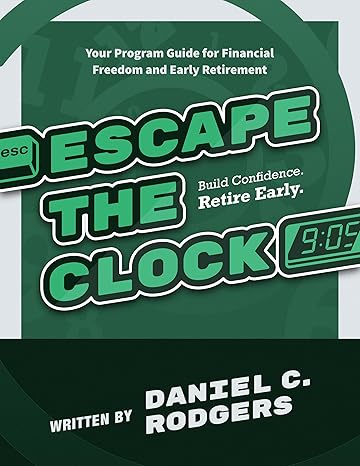

Daniel C. Rodgers’ Escape the Clock is a comprehensive manual that redefines how we think about work, wealth, and retirement. The book meticulously guides readers through the journey of achieving financial independence and embracing early retirement. It draws from the author’s personal experiences and professional expertise in program management. By blending narrative elements with practical advice, Rodgers provides a roadmap to reclaiming time and crafting a purpose-driven post-work life.
What stands out most about Rodgers’ writing is its clarity and relatability. He opens the book by describing the suffocating grind of the modern work-life cycle—a sentiment many can resonate with. The chapter “Trapped by the Clock” is particularly compelling as it details the emotional and physical toll of overwork. Rodgers’ candor about his own struggles adds authenticity, and his emphasis on financial independence as a means of reclaiming life makes the narrative deeply motivational. At times, some of his anecdotes cover similar ground, which can slightly soften the impact of his otherwise sharp insights.
The book’s strength lies in its structured approach to financial planning. Rodgers simplifies intimidating financial concepts, breaking them into digestible steps. Chapters like “Build Your Program for Financial Independence and Early Retirement” are treasure troves of tips—whether it’s calculating a financial baseline or setting measurable goals. I appreciated how the book demystifies investment jargon, though some of the more detailed strategies, like leveraging dividend stocks or rebalancing portfolios, might feel a bit complex for beginners. I think a slightly greater focus on balancing technical advice with simpler explanations could have made these sections more approachable.
Rodgers also shines in promoting a holistic vision of retirement. Instead of framing it as an end, he encourages readers to view it as a beginning—a chance to pursue passions and give back. The chapter “Retire Purposefully” is a standout, brimming with ideas for leading a fulfilling post-retirement life. There is a noticeable focus on ambitious goals, which might feel a bit lofty for readers seeking a more straightforward or minimalist approach to retirement.
Escape the Clock is an inspiring and meticulously detailed guide that will resonate with anyone determined to break free from the rat race. I feel it’s ideal for professionals in their 30s to 50s who are financially savvy and open to detailed planning. If you are looking for a practical framework paired with emotional encouragement to achieve early retirement then I think this book is a must-read.
Pages: 356 | ASIN : B0DPLP1D1V


