Blog Archives
Pontus and Electra to the Depths of the Sea
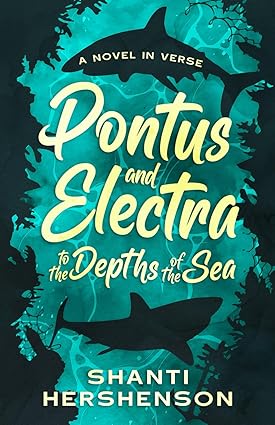

In Pontus and Electra: To the Depths of the Sea, Shanti Hershenson weaves a lyrical, aching tale of two lonely great white sharks—Pontus and Electra—who find purpose and connection in each other. Told in a poetic, vignette-like structure, the book alternates perspectives, blending environmental commentary with raw emotion and surprising tenderness. Against the backdrop of warming oceans, human threats, and grief, Pontus and Electra navigate fear, loss, companionship, and ultimately love, diving deeper into the sea and each other.
I didn’t expect to get emotional reading about sharks, but here I am, completely gutted and grateful. Hershenson writes with a dreamy style that’s both tender and brutal. Lines float like seafoam and then crash like waves. I loved the way she captures the loneliness of the ocean, of being “one-of-a-kind,” of searching the blue void for someone who understands. And when Pontus meets Electra? I held my breath. Their relationship builds slowly, clumsily, beautifully. It’s not just a romance, it’s survival, forgiveness, and healing.
There’s no traditional plot arc, and the prose leans on repetition and abstraction. But for me, it worked. It made the ocean feel mythic, the sharks feel ancient and sentient. The environmental message about pollution, overfishing, oil spills, and the cruelty of finning hits hard, but it never feels preachy. It’s heartbreaking because it’s told through creatures just trying to live. The parts about Electra losing her mother were absolutely wrenching.
Pontus and Electra is a love story, yes, but also a quiet plea to look deeper, to care more, to recognize the wild hearts beneath the waves. I’d recommend this book to readers who enjoy poetic storytelling, character-driven narratives, or marine life in fiction. Teens and adults alike could connect with it. It’s especially perfect for fans of lyrical prose and gentle speculative stories.
Pages: 139 | ASIN : B0F6VX7GDB

Writing in the Moment

Always Something Heartfelt: Life, Love, and Heartbreak is a raw, vulnerable, and deeply personal collection of poetry and reflective prose exploring a myriad of human experiences. What inspired you to write this particular collection of poems?
Every piece in this collection was hand-stitched with everything I was feeling inside at the time of its inception. Growing up, it felt like the only time I was allowed to be sad, disappointed, hurt, etc. was at funerals. I started journaling when I was 17. It was a newfound outlet to what started to feel like a form of freedom to be able to communicate my raw emotions. Then, one near-fatal curveball in life, in the form of a car accident that physically propelled me from a vehicle, pushed me to open up to the world because life wasn’t promised. I gained the confidence to boldly articulate things I felt. Life became too short to be anything other than authentic. Through performing at spoken word events, I got feedback that showed me that my expressions were relatable. When I chose the poems from my collection to put together Always Something Heartfelt, I focused on providing my most genuine expressions. The goal was to expound on the notion that my experiences, though deeply personal, were relatable to others.
How do you approach writing about deeply personal or emotional topics?
I write what I feel in the moment with as much honesty as I can manage. I approach emotion the way I used to approach music—as therapy. Whether I’m hurting, reflecting, or just trying to understand something, I let the pen run freely. Free verse gives me the room to speak plainly and honestly, without worrying about form getting in the way of truth. I aim for clarity, and I hope that clarity resonates with people who’ve felt something similar.
Do you have a favorite poem in the book, and if so, why does it hold special meaning for you?
I do not have one particular favorite, but there are some poems I really like. That list includes poems like “She trusted Me”, “TV Failed Me”, “Maybe I never loved her”, “Windows”, “The next guy”, “Temporary insanity”, “I really wanted to”, and “Like you”. These are poems that are pivotal spaces and times in my life. To me, it’s like going through the pages of your life and marking them with a highlighter.
How has this poetry book changed you as a writer, or what did you learn about yourself through writing it?
Writing this book showed me that authentic emotions, though deeply personal, are very relatable beyond just the community that I’ve shared my expressions with over the years. These poems represent universal concepts that express how we all can feel at any given moment in life. That notion encourages me to keep writing and count myself as blessed to even have experiences to share. Though considered fleeting and temporary, emotions provide substance to your experiences and help you set, change, or stay the course in life.
Shadows Amongst the Threads

Shadows Amongst the Threads is a haunting, soul-baring collection of poetry that plunges headfirst into the murky depths of the human psyche. Written by J.A. Santana, the book explores the concept of the “shadow” — that darker half of our personality Carl Jung warned us not to ignore. The poems are a tapestry of anguish, longing, introspection, and myth. The collection moves through surreal landscapes—withered forests, shadowy corridors, dreamscapes, and apocalyptic ruins—while reflecting on fear, identity, sin, love, and collective moral decay. Santana threads together classical references, psychological insights, and raw emotion, pulling readers deep into a world where monsters wear familiar faces, often our own.
I enjoyed how immersive and atmospheric the writing is. Santana’s voice feels ancient and modern all at once—like a lost prophet speaking in riddles. The rhythm and word choice at times feel Shakespearean or Biblical, yet there’s also a grounded emotional rawness in many of the lines. Some pieces like “Darkness,” “Doppelgänger,” and “Rain I” are unsettling in their vivid imagery but unforgettable in their truths. You can feel the poet wrestling with shame, existential dread, and an aching thirst for meaning. And it isn’t just gloom for gloom’s sake. There’s an undeniable urgency behind the words—as if Santana is begging readers to confront their own shadows before they become monsters.
The language, though beautiful, is dense. I found myself needing to take breaks, reread stanzas, and sometimes simply sit with the weight of it all. A few poems are abstract or metaphor-heavy, and the emotional intensity sometimes overwhelms the clarity. But even when it was hard to follow, I never doubted the sincerity. There’s a strange kind of beauty in getting lost in Santana’s bleak, lyrical universe. It’s not for everyone, but for those who’ve stared down their own darkness, it will feel eerily familiar.
Shadows Amongst the Threads is a collection that rewards patience and introspection. I’d recommend it to anyone who loves poetry that digs deep into the soul and isn’t afraid of getting their hands dirty. It’s especially powerful for readers interested in shadow work, trauma, mythology, and the emotional weight of existence.
Pages: 94 | ASIN : B0BKGZ6L6V
Always Something Heartfelt Life Love and Heartbreak

Always Something Heartfelt is a raw, vulnerable, and deeply personal collection of poetry and reflective prose by Ashton Harper. Spanning multiple emotional phases of the author’s life, the book travels through love, heartbreak, fatherhood, self-doubt, spiritual resilience, depression, and healing. Divided into five parts, it weaves a nonlinear journey of introspection and reckoning, delivered through conversational yet impactful language. Harper reflects on intimate experiences and societal observations with unfiltered honesty, never shying away from emotional depth.
Reading this book felt like being invited into someone’s private journal—except the handwriting was lyrical and honest to the bone. Harper’s writing isn’t polished in the traditional literary sense, and that’s what makes it special. His language is colloquial, immediate, and unpretentious. There’s something deeply brave about the way he lays his pain bare—whether it’s about being alone, yearning for his child, or admitting where he’s gone wrong in love. He manages to ask the kind of questions we all keep buried. And when he’s angry or defeated or full of love, he lets it rip. It’s messy, but it’s real. At times, I found myself underlining lines like I was trying to hold onto pieces of someone else’s heartbreak to better understand my own.
The emotional weight can be heavy, and the lack of traditional structure might not be for everyone. But then again, that may be the point. Love, grief, identity—none of it follows rules. And Harper’s refusal to wrap his pain in bows or follow poetic conventions feels like an act of rebellion. A lot of his strongest pieces come when he shifts from personal reflection to cultural critique, challenging toxic masculinity, absentee parenting, and community disconnection. That balance of personal story and broader relevance gives the book its power.
If you’ve ever loved someone who left you, struggled to find your place in the world, or looked in the mirror unsure of what you saw, then Always Something Heartfelt Life Love and Heartbreak will feel like a conversation you didn’t know you needed. I’d recommend this book to readers who crave vulnerability and aren’t afraid to sit with discomfort. It’s soulful, heavy, and at times, beautifully healing.
Pages: 148 | ASIN : B0CTFPG56X
The Science of the Afterlife
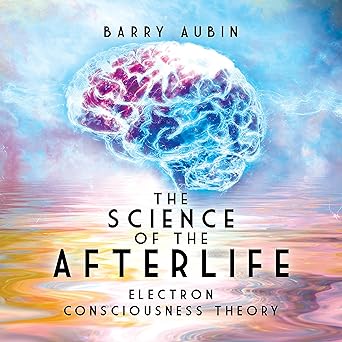

Barry Aubin’s The Science of the Afterlife is a bold attempt to merge science, religion, and philosophy into a single cohesive theory of existence beyond death. He introduces the “Electron Consciousness Theory,” arguing that human souls are made of electrons and that our consciousness persists after death as an electrical presence in the universe. Through a mix of scientific speculation, religious references, and personal insights, Aubin builds a case that the afterlife is not just a matter of faith but of physics. He challenges readers to rethink what it means to exist and whether death is truly the end.
Aubin’s writing is both ambitious, which makes the book engaging yet, at times, overwhelming. He presents compelling questions, like if energy cannot be destroyed, then where does our consciousness go? And he supports them with theories drawn from thermodynamics and neuroscience. One of the most intriguing parts of the book is his exploration of how electrons store memory, suggesting that our thoughts and experiences may survive in a form beyond our physical bodies. This idea resonates with my own beliefs about the afterlife. If souls are energy, and energy continues to exist, then it seems only natural that we persist in some way. His discussion on how electrons might disperse and communicate after death made me pause and reflect on the idea of spiritual presence.
While I appreciate his effort to explain the afterlife through physics, there were moments when his reasoning seemed more intuitive than evidence-based. The connection between morality and the electrical charge of a soul was an interesting concept and left me wondering. Still, his passion for understanding the spiritual world through scientific means is admirable.
One of the most thought-provoking aspects of the book was its discussion on telepathy and spiritual communication. Aubin suggests that electrons within the brain may allow for an exchange of thoughts beyond death, potentially explaining ghostly encounters, divine voices, or even prayer. The idea that we are all part of a vast electrical network, constantly interacting on some unseen level, aligns with many religious and spiritual beliefs. While mainstream science may dismiss such claims, I found comfort in his argument that just because something is not fully understood does not mean it is not real.
The Science of the Afterlife is a thought-provoking read for those who are open to unconventional ideas about existence beyond death. It is not a traditional religious text, nor is it a rigorously scientific one, but it is an imaginative and heartfelt exploration of what might lie beyond. While some of his theories may be difficult to accept, his core message is one of hope: that life, in some form, continues. And for those of us who already believe in an afterlife, that is a comforting thought indeed.
Pages: 34 | ASIN : B09F197Z6M

Grief is a Teacher

On the Ever-Lovely Morrow is an introspective poetry collection that explores themes of love, freedom, self-discovery, and personal transformation through honest reflections on life’s challenges and societal norms. Why was this an important book for you to publish?
I felt like I had more that I needed to say, and I needed to share it in a sense and a space that was new. On the Ever-Lovely Morrow is actually the companion to its predecessor At the Beginning of Yesterday, which was published under a different name, that being Tiffiny Rose Allen.
Sometimes, you take a look at your life and see how much you’ve changed, and in the process, you realize how much you need to reinvent yourself, how much you have reinvented yourself, and what image you want to share with the world. I believe as humans we are ever-evolving, and it’s important to show that change is just a staple of life and an important one at that.
In several poems, grief seems to act as a catalyst for transformation. How do you view the relationship between loss and personal growth in your writing?
My relationship with grief has been something that has at times felt like a constant, but I have always found ways to transmute it and make it into something beautiful. Grief is, in and of itself, a beautiful thing, which demands we look at ourselves and our lives and the parts that we are playing in it. Grief is a teacher. I try my best to translate that into my work when I write.
Your reflections on societal norms and expectations are powerful. What inspired you to address these topics so openly in your poetry?
I felt the need to express these topics because they were things that had affected me personally, things that had made an impact on how I held myself, how I viewed myself, and how people viewed me and treated me. I don’t think anyone is limited to being just one thing, and it was important to me to show how multifaceted I am as a person, and hopefully in sharing that, someone could see themselves within those views as well.
What is the next book that you are working on and when will it be available?
I currently have an anthology in the works, it being Volume II of the Dreams In Hiding anthology. The title is After Words We Go From Here and it is centered on After pieces and prose. For those unfamiliar, After pieces are pieces of writing that are inspired by other forms of art or artists. This should be published in the late fall or early winter of 2024.
Apart from that, I have a few different projects that are in the very early stages of development, and we’ll see how they progress, but I am very very excited to share them one day.
Author Links: GoodReads | Website | Amazon
What comes after Yesterday? There is the present, then tomorrow, what happens on the Ever-Lovely Morrow?
In this companion to the poetry collection At The Beginning Of Yesterday, the ship of the author’s emotions will navigate you through reinvention, resurfacing, and feeling out the waves of healing.
Everything, in some form or another, comes in waves. This is a collection that celebrates being a writer, acknowledges the non-linearity of emotions, and dives into the themes of what it means to step into one’s own definition of living.
Peace, Comfort, and Joy

I Will Dance Across The Morning Sky is a moving collection of poems that invites readers into a world of introspection, longing, and raw emotion. Why was this an important book for you to write?
I wanted to write something to give comfort to those who have lost family members, friends, and pets.
The art in this book is beautiful and perfectly complements the poetry. What was the art collaboration process like with the illustrator Sudipita Dasgupta?
I prayed for the right illustrator and looked for several weeks before finding a children’s book cover created by Sudipita. His style was exactly what I wanted and immediately knew it was just what the book needed.
Studipita in India and I in the states, went back and forth via messenger and email discussing what to put on each page.
Every page is an individual work of art that gives vision to the words.
What was the most challenging part of writing this collection of poetry and what was the most rewarding?
As with every writer the challenge in poetry is to keep it short, use the right words in the right order, and create flow
Rewarding? To see how many lives have been touched with I Will Dance Across the Morning Sky
What do you hope is one thing readers take away from your poetry?
Moments of peace, comfort, and joy
Author Links: GoodReads | X | Facebook Heartstring Productions | Facebook Author Page | Website | LinkedIn | Book Review
There comes a time in everyone’s life that a close friend, relative or pet passes to the other side. Children and adults are in need of comfort. This book was created to inspire and raise the spirit of all who read it. Great imagery for children as well as adults. Where do we go? What do we do? Oh, imagine the fun we will have! As you read let your imagination soar!
I Will Dance Across the Morning Sky is a perfect keepsake gift to treasure to celebrate a life well lived, for those who have lost loved ones, friends, and their pet babies.
I Will Dance Across the Morning Sky

I Will Dance Across the Morning Sky is a moving collection of poems that invites readers into a world of introspection, longing, and raw emotion. The book’s essence lies in its exploration of human connection, loss, and the quest for meaning in moments of despair. Each poem in this book weaves together imagery and sentiment in a way that feels both deeply personal and universally relatable, creating a tapestry of experiences that resonate with the soul.
Simplicity masks complexity here. The language, deceptively straightforward, acts as a vessel for profound emotion. A simple line can explode with meaning. Take, for example, the image of “a heart dancing across broken glass.” It’s a vivid portrayal of pain mingling with hope, resilience intertwined with fragility. This line alone haunts us, refusing to leave our thoughts, much like the struggles we all face. The poems tackle heavy subjects such as grief and loneliness, yet they do so with a sincerity that feels unforced, making the experience refreshingly authentic.
Connection, or its painful absence, sits at the core of this book. A particular poem lingers in the mind, depicting two people sitting together in silence, yet a chasm exists between them. That stark portrayal of isolation, even in company, strikes a nerve. It’s not just about what’s written; it’s about what isn’t. The spaces, the silences, resonate as loudly as the words themselves. The themes are beautifully rendered, and the exploration of love and loss treads familiar ground. It is worth noting that there were times I yearned for a twist or a fresh perspective. The steady tone and consistent themes offer exactly the kind of solace some readers seek, a stable anchor in a turbulent world.
I Will Dance Across The Morning Sky leaves its mark. It’s a collection that reaches out to those of all ages who need a voice in the silence, a companion in their pain. For anyone grappling with life’s hardships, or simply searching for a piece of writing that speaks to the heart, this book offers solace. It’s easy to consume, but its impact lingers, making it not just a collection of poems, but an experience to be felt deeply.
Pages: 42 | ASIN : B08RTYMPG3


