Baker Vaughan follows a man in his fifties who leaves a polished but hollow life in New York, heads to Idaho, and tries to reclaim a calling to the priesthood that he abandoned decades earlier. What was the inspiration for the setup of your story?
The setup came directly from my own life, though Baker’s journey diverges significantly from mine in the details. Sixteen years ago, I left New York City for Idaho—traded the polished surfaces and relentless pace for something quieter, more spacious. Five years after that move, I began discerning a call to the Episcopal priesthood. I spent two years in that process before ultimately deciding it wasn’t my path.
What I discovered during those two years became the heart of this story.
As a parishioner, I liked the church, but I didn’t love it. I found meaning in the liturgy, community in the congregation, and solace in the rituals. But when I stepped into discernment—when I began to see the church not from the pews but from the inside—everything shifted. I encountered the business of it all: the politics, the bureaucracy, the institutional machinery that keeps a church running. Budgets, committees, and personnel issues. The gap between the idealized faith I’d held and the messy, human reality of the institution was… painful. Disorienting.
That disillusionment is what I wanted to explore with Baker. He comes to Idaho carrying an old, half-remembered sense of calling—something he abandoned decades earlier. Unlike me, he had that youthful pull toward the priesthood, but he never pursued it. Now, in his fifties, with his polished New York life feeling increasingly hollow, he decides to try again.
And like me, he’s never seen behind the curtain before. He’s been a believer, perhaps even devout, but always from a distance. When he finally steps into the inner workings of the church, he discovers it’s not what he imagined. The sacredness is still there, but so is the machinery—the compromises, the egos, the institutional inertia.
I wrote this story because that reckoning felt important to me. Not as a condemnation of the church, but as an honest exploration of what happens when our ideals meet reality. What do we do when something we’ve held as sacred reveals itself to be deeply, stubbornly human? How do we reconcile faith with institution? Those questions haunted me during my own discernment, and they haunt Baker throughout his journey in Idaho.
The novel resists the idea of “starting over” and leans into excavation. When did that distinction become central to Baker’s story?
Baker’s excavation is multifaceted—he’s digging into all three layers. The first layer is his younger self. He has to examine why he abandoned the priesthood impulse decades ago. The concrete reason is clear: his wife died in the middle of seminary. But what he’s been wrestling with for the next forty years is whether that was the right decision—whether grief was reason enough to walk away, or whether he used it as permission to run from something he was already afraid of. What was he running from? What was he running toward? The loss is real and devastating, but there’s something else in that younger version of himself—some fear or ambition or wound—that he never fully understood. He can’t reclaim a calling without understanding why he let it go, and whether the reason he’s told himself all these years is the whole truth. The second layer is his faith foundations. Baker has held an idealized version of faith for most of his life—a set of spiritual assumptions that shaped him, or perhaps shaped the absence of a life. Now he has to question those foundations. Were they ever solid? Were they his, or were they inherited, unexamined? Excavation here means asking whether the faith he thought he had was ever real, or just a story he told himself. The third layer is the church’s institutional reality. This is where he uncovers what the church actually is beneath the preconceptions—the business behind the sacredness. The politics, the compromises, the human messiness. It’s not what he imagined, and that gap forces him to reckon with whether his calling was to an ideal that never existed.
You treat religion as complicated, entangled, and sometimes uncomfortable. Why was it important not to present faith as easy or purely redemptive?
As the author, I was deliberately avoiding the redemptive arc—the one where disillusionment becomes cathartic, where seeing the church’s flaws leads to clarity and renewal. That felt dishonest to me. In my experience, and I think in most people’s experience, faith doesn’t work that way. The complications don’t resolve. They accumulate.
That’s where Karl Thompson came in. He’s a former bishop, and he becomes Baker’s mentor. But Karl isn’t offering redemption or answers. He’s already lived through his own disillusionment about the church. He’s seen the machinery, the politics, the human messiness of it all. And he’s made a kind of peace with the fact that faith and the institutional church aren’t perfect—that they can’t be separated from human limitation.
What’s crucial is that Karl’s peace isn’t clarity. It’s not that he’s figured it out or found a way to reconcile the contradictions. He’s simply accepted that the complications are irreducible. That faith will always be entangled with institution, with ego, with failure.
And Baker sees him as fundamentally human first. Not as a spiritual authority. Karl is flawed, tired, and sometimes cynical. He’s a man who’s learned to live with discomfort rather than transcend it. That prevents the novel from treating him as someone who offers easy answers or models a “right” way through.
I think that’s more honest to the actual texture of faith and human experience. We want religion to be clean, to offer us certainty or transformation. But it’s made of people. It’s compromised from the beginning. The peace, if there is any, comes from accepting that—not from resolving it from sitting with the entanglement rather than trying to escape it.
Baker is in his fifties, which is unusual for a “coming-of-self” narrative. Why tell this story at that stage of life? Do you believe it’s ever too late for transformation?
I don’t think it’s ever too late for transformation. But I also don’t think transformation at fifty looks like what we imagine it does at twenty-five. There are real constraints. The Episcopal church has a mandatory retirement age of seventy-two. Learning becomes harder as we age—that’s just biology. So Baker is in this liminal space where he’s old enough to know what he’s risking, young enough that he could theoretically still pursue priesthood, but acutely aware that the window is closing.
BAKER VAUGHAN: A NOVEL Love, Rebuilding, and Discovery Keep Calling Baker Vaughan is a man shaped by success, and undone by loss. After heartbreak shatters his world during his second year at Yale Seminary, he runs. From grief. From faith. From himself. What follows is a carefully constructed life built on achievement and distraction, as he trades his spiritual calling for a high-powered advertising career on Madison Avenue. For twenty-five years, Baker moves through life outwardly successful but inwardly unmoored, carrying the quiet weight of absence he has never learned to face. Until Idaho. In a small town with an unexpected sense of welcome, Baker begins to glimpse something he thought was gone forever: the possibility of starting again. But healing is never simple. In Boise, he meets Karl Thompson, whose presence forces him into uncomfortable questions about truth, morality, connection, and what it really means to be known. Baker Vaughanis a deeply human novel about grief, reinvention, and the fragile courage it takes to stop running. It explores what remains when everything else falls away, and the surprising ways life offers second chances when we finally allow ourselves to receive them.
Baker Vaughan is a contemporary family saga that follows a man in his fifties who leaves a polished but hollow life in New York, heads to Idaho, and tries to reclaim a calling to the priesthood that he abandoned decades earlier. From there, the novel opens outward into his past and present at once: family history in Virginia, old love, public shame, church politics, private guilt, and the stubborn hope that a person can still change late in life. What stayed with me most is that this is not a story about reinvention in the glossy sense. It is about excavation. Baker is not building a brand-new self. He is digging through the rubble of the one he kept dodging for years.
What I liked most about Hotchkiss’s writing is that it trusts conversation, memory, and moral mess more than plot tricks. The book has a big emotional reach, but it usually moves in a human scale, one uneasy conversation, one humiliating mistake, one remembered kindness at a time. I found that effective. Baker can be self-aware and self-deceiving in the same breath, which made him feel real to me. The prose often lingers on place, class, church ritual, and family texture, and that gives the novel a lived-in quality. I could always feel the author’s investment in these people, and that sincerity carried me through.
This book does not treat religion as wallpaper or as an easy source of wisdom. It treats faith as something tangled up with vanity, longing, performance, grace, and the need to be forgiven without always knowing how to earn it. That made the novel feel sharper to me than a simple redemption story. I also liked the way the family saga side of the book deepens the present-day drama. Baker’s mother’s alcoholism, the pressure of class and expectation, his early sense of calling, and the old relationships that still shape him all give the story weight. You can feel how the younger Baker never really disappears. He just ages into a more complicated man.
Baker Vaughan will resonate with readers who enjoy character-driven fiction, church and family dramas, and novels that care more about conscience than speed. I would recommend it to people who like literary fiction with a strong emotional backbone, especially readers drawn to stories about second chances, spiritual restlessness, and the long shadow of earlier choices. It’s reflective, sometimes raw, and patient in the way it lets a life unfold. The people most likely to appreciate it are readers willing to sit with an imperfect man and watch him try, fail, remember, and keep reaching anyway.
The Meditative ContemplationZ feels less like a conventional book than a staged interior performance, a gathering of aphorisms, prose-poems, meditations, and lyrical monologues arranged around spirituality, adversity, love, wisdom, death, Blackness, and legacy. What held me all the way through was the sense that zO-AlonzO Gross isn’t trying to build a neat argument so much as a lived atmosphere. He moves from compressed lines like “time leaveZ stretch marks” to longer pieces that open into memory, social critique, and testimony, as in the barber shop vignette “They call me speak easy,” with its grief over gentrification and lost Black community, or the recurring insistence that art, suffering, faith, and self-knowledge are bound together. The book’s visual dimension matters too. The paintings and photographs don’t feel ornamental. They reinforce the sense that this is a collaborative, almost theatrical object, one that wants to be seen as much as read.
Gross writes with a seriousness that can be hard to pull off, and here it works because the conviction is real. When he says the artist has to love the work past indifference, bad turnout, family doubt, and years of invisible labor, I believed him. The same goes for the passage comparing fighters and artists, where the body blows of one life meet the psychic blows of the other. That idea could’ve landed as a slogan in weaker hands, but here it has bruises on it. I also liked how often the book risks tenderness without getting soft. A line about love arriving as “a cold bottle of water next to her bed at 3 am” is so simple, so unshowy, and because of that it lingers. Even the spiritual passages, which lean grand and incantatory, have a searching quality rather than a smug one. The book keeps returning to the thought that to know God, or truth, or purpose, you have to strip away performance and get closer to the self beneath it.
This is a book whose force comes with rough edges, and I mean that as praise. The diction can be florid, the capitalization and stylization relentless, and some pieces hit with more depth than others. There were moments when the aphoristic mode flattened complexity into a pronouncement. But even then, the voice felt urgent, personal, and proudly self-fashioned. The sections on Blackness especially gave the book another register, sharper and more satirical, turning wit toward racism, stereotype, and the humiliating absurdities of public life. Those pieces widened the book’s emotional field. They reminded me that Gross is not only meditating in private but answering the world, sometimes with sorrow, sometimes with laughter, sometimes with a line sharpened like a blade. The artwork and photographs throughout fit the pieces beautifully, and they add a thoughtful, provocative visual layer that deepens the book’s reflective mood.
I found The Meditative ContemplationZ uneven in the way many deeply personal books are, but also vivid, memorable, and unmistakably alive. I came away feeling I’d spent time inside a singular mind, one that believes art should console, provoke, testify, and leave a mark. I’d recommend it most to readers who like poetry-inflected nonfiction, spoken-word energy on the page, and books that care more about voice, spirit, and emotional truth than formal restraint. It’s a book for people who don’t mind a little intensity if the feeling behind it is earned, and here, more often than not, it is.
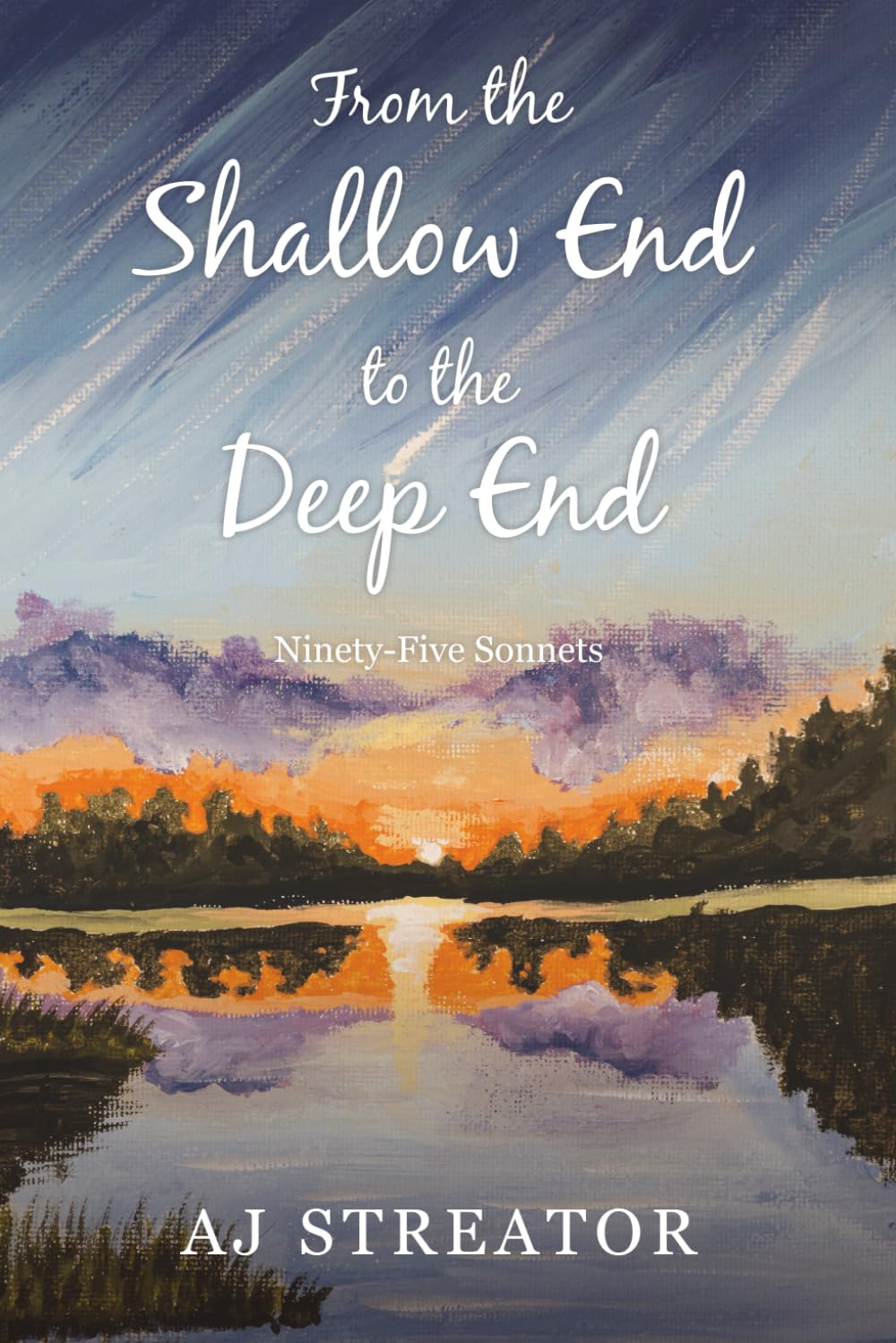
From the Shallow End to the Deep End is a rich and deeply personal collection of ninety-five Shakespearean sonnets that moves through childhood memories, family histories, heartbreaks, faith, despair, and redemption. The book travels in a steady descent from innocence to complexity and then rises again toward clarity and grace. Its structure mirrors the stages of a life that has been lived with open eyes and a bruised but persistent heart, and each section lays bare a different layer of the poet’s world. Streator uses the traditional sonnet form to anchor experiences that feel modern, messy, and often raw, and the tension between old structure and new emotion is one of the book’s strongest features.
I was surprised by how quickly the writing pulled me in. The language is formal on the surface, but beneath it flows a current of sincerity that feels warm and human. I kept pausing at lines that carried a punch not because they were fancy but because they were honest. The poems about childhood felt especially sharp. Scenes of brothers growing apart, parents missing from the stands, and friendships fading hit harder than I expected. They had this way of stirring old memories in me, making me nod along and think, yes, I’ve been there, too. The sonnets in the middle section became heavier and darker, and I admit they made my chest tighten. When the poet spoke about loss, depression, and the desperate quiet of survival, the writing felt intimate. I appreciated that. It made the collection feel alive.
Sometimes the rhyme scheme amplified the weight of the words and made the pain or the joy ring louder. I caught myself smiling at the poems about his children because they warmed the whole book. They softened the darker stories without pretending everything is fixed or simple. That mix of light and shadow felt real to me, and I found myself admiring how Streator holds both without flinching. The shift toward faith in the later sonnets felt authentic, not preachy, more like a man trying to keep his footing after being tossed by life one too many times. It gave the final stretch of the book a quiet sense of hope.
I walked away from this collection feeling both moved and grateful. I’d recommend From the Shallow End to the Deep End to anyone who loves poetry that speaks plainly about life’s messiness while still finding beauty in it. I think it’s well-suited for readers who appreciate traditional forms but want the content to feel fresh, personal, and unguarded. It’s also a meaningful pick for anyone who has lived through family storms, heartbreak, or the slow rebuilding of a life. The book isn’t afraid to wade into deep water, and it invites you to step in with it, one sonnet at a time.
Burned Butter Island follows a lonely boy who lives with his father, a grey cat, and a white duck on a small Baltic island where the lighthouse stands watch over wind and sea. The boy, still grieving his mother, wanders through forests filled with foxes and white deer, bakes blackberry tarts, reads old books, listens to storms, and discovers the strange magic of a narwhal’s tusk. When a violent storm pulls him into the ocean, a real narwhal saves him, guiding him back to shore and back to hope. The book blends poetry, fable, memory, and gentle magic into a tale about loss, wonder, and the courage to live again.
The language is simple, yet it carries an emotional weight that sneaks up on you. Scenes drift from soft domestic moments to wild visions of storms and enchanted creatures. I found myself slowing down because the rhythm feels like someone humming by the fire. I loved the poems sprinkled throughout. They felt warm, handmade, and a little fragile. Sometimes the narrative jumps between moments and I had to catch up. It felt like listening to someone who speaks from the heart and lets the story wander where it wants to go.
What I liked most was how honestly the book speaks about sadness. The boy’s grief shows up in tiny gestures, in memories of his mother’s lullabies, in the way he stares at the tusk as if it holds the answer to something he cannot name. I felt a lump in my throat when he read the message on the rocking horse. The moment he sees that love does not vanish, and that sadness does not have to swallow him whole, felt tender and real. The author writes about loneliness without heavy words and lets magic offer comfort instead of escape. I liked that a lot.
I would recommend this book to readers who enjoy gentle stories that glow from the inside. It is perfect for people who love fairy tales, lyrical writing, and small moments that carry big feelings. It would also comfort anyone who has walked through grief and wants a reminder that joy can return in unexpected ways.
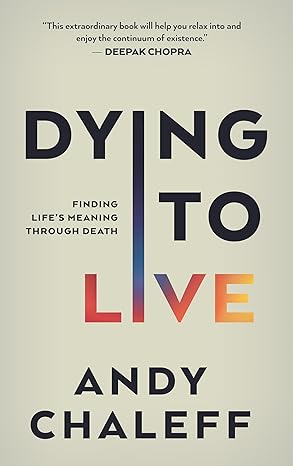
Dying to Live takes readers on an intimate and eye-opening journey, revealing how making peace with mortality can unlock a richer, more meaningful life. Why was this an important book for you to write?
For most of my life, death has been a silent companion, something that shaped my choices more than I realized. From losing my mother when I was young to the many moments since where mortality came close, I’ve learned that it isn’t something to fear as much as it is something to learn from. Writing this book was a way of bringing those lessons forward, not only for myself but for anyone who has ever felt the weight of impermanence and wondered how to live more fully because of it.
What were some ideas that were important for you to share in this book?
I wanted to show that death is not just an end but also a mirror. It reflects back the stories we’ve been telling ourselves, the identities we cling to, and the fears we avoid. One idea that mattered to me was the practice of “dying to live,” which is about shedding old roles, patterns, and emotional baggage so that we can step into a freer, more authentic life. I also wanted to share that this work isn’t abstract philosophy. It is lived, messy, human. My stories are meant to open space for readers to look at their own lives with gentleness and courage.
How has writing Dying to Live impacted or changed your life?
The writing process forced me to sit with truths I might have preferred to leave buried. It slowed me down, made me listen more deeply to myself, and invited me to face the places I still resisted. In doing that, I found more ease, more gratitude in the everyday. By leaning into death I became more alive, more playful even. It reminded me that life is fragile, fleeting, and far too precious to postpone.
What do you hope is one thing readers take away from your story?
That it is possible to turn toward death without being consumed by it. My hope is that readers will feel less alone in their fears and more connected to the beauty of simply being here. If even one person puts the book down and feels a little lighter, a little freer to live with love and presence, then it has done its job.
What if embracing death is the key to truly living? We spend our lives avoiding the thought of death-yet its presence shapes everything we do. In Dying to Live, Andy Chaleff takes readers on an intimate and eye-opening journey, revealing how making peace with mortality can unlock a richer, more meaningful life. Blending memoir, philosophy, and deeply personal reflections, Chaleff invites us to step beyond society’s distractions and face death with curiosity rather than fear. Through poignant stories and thought-provoking questions, he helps us see that dying isn’t the end of life’s meaning-it’s where we finally begin to understand it.
Andy Chaleff’s Dying to Live is part memoir, part meditation, and all heart. With the tone of an honest friend and the vulnerability of someone who’s walked through fire, Chaleff invites readers into an intimate, sometimes raw conversation about death and, maybe more importantly, about how thinking about death helps us actually live. This isn’t a book that preaches answers. Instead, it’s a meandering, deeply personal journey through loss, fear, letting go, and making peace. From the death of a childhood dog to the gut-wrenching loss of his mother, and on through reflections on identity, legacy, and even sex and silence, Chaleff wrestles openly with life’s biggest unknown.
What struck me first was how disarmingly simple and powerful the writing is. Chaleff doesn’t try to impress with fancy language. He speaks like someone who just wants to be understood. He writes about the death of his dog, Apricot, when he was six, and how that loss introduced him to what he calls the “gray zone,” a numbing fog that returns every time grief visits. His ability to recall that moment without filtering it through adult logic gives the story a punch of realness. And when he says, “Buying this toy is just a way to bring a little joy back into your life, not a reward for your grief,” I teared up. It reminded me of how often we try to patch grief with distractions and don’t realize we can feel two things at once, sad and grateful, broken and hopeful.
One of the most impactful chapters, for me, was Chaleff’s account of learning about his mother’s death in a car accident, a moment that irrevocably altered the course of his life. He connects this devastating event to the parable of “The Farmer and the Horse,” suggesting that it is often impossible to immediately discern whether a moment is truly good or bad. That kind of spiritual patience is rare and difficult to cultivate, yet Chaleff communicates it with quiet clarity. It’s this calm, unembellished insight that elevates the book beyond memoir; it becomes something closer to healing.
Another particularly striking section is when Chaleff reflects on the profound shift that occurs after the loss of both parents, the realization that he now stands closest to death. While the subject is inherently somber, his description of sorting through old boxes and choosing to let go of long-kept mementos carries a quiet elegance. “It wasn’t about erasing the past,” he writes, “but making space for the present and future.” That sentiment lingered with me. It prompted me to consider the things I’ve held onto, not out of necessity, but because they anchor a sense of identity. Chaleff’s exploration of detachment is neither rigid nor emotionally distant; it is sincere, deeply personal, and quietly resonant.
Dying to Live is not so much a book about death as it is a meditation on how to live with greater presence and depth. It speaks to those who have experienced profound loss, who find themselves quietly wrestling with mortality in the still hours of the night, and who carry unresolved grief just beneath the surface of daily life. It is especially meaningful for readers who yearn to live more intentionally but may not know where to begin. I would recommend it to anyone prepared to pause, reflect deeply, and perhaps be moved in unexpected and lasting ways.
Final Notes follows a 107-year-old man on his deathbed who drinks a medically approved psilocybin tea that takes his mind on a mind-bending journey to explore what it means to exist. What was the inspiration for the setup of your story?
Ever since I was quite young, I have been aware and interested in the absolute inevitability of my own death, of everyone’s, really. I have encountered it in my own life many times, puzzling at its often arbitrary takings and the metaphysical implications of oblivion. My own adventure with psilocybin, the proverbial “magic mushrooms,” caused me to explore this somewhat peculiar obsession. The title and premise for the book came to me during such a trip.
I thought this story had a unique setup and an interesting premise. What were some goals you set for yourself as a writer in this book?
I chose the deathbed setting of a very elderly man, as such an individual would have had much to reflect upon and consider, and was consciously aware that his remaining time was limited to hours. As I have with other published works, I created the last line of the book and wrote towards that. On a more personal level, it presented me with the opportunity to delve deeper into the mystery of death and come to some conclusions of my own, like how I would like to leave existence if given the chance.
What were some themes that were important for you to explore in this book?
Obviously, death and the process of dying when one is fully aware that the end is imminent. But I also wanted to tease the reader with his or her own reflections on mortality and the prospect of non-existence, what it might mean when eventually no one remembers anything about you. Another motif is the incredible understanding of what it means to live on a “pale blue dot” in a minor galaxy where nearby nothingness is all we know.
What is the next book that you’re working on, and when can your fans expect it out?
Ha! Well, this book is certainly a “one-off” due to the subject matter. But before starting this book, I was halfway through writing what I thought was a sci-fi book with an interesting premise involving nano-bots and avian flu. I stopped after I realized that AI had outrun my plot and narrative. I may go back and do a rewrite, though I admit to being a bit “spooked” by the acceleration of AI and its implications for everything.
A dying man takes the trip of a lifetime in the company of Azure Sky, a psilocybin infused tea, resulting in a remarkable end-of-life experience.
Everyman meets Alice in Wonderland is a thoughtful and adventurous journey of the mind that focuses on the recall, revelations and realizations that one experiences at the onset of death.
Meet an unnamed 107-year-old man at the end of his life. His ingestion of medically approved psilocybin carries him on a mind-bending journey as he contemplates his imminent future of eternal non-existence. Mentally alert but physically depleted, the dying man accepts the offer-his doula and hospice team at his side. Soon, the psilocybin triggers recall, revelation, and realization in startlingly new ways that create an odyssey of the mind in the narrator’s last hours. His experience is accompanied by a proprietary selection of music fashioned by Johns Hopkins for such occasions.
Inspired by the actual practice of using psilocybin to process, understand, and come to terms with terminal illnesses and trauma, Final Notes is a beautiful narrative with prose as lyrical as the music played on its pages.
Readers will come to grips with their own comprehension of what it means to “exist,” as well as be encouraged to ponder universal truths of life and death. The incredible inward journey of a man at the end of his days is a powerful lesson for every human willing to contemplate the inevitable occasion of one’s deathday.