Blog Archives
Raw Meaty Bones: Promote Health


Raw Meaty Bones: Promote Health, by Dr. Tom Lonsdale, is an eye-opening exploration into the world of pet nutrition. It challenges the norm with a bold proposition: the best diet for our carnivorous companions is one that mimics their natural eating habits, primarily consisting of raw meaty bones. Through an engaging narrative, Lonsdale critically examines the pet food industry and its impact on pet health, offering a fresh perspective on what truly constitutes a healthy diet for domesticated animals.
Dr. Lonsdale’s writing style is a blend of informative and persuasive, making complex veterinary concepts accessible to a broad audience. His arguments are well-structured, guiding the reader through a logical progression of ideas from the problems inherent in commercial pet foods to the benefits of a natural diet. The book provides a passionate and dedicated perspective on the pet food industry, offering insights that will be enlightening to many readers. While Lonsdale’s enthusiasm is clear throughout the text, it also opens up opportunities for readers to seek out additional, varied viewpoints to enrich their understanding. This approach highlights the importance of a multifaceted discussion in scientific matters and encourages readers to explore the topic further to form a well-rounded opinion.
The most compelling parts of the book are the case studies and personal anecdotes from Lonsdale’s veterinary practice. These real-life examples effectively illustrate the health transformations pets can undergo when switched to a diet of raw meaty bones. The book thoroughly examines the pet food industry, presenting its critique with a depth that emphasizes the author’s deep commitment to animal welfare. The book is very detailed. It serves to ensure the reader fully understands the complex issues at hand. This reflects the author’s passion for the topic and their desire to inform and educate readers about important aspects of animal care.
Raw Meaty Bones: Promote Health is an enlightening read that challenges conventional pet nutrition wisdom. It’s a valuable resource for pet owners seeking to improve their pets’ health through diet, as well as for those interested in a critical look at the pet food industry. This book is especially recommended for pet owners who are exploring natural diets for their pets and veterinary professionals interested in alternative perspectives on pet nutrition.
Pages: 500 | ASIN : B0C3WFSM3N

Happy Thoughts: Going to the Aquarium

Happy Thoughts: Going to the Aquarium, by Lisa Jacovsky, presents an insightful glimpse into the life of Emma, a young girl with autism who has her own unique way of communication. Unlike her peers, Emma relies on index cards to express herself when she feels comfortable, a distinctive trait that sets her apart in social interactions. This narrative becomes especially poignant when Emma encounters new individuals, such as a boy named Alex at the aquarium, highlighting both the challenges and the triumphs of her communication method.
Jacovsky’s narrative is commendable for its sensitive and innovative portrayal of autism. By choosing index cards as Emma’s medium of expression, the author provides a tangible and relatable tool for young readers to understand and empathize with different communication styles. This technique effectively fosters awareness and acceptance among children, demonstrating that differing abilities should be embraced and respected. The aquarium setting is a masterstroke, offering a serene and engaging backdrop for this enlightening tale. It not only serves as a non-threatening environment for character interactions but also enriches the story with vibrant illustrations of marine life, including seals, dolphins, and beluga whales. John Thorn’s illustrations are noteworthy for their charm and their role in bringing the story to life.
Jacovsky‘s book stands out for its educational value, seamlessly weaving a lesson on acceptance and uniqueness into an enjoyable story. Emma’s journey, marked by her distinctive way of interacting with the world, is a testament to the beauty of diversity and the importance of understanding those who may seem different.
Happy Thoughts: Going to the Aquarium is a meaningful exploration of individuality and communication. Jacovsky’s thoughtful approach makes this book a valuable read for children, illuminating the richness that different perspectives bring to our world.
Pages: 30 | ASIN : B0CVHTT9W5
Unique Part of Australian Fauna

Bush-Turkey Needs a Friend follows a curious young bird who embarks on a journey of self-discovery while trying to find a friend who resembles himself. What was the inspiration for the setup of your story?
I have been studying Australian brush-turkeys (commonly known as bush-turkeys) for many years and I realised that even though they are such a unique part of Australian fauna, children know very little about them.
What were some ideas that were important for you to share in this book?
First, to educate children about the very special way a brush-turkey incubates its eggs (by dumping them in mounds of leaf litter), and about their unique approach to parenting (not looking after your young at all).
Second, as a teacher, to address personal issues that many children face – is it ok to be different? How patient do I need to be before I can find a friend?
Are there any books or authors that inspired you to become a writer?
Among the children’s books all those that promote Australian wildlife to young readers, such as On the Trails of the Plains Wanderer by Rohan Cleeve.
What is the next book that you are working on, and when can your fans expect it to be out?
I’d prefer to skip that question – still thinking about it. Not sure really! I just had to write this book because it was bothering me that children know so little about brush-turkeys.
Author Links: GoodReads | Twitter | Facebook | Website | Amazon
Benefits of reading Bush Turkey Needs a Friend:
Uplifting animal adventure with valuable life lessons about friendships and the power of self-acceptance.
Creating an emotional connection to a young bird that initially struggles to find a friend.
A newfound understanding of the Brush (Bush) Turkey, a remarkable Australian native bird found in bush and backyards.
Reading level varies from child to child, but we recommend this book for ages 3 to 8.
The Plastic Tree and His Friends

Nick Rozak’s children’s book, The Plastic Tree and His Friends, invites young readers into a unique urban tale that intertwines the themes of diversity, the significance of pollinators, and self-acceptance. Set against the backdrop of a city playground, the story unfolds from the perspective of a plastic tree, an unconventional protagonist that engages readers with its journey of self-discovery and understanding of the natural world. As the seasons shift, the plastic tree becomes acutely aware of its differences from the surrounding living trees. This narrative arc elegantly mirrors the feelings of alienation and self-doubt that many individuals experience when confronted with their uniqueness. It is a poignant exploration of identity and belonging, relayed in a manner that is accessible and relatable to a young audience.
The narrative takes an intriguing turn when a group of friends, serving as symbols of diversity and acceptance, choose to inhabit the plastic tree. This decision sets off a series of events that enlighten both the tree and the city’s inhabitants about the crucial role of pollinators in our ecosystem. This dual message — recognizing the importance of pollinators and embracing our differences — is woven seamlessly into the story, imparting valuable lessons without overshadowing the narrative’s whimsical charm. Complementing Rozak’s storytelling are the gentle and whimsical illustrations by Victoria Skakandi. Her artwork adds depth and visual appeal to the narrative, enhancing the story’s accessibility to a young audience.
The Plastic Tree and His Friends is a heartwarming and educational children’s book that promotes the values of diversity, inclusion, and environmental awareness. Nick Rozak’s picture book resonates with readers of all ages and reminds us of the intricate and beautiful tapestry of life where each element, no matter how small or different, has a role to play.
Pages: 35 | ASIN : B0CT95MV3W
Stewards of a Healthy Planet

The Adventures of Captain Polo: Polo and the Yeti follows a polar bear on an adventure who is captured and in danger of being sold to a zoo if he cannot escape and continue his journey. What was the inspiration for the setup of your story?
This is the second book of a trilogy that was originally published as a single title. When I decided to split this story into three separate books, I knew I had to find a cliffhanger on which to end the first book, and the perfect scene was when Polo is captured at sea. This is what inspired the setup in Book 2 starting with Polo escaping in the port of Shanghai, and it was a good way to simultaneously continue the main character’s travelogue into a key geography for topics relating to climate change (both in terms of issues and solutions) whilst maintaining the vital element of fast-paced entertainment required to carry the story along.
Many of the scenes in this part of the book are inspired by Tintin comics, both graphically and in terms of the plot.
Captain Polo may be a polar bear, but he has human characteristics and encounters problems because he is seen as just an animal. What were some driving ideals behind your character’s development?
A fundamental driving characteristic of character development in this first trilogy that carries through all three books is that the initial reaction of most human characters to Polo is surprise or even fear. This is a rational argument denoting the most probable reaction any human would have to suddenly encountering a bipedal polar bear in the most unexpected places. The pattern that immediately unfolds is that those same people quickly realise this is not an ordinary wild animal; Polo’s human traits quickly break through people’s fear and surprise to the point where they see him on their level as a conversant and highly intelligent being. This then allows Polo to interact in a meaningful way to carry the non-fiction elements of the book.
The Adventures of Captain Polo: Polo and the Yeti, I felt, did a good job explaining climate change and global warming to young readers. What is one thing that you hope readers take away from the story?
The main thing I wanted this particular book to communicate to readers is that two of the countries in the world that rank among the highest offenders in terms of causing global warming (China and India) are actually also among the most innovative for climate solutions, whether through public policy, technology, or both. Polo and the Yeti fulfills this purpose and the geography involved also provided me with an opportunity to throw in some messages of wisdom from Eastern religions and spiritual sources, many of which explicitly allude to humans’ responsibility as stewards of a healthy planet.
This is important to me because my readers so far at least tend to be mostly from the Western world, and I want my books to present the reality of climate change while also taking into account the perspective of other parts of the world, particularly in terms of social and technological innovation to mitigate and adapt to climate change. It is important that young readers appreciate they are part of a single world, and not as isolated as they might think from kids their age who live very far away.
When will Book 3 be available? Can you give us an idea of where that book will take readers?
Book 3 is already available! The final installment of the trilogy takes Captain Polo across the Arabian Sea into East Africa, down the River Nile, and on into Western Europe. Polo has many adventures along the way and learns about even more subtle and unexpected facets of climate change, such as the combined impact of global warming and tourism on Masai populations in Kenya and how climate change is, at least in part, at the root of the problematic immigration of desperate refugees from North Africa and the Middle East seeking asylum in Europe. At the end of Book 3 Polo is guest of honor of former President Obama, befriends Leonardo DiCaprio and Edward Norton, and makes a new friend in London Zoo…
Author Links: GoodReads | Twitter | Facebook | Website | Amazon
Captain Polo and the Yeti is an exciting graphic novel in the tradition of the legendary Tintin and Asterix series. If you like stories of adventure and humour with accurate geographical and cultural settings, then you’ll love this fast-paced, educational and entertaining tale.
Captain Polo is devastated: his precious boat is in pieces, lying at the bottom of the Pacific Ocean, and he is locked in the hold of a fishing vessel, destined to be sold to a zoo in a foreign land.
In Book 2 of the series, Polo faces countless dangers and obstacles on a path that will take him across China, up the mighty Himalaya mountains into the forbidden monasteries of Tibet, through the swampy delta of Bangladesh, and into India. On his voyage Polo meets many colourful, informative, heroic, kind, mischievous and also dangerous characters, ranging from an enlightened Chinese farmer to a jealous Fakir, a disgruntled Bengal Tiger to the Dalai Lama himself. On his way Polo also meets and learns from a character drawn from legend…
Every step of the way the bear who has become Captain Polo hones his understanding of the causes and effects of climate change, the true meaning of global warming and how it is affecting all living creatures and human societies. Polo also witnesses the heroic efforts of individuals, human groups and governments who are learning to adapt to a changing world, reduce their carbon footprints by innovating in the use of cutting edge technology and becoming leaders in the adoption of clean energy.
Captain Polo is half way around the world and a long way from home. On his travels he has picked up new understanding and knowledge about how global warming is affecting people across the world.
Get Book 2 in the series to share in his learning, and have fun while doing so!
A Mischievous Squirrel

Fall: Colours and Squirrels is a beautifully done picture book for children filled with brightly coloured photographs and a curious squirrel taking kids on an educational journey. What was the inspiration for your story?
We have a mischievous squirrel that calls our property home, often teasing the dogs. Amidst the playful antics, the vivid hues of the leaves, our apple trees, hazelnut bushes, walnut trees, and the pumpkin-filled garden have ignited inspiration.
There are so many wonderful things about Autumn; what made you decide to focus on a squirrel in this children’s book?
The squirrel’s antics of collecting nuts and darting around our property, leaping from fruit tree to nut tree, provided ample inspiration for incorporating him into the story.
What were some educational aspects that were important for you to include in this children’s book?
I intentionally selected basic sight words suitable for beginner readers and crafted the story around colors frequently observed in autumn. These colors were selected from different aspects of the farmyard, such as the fruit trees, nut trees, and pumpkins, resulting in an easily readable book adorned with bright pictures and large text.
What will the next book in that series be about, and when will it be published?
The next installment in the series, titled Pets: Do You Want One? was published on October 23rd, 2023. This book is even more vibrant and features a variety of pets in an interactive story with brightly colored pages and borders.
Author Links: GoodReads | Twitter | Facebook | Instagram | TikTok | Pinterest | Website | YouTube | Amazon
Wild Acres Farm Series
Crafted by Carolyn Wild with extensive literacy education experience, this collection of leveled emergent readers integrates beginner sight words, picture dictionaries, science facts, repetitive decodable words, rhyming text, colored rebus picture clues, math concepts and learning-to-read tips. Recognized for its positive impact, the series has earned recognition and awards for reading success in classrooms, daycares, and homes.
The World of Children’s Literature

Dogs: A Counting & Comparing Book introduces beginning readers to popular dog breeds while teaching them numbers and the skill of making comparisons. Where did the idea for this book come from?
I have always loved dogs, well any animal really! As a child we always had animals around us – dogs, cats, guinea pigs, chickens. My grandfather had a farm – so there were even more animals there. My first picture book was a counting book about Monsters (Monster Counting Book 1 to 20) and it remains a best seller for me – so I thought it would be great to complement this book and create another counting book about my favourite animal – dogs.
How has your experience as a teacher influenced your writing?
My experiences as a teacher have greatly influenced my writing career. Being a teacher enabled me to explore the world of children’s literature and to experience first-hand how children react to stories and what they enjoy most. So when I started writing my own books I wanted to make sure they were educational in some way – but most importantly – that they were fun to read.
The illustrations in your book make me smile. Can you tell us a little about your illustration process?
I am not an illustrator. I wish I was! So I have to rely on finding illustrators that match the vision for my books. I tend to choose illustrators that create funny images. I want the children as well as the adults to get a giggle out of my books.
What is the next book you are working on, and when will it be available?
My next book is a non-fiction book about the smallest animals in the world. It will have information about each featured animal as well as a STEM (Science, Technology, Engineering and Maths) activity to encourage children to become problem-solvers and creators.
Author Links: GoodReads | Instagram | Facebook | Website | Amazon
This book is a delightful parade of comical pooches bounding through a world of numbers; crafted to captivate the eager minds of 2 to 5 year-olds. This is where learning feels like play, and every page turn unfurls a new layer of fun.
Dogs of all breeds and sizes leap from the pages, teaching your child to count from one to ten. But it doesn’t stop there—the loveable canines bring comparisons alive: long versus short, young versus old, tall dogs juxtaposed with short ones, happy pups with sad ones, and energetic dogs sprinting past those drowsy and dozing.
Your challenge? Find all the dog breeds listed at the back of the book!
Whether snuggled up for bedtime stories or learning in early years’ classrooms, this book promises to be a treasure trove of giggles and learning. Prepare to watch your little one’s understanding of numbers and comparisons blossom, hand-in-paw with their newfound four-legged friends. So, ready for the pawfect count-along? Let the tails begin!
Timmy the Martian
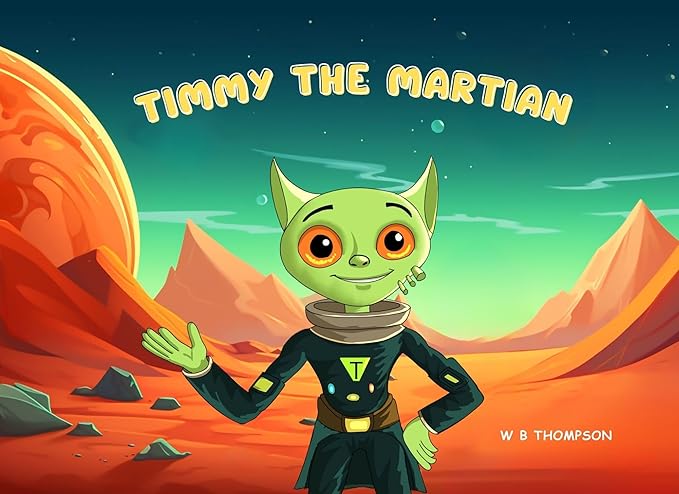
W.B. Thompson’s Timmy the Martian is a charming tale that invites young readers into the world of Timmy, a green Martian distinguishable by three moles on his face. Seeking companionship, Timmy embarks on an adventure to Earth, where he hopes to forge new friendships. However, his arrival on Earth doesn’t go as smoothly as anticipated, with his unique appearance initially causing fear among the children he encounters. This emotional journey takes a positive turn with the introduction of Henry, a boy whose three facial moles mirror Timmy’s, leading to an instant and meaningful connection despite their interplanetary differences.
Thompson skillfully weaves a narrative that addresses the theme of diversity and acceptance. The shared trait between Timmy and Henry serves as a clever device to explore and celebrate differences, imparting an important message about inclusivity to young readers. The story unfolds in a way that’s both engaging and empathetic, making it relatable for children who may feel different for various reasons. The book’s visual aspect is as impactful as its narrative. The illustrations in Timmy the Martian are noteworthy for their vibrancy and detail. Full-page spreads bring the story to life with vivid colors and imaginative depictions of both Earth and space. These illustrations are not just complementary to the story but are integral in drawing children into Timmy’s world, enhancing their reading experience.
W.B. Thompson’s Timmy the Martian is more than just a story; it’s a resource that can help children understand and embrace diversity. Its captivating illustrations and meaningful narrative make it a valuable addition to any young reader’s library. I find Timmy the Martian to be a delightful and educational read and one that I confidently recommend to both parents and teachers alike.
Pages: 31 | ASIN : B0CQQ1MW6L



 LITERARY TITAN