Blog Archives
A Tuft Of Thistledown
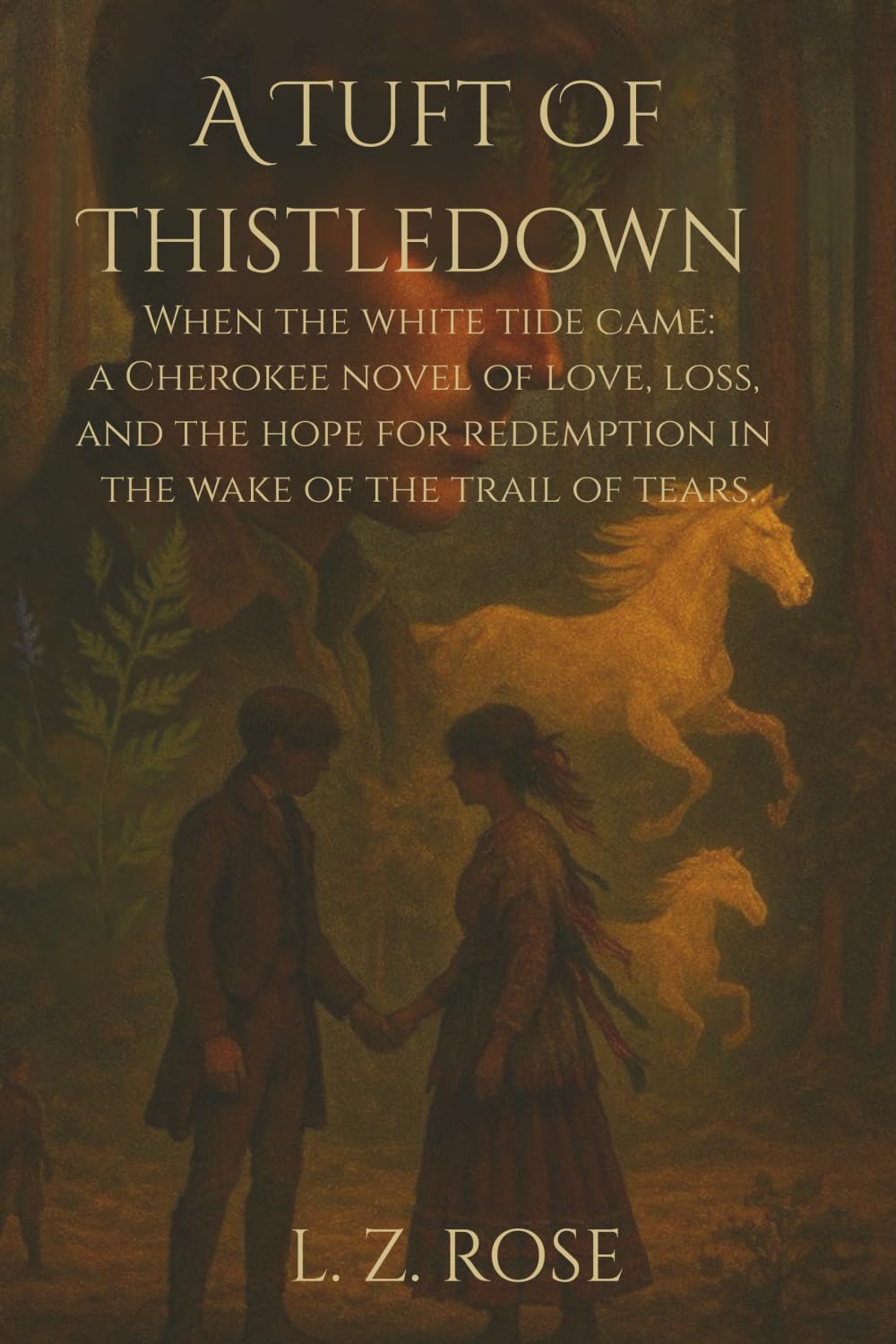

A Tuft of Thistledown is a gripping historical novel that plunges deep into the brutal realities of the Trail of Tears. Set in 1839, the story follows a harrowing clash of cultures, where violence, survival, and the unyielding will to endure take center stage. Through raw and vivid storytelling, the book presents the perspectives of both the Cherokee people fighting to preserve their way of life and the white men determined to erase them. The novel weaves together historical accuracy and emotional intensity, capturing the pain of forced removal and the complex motivations behind acts of cruelty and resistance.
What struck me most about this book was its unflinching portrayal of human suffering. The opening scene alone is enough to make your stomach turn; a one-eyed Cherokee man, bound and tortured, refusing to break. The descriptions are visceral, the emotions sharp as knives. It’s not just the violence that gets under your skin, though. It’s the way the characters grapple with their choices. The blacksmith, for example, torn between obedience and conscience, sneaks a bottle of whiskey to the dying man, only to later realize the man couldn’t even drink it. That moment, small but devastating, is where the book shines. It makes you feel the weight of inaction, of complicity.
Beyond the gut-wrenching pain, the novel’s pacing keeps you on edge. The sections with the Cherokee people offer a striking contrast to the brutal interrogations and raids. Scenes with Horse Song and Runabout, especially when she sees the white man at the eagles’ clearing, are filled with tension, but they also carry a quiet beauty. The descriptions of their hidden village, the careful collection of mulberries, and the intimate moments between families remind us of what’s at stake. And just when you start feeling safe, the book rips that away. The moment the children run screaming into the council house, yelling about white men, your heart stops right along with Horse Song’s.
One of the most intriguing elements of the book is John Lucas Jr., a character you want to hate but can’t entirely dismiss. He is methodical, cruel, but also strangely haunted. The way he follows the golden foal, chasing echoes of a past he doesn’t fully understand, adds a layer of depth to his character. He is not a villain in the mustache-twirling sense but he is something worse. He is a man who sees himself as rational, as doing what needs to be done, and that makes him terrifying. His realization that the foal carries a crescent moon marking, just like a horse from his past, hints at a connection to the people he is hunting. That moment lingers, making you wonder how much of him is still human and how much has been lost to cruelty.
I would recommend this book to anyone who appreciates historical fiction that doesn’t hold back. If you are looking for a comfortable read, this isn’t it. The writing is sharp, the themes are heavy, and the emotions hit hard. A Tuft of Thistledown is an experience that will stay with you long after you’ve turned the last page.
Pages: 374 | ASIN : B0DQLPGZVX

Pope Joan


Pope Joan, by Pablo Zaragoza, is a historical novel that tells the gripping story of a woman who defies societal norms and disguises herself as a man to rise through the ranks of the Church, ultimately becoming the Pope. Set in the brutal and unforgiving world of the ninth century, the book weaves history, myth, and speculation into a rich narrative about ambition, intelligence, and survival. Joan, born into a world that limits women to silence and servitude, refuses to accept her fate. She thirsts for knowledge, a rare and dangerous trait for a female, and her relentless pursuit of learning leads her on a path few could imagine. The book follows her struggles, victories, and the immense risks she takes to carve out a place in a world that would see her destroyed if the truth were known.
One of the things I loved about this book was how vivid and immersive the writing felt. The details of medieval life are gritty and raw. Joan’s intelligence shines through every page, and her thirst for knowledge is portrayed so powerfully that I felt her frustration every time someone tried to snuff it out. There’s a scene early on where her father, a rigid and cruel priest, beats her simply for being curious. That moment alone set the tone for the kind of world she was up against.
Another thing that stood out to me was how the novel balanced historical depth with emotional intensity. Sometimes, historical fiction can feel weighed down by facts, but this book never lets the history overpower the human heart of the story. Joan’s relationships—her forbidden love with Gerold, her conflicts with the men who underestimate her, and her silent struggle to remain hidden—kept me glued to the pages. The tension was constant. Every moment, I was bracing for the inevitable discovery of her secret, yet I couldn’t stop hoping she’d keep pulling off the impossible.
There are moments throughout the book that are very dramatic. Some of the characters, particularly the villains, left me wanting more depth to their character to understand their intensity. Joan’s father, for instance, was especially harsh, which emphasized the struggles she faced. While I understood that his role was to represent the oppressive forces of the time, I occasionally wished for a little more nuance in how those forces were portrayed. Still, the book remained engaging, and even in its most heightened moments, it never lost its emotional depth.
I’d recommend Pope Joan to anyone who loves historical fiction, particularly readers who enjoy stories of strong women defying the odds. If you’re looking for a novel that combines rich historical detail with a gripping, fast-paced story, this one is worth picking up. It’s intense. It’s emotional. And it’s the kind of book that stays with you long after the final chapter.
Pages: 179 | ASIN : B0CW1JH88C
Time Travel Tugged At Me

Black Cliff Chronicles follows two high school seniors who become lost on a hike, and they wind up traveling back in time 300 years into a horrific civil war. What was the inspiration for the setup of your story?
During the Pandemic, I finished writing The Youngest Doughboy screenplay, the story of the youngest American soldier in WWI – 12-years-old – and was looking for around for another project when I remembered a news story about an incident that happened years ago. A woman and a man hijacked a bus in a small town in Arkansas and begged the local police to kill them. They were members of an odd little church and said they would be resurrected three days after their death. The police did everything they could to save the pair, but in the end, both died.
I asked myself what if the man and woman were telling the truth and were resurrected three days later? And then I thought, what if they were pawns in a larger story, a political plot perhaps, a plot that might even threaten the entire country? The idea of time travel tugged at me. It felt right. That was the start of Black Cliff Chronicles.
When you first sat down to write this story, did you know where you were going, or did the twists come as you were writing?
The story grew organically with wonderful characters, ideas, and incidents seemingly appearing out of nowhere following the inciting incident – the bridge where the bus hijacking takes place.
I did a tremendous amount of research into the past events featured in the story. The chief historical event was the awful 1648 Cossack uprising in the Ukraine and its mass murdering general Bohdan Khmelnytsky.That research led to new avenues to pursue. Khmelnytsky became the novel’s antagonist.
What were some themes that were important for you to explore in this book?
Courage, selflessness, and bravery are the themes that fill the main action. We feel what our heroes are feeling – fear, hope, and the determination to succeed without regard to cost. Selflessness adds poignancy to the story.
Is this the first book in the series? If so, when is the next book coming out, and what can your fans expect in the next story?
Black Cliff Chronicles is written as a standalone novel. I’d like to write two more entries in the Black Cliff universe. Black Cliff Chronicles takes place at the millennium. Book Two will be located in time around 2016. Book Three will concern events in the 2030s or 40s. At least that is the plan.
Author Links: GoodReads | Amazon
The thriving university town of New Jerusalem nestles in the secluded hill country north of the Ozark National Forest in rural Arkansas. New Jerusalem is a wonderful place to put down roots as long as you don’t go into the experimental forest and find Black Cliff, a place of dark power.
Was it a simple misstep in 1989 when high school seniors Mary Sanders and Charlie Barrows became lost during a fall hike and stood facing Black Cliff? Or were other forces at play?
Before they can flee, Black Cliff entangles Mary in a web of time travel, strands that transport her back 300 years in history to a horrific civil war and a daring solo rescue mission.
Months later, Mary returns to New Jerusalem and to 1989, battered by her war experiences and heartsick over those she left behind. Once home, her struggles continue. Time travelers and friends gather to help Mary and Charlie. They have less than three days to rescue America from a plot to seize the presidency.
Maurice in London

Maurice Verdal is restless. He’s dapper, charming, and endlessly curious about the world, and right now, he’s bored of Paris. So, on a whim, he leaves for London, eager to immerse himself in the city’s social scene. Written by Xavier-Marcel Boulestin and originally serialized in Akademos in 1909, Maurice in London is a witty, observant, and gossipy tour of pre-World War I London’s queer subcultures. Maurice, a well-dressed and well-connected Frenchman, floats through high society and artistic circles, mingling with theater actors, aristocrats, and eccentric socialites, all while dissecting the oddities of English life with his sharp and often sardonic humor.
The writing is lively, drenched in irony, and full of razor-sharp observations about people who desperately want to be noticed. Maurice’s narration is both indulgent and self-aware, which makes him a fascinating character to follow. Take, for example, his interactions with the flamboyant and ever-dramatic Reggie de Vere, who declares, “I adore acting like a tart; I have tendencies in that direction.” Maurice doesn’t judge him outright, he simply watches, amused, and lets Reggie’s behavior speak for itself. This is a common pattern in the book: Boulestin doesn’t hammer his points home. Instead, he trusts the reader to catch the subtle digs, the unspoken hierarchies, and the absurdities of social posturing.
One of the book’s greatest strengths is its vivid portrayal of a particular time and place. This is London after Oscar Wilde’s trial, where the old-school aesthetes are fading, and a new wave of modern, queer intellectuals are reshaping the scene. Maurice navigates it all with an outsider’s keen eye. Whether he’s dodging bills in fancy restaurants, watching actors compete for attention, or attending an over-the-top house party that ends in scandal, his experiences feel authentic. The dialogue is snappy, often hilarious, and full of lines that would fit seamlessly in a modern social satire.
I feel like the story is less concerned with the plot than with experience, and that makes for a lot of scenes where people simply talk, gossip, and revel in their own cleverness. It’s entertaining, but some moments feel like they exist purely for the sake of capturing a mood rather than moving the story forward. The final chapters, in particular, lean heavily into these social vignettes.
Maurice in London is perfect for readers who love social satire, historical queer literature, or novels that thrive on wit and character dynamics. Fans of Oscar Wilde, Evelyn Waugh, or even The Great Gatsby will find much to love here. It’s a novel filled with lavish settings, scandalous characters, and dialogue that still sparkles over a century later.
ISBN : 9781590217849
A Slippery Slope

In The Last Desperado, a miner reflects on his years spent as part of an infamous gang and the regrets he has after decades of criminal activity. Where did the idea for this novel come from?
I was inspired to write my story by the real life of my Grandfather, AM Brand. The fictional Al Bullock’s life was shaped by my Grandfather. My Grandfather was born into poverty in Cumby, Texas in 1906. The Barrow and Parker families grew up in the West Dallas slums near Cumby during the same period. Although they never knew each other, all three families shared in their struggles and suffered from the Great Depression.
AM’s family moved to Webb City, Missouri, in 1920 to work in the lead mines in Missouri and Oklahoma. He and his brother Charles had to quit school in 8th grade to work with their father, John, in the toxic lead mines. His father and brother died from silicosis, and my Grandfather lost half of his right lung.
The Barrow Gang chose a life of crime instead of backbreaking work like AM. The exploits of the gang depicted in my book are mostly true. The April 13, 1933, shootout in Joplin, Missouri gave them national recognition. During their two-year crime spree, fact and fiction was a slippery slope. I combined myth and reality seamlessly to create the fictional Al Bullock’s role as an unknown Barrow Gang member.
Like Al Bullock transforming his life from poverty to great wealth, my Grandfather’s life followed a similar trajectory. After suffering for 20 years as a lead and copper miner, he quit in 1945 at 39.
He moved to Oregon and started a roadside enterprise in a small town on the Columbia River that included a café, gas station, motel, and a small zoo. He acquired a sea lion a few years later and, without any experience, trained the seal he named Sparky.
In 1954, he sold his roadside enterprise and started on the road in a converted ambulance with a small pool for the seal. He toured the country, hitting sports shows and County fairs, and started playing his seal act at the Como Zoo in St. Paul, Minnesota, in 1956. In his Sparky the Seal act, he was the consummate entertainer appearing on national TV on the Ed Sullivan Show.
There was a lot of time spent crafting the character traits in this novel. What was the most crucial factor for you to get right in your characters?
I framed the actions and dialog of the story characters to fit into this unique time in history with the world on the brink of an economic apocalypse. These desperate times brought out the best and worst in people. I wanted to show how ordinary people react to the challenges of the times. Although my book is fictional, the Bullock family characters and timeline are based in fact. Al Bullock was modeled after my Grandfather. His wife Judy and son Michael were molded after my grandmother and my father.
The Barrow Gang members were based on numerous historical accounts. They were complex people who could shoot and kill someone without hesitation. They could also be compassionate. The fictitious Snyder Gang was modeled after the violent and ruthless criminal gangs during prohibition.
What is one pivotal moment in the story that you think best defines Al?
There were two defining moments in the story. The first was the Barrow brothers inviting Al Bullock to join their gang. The Great Depression crushed Al’s dreams for a better life. At this vulnerable time in his life, the Barrow brothers offered excitement, easy money, and an opportunity to strike back at the wealthy overseers from the banks and big business.
The second crucial moment in the story is Al Bullock’s decision to do a solo break-in at the bootlegger’s warehouse. He was surprised by the gangster guard and engaged in a desperate struggle with the big man that ended with him unintentionally killing the man. He is devasted by his actions and instinctively knew he has crossed a line of morality, descending from a good, law-abiding man to a thief and killer. Even with his spectacular success, he is haunted by his actions for the rest of his life.
What is the next book that you are working on, and when will it be available?
I started writing late in life at 72. Over the last three years, I have written three fiction books. Each book I wrote was based upon a story I imagined. My favorite genre is historical fiction and I plan to write another book this year that would be completed by the end of the year.
Author Links: X (Twitter) | Instagram | Facebook | Website
Another Time

Another Time explores love, sacrifice, and the tangled web of family secrets. The novel follows Frank, a man whose life is shaped by wartime choices, shifting relationships, and the unspoken truths that bind people together. We meet Amy, Jeanie, and Imogen, women who each, in different ways, leave their mark on Frank’s life. As the years unfold, so do the hidden ties between characters, and the consequences of past actions emerge with gripping intensity. Set against the backdrop of Australia’s changing landscape from the 1940s onward, this historical fiction novel is a story of love that endures, truths that come too late, and relationships that are as complicated as they are real.
One thing that really struck me about this book was how natural the dialogue felt. Ostenfeld’s writing mirrors how people actually talk, which made me feel like I was sitting at the kitchen table listening to family stories. Take the scene where Bonnie bursts into the room, rattling off about sheep blocking the road, swearing as her mother scolds her. It’s chaotic, funny, and so authentic. It’s exactly how a lively, unfiltered family member would talk. The dialogue drives the story forward and keeps the pace moving without feeling forced. I enjoy a slow-burn novel, and I appreciate the depth Ostenfeld brings to her characters, but there were moments, especially in the middle, where I felt conversations or descriptions stretched on longer than they needed to.
Another aspect that I liked was how deeply the book dives into family dynamics, especially the weight of secrets. One particularly emotional moment is when Frank and Fred discuss the lie they’ve been telling Bonnie and Verna about their real relationship. There’s a sadness in Frank’s acceptance that “life isn’t fair to very many people,” a quiet acknowledgment of the burdens people carry to protect others. The way the novel explores the lengths people go to in order to keep things from falling apart, whether it’s out of love, shame, or duty, made me think about how many real families function in the same way.
The love stories in Another Time are anything but straightforward. There’s young, passionate love between Frank and Amy, and then there’s the quieter, more complex love that comes later. But the most surprising (and, honestly, slightly shocking) relationship is between Frank Jr. and Bonnie. Technically, they’re not related, but their connection is tangled in such a way that even they aren’t sure how to feel about it. The way the book handles this emotional mess is thought-provoking. Ostenfeld doesn’t give us easy answers, just like life doesn’t. It left me sitting there, thinking.
If you love family sagas that unfold over decades, where characters are flawed but deeply human, Another Time is for you. It’s perfect for readers who enjoy a mix of historical fiction and emotional drama, with a side of scandal thrown in for good measure.
Pages: 334 | ASIN : B0CTWKH8B9
The Last Desperado

Lee Brand’s The Last Desperado tells the gripping story of Al Bullock, a lead miner turned accidental outlaw, as he reflects on his tumultuous past tied to the infamous Barrow Gang during the 1930s. Spanning decades, the novel intertwines the Great Depression’s grit and hardship with the adrenaline-fueled chaos of crime, weaving a rich tapestry of Al’s regrets, redemption, and the weight of choices that defined his life.
Brand’s descriptions of the era, the desperation of the Great Depression, the stark inequities of wealth, and the tension of small-town life are vividly painted. I could almost feel the dust storms, hear the roaring engines of getaway cars, and sense the weight of poverty on Al’s shoulders. One particular standout moment was when Al hitched a ride with Clyde and Buck Barrow. The unease was palpable as their “friendly” chatter gave way to a more sinister tone. The buildup to their gas station heist was so tense I found myself gripping the book tighter. Brand has a knack for cinematic pacing.
The book’s exploration of morality is both fascinating and frustrating. Al is a deeply flawed but sympathetic character. His inner conflict struggling to provide for his family while being drawn into the thrill of crime is written with raw honesty. Yet, at times, his passivity annoyed me. For instance, when he realizes who Clyde and Buck truly are, his hesitance to escape or act feels too drawn out. That said, the complexity of his choices is the novel’s strongest suit. It asks readers tough questions: What would you do in his shoes? How far would you go for survival?
Brand’s writing shines brightest in action scenes. The big shootout in Joplin, for instance, was chaotic, gritty, and cinematic. Sometimes, the dialogue crackles with authenticity, like when Clyde intimidatingly explains their “Robin Hood” philosophy. Other times, it veers into over-explanation, pulling me out of the narrative. Al’s reflections on love and loss, particularly about his wife Judy, added depth but occasionally felt melodramatic. His musings were poignant, though, when he revisited his life-altering choices, like the gut-wrenching confession to his grandson, Jason.
The Last Desperado is a gripping tale with a lot of heart. It’s a raw, emotional, and action-packed novel that captures the chaos of desperate times and the weight of human choices. If you’re into historical fiction with a touch of crime drama, this one’s for you. It’s a story that lingers long after the last page.
In the Shadows of Castles

In the Shadows of Castles is a historical novel that plunges the reader into a world of brutal ambition, betrayal, and survival, following the journey of Ralph Pomeroy as he carves his way through a medieval landscape rife with violence and intrigue. From the very first pages, where Ralph defends a maid from his monstrous father and changes the course of his own life, the book grips you and refuses to let go.
The author does not shy away from graphic violence, whether it’s a battlefield soaked in blood or the raw horror of domestic abuse. The opening scene, where Ralph catches his father assaulting a maid and retaliates with lethal force, sets the tone for a novel that is brutally honest about the era it portrays. The writing makes these moments feel immediate and visceral. The raw descriptions of power struggles and suffering make for an immersive, if at times gut-wrenching, read.
The character development is another highlight. Ralph’s transformation from an abused boy to a hardened warrior is fascinating. His choices are rarely black and white, and that moral ambiguity makes him feel real. At one point, after years of violence, he reflects that he never wants to be like his father, yet he rules with the same iron fist, wrestling with the ghosts of his past. The contrast between his brutality and his tenderness toward his wife, Tate, and their children makes him complex rather than just another medieval antihero. Other characters, like Morwenna and Whitgar, bring additional layers of intrigue, especially during moments of high-stakes strategy and battle scenes.
There is hardly a moment to breathe between fights, betrayals, and desperate escapes. While this keeps the reader engaged, it occasionally leaves little room for quieter, more reflective moments. Some plot points could have been explored with more depth, such as the internal struggles of supporting characters. The writing style itself is clear and evocative, with a knack for vivid detail, whether describing the stench of a city sewer or the glint of torchlight on a sword.
In the Shadows of Castles is not for the faint of heart. If you enjoy historical fiction that leans into its brutality rather than romanticizing the past, this book delivers. The novel thrives on tension, power struggles, and moral dilemmas, making it a gripping read for those who appreciate historical realism over fairy tale endings. If you’re looking for a story that pulls no punches and drags you straight into the mud and blood of the medieval world, this one is worth picking up.
Pages: 432 | ASIN: B0B457G4X8



 LITERARY TITAN