Blog Archives
Book of Me


Book of Me felt like sitting across from Kevin in a diner while he talked me through his life, one wild episode at a time. This nonfiction autobiography-memoir traces his journey from a rough-and-tumble childhood over a butcher shop in Queens to the cookie-cutter dream of Levittown, through hippie days and garage bands, brushes with rock legends, marriages and divorce, a Christian conversion, big wins in real estate, brutal losses, bipolar disorder, cancer, and a late-life run at politics and entrepreneurship. The book is broken into short, titled episodes that move mostly in order, each one another story about how this ordinary guy kept stumbling into extraordinary situations, learning to laugh, get back up, and lean hard on his faith.
The writing keeps the feel of spoken storytelling, which makes sense since Kevin originally told these stories on camera. You can hear him in the run-on excitement of a good memory and the quick punch of a painful one. The style is loose and conversational, sometimes a little meandering, but it feels honest rather than messy, like listening to a friend who has a lot of life to cover and is trying not to leave out the good parts. As a memoir, it reads less like a polished literary project and more like a long, vivid conversation, helped along by the pencil sketches and the playful chapter titles that keep you turning pages to see what ridiculous thing happens next. At times, I wanted a bit more trimming or reflection between the anecdotes, but the energy and humor kept pulling me back in.
I also appreciated the choices he makes about what to show and how vulnerable he is willing to be. Kevin leans hard on self-deprecating humor, especially when he is talking about getting into trouble as a kid, crashing on the ice, or starting one more half-baked business, and that humor softens you up before he walks you into heavier territory. When he writes about his Christian conversion, his mental breakdown and bipolar diagnosis, or facing cancer, the tone shifts in a way that feels earned. He does not pretend to have it all together. Instead, he keeps circling back to this idea that life is about the journey, about falling, learning, and getting back up with God, family, and a few loyal friends at your side. In a genre that can sometimes feel like a highlight reel, it was refreshing to see him include so many moments where he did not look good, or did not win, or just barely survived.
By the end, I felt like I had been on a long road trip with someone who talks a lot, laughs loudly, prays openly, and is deeply aware that he has been both reckless and blessed. This is an autobiography for readers who enjoy true, larger-than-life stories more than careful literary craft, who like faith-driven narratives, and who do not mind a little chaos mixed in with their inspiration.
Pages: 494 | ASIN : B0FJWKDKZR

Laughing at Life’s Changes

My Socks are Dirty, Too is a loose, goofy collection of short bits, gags, and cheeky observations about aging, marriage, senior-center hijinks, bodily mishaps, and everyday life. What made you want to write humor specifically about aging and senior life?
I come from a very large family on both sides of my parents. They were raised during the depression in a time when families were brought closer together.
We always had large family reunions so I was exposed to senior citizens’ life at a very young age. I remember the laughter between family members as they compared life’s changes. Some of the family members were grim and others faced the realities of aging head on with laughter. Those laughing were much more fun and seemed to live a more abundant life and maybe even a little longer. I choose to face my own personal setbacks as an opportunity to find some humor if possible when sharing.
You lean into bodily mishaps, memory lapses, and embarrassment instead of avoiding them. Do you think people take aging too seriously?
Yes, some people certainly do. I prefer to associate with those who don’t.
Beneath the jokes, there’s warmth and familiarity. Was that intentional or unavoidable?
That was very intentional so that readers can associate my antics with theirs. I did a wide range of chapters through three books so there would be something there for everyone.
A portion of the proceeds goes to charitable causes. Why was that important to you?
I had a good friend pass from the complications of Alzheimer disease. I saw what a tragedy it was and pain on his family, anything I can do to help, I want to.
We have always rescued our Boxer Dogs, and we support what is now Lone Star Boxer Rescue (formerly Austin Boxer Rescue) here in Texas. We have been donating to them for 20 years now, and there will always be that need after my wife and I are long gone. So, the legacy will live on after we are gone when our heirs continue to forward any proceeds if there are still book sales.
Author Links: Facebook | Website
Dollartorium

Ralph earns his living in a modest Kansas shop, frying corndogs that are undeniably good and reliably popular. The work keeps him afloat for a while. It offers routine, modest comfort, and a sense of pride. Eventually, though, the numbers stop working. Sales stall. Bills pile up. Stability slips away.
At that moment of strain, Ralph’s wife introduces him to “Dollartorium,” a tantalizing promise discovered through an infomercial. The course offers bold ideas and glossy solutions. At first, it feels like salvation. New business concepts suggest a way out, maybe even a breakthrough. Then the foundation collapses. What seemed like an opportunity quickly unravels, leaving Ralph to reckon with the fallout. With the help of his daughter, Stella, he is forced to retrace his steps and search for a more realistic way forward for his family.
Dollartorium, by Ron Pullins, is a work of fiction that probes capitalism, hustle culture, and the pressures these forces place on families. Humor runs throughout the novel, but it never fully softens the sharper insights beneath the surface. The comedy entertains; the implications linger.
Pullins shows a clear awareness of how precarious financial life has become for many people. Ralph’s anxiety feels earned. His frustration resonates. The sense that the system is tilted against ordinary workers gives the story its urgency. The Dollartorium scheme itself feels uncomfortably familiar, echoing countless real-world programs marketed to those already struggling. These promises prey on desperation, and Pullins does not shy away from exposing their ethical rot.
Stella emerges as the novel’s moral and intellectual anchor. She tempers Ralph’s desperation with reason and clarity. Her perspective restores balance and nudges the story toward resolution. Yet even as the family regains its footing, the larger problem remains unresolved. The system that cornered them still stands. Pullins underscores this truth with restraint, allowing the message to land without sermonizing.
The novel closes on a note that is satisfying, though far from idyllic. That choice feels intentional. Pullins has more to say than a neat ending would allow. Through his characters, he gives voice to frustrations that have become commonplace, about inequality, exploitation, and the illusion of easy fixes. The odds remain stacked against the little guy, and the allure of grand, risky schemes proves hard to resist. Dollartorium captures that tension with clarity, humor, and an undercurrent of quiet anger that makes it linger after the final page.

My Socks are Dirty Too

My Socks are Dirty, Too is a loose, goofy collection of short bits, gags, and cheeky observations about aging, marriage, senior-center hijinks, bodily mishaps, and everyday life. The book moves fast and hops from one joke to another, almost like listening to a friend who can’t stop cracking wise as he recounts stories about his wife, his buddies, his church antics, and all the strange things that happen as the years pile up. It feels like flipping through a scrapbook of one-liners and mini-stories built to get a grin, a smirk, or a full laugh, with topics ranging from HOA mischief to senior-center pranks to marital back-and-forths and the general chaos of getting older.
While reading, I kept finding myself smiling at how unfiltered the writing is. The author leans into a kind of playful orneriness that feels honest, like he’s laughing at life before life gets the chance to laugh at him. Some jokes are silly, some are sharp, and some hit with that little sting of truth that comes with age. I liked the rhythm of it. The quick hits kept me turning pages because I never knew if the next line would be a groaner or something that would make me snort-laugh. I also enjoyed how he describes the senior center like it’s a sitcom set. The quirky characters and wild signage made the place feel alive and weird in the best way. It all felt familiar, as if he were letting me in on a private hangout with the neighborhood troublemaker.
I also felt a kind of warmth beneath the joking. Even when he teases his wife or pokes at aging bodies and fading memory, there’s affection tucked into the cracks. The stories are crude at times and sometimes outrageous, but the heart shows through. It reminded me of listening to an older relative tell stories that drift between the ridiculous and the meaningful. Some bits made me roll my eyes in the best possible way, and others caught me off guard with how relatable they were. Aging can be hard, but the author treats it like a long, rowdy adventure where you either laugh or you stew, and he refuses to stew.
I’d recommend this book to readers who enjoy quick humor, playful irreverence, and a lighthearted look at senior life. It’s great for anyone who wants to laugh about the oddness of growing older or who appreciates a storyteller who doesn’t take himself seriously. If you like joke-heavy books you can dip in and out of, or if you just need a pick-me-up, this one fits the bill.
Pages: 122 | ASIN : B0F7VPXGZ9
Too Complex: It’s a (Enter Difficulty Setting Here) Life
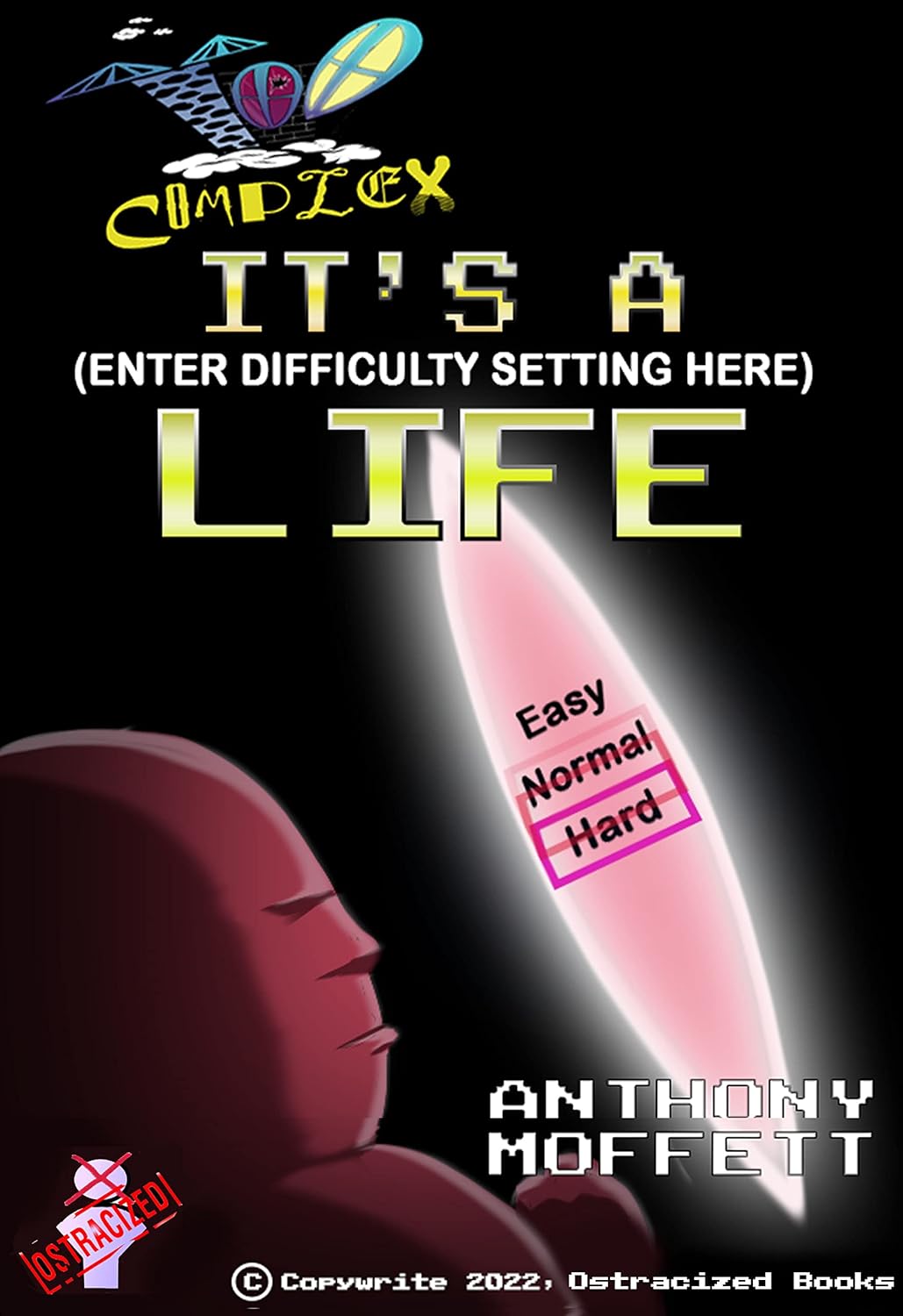
Cody Redbond lives to game. Addiction defines him. His fixation centers on Fantasy Estate, an online battle royale that consumes his days and erases everything else. Hours disappear. Priorities collapse. The game becomes his only reality, while the world beyond his screen loses all appeal. Employment slips away. Social skills erode. Eventually, eviction follows. Even then, Cody refuses to move on. He is too deeply embedded in the digital realm to disengage on his own.
Enter leasing agent Mavirna Holmes and property manager Corey Dwellen. Their task is simple in theory and nightmarish in practice: reach Cody and reclaim the apartment. Doing so requires navigating a living space that has deteriorated into absolute chaos, a physical manifestation of Cody’s inward retreat.
Too Complex: It’s a (Enter Difficulty Setting Here) Life, by Anthony Moffett, is a compact and sharply comic work that blends prose with illustrations. It occupies a space somewhere between novella and graphic novel, using visuals to punctuate its humor and heighten its absurdity.
At its core, the book is an absurdist adventure tailored to video game enthusiasts, but its reach extends further. It functions as a satire of modern adulthood, skewering burnout, disconnection, and the quiet despair that drives escapism. As Cody’s story unfolds, sympathy becomes inevitable. He has not merely abandoned reality; he has replaced it with something brighter, louder, and more responsive. Ironically, the so-called real world offers little incentive to return. It appears dull, unforgiving, and deeply uninspiring by comparison.
This contrast captures the enduring appeal of video games. They promise immersion without consequence, excitement without monotony. When everyday life feels hollow or exhausting, fantasy becomes irresistible. Mavirna and Corey, the unfortunate duo assigned to retrieve Cody, find themselves on a quest of their own, one that mirrors the very games Cody adores. The ultimate irony lies in the aftermath of his obsession. The artificial world he clung to has reshaped reality itself, transforming his apartment into a grotesque, pest-ridden dungeon.
The result is a book that is unabashedly fun. It is silly, unhinged, and gleefully excessive. Beneath the humor, however, lies a pointed warning. Too Complex entertains first, but it also lingers, offering a sharp and thoughtful reflection on escapism, avoidance, and the cost of choosing fantasy over life. I highly recommend this humorous and highly relatable tale to gamers and non-gamers alike.
Pages: 73 | ASIN : B0BR4J3L9Y
The Sound of Violet, 10th Anniversary Edition

Allen Wolf’s The Sound of Violet follows Shawn, a young autistic programmer who longs for connection, and Violet, a woman trapped in exploitation who hides behind a practiced charm. Their worlds collide in ways that neither one expects, and the story weaves romance with themes of trauma, hope, misunderstanding, and the hard work of seeing someone for who they truly are. It moves between humor and heartbreak with surprising ease, and the plot leans into both the sweetness and the messiness of love.
I found myself rooting for Shawn almost immediately. His inner life felt vivid. His sensitivity to color and sound created moments that were oddly beautiful, and I kept pausing to imagine how overwhelming the world must feel to him. I liked how the writing didn’t try to polish his edges. It let him be blunt and awkward and sincere. Those traits gave the story its emotional heartbeat. Violet’s chapters hit me differently. I felt the tension behind her confidence. I felt the fear tucked between her jokes. The writing made her pain feel present even when she tried to hide it, and that contrast kept me pulled in. I caught myself more than once whispering, “Please get out of there” as her world closed in on her.
What surprised me most was how simple the prose often felt while carrying so much weight. Scenes slid quickly from funny to tense, and I liked that the book didn’t pretend those shifts were unusual. Life works like that sometimes. A moment is warm, then it isn’t. A date feels hopeful, then it falls apart. The story’s rhythm captured that truth, and it kept me leaning forward. I also found myself getting irritated with certain characters, which I count as a success. The book wanted me to feel the discomfort of exploitation and the sting of people who misunderstand others. It worked. I felt it.
By the end, I was glad I stayed with the story. It made me think about how people judge each other, and how much quieter the world becomes when someone finally listens. I would recommend The Sound of Violet to readers who enjoy heartfelt romances, stories about neurodivergent characters, or narratives that explore heavy themes with gentleness. It would also appeal to book clubs that like talking about big emotions and complicated choices.
Pages: 319 | ASIN : B0FMP438MV
Peaches and the 19 Cobras

Peaches and the 19 Cobras tells the story of Peaches and Jake, two sweet rescue dogs who misunderstand COVID-19 as “19 cobras” and spend the pandemic doing everything they can to protect their mom. The book moves through their daily adventures from quarantine in Florida to summers in Maine. There are masks and costumes, funny misunderstandings, shiny Christmas trees, and a whole lot of love. The dogs tell the story in their own voices, so the whole thing feels warm and comforting.
As I read it, I kept catching myself smiling. The writing feels like someone chatting with me in their kitchen. It’s simple in a good way and full of genuine emotion. The idea of hearing the pandemic through the ears of two confused and devoted dogs was surprisingly emotional. It reminded me of how strange that time was and how pets kind of carried so many of us through it. Some moments even made my eyes sting a little because the mix of humor and fear from that year still sits in my chest. Seeing the dogs try to make sense of everything made the whole memory softer for me.
I also loved how the book leans into joy. There are photos everywhere, and they’re adorable. The stories jump from masks that never stay on to gigantic Christmas trees to lobster dinners in Maine. It felt chaotic in a charming way. Like watching someone you love tell a story while getting distracted every few sentences. I honestly laughed out loud when the dogs kept ditching their masks or when Peaches tried to look fierce with her tiny warrior stance. The whole thing just felt honest. Not polished in a stiff way. More like real life with all the messiness and sweetness mixed together.
Peaches and the 19 Cobras is great for kids who want a gentle way to understand a heavy moment in history and for adults who want a soft, funny reminder of how we made it through. Anyone who loves animals or who leaned on a pet during the pandemic will feel this one. It’s light and goofy and unexpectedly touching. I’d happily pass it along to families, teachers, grandparents, and anyone who just needs a picture book that feels kind.
Pages: 88 | ASIN : B0DDW3GM88
The Arts Council

When I finished The Arts Council, a satirical novel by Dolly Gray Landon, I felt like I’d been dropped into a carnival mirror version of the arts world. The book follows Honorée Oinkbladder, a gifted young artist raised inside a family business that quietly manufactures the physical tokens of achievement for institutions everywhere. Through her eyes, we watch a small city’s arts ecosystem twist itself into a tangle of ego, corruption, favoritism, and theatrical self-importance. Her tense rivalry with Modesty Greedance unfolds against a backdrop of inflated awards, misused donor funds, and a once-noble arts council that has drifted far from its original ideals. The result is a story that sits squarely in the literary satire genre, though it often reads like a character-driven dramedy with teeth.
The writing is lush, verbose in a way that feels deliberate, like Landon wants the excess itself to be part of the joke. There are long, winding sentences loaded with wordplay and invented terms, and then sudden needle pricks of clarity. It’s funny, but also strange, because the humor is threaded through moments that cut close to the bone: the way Honorée hides her beauty so she won’t attract the wrong kind of attention, or the way Modesty relies on spectacle instead of craft because spectacle is what the system rewards. The satire bites hardest when the book peels back the arts council’s history, revealing how a once-merit-driven institution slowly rotted after a leadership collapse. The contrast between past ideals and current dysfunction is one of the book’s most memorable tensions.
What I liked most was how much the novel asks us to think about value. Who gets to decide what counts as art. Who benefits from the illusion of fairness. Who learns to play the game and who refuses. Even the absurd elements feel purposeful: Honorée’s family literally manufactures the symbols that feed inflated egos, yet they see through them more clearly than anyone else. That irony gives the book a reflective core I didn’t expect. The novel also manages to be playful without losing its edge. It mocks the arts world, yes, but it also mourns what the arts can become when honesty gives way to self-interest. I found myself chuckling at one page and nodding in recognition on the next.
The Arts Council is a bold, brainy satire with a lot on its mind. I’d recommend it to readers who enjoy literary fiction that doesn’t mind being a little unruly, especially anyone curious about the messy intersection of art, ego, and institutions. If you like stories that mix humor with critique and aren’t afraid of dense, stylized prose, this one will keep you thinking. For readers who enjoy sharp, offbeat takes on creative culture, it’s a fascinating ride.
Pages: 558 | ASIN : B0G2TFBLHZ



 LITERARY TITAN