Blog Archives
History and Heritage

The Word of Y’Neshu: Heart of the Ijeya follows the journeys of J’Kana, a steadfast Kanawe, and his son Kamari as they navigate the complexities of familial bonds, spiritual trials, and ancient traditions. I think this original idea is intriguing. How did you come up with this idea and develop it into a story?
It all began with J’Karo. I spent 2023 researching a plethora of African cultures and languages to develop the concept of Y’Neshu, and even discovered my own Mandinka, Fulani, Kpelle, and Mende heritage in the process. From there, it was about creating a language using linguistic commonalities from across the African continent and building in historical occupations and concepts from tribes in my own heritage and others. I figured that the best way to accomplish the learning of the culture and the language was through a story all about a Master and Apprentice, so I wanted to tell the story in two parts. The Past, which shows J’Kana’s training under Kanawe Y’Sawe, and the Present, where we find that J’Kana is teaching his son Kamari about the history of their family (more on that later). I wanted to write something that could be appreciated by everyone, but also bring to light the beauty of African cultures that are oftentimes ignored in the stream of 21st-century literature. I also realized along the way that there are other people like me at the start, who were Black and wanting to reconnect with their heritage in a way that they previously couldn’t have. So this is as much a gift to the Black community as it is to those who just love a good fantasy.
I find the world you created in this novel brimming with possibilities. Where did the inspiration for the setting come from, and how did it change as you were writing?
Y’Neshu is actually a J’Karo word that means “Divine Crown,” and I pulled from a number of different geographical fixtures in the African continent. Deserts, plains, shorelines, grasslands, mountains, volcanoes, and forests that span the entirety of the continent were important so that it could truly feel as realistic as it was fantastic. As I went through the story, though, it forced me to think about the finer details and how Y’Neshu itself fits into the grander scheme of the War of the Ancients, the training of the ijeya, and the cultures that blossom all across the Four Empires.
What were some themes that were important for you to explore in this book?
Identity is a huge focus for this story. When J’Kana and his Father, Y’Sawe (Spoiler Alert but I guess not really) are first introduced in the Prelude, they’re nameless characters with a lot of personality. You see the love between a father and son, you feel the heartache when Shifi burns, and even though J’Kana turns into J’Foja on the streets of Memifi, something in him remains joyful and playful despite it all. The exploration of the Kanawe, the struggle over the J’Karo and Batabari languages, and the backstories of other characters like Nihani, Chishashi. and J’Chera all play into that theme of identity.
Through Mahute the Dagger and the Kanawe, there also comes a thematic focus on Education vs. Tradition that brings up the questions of 1) Should we accept tradition at the expense of heritage, 2) Is educating ourselves on our history and heritage worth it if it costs us who we have become, and finally, 3) Who can be trusted to teach the history of groups whose heritage has been denied them?
Is this the first book in the series? If so, when is the next book coming out, and what can your fans expect in the next story?
This is the first book in the series, and the second book is almost done! The next book continues J’Kana’s story, with more J’Karo lessons, more exploration of Y’Neshu, and a deeper connection to the ike overall! Also, it should be noted that J’Kana’s story is only one of the trilogies that I have planned in Y’Neshu! Every protagonist has already been revealed, so definitely stay tuned.
Author Links: GoodReads | Instagram | Threads | Facebook | Website | Amazon
The Word of Y’Neshu: Heart of the Ijeya


Jordan Hampton’s The Word of Y’Neshu: Heart of the Ijeya is a sweeping tale of identity, resilience, and mystical heritage. Set in the vibrant and richly detailed country of Y’Rakili, and taking readers across the continent of Y’Neshu, the story follows the journeys of J’Kana, a steadfast Kanawe, and his son Kamari as they navigate the complexities of familial bonds, spiritual trials, and ancient traditions. Hampton weaves a narrative that is as much about survival and sacrifice as it is about learning to wield the mysterious language of J’Karo. The layered world-building, from the fiery heart of Mount Y’Bayeka to the bustling streets of Memifi, serves as both backdrop and character in this spellbinding epic.
The strength of this book lies in its thematic depth and world-building. The J’Karo language, with its ancient syllabary, is fascinating and adds layers of authenticity to the lore. I particularly enjoyed the father-son lessons where J’Kana teaches Kamari phrases like “Sabele” and “Chishama,” making the bond between them feel real. While the book’s action sequences, like the fight with the Asanibo, are gripping, they sometimes overpower the quieter, reflective moments that give the story emotional weight.
The writing in this book is lush and evocative, with beautifully detailed scenes that bring the world to life. For instance, the opening moments—depicting the Outer Grasslands and Y’Sawe’s playful interactions with his son—are rich in vivid imagery, though some readers might find them a touch more elaborate than necessary. I couldn’t help but smile at the innocence of J’Kana’s roar imitating an ara beast. Yet, these tender moments serve as a poignant contrast to the horrors that soon follow in Shifi, grounding the emotional stakes. Hampton’s ability to shift tone—from lighthearted familial banter to the haunting dread of the undead—deserves praise.
As for the characters, J’Foja, the orphaned thief, is a standout. His struggles in Memifi and his reluctant charm brought warmth to the narrative. His budding rivalry-turned-respect with the Kanawe is one of the most intriguing dynamics in the story. The nuanced exploration of grief—Y’Sawe’s over the loss of his wife and the boy’s over the family and life he lost—is heart-wrenching. These moments are what made me genuinely care for the characters.
The Word of Y’Neshu is a richly imagined tale for fans of epic fantasy and spiritual allegory. Its combination of cultural depth and emotional resonance makes it a must-read for anyone who loves stories steeped in myth and meaning. I’d recommend this book to readers who enjoy fantasy worlds akin to Tolkien or Brandon Sanderson but with a unique linguistic and cultural twist.
Pages: 408 | ASIN : B0DN3K17FF

A Collision Course of Ideologies

Eruption 2085 follows a man in the middle of a brutal war where allegiances are questioned, brothers are lost, and one brother is in the seat of power they set out to destroy. What was the inspiration for the setup of your story?
The setup for Eruption 2085 is the result of combining the events of the real world with the journey of the characters. We were shown a lot of the worst in 2020, between massive outbreaks, police brutality, questionable politics and a seemed regression in race relations, and we see all of this addressed in Ignition 2084. Eruption takes all of the struggle and social turmoil of its predecessor and amplifies it through the characters’ experiences. John and Brian are set on a collision course as their personal ideologies are tested through the nature of war. It really strives to ask the question of what happens to the ally when the battle gets hard? Will they stand and fight by the side of the oppressed, like Bill and Kincaid, or will they fight for themselves and subject their “friends” to yet more longstanding oppression?
Your character development is one of the highlights of your novels. What character did you enjoy writing for? Was there one that was more challenging to write for?
All of my characters are very fun to write for, and they all have a different perspective on what happens throughout the story. If I had to pick one, though, I think that John is always going to be my favorite to write for just because I think we see the most from him. We’ve seen him as the military leader, the husband, the father, a friend, an enemy, and so much more, and we’ve seen how frantically and urgently he protects the ones he loves. At the same time, Brian is a lot of fun, too, since he grows more unhinged as the story goes on. I think that both of them and their relationship in particular poses a unique challenge just because they create a unique dichotomy of perspectives.
I find the world you created in this novel brimming with possibilities. Where did the inspiration for the setting come from, and how did it change as you were writing?
It’s always fun to look at a map and decide where to go at a moment’s notice, and what I found out during the telling of this story is that the same is true when you want to plan an epic battle scene. There are scenes in this book that take place in Tennessee, North Carolina, Mississippi, Arizona, etc., and all of them are broken compared to what they look like today. Each scene shows a few actual landmarks that would resonate with people who actually live there, but it is still a very fictionalized version of those cities and states. The interesting thing is that this hasn’t changed too much since the battle scene in the ruins of the White House from Ignition.
What is the next book that you are working on, and when can your fans expect it to be out?
After working on a dystopian science-fiction duology for the last two years, I thought to shift gears and work on something a little less research-heavy. To that end, I actually just finished writing a Pan-African Fantasy novel entitled The Word of Y’Neshu: Heart of the Ijeya, and I am extremely excited about the series and the languages that will spring up from it. As for a release date, though, I have no idea yet. For any fans waiting to see what happens next, all I can say is just keep an eye out on my platforms for when the announcement drops!
Author Links: GoodReads | Facebook | Website
Eruption 2085


In Eruption 2085, author Jordan Hampton continues the narrative he began in Ignition 2084, weaving a complex tapestry of war, allegiance, and survival. The protagonist, John Hamlin, once revered as the Lightning Dragon of the Violet Shadows faction, now finds himself in the midst of a raging war as the Director of the Yaiba. This novel intricately details the formation of a fragile alliance between the Yaiba, a clan of fierce warriors, the remnants of the Violet Shadows, and the Kabuto Sanctuary, united in their opposition against the formidable Scarlet Kingdom.
The story is a rich blend of genres, incorporating military strategy, science fiction, and fantasy elements. For newcomers to the series, the initial chapters offer an exciting opportunity to immerse oneself in the intricacies of this richly crafted world, with the promise of deeper engagement and understanding as the narrative progresses. Hampton’s writing style is dynamic and multi-layered, reminiscent in some respects of the classic G.I. Joe cartoon series, but with a distinctly literary flair. Set in a near-future landscape, the novel has advanced weaponry, characters possessing extraordinary abilities, and multiple factions locked in a power struggle. The novel thrusts the reader into the heart of its tumultuous world, where deciphering the complexities can be demanding. However, the story truly shines in the quieter moments of character development. John Hamlin emerges as a robust and engaging protagonist, supported by a cast of well-crafted side characters and intriguing antiheroes.
As the reader becomes more immersed in this world, the depth and richness of the narrative become evident. While it might be tempting to categorize Eruption 2085 as a straightforward action novel, it offers much more, with a substantial storyline underpinning the vivid scenes of conflict and confrontation. This novel is a testament to Hampton’s skill in creating a vivid and compelling world that captivates and entertains.
Pages: 532 | ASIN : B0CRD2H5ND

We Had A Reason To Fight

Ignition 2084 follows a warrior in the insurrection who is fighting for his people and a chance at freedom and peace from the ones that want to destroy all others. What was the inspiration for the setup of your story?
Ignition 2084 was a response to 2020. Disease ran as rampant as racial disparities, politicians failed to prove their trustworthiness and care for the public, and violence was on the rise. Between the wrongful killings of Ahmaud Arbery, George Floyd and Breonna Taylor; the increase of domestic violence; the rampant deaths from COVID-19; it seemed that for many of us that year, we had a reason to fight for freedom and peace from the things (or in some cases, people) that were so determined to destroy all others.
What were some of the emotional and moral guidelines you followed when developing your characters?
A lot of the characters in Ignition are based on real people from throughout my life. Some are friends, enemies, mentors, students, or family of mine, so when developing the characters I wanted them to be true to form. I wanted this to be a love letter to the people who helped me to become who I am, but I also wanted to recreate the realness of the people from whom the characters derived their base. They had to have their own views, not just the view that I present as the author. They had to present their own motivations for the good or bad that they do, and regardless of which side they fall on, there are always questionable thoughts, words and actions between them. Just like in life, I wanted to see how they would forge a path ahead, or even if they would.
What were some themes that were important for you to explore in this book?
The effects of war on family was one of the central themes, along with the effects of war on individuals. I wanted to explore the side of military life that I got to see as a military brat that often gets overshadowed in stories. There is an equal focus on survival and the inequality of rich and poor as it relates to the ideas of freedom and tyranny, and of course a somewhat obvious focus on racial tension.
Will there be a follow-up novel to this story? If so, what aspects of the story will the next book cover?
A sequel novel is underway, codenamed “Project ShadowStorm,” and is set to release around the holiday season this year. This one picks up where the last one leaves off, with a mixing of new and old characters that endeavor to put an end to the war that began in the first installment. There will be a lot more action, a few compelling moments, a few loose ends tied up, and a deepening of the in-world mythos as we continue to address some of the important issues in our society in the hopes of making real change over real conversations.
Author Links: GoodReads | Facebook | Website
The year is 2084, and the Hanzo Gear’s done a lot to level the playing field against Kingdom Scarlet in the last 38 years. After the Second Civil War destroyed America in 2020, the minorities displaced by the autocratic Kingdom split into three factions, all watching for just the right moment to strike back.
The Kabuto Sanctuary built a network of tunnels during the war, and relied on stealth and sabotage. The Yoroi Alliance, nestled in the Grand Canyon, lay numerous deadly traps to keep the outsiders at bay. The Yaiba Insurrection have continuously engaged their enemies directly, and when they were pushed to the brink of extinction, they created the Hanzo Gear.
The Reds are on the move again, more determined than ever to bring the other factions to heel. John Hamlin is the strongest warrior that the Insurrection has to offer, but when his home is invaded and the people he loves are threatened, captured or killed, the strength that had preserved his peace for years is called into question.
Ignition 2084
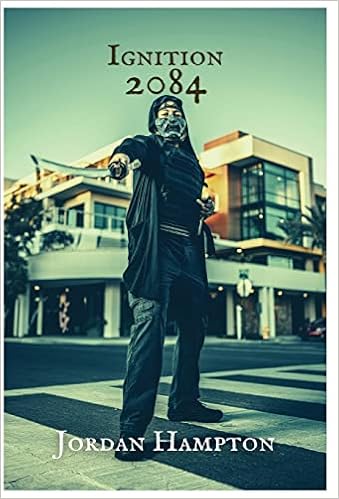
Ignition 2084, a new science fiction novel by Jordan Hampton, takes place in the long shadow cast by a Second Civil War fought in the United States in 2020. From the War rose the tyrannical and white-dominated Scarlet Kingdom, opposed by three other factions mainly divided along racial lines. As the Kingdom redoubles its efforts to reunify the country by force, one of those factions, the Yaiba Insurrection, manages to level the playing field via new military technology and the skill and courage of warrior John Hamlin.
Hampton’s greatest strength lies in his action scenes; he understands well what makes for good action in print. Not simply in spectacle, as in a movie; instead, he gives each scene context through dialogue and just enough description that the reader always understands the stakes in each fight and, from the prologue onwards, feels invested in each character’s fate. Even incidental characters who appear only briefly often receive a name and a small piece of characterization through dialogue or narrative so that every scene feels like it involves real people with a life outside the immediate context of the story. One should also note that while technology certainly plays a significant role in the story and the spectacle of, e.g., the heat-generating Reikiken sword are appealing, Hampton never lets them overshadow the main points of the story.
Now, Hampton seems to have meant for the racial divisions among the various factions and how they’re handled to be relevant to the real world, which forms an essential aspect of the novel. However, Ignition 2084 is primarily the story of John Hamlin. Though Hampton does have something to say about the real world, he’s not heavy-handed or overly preachy but lets the novel speak for itself.
Overall, Ignition 2084 is a gripping and entertaining Science Fiction novel that’s easy to recommend to any fan of the genre. With espionage, military action, and thrilling battles, readers will be drawn in and hooked from the opening pages of this not-so-distant future story.
Pages: 642 | ASIN : B0B7D2S22Q



 LITERARY TITAN