Blog Archives
A Gray Cat Showed Up One Saturday

The Great Contagion follows an ancient, sharp-witted cat with a human soul who helps a man confront a deadly sickness sweeping the land. What was the inspiration for the setup of your story?
The idea for The Great Contagion came to me when I was working on Cat Sidhe, another novel in The Merliss Tales series. Cat Sidhe takes place about fifty years after the events in The Great Contagion. I mentioned that the results of a great plague were still visible at the time of Cat Sidhe. After calling attention to this plague numerous times, I decided that I needed to find out what had happened. The result of that exploration was The Great Contagion.
More interesting is the idea for Merliss herself who is based on a real feline. A very thin, sickly, gray cat showed up on our driveway one Saturday and tried to get into our breezeway. We gave it some food and then took it to an emergency vet. The cat had no microchip and was not terminally ill. She was suffering from a respiratory infection, an eye infection, malnutrition, and thousands of fleas. In other words, she needed antibiotics and TLC. A few hundred dollars later, we left the vet with a new cat named Smokey, who was the sweetest lap kitty you can imagine. We never knew how old Smokey was, possibly pushing twenty. She spent her last two and a half years being spoiled by us. Thanks to Smokey, I felt inspired with the idea for an ancient gray cat in a fantasy setting.
What drew you to writing a fantasy centered on healing rather than conquest or warfare?
Many fantasy stories centered on conquest and warfare focus on protagonists occupying the upper strata of society. If you want your characters to directly influence events and you’re dealing with politics and warfare, the characters will need to be in positions of power. I wanted to write stories about characters outside the circles of political and military power and show them dealing with events outside their control, struggling to have an impact on their environment. The healing arts are one area in which a relatively low-status character can impact many others, including high-status characters. Healers also travel through villages and the countryside as part of their work.
How do you build tension in a story that unfolds at a measured pace?
The Great Contagion is composed of numerous subplots that interact and conflict. Some of the subplots center on conflicts and problems related to the people. Others revolve around Merliss, the old gods, and other magical creatures. There is also a subplot involving Merliss and the local cat population. All the subplots are tied together by the contagion, and Merliss is a witness to all the events described. I build tension by staggering high points from the various subplots and planting seeds to set the stage for later scenes of intense action. The level of action increases throughout the book.
What is the next book you are working on, and when will it be available?
The next book in The Merliss Tales series is The Forging of Merliss. The origin tale, this novel is set thousands of years in the past and will tell how Merliss’s spirit came to occupy the body of a cat. I hope to release this book by spring 2027.
Author Links: GoodReads | BlueSky | Website
Merliss is no ordinary cat. She’s a young girl’s spirit trapped in a cat’s body. While the magic that banished her has snatched away her ability to speak to humans, it has given her a life spanning millennia. For centuries she has lived with the cunning folk, assisting their efforts to heal the sick and ward off malevolent creatures. Now a bleeding sickness has thrown the medieval community into chaos.
The cunning man Hailaird and his apprentice Fendrel are in danger from the disease. The life Merliss has worked so long to build is in jeopardy. Before she entered the cat, she had trained to be a shaman. Do her centuries of experience hold a secret to a cure? But disease isn’t her only nemesis.
A pair of malevolent creatures have crossed the moor into the forest, threatening more havoc. With disease and monsters ravaging the land, Merliss is hard-pressed to survive. It couldn’t be worse, until a mob looking for a scapegoat turns its wrath on Merliss. Tooth and claw and magic may not be enough.
The Great Contagion: A Merliss Tale


The Great Contagion is a fantasy novel about Merliss, an ancient and sharp-witted cat with a human soul, who helps a cunning man and his apprentice face a deadly sickness spreading through the Westerlands. As the illness worsens, Merliss and Fendrel are pulled into a dangerous mix of plague, politics, old magic, monsters, and fear. At its heart, this is a fantasy adventure about healing, survival, and the strange loyalty that can grow between people and creatures who do not always understand each other.
What I enjoyed most was how grounded the fantasy feels. Jeff Chapman gives the world a lived-in texture, with herb jars, river paths, sickrooms, sheep farms, old grudges, and weather that seems to press against every scene. The magical elements are there, of course, with pookas, ley gates, goblins, and blood magic, but they don’t t float above the story. They feel rooted in the dirt. Merliss is the reason the book works as well as it does for me. She’s funny, proud, wounded, and practical, and seeing the world through her senses gives the story a fresh angle. A plague story could easily become grim in a flat way, but Merliss keeps it alert and alive.
I also appreciated the author’s choice to let the danger come from several directions at once. The contagion is frightening, but so are suspicion, class cruelty, political power, and ordinary selfishness. The Lord Sheriff’s harshness and the villagers’ fear make the sickness feel bigger than medicine alone. That said, the book asks for patience. It spends time on travel, observation, and small exchanges, and not every reader will want that slower, watchful pace. I did. There were moments when I wanted the plot to tighten, but I also understood the tradeoff. The story is built like a cat moving through tall grass, stopping, listening, circling, then suddenly striking.
I would recommend The Great Contagion to readers who enjoy character-driven fantasy with folklore, healing lore, animal perspectives, and a medieval atmosphere. It will especially appeal to those who like their fantasy thoughtful rather than flashy, with danger that feels physical and moral at the same time. Readers looking for nonstop action may find it measured, but readers who enjoy a strange and clever heroine and a world full of old magic will likely settle in and stay.
Pages: 347 | ASIN : B082F32BHF

Eternal Search for Meaning

Flight of a Prodigy follows an eight-year-old street kid in ancient Rome who, after witnessing the death of his only friend, is captured and thrown into slavery, where he is trained to become an elite warrior. What was the inspiration for the setup of your story?
The inspiration came from my fascination with how traumatic events, particularly in our formative years, can affect the type of people we become, and how our perception of such events can either damage or expand our minds. I wanted to explore what happens when innocence refuses to yield to a predominant evil, and ancient Rome provided a platform where brutality and glory coexisted.
The death of the boy’s only friend symbolizes the loss of all he had, including his dreams and his childhood itself, while his capture into slavery reflects the harsh truth that fairness is rare. The exceptionally brutal training he is thrown into could be perceived as a punishment or a transformation, an allegory for resilience, identity, and strength through suffering. I wanted to reimagine them in a historical setting that feels both raw and epic.
What are some things that you find interesting about the human condition that you think make for great fiction?
What fascinates me most about the human condition is that, first of all, we are emotional creatures driven by hereditary traits in addition to our learned traits. And when we are forced into confrontation and must defeat the challenge or fall to it, emotions can be cast aside for incredible resolve or enhanced for a potential final stance. We all experience grief and hardship, but what makes great fiction is seeing how characters rise or fall when tested. I’m drawn to resilience because only in due time can we appreciate sadness for providing happiness, or weaknesses for providing strength, or hatred for providing love. For me, fiction thrives when it explores innocence colliding with a brutal reality, weakness evolves into power, and the eternal search for meaning in a chaotic world continues.
What were some themes that were important for you to explore in this book?
I enjoy a good coming-of-age story, so one of the most important themes to explore in this book was the loss of innocence, how a kid is forced to confront a brutal reality and reshape his identity in a world that never allowed him to be a child. How, after his escape from servitude, he teeters on a fulcrum between good and evil as he strives to learn more about himself and how to survive in civilization.
Another key theme was poking a little fun at humanity’s futile need to understand everything. What we cannot fully wrap our minds around must be magic, the will of the gods, preordained fate, or perhaps ancient aliens. I leave it for the readers to decide.
Ultimately, I am fascinated by how transformation from grief, through struggle and survival, can propel someone into an event larger than life. Those explorations felt essential to me because they create the kind of epic, emotionally charged fiction I love to read and write.
Will this novel be the start of a series, or are you working on a different story?
Although I would never say never to a sequel, Flight of a Prodigy was written as a stand-alone story. I try to write what I want to read, no endings left open or loose ends untied, no poor editing to save time, and no short stories disguised as a book.
I am currently working on a new Historical Fiction, and I’m starting to get excited for it. It has the potential to be my best work… if I don’t screw it up.
Author Links: GoodReads | Amazon
Remy’s journey begins as a homeless eight-year-old surviving on the unforgiving streets of ancient Rome. When his situation could not possibly become worse, it of course does. Thrown in to slavery, he must undertake what would become an eight-year training regimen devised by evil people for evil purposes. Only a few hundred survive, to form an elite group of warriors. Remy not only endures but thrives, becoming its prodigy.
Remy escapes with his life, only to find freedom is full of more challenges than expected. Though merely sixteen he is a volatile and dangerous weapon, at home in a fight but lost in civilization. He gains employment to scout for a traveling wagon party in hopes of remaining unnoticed by those that may be searching for him.
His new employer and coworkers consist of three beautiful young ladies, Annabelle, Divina and Gee, along with their surviving family members and household guards. It is a slow, difficult, and humorous process of growth for Remy. Will his newfound friendships, acceptance, trust and maybe even love, allow him to overcome the evil psychological affects that manipulate his childhood traumas?
Respect for Nature

Walk With Me follows a former park ranger and his grandson who bond through hikes and camping trips, and through their adventures learn valuable lessons about passing down knowledge, love, and courage. What was the inspiration for the setup of your story?
Walk With Me was inspired by my three grandsons, and I dedicated the book to them. As they’ve grown, I have tried to be their window to the outdoors, and it has rounded my life in amazing ways.
What were some themes that were important for you to explore in this book?
Important to me in my novella is the passing of valuable information – life skills – from one generation to the other. Respect for nature is a critical concept to pass on to all who will read my novel.
What experience in your life has had the most significant impact on your writing?
Influence from my parents, especially my mother, who encouraged my passion for written expression.
What story are you currently in the middle of writing?
I’ve written books in many genres, and Walk With Me is my latest. My favorite genre to write is historical fiction, and my thoughts are trending there again. Time will tell…
Author Links: GoodReads | Amazon
Tragedy and Triumph

Final Eclipse follows a teenage boy and his emotionally distant father who must confront a global crisis sparked by a solar anomaly, blending space science, grief, and geopolitical tension into one unpredictable story. What was the inspiration for the setup of your story?
I first thought of the premise for Final Eclipse when I was teaching upper-level physics courses at my university. I realized that combining some of the newest ideas in long-range space travel and radiation pressure with what we know about the mechanics of so-called “Lagrange orbits,” you end up with a potentially simple way to devastate Earth by casting the entire planet into permanent darkness. When I found that no other author had used this premise the way I envisioned it, I knew I had to write a story that would explore humanity’s struggle to survive such an apocalypse. And I knew that I could keep real-life science at the core of the story without resorting to highly speculative theories or pseudoscience.
Kevin’s voice feels incredibly authentic. Did you draw from any real-life experiences or teens you know to shape his character?
Some of Kevin’s character comes from memories of my own childhood, though there are distinct differences. Much of his character is an attempted departure from the cliché of the “reluctant hero” used in so many stories, or the “chosen one” with special gifts or powers who just wants to be normal, but is the only one who can save the day for some reason.
Kevin, on the other hand, is a smart kid, but otherwise, pretty normal. His story is of one who is determined do something anyway, trying to push in to the center of the action, wanting to be more special and heroic than he realistically can be, and struggling to believe that despite his limitations and the devastating odds against him, that he can still make a difference and that there is still hope for humanity.
The book shifts from intimate drama to global stakes seamlessly. How did you balance pacing and tone without losing the reader?
Any character-driven story needs to connect with the reader on an intimate, personal level. One of the best ways to do this is through family and friends. I start there in my story and then work outward to bigger and more global events, always circling back to the main characters. I have them travel to several countries and intersect with people of various backgrounds and cultures to give depth to the story. For me, it is more important to follow a handful of central characters, even if they are not always at the center of every important event around the globe. Any story like this has to bring a balance of complexity and simple life, despair and hope, mystery and discovery, tragedy and triumph.
Do you see Final Eclipse as a standalone story, or is there more to come?
Final Eclipse is the first book in the Shadow of Winter trilogy. The second book in the series, Leviathan Rises, will be released in the spring of 2026.
Author Links: GoodReads | Facebook | Website | Amazon
NASA research satellites suddenly go silent as a mysterious dark “spot” appears in front of the sun. A young Kevin Mycroft discovers that the spot is steadily growing in size, threatening to throw the entire earth into permanent darkness. When senior NASA scientists, including Kevin’s father, begin intentionally hiding the truth, Kevin convinces his friends to take action on their own. But is there anything they can do to fight the grim fate that awaits the planet?
The origin of the eclipse soon reveals that cold and darkness are not the only enemies lurking in the shadows. And as each fight for survival seems to backfire, Kevin’s hopes fade while he questions whether he, or anyone else, can be the hero that the world so desperately needs.
The Ascenditure
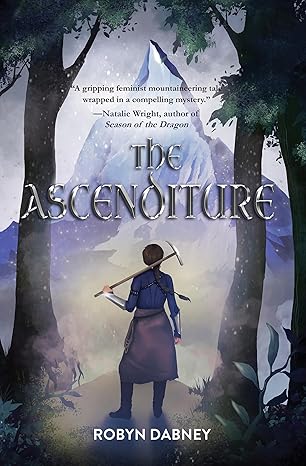
The Ascenditure is one of those books that grabs you and doesn’t let go. Set in a gritty, rain-soaked world where climbing mountains isn’t just sport—it’s survival—this story follows Klarke Ascher, a determined young woman fighting tooth and nail for a spot on the kingdom’s elite climbing team. But climbing, as it turns out, is the least of her battles. The real summit is freedom—from a system that sees women as nothing more than property, from a king who silences dissent with gallows, and from a future that promises marriage to a stranger if she fails. There’s rebellion, resilience, and a whole lot of heart.
I couldn’t put this one down. The writing is so visceral. From the opening chapter where Klarke scales a cliff in a soaking rainstorm—mud on her boots, blood on her fingers—you feel everything. “The only place I truly feel free is pressed against granite,” she says. The climb isn’t just physical; it’s symbolic, and Robyn Dabney writes those moments with so much tension and grace.
What hit me hardest, though, wasn’t just the injustice Klarke faces—it was how real it all felt. The sexism, the corruption, the constant need to prove herself twice as capable just to be considered. There’s this scene after she crushes the climbing trial, and yet she still gets passed over for a spot on the team. The moment Russet Kamber is named instead, you can feel her heartbreak, and it’s not just personal—it’s political. The city erupts in protest. People die. And Klarke doesn’t crumble. She runs straight into the chaos. That moment when the crowd starts chanting her name gave me chills.
Klarke’s relationship with Kiel is layered. When he proposes to her—not out of romance but out of desperation to keep her from being married off—you feel how trapped they both are. And when she tells him she’s going to flee to Kobo, where women are free, I wanted to jump into the book and help her pack. But then the city rises, the people rally behind her, and Klarke changes course—not to run, but to fight. That shift is powerful.
I’d recommend The Ascenditure to fans of The Hunger Games, The Handmaid’s Tale, or anything with strong feminist vibes and high-stakes rebellion. It’s perfect for readers who love flawed but fierce female leads, rich world-building, and stories that blend action with soul.
Pages: 358 | ASIN : B0CD9J6NNZ
History and Heritage

The Word of Y’Neshu: Heart of the Ijeya follows the journeys of J’Kana, a steadfast Kanawe, and his son Kamari as they navigate the complexities of familial bonds, spiritual trials, and ancient traditions. I think this original idea is intriguing. How did you come up with this idea and develop it into a story?
It all began with J’Karo. I spent 2023 researching a plethora of African cultures and languages to develop the concept of Y’Neshu, and even discovered my own Mandinka, Fulani, Kpelle, and Mende heritage in the process. From there, it was about creating a language using linguistic commonalities from across the African continent and building in historical occupations and concepts from tribes in my own heritage and others. I figured that the best way to accomplish the learning of the culture and the language was through a story all about a Master and Apprentice, so I wanted to tell the story in two parts. The Past, which shows J’Kana’s training under Kanawe Y’Sawe, and the Present, where we find that J’Kana is teaching his son Kamari about the history of their family (more on that later). I wanted to write something that could be appreciated by everyone, but also bring to light the beauty of African cultures that are oftentimes ignored in the stream of 21st-century literature. I also realized along the way that there are other people like me at the start, who were Black and wanting to reconnect with their heritage in a way that they previously couldn’t have. So this is as much a gift to the Black community as it is to those who just love a good fantasy.
I find the world you created in this novel brimming with possibilities. Where did the inspiration for the setting come from, and how did it change as you were writing?
Y’Neshu is actually a J’Karo word that means “Divine Crown,” and I pulled from a number of different geographical fixtures in the African continent. Deserts, plains, shorelines, grasslands, mountains, volcanoes, and forests that span the entirety of the continent were important so that it could truly feel as realistic as it was fantastic. As I went through the story, though, it forced me to think about the finer details and how Y’Neshu itself fits into the grander scheme of the War of the Ancients, the training of the ijeya, and the cultures that blossom all across the Four Empires.
What were some themes that were important for you to explore in this book?
Identity is a huge focus for this story. When J’Kana and his Father, Y’Sawe (Spoiler Alert but I guess not really) are first introduced in the Prelude, they’re nameless characters with a lot of personality. You see the love between a father and son, you feel the heartache when Shifi burns, and even though J’Kana turns into J’Foja on the streets of Memifi, something in him remains joyful and playful despite it all. The exploration of the Kanawe, the struggle over the J’Karo and Batabari languages, and the backstories of other characters like Nihani, Chishashi. and J’Chera all play into that theme of identity.
Through Mahute the Dagger and the Kanawe, there also comes a thematic focus on Education vs. Tradition that brings up the questions of 1) Should we accept tradition at the expense of heritage, 2) Is educating ourselves on our history and heritage worth it if it costs us who we have become, and finally, 3) Who can be trusted to teach the history of groups whose heritage has been denied them?
Is this the first book in the series? If so, when is the next book coming out, and what can your fans expect in the next story?
This is the first book in the series, and the second book is almost done! The next book continues J’Kana’s story, with more J’Karo lessons, more exploration of Y’Neshu, and a deeper connection to the ike overall! Also, it should be noted that J’Kana’s story is only one of the trilogies that I have planned in Y’Neshu! Every protagonist has already been revealed, so definitely stay tuned.
Author Links: GoodReads | Instagram | Threads | Facebook | Website | Amazon
Banewind

Banewind, by M.B. Chapman, is a captivating exploration of self-discovery and hidden legacies, following the journey of an ordinary individual who must confront extraordinary challenges to uncover her true potential. The protagonist, Genevieve DeWinter, is an 18-year-old high school senior whose life takes a dramatic turn when she discovers her connection to the Formulists, mystical beings tied to her ancestry. Set in the quiet town of Parma, Ohio, Genevieve’s world is upended as mages invade, revealing that she is a Holy Guardian, part of a lineage sworn to protect against dark forces. With the malevolent Voidweavers targeting her to resurrect their fallen leader, Genevieve must navigate a perilous path of adventure and hidden truths to prevent a new era of darkness.
One of the most striking elements of Banewind is its vivid imagery. Chapman’s masterful descriptions bring to life the enchanting world of Banewind and the ominous realms of the Voidweavers with stunning clarity. The settings, from the familiar streets of Parma to the mystical landscapes of the Formulists, are depicted in such rich detail that they draw the reader fully into Genevieve’s extraordinary journey. These descriptions not only stimulate the imagination but also evoke strong emotional responses, deepening the reader’s connection to the story and its underlying sense of wonder and danger.
Genevieve DeWinter, as the protagonist, is another standout aspect of this novel. Her character is compelling and relatable, offering a fresh take on the classic coming-of-age narrative. As an 18-year-old on the brink of adulthood, Genevieve is portrayed with depth and authenticity. Her evolution from an ordinary high school student to a central figure in an ancient magical conflict is both thrilling and poignant. The novel handles her inner conflicts, resilience, and growth with great sensitivity, making Genevieve a character readers can deeply connect with and root for throughout the story.
The combination of rich imagery and a well-crafted protagonist creates a dynamic and engaging reading experience. Chapman skillfully blends Genevieve’s personal evolution with the broader, fantastical elements of the plot, resulting in a story that is both thought-provoking and immersive. Through Genevieve’s eyes, readers embark on a journey of self-discovery and bravery, set against a backdrop of spellbinding adventure and looming darkness. Banewind is a mesmerizing tale that will captivate anyone who enjoys a blend of fantasy, adventure, and deep character development.
Pages: 270 | ASIN : B08MQTPMYF


