Blog Archives
The Scars of War

Trial of Roses follows a young man with a dream to learn magic and protect his homeland. To achieve his goals, he must overcome his enemies and personal demons. What inspired the setup of your story?
I was very much inspired by work such as My Hero Academia and you could say in general the genre of teenagers or young adults in a school type setting but with superpowers or magic involved. I have never done a story like this before so I thought it would be an interesting direction. On top of that I wanted to explore a few of the minor characters from the very first Pantheon book and this seemed like an excellent way to not only flesh them out but flesh out the entire Mystic Order as well. What started as just a short intro chapter turned into a whole little book to itself.
I find the world you created in this novel brimming with possibilities. Where did the inspiration for the setting come from, and how did it change as you were writing?
That is an excellent question! I was very much inspired by the works of young adult fantasy books. There are many that are very famous such as the Harry Potter series. The idea of a school for magic was a very entertaining and endlessly interesting idea to explore. However, I knew it would need to have a distinct flavor to it and so immediately I decided to give it a higher stakes sort of feeling where students can and will die. Moreover, it would be set in its own distinct world that was separate from what we call the “real world.” On top of that I wanted to tie in the culture of the Sebelian people themselves. What started as a very simple story about a young teenager learning how to cast spells turned into a much deeper story about fighting personal demons and even coming to terms with the toxicity of one’s own culture. I find that the protagonists in this story must deal with the sins of the past that have led to scars on their own psyches. Some of them rise above it while others are consumed by it. It is why the trilogy itself is called the Law of Might, a concept which was discussed in many Pantheon books but is really delved into here.
What were some themes that were important for you to explore in this book?
There are many themes in this book that I wanted to touch on. Many are expanded upon in the follow-up books to Trial of Roses. The number one focus for me was the power of culture in a society. It is something every civilization has, otherwise it would not be a civilization at all. I wanted to show that even though a few things in the book would be frowned upon in our society, maybe even seen as barbaric, for the Sebelian people such things are the expected norms. Even when culture is self destructive, it has a tendency to live on.
Another topic that lingers in the background of these young characters is the lasting scars of war. In this particular way I was inspired by All Quiet on the Western Front, a certified classic in the war genre. I was reminded of the opening scene I read back in high school. The German students are in the prime of their life as they exit the education system, and a sa crescendo to this stage of their lives, their teacher of all people sells war to them like one would sell a movie ticket to a potential customer. In a similar fashion, the young characters in this book are enraptured by the idea of serving their country just as their fathers, mothers, and siblings did in the past War for Sebelian Liberation. This need to honor sacrifice and live up to family names is what drives these characters forward and sometimes into disastrous consequences. Jingoism is a force that is still around to this day and permeates many societies, especially the American one. I found it very important to make sure this issue was looked at through many different lenses as the story progressed.
When will book 2 be available? Can you give us an idea of where that book will take readers?
Luckily I was able to release the entire Law of Might trilogy very close together! This was no easy feat as the story progressed and went from one short novella into a small trilogy that was more or less self-contained but still tied to the main Pantheon series. In the follow up story, Trial of the Lake, Sinhar will finally start learning how to work with magic and what it entails if he cannot keep up with the rest of his classmates. Just beneath the surface of all this, however, lies another battle. The Mystic Order has been around for generations and like any institution that has been around for that long it is riddled with its own secrets. Not only is there the threat of ostracization for those who do not fit within the mold of society, but there are also the secrets of those who now hold power and what they did to achieve it. The sequel will introduce new characters but will also explore ones who had minor roles in the main series and are more fleshed out here.
Author Links: GoodReads | Twitter | Facebook | Website
The Law of Might novella trilogy serves as a prequel to the Pantheon series but also stands entirely on its own. Fans of adventure, fantasy, and horror will rejoice. Check out the series that has readers enthralled and coming back for more:
Trial of Roses: A Dark Epic Fantasy Novella (Law of Might Book 1)
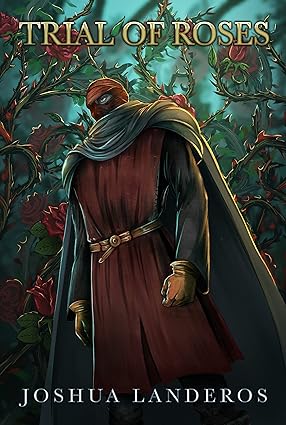

Trial of Roses, the inaugural installment in Joshua A. Landeros’s The Law of Might prequel trilogy, introduces readers to Sinhar, a young warrior with aspirations to join the Mystic Order. This pursuit is not just a personal ambition for Sinhar, who has been shaped by a lifetime under the specter of war, but also a commitment to safeguard his homeland. The narrative, which can be enjoyed independently or as a precursor to the Pantheon series, navigates the perilous trials Sinhar must endure, where the prospect of survival is uncertain.
Landeros masterfully creates a world brimming with magic and mystery, captivating the reader in a realm where every decision holds the weight of life and death. The novel skillfully draws one in with its initial chapters, setting a tone rich in promise and excitement. As the story unfolds, the focus shifts more towards advancing the overarching plot, a move that aligns with its role as a prequel. This narrative choice, while occasionally placing the characters in the backdrop, adds to the anticipation of how these characters will further develop and influence the world in the broader context of the series. The balance between character growth and plot progression is a delicate dance, and Trial of Roses intriguingly sets the stage for future explorations in this enchanting universe. This book is an engaging read, particularly for those seeking a fantasy novel that is both accessible and rich in story and lore. Landeros’s talent as a storyteller is evident, and there is a genuine intrigue to see how Sinhar’s journey evolves in subsequent books.
Trial of Roses is a captivating novel that is perfect for readers who love to explore the world of dark fantasy. Its intricate storyline and rich historical context make it a compelling read. The author, Landeros, has skillfully woven together a tale that is both imaginative and thought-provoking, leaving readers eagerly anticipating what he has in store for them in his future works.
Pages: 131 | ASIN : B09NZDQYYP

This Felt Personal

The Vision Prelude follows a young warrior who sets out to gain a different life than the one of war and strife he was raised in. What was the inspiration for the setup of your story?
This story was inspired by my obsession with the Vinland Saga. In that story, Thorfinn strives to find what his father called “Vinland”, a mystical and untouched land where there is no slavery or war. On top of that, he wants to get to these lands without using coercion, war, or duplicity. In much the same way, this is Sir Longavian’s mission when arriving on the shores of Sebel. Jingseh, the continent in the east, has been plagued with war since before he was born. It is the time of peace that the noble knight tries his best to go further out into the world than his father ever did. Pinus is also not a conqueror by any means. Even though he has his darker moments, at his core he strives to never trample upon the weak.
Pinus wants more than the world he grew up in and sets out to sea in hopes of finding a better life. What were some driving ideals behind your character’s development?
For me this felt personal. It’s the simple idea of expanding your worldview and experiences beyond what your parents did. I think many parents would agree the whole goal of their guidance is to ultimately give their children a better life and even greater opportunities than they had for themselves. Pinus was given that gift at a terrible price, and now he is trying to fulfill that dream one step at a time. The problems arise when he runs into obstacles like lack of funds, the wrath of mother nature, and of course the very people of Sebel themselves.
What were some themes that were important for you to explore in this book?
For one thing, I really wanted to explore Jingseh, the land of the Forest People. Their culture is an odd blend of nature-oriented mindfulness while at the same time focusing on European-style medieval caste systems. Pinus finds himself at the top of that system, and must accept both its gifts and its curses. At the same time, I also wanted to explore the horror of wars and close mindedness. As the Asum of Allusea said quite poignantly, when the elite of Jingseh weren’t fighting the Ankar people, they were fighting amongst themselves. Part of her reason to accept Pinus was an effort to not follow the isolationist mentality of her forebears.
Where does the next book in the series take the characters?
The next book, The Demon Seed, will be quite a ride for readers. A hundred cycles later, Pinus has not only established a thriving trade-based relationship with Sebel, but he’s also come to rear a family of his own. Despite the joy, there is smoke on the horizon. Old hates never die, and worse still, certain individuals from within and outside threaten to tear apart the amity between the world’s nations. Greed and war rear their ugly heads and Pinus must do everything in his power to stop it. The story will be available first on Kindle Vella before being released as a paperback and ebook in December of this year. Readers should prepare for a wild ride with any new characters, breathtaking new worlds, and exhilarating action!
Author Links: GoodReads | Twitter | Facebook | Website
This collected edition includes extras for readers, including:
Detailed maps of the world!
Character illustrations!
Multiple previews!
Destinies clash in the novella The Vision Prelude. Previously published as Law of Sacrilege [Episodes 1-10] on Kindle Vella.
The Vision Prelude
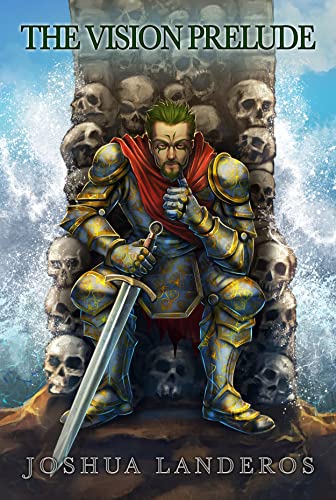
The Vision Prelude (Law of Sacrilege Book 1), by Joshua Landeros, is a fantasy story about Pinus Ave Longavian. He is a Jengsehi knight leading an expedition to open up trade with the people of Sebel. In the process, he’s taken back to his past.
I enjoyed how Joshua Landeros brought his world to life. It was easy to see what he was describing. He created a caste system and magic rules that felt real and natural. Neither one overwhelmed the story. In reading this, I got a remarkably good sense of the Jengsehi. I was able to see the island they lived on. The culture was rich. Religion wasn’t discussed much, but enough was there to get a good sense of it. While this was a religion that Landeros made for his world, I could see the real-world influence on it. And I liked how he didn’t just make it so that there wasn’t any conflict.
While there was a lot about the Jengsehi, there wasn’t much given about the Sebels. In a way, this is a good thing because they have been closed off from other cultures. They don’t trade with anyone. Pinus could change their minds but not necessarily in the way he intended. It got far more personal for him than he then he thought it would. I would’ve liked to have seen more from the Sebels to truly explain why they were closed off and why Pinus’s reaction to his father’s death was such a turning point for the Sebels.
The Vision Prelude (Law of Sacrilege Book 1), by Joshua Landeros, is a riveting and well-imagined world with characters that feel real. I enjoyed the book so much that I wanted it to be longer to fully bring the two cultures together. I look forward to seeing where the author takes this in future works.
Pages: 167 | ASIN : B0BN8RZKN3
For The Readers To Decide
In The Phantom a rebellion is revealed and the destinies of individuals will intersect when dreams and desperation collide. What was the one thing that motivated you the most to write this book?
That is a great question. For me, the driving force behind the book was the notion of empire and the cost it brings. As an avid history reader, I found myself drawn to battles and political inquisitions from both the recent and distant past. Moreover, I wanted to focus on a different type of war. The Harmonious Union, technically speaking, is not your traditional behemoth of an empire like say Rome, Britain, or Spain. It functions more like the United Nations with the Nameless Continent serving as a foundation for a brotherhood between the nations. In turn, the Expeditionary League functions as a multinational peace-keeping force. I drew inspiration from the modern day status of NATO which serves as a tight coalition between what many would see as the western powers. NATO originally served as a deterrent against the Soviet Union, a rival superpower during the Cold War. Even with its main adversary gone, however, NATO has not been dissolved. To the contrary, NATO has carried out offensive operations in the former Yugoslavia, several nations of the Middle East, and even took a crack at Africa during the Libya campaign. Many would argue these bombing campaigns were the only alternative to deal with tyrants and tottering nations, but there’s no doubt that the price of such campaigns has been extensive for stability and civilian life.
That was the duality I wanted to show with the Expeditionary League and their foes. Pantheon:The Phantom‘s central theme is that no adversarial nation appears in a vacuum. All actions have a historical precedent and an origin point, even if one doesn’t agree with the policies and aftermath of a rogue state, a band of terrorists, or the now lesser used term radicals. The Pact of Ram can be seen as any number of these historical groups. That to me would be for the readers to decide. Are they freedom fighters, or dangerous insurrectionists and anarchists?
There is a lot of fantastic action in this book. Was that intentional or incidental to the story you wanted to tell?
It actually developed naturally for me. I sat down and first decided the geographic layout of each theater of combat. A promontory over a foggy ocean, a ship out at sea, a forest not far from a beach, all of these things took time for me to visualize. Then I wondered how the characters would use that environment. Unlike my previous science fiction works, magic was a factor so I also decided to make full use of that. I wanted to give each nation a unique use of their mages’ abilities, and for me it was a whole lot of fun that way. The Daijo bend water, ice, and fog to their will while Yunians rely more on alchemy and even music itself. The lone Ilean soldier portrayed uses a much more aggressive style than all the rest and walks a fine line between black magic and what’s legally sanctioned. I hope to explore more of these characters in the future.
Do you define your character’s motivations before writing or are they revealed to you as you write?
As a writer, I am admittedly slower because I like to build thorough skeletons of my chapters and characters. Thanks to the power of Google Docs, I can line up my chapters from start to finish and examine if the order is logical or substance is needed. Even so, I also discover much about the characters as I write. This process of “putting meat on the bones” leads to development of character personality quirks, underlying motivations, and sometimes even backstory reveals. A soldier is never just a soldier any more than a king is just a king. I try to keep that in mind when I write.
What can readers expect in book three in the Pantheon – Genesis Arc?
Oh boy! This is a book I can wait for readers to experience! I actually wanted to release it in 2022, but a slew of ideas and expanded storylines led to me pushing it back. The next book will be released in August of 2023 and will be called Pantheon: The Contact. As I’ve spent more and more time in the world of the Pantheon series, I’ve found myself developing the history of the world, its culture, and of course its dark secrets. Many of these dark secrets will come to light in the third book.In a similar vein to the Malazan Book of the Fallen Series, each book will now focus on a different set of characters though many characters will crossover between stories of course. Pantheon volume 1 introduced primarily Atty Sowell and Yaphet Orinse while the Phantom focused on Atty, her father Palkan Sowell, and the Pact of Ram warriors. Pantheon: The Contact will follow Yaphet as he discovers a massive conspiracy that has rotted the integrity of the Sebelian south. Hot on the trail of these dark secrets is the huntress Dahan who will discover her own sordid history. All the while, Palkan Sowell continues his hunt for the Pact of Ram. What he discovers, however, is no less than a monstrosity that threatens to consume the entire world of Avah. An ancient terror will emerge from the shadows and drag the nations into chaos. An ancient terror for centuries known only as The Wanderer. This is a character who has briefly appeared in the first two books but also in the Law of Might trilogy. The Wanderer’s backstory will be explored in the Law of Sacrilege books.
There’s much more to come in the Pantheon Universe!
Author Links: GoodReads | Twitter | Facebook | Website
In the eastern sea, a bounty hunter prepares for another job. The pay is good and the gig seems easy enough. Yubira hails from the desert continent in the west and has seen much of the world. Wars and the grueling trials of the underworld are what she’s used to. With her partner by her side, nothing seems impossible. That is until the day she runs into an old acquaintance from her past. Their encounter will change her life forever.
The destinies of these individuals will soon intersect. Dreams and desperation will collide. Fans of adventure, fantasy, and horror will rejoice with the Pantheon series. The epic saga continues with Pantheon: The Phantom.
Pantheon: The Phantom
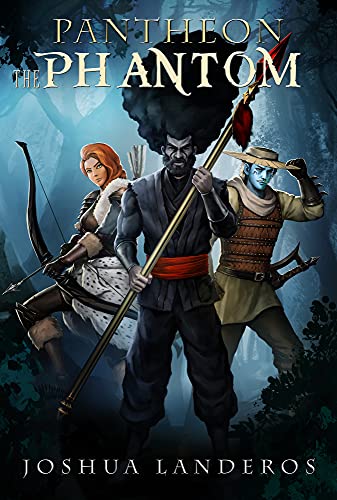
Pantheon: The Phantom is Joshua Landeros’s second book in the Pantheon series. It is a sweeping fantasy epic that manages to carry on the first book’s story while expanding its world and bringing in enjoyable new characters.
The book is set in Landeros’s world of Avah and follows its people as they come to terms with the events of the first book and struggle to recover from the Hollow Wars. Just as people were hoping things were calming down, a new threat, the Pact of Ram has, arisen. As this new threat rises every allied nation is called to combat it. But who is really behind this new threat, and who can be trusted?
While this may be a conflict that spans nations, Landeros makes the wise choice of focusing his narrative on the everyday people dragged into it. The Phantom primarily focuses on Palkan Sowell, his daughter Athaliah and the rest of their people as they are pulled into a conflict they want nothing to do with.
The book features a diverse range of characters, and Landeros excels at fleshing them out. As in his earlier works, Landeros focuses on characters from all sides of the conflict, emphasizing their motivations, whether political, religious or purely self-preserving. While at first, the lines between good and evil seem clear cut, over time, it becomes increasingly clear that not everyone can be trusted, and even the heroes might have to get their hands dirty.
This is still a sweeping epic, however. When Landeros isn’t focusing on his individual characters, he is writing massive battles that often follow several different perspectives at once. While his writing is excellent across the board, Landeros’s writing is at its best when he is in the thick of battle. His battles are bloody, violent, and well-paced.
The pacing, in general, is excellent. Landeros deftly manages the balancing act of fleshing out the world he has created, forming deep characters, and keeping the pacing brisk. While his characters are enjoyable enough that I would have liked to spend more time with them, Landeros makes the wise choice to keep the plot moving ever onward.
The world-building is excellent here. Landeros has created his own world and filled it with different nations, races, and peoples, all with their own in-depth histories. Thankfully Landeros avoids too much exposition, and the reader gets to learn about his world in an organic way rather than being bogged down in lengthy explanations and exposition. If you’re a fan of fantasy epics, exciting battle scenes, or political intrigue, The Phantom is the book for you. While it might be a good idea to start with the first book if you want to follow everything, as a newbie Landeros made me feel welcome and I was never too lost. Highly recommended.
Pages: 313 | ASIN : B096L6QJT9
A Violent And Often Unpredictable World
Pantheon follows a farm girl and an orphan boy whose fates are intertwined as they set out on separate adventures a continent apart. What was the inspiration for the setup to your story?
My inspiration came from a few different places. A lot of my inspiration came from The Old Kingdom Series by Garth Nix, The Vinland Saga by Makoto Yukimura, and in large part the Monstress graphic novel series by Marjorie M. Liu. Garth Nix has a talent for deep dives with characters who live in worlds quite distinct from our own. Magic is both a source of power but also something toxic to the human body if handled incorrectly. Life and death share the same importance to the story which I wanted to impart in my series as well.
Vinland Saga takes a youthful character and plunges him into a violent and often unpredictable world filled with schemers and the power hungry. There’s a great emphasis on the duality of men in the many chapters and that was something I definitely wanted to focus on in my story. Loss of innocence is there too and since my characters were going to be young, their teens and early twenties respectively, I wanted them to go through a similar journey.
Monstress does a stellar job at worldbuilding. Quite frankly I find it jaw dropping. The technology, the extensive history, even the multiple factions vying for power, it all comes together beautifully. That masterful level of storytelling was a goal of mine the entire time.
Athaliah and Yaphet both have life-altering experiences on this journey. What were some driving ideals behind your character’s development?
Going back to Vinland Saga, I wanted there to be an emphasis on the loss of innocence. In Atty’s case, she starts out as a close-minded hunter and farmer but slowly is drawn to the life of a soldier. Not only that, but she begins to see the world isn’t so black and white. Some of her naivete comes from being so young, but a lot of it also comes from her parents’ decision to hide the world from her.
In Yaphet’s case, I wanted to have an Attack on Titan-style reveal of a conspiracy and a disastrous lie. Yaphet seeks acceptance and knowledge, but these very things lure him closer and closer to a very dark truth that threatens to shatter the world he knew. The truth is a hard thing to accept. For some it’s impossible, and that is the nature of Yaphet’s journey during the story. For Yaphet, his hardest trial will be self acceptance and forging his own path.
What were some themes that were important for you to explore in this book?
I tried to focus on a few different ones. Over time, I developed them and I hope to continue to do so in future Pantheon entries. For me one of the most important was discrimination. Discrimination is a heavy part of human history no matter what continent you’re on, and even in the modern era it’s still a touchy subject. I wanted to make sure this was an integral part of Pantheon whether it be the hate between the Jingsehi and the Sebelians or even the hatred that Yaphet and Atty experience from their own people.
Just as important was the use of violence and fear to mold minds. Everyone has heard the theme of “people fear what they don’t understand.” In the world of Pantheon, not only is this still very much true, but in the unknown realms, there actually is great evil. The only thing is the characters often misinterpret where the danger truly stems from. Even though I’m building a fantasy world, I still wanted those connections to the world we all live in. As an avid history reader, there was a lot for me to draw on.
What is the next book that you are working on and when will it be available?
Great question! I actually have a lot going on. Recently I have been experimenting with Kindle Vella and releasing episodic stories. So far I have launched two, Law of Sacrilege and Pantheon: Genesis. Pantheon: Genesis is actually a continuation of Pantheon (Pantheon #1) and Pantheon: The Phantom (Pantheon #2). It mainly follows Yaphet’s storyline and later will be published as Pantheon: The Contact, the third book in the series. Law of Sacrilege season one will be the next book in the series and will be published as The Vision Prelude on December 7! This story is a prequel that takes place a hundred years before the events of Pantheon and actually explores the world of the Jingseh and beyond. Curious readers can get all the latest news on my website and social media!
Author Links: GoodReads | Twitter | Facebook | Website
Pantheon
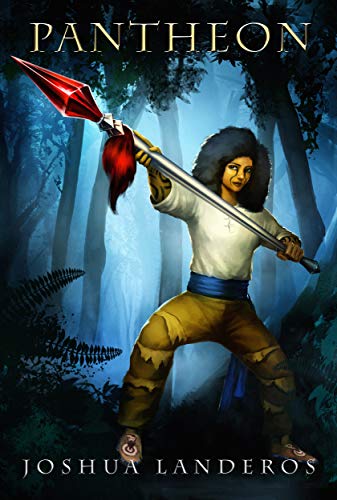
Pantheon is the first of a two-part novel by Joshua Landeros. It takes place in the world of Avah, which has known peace for a generation after the devastating Hollow Wars. However, when a chieftain of the Midland Plains on the continent of Sebel tracks down bandits who’d raided his village’s crops, he finds hints of a conspiracy and a heretical cult that are plotting to overturn the peaceful world order. The story is told through the eyes of the chieftain’s daughter Athalia as she travels around Sebel and through Yaphet Orinse, an orphan raised by the venerable Asum of Giganato Shrine, who has seen disturbing visions of war.
Among Pantheon’s highlights is Landeros’ impressive world-building. He gives us enough information about Avah and Sebel that it feels like a real place without overwhelming the reader with a deluge of unneeded history and geography. He’s especially good at letting the reader know that there’s more to the world than what we see – for instance, Yaphet is close to the Asum of Giganato but not a member of the inner circle of the shrine the Asum leads, meaning that he and the reader have an almost but not quite insiders’ view of this part of the story.
The plot moves at a moderate pace. Much of the novel is spent accompanying Athalia on her travels and Yaphet in his training. These chapters make the reader invested in these characters’ lives. Still, Landeros regularly gives us a glimpse of the larger story, so no chapter is wasted space, and the reader always feels like he’s progressing. Landeros’ prose is serviceable; there are no Shakespearean turns of phrase, but it’s never awkward or unclear, either, and he excels at describing the action. However, readers should be aware that the novel does end on a cliffhanger, so those wanting the complete story will need to continue to the second novel.
Pantheon is a captivating dark fantasy novel that immerses the reader into a new world without feeling overwhelmed. The exciting adventure that the two protagonists undertake will give readers a feeling of horror as they encounter strange and dangerous beasts, and at times there is a sense of the more significant danger brewing under the surface as the delicate balance of peace is being disrupted.
Pages: 268 | ASIN : B088SY6PF4



 LITERARY TITAN