Blog Archives
Honest Actions Always Win
The Fox’s Tower follows a cunning and sneaky fox who wants to build the tallest building in the city at any cost. What was the inspiration for your story?
The Fox’s Tower is the third book in my Fox Series, and the next three are already well underway. The whole series is inspired by people throughout society who promote their individual interests and power. The main character, Francis the Fox, is an archetype who sees the community as his playing field and is ready to use any means to reach for power, position, and wealth.
This third part of the Fox Series emphasizes the theme of competition. When the desire to beat everyone else and stand out from the crowd grows to extreme proportions, the result can even be a disaster. At worst, the dishonest pursuit of financial gains can lead to severe social phenomena, such as bribery and circumventing the rules—even at the expense of safety, as in my Fox story.
Construction can sometimes become a means of exercising power and showing off. We witness exaggerated constructions around us, where maximum attention value is often sought in addition to financial profits. Sometimes, massive structures—bridges, monuments, palaces—also proclaim the strength and importance of their builders. Even today, some want to leave behind their pyramids.
What were some educational aspects that were important for you to include in this children’s book?
Making children realize that selfish and inconsiderate behavior has consequences is essential. Although everything may seem to be going well initially, the victory may be short-lived. I want to emphasize that honest action always wins in the end. Although this does not instantly seem true in real life, justice will eventually prevail. The profit it gives can be more than money and power. The victory of justice can enhance humanity, cooperation, and a balanced, harmonious life.
The persistent planning and goal-oriented actions of Francis the Fox with his projects could be seen as an educational element in this book. We could admire his enterprise and consistency to a certain extent as long as we simultaneously realize the skewed morals involved. As I write about Francis, I often think how much good could be achieved if the fox’s enormous potential and enthusiasm were directed toward a decent course. With the right attitude, such a person could be helpful to others. But, sadly, Francis is just looking for his rewards.
Along with the adventure elements, I also want to highlight the importance of following the rules agreed upon in society. Here, building regulations serve as such an example. At least when it comes to a well-functioning and developed society, the established procedures also have reasonable justifications and aim to improve overall functionality and citizen’s safety. Unfortunately, we often hear news about how inadequate obeying and controlling building regulations has led to loss of life. For example, many drastic consequences of natural disasters could have been avoided with responsible foresight. Human lives are a high price for the builders’ neglect and greed and the authorities’ incompetence!
What were the morals you were trying to capture while creating your characters?
When I write a story, the characters belonging to it are also found somewhere in my subconscious. I feel like they’re in my mind, and I don’t have to create them. Persons, or at least some of them, represent some counterforce to others. That’s how human relationships are in real life, after all. A certain amount of confrontation and challenging each other is part of life. Even in a fairy tale, it is possible to present complex moral considerations through such compositions.
My characters usually have different sides, but especially in the Fox Series, the two main characters are rather black-and-white as personalities and influencers. Finding much good in Francis the Fox is difficult, as his actions are usually utterly self-centered.
On the other hand, the old and experienced mayor, William the Wolf, represents honesty and reliable management of societal issues. In addition to all the good features, he is incredibly patient. From book to book, time after time, he gives his young protégé Francis yet another chance to get his life back on track. But I can reveal to you that the fox’s dubious behavior in the future parts of the series exceeds all the acceptable limits. Mayor Wolf realizes that he can no longer control the young fox. All that remains is exposing his tricks, providing fair punishment, and minimizing the damage.
Several other characters with morally different action models exist between these two opposite extremes. Some are weak but kind. Others may be weak and succumb to temptations to gain fame and money or fulfill their dreams in the wake of a fox.
It is exciting to transfer the complex relationships and power games of real life into the world of a fairy tale. This way, it is possible for children to notice the injustices around them early on and learn to fight for good.
Will Francis the Fox have another chance at making one of his big dreams come true?
The Fox’s Tower is the third book in the series. Until now, each book describes a new attempt by a young fox rogue to get something that doesn’t belong to him. At least the means he uses are questionable time and time again. The fourth part of the series has already been illustrated, and the texts for the next two are ready, so I know what will happen to him very well.
I can assure you that Francis the Fox has enough dreams! They relate to the media world, leadership positions in society and elections, and financial interest in waste management and research. As you see, he has plenty of activities where he can dream, try, and fail again.
Even if the fox’s evil plans fail repeatedly, he doesn’t understand any wrongdoing in his actions. That is his fate, and he learns nothing from his previous mistakes this way. He imagines that he is aiming for something great and good, but in reality, it is quite different: he commits crimes for his benefit, and punishment follows his failure. This is pretty sad. — I hope that by reading about the life of a crooked fox, children will learn to set better goals for themselves in the future.
Author Links: Facebook | Website
How long will his money and building materials last? Could the tallest tower in the city collapse, along with Francis’s dreams?
Crookedness, Dishonesty, and Betrayal
The Fox’s Palace follows a fox that tricks his friends in order to get the land he wants to build his dream amusement park, he learns a hard lesson however when his tricks are discovered. What was the inspiration for your story?
Francis the Fox is the main character of one of my book series. Through his actions and adventures, I have revealed many forms of crookedness, dishonesty, and betrayal. My goal is to increase children’s understanding of society and help them see the motives of different actors. This is an essential skill as an adult!
I write social satire for children. I want to bring out the dark sides of human relationships, business life, and society that also occur in real life. But I want to do it lightly enough and use a lot of humor so it works for children and teaches an understandable lesson on the right and decent ways of doing things.
What is one thing that people point out after reading your book that surprises you?
One exciting feature regarding the Francis the Fox Series and people’s reactions is the readers’ opinions about the endings of the books. Let me explain.
Some readers are hoping for the worst possible ending for this “wretched hero.” They would like to avenge the fox’s evil deeds even more severely than I have done in the story. Some would like to make the evil hero entirely out of business and incapacitated for the rest of his life.
I have to explain to them that, unfortunately, I believe that the swindlers will continue to misbehave even in the future. Very few become completely clean and continue as perfectly decent citizens. My fox has such a mind that he does not stop pursuing his personal interests. He is very persistent and always continues to come up with new projects.
Another group of readers is those who enjoy the fox’s tricks and the fact that he always continues with new ideas in the next book. They see in the fox some human imperfections that can be hidden in all of us. We just value honesty more and control our selfish needs better.
I understand both of these opinions. I have an almost contradictory attitude towards this fox. First, I always let him try and go his own way, and then I make him fail in his actions, and some punishment follows. I don’t believe my villain, Francis, will ever become kind and honest, so there is still plenty to write about in the Fox Series.
Is there any moral or idea that you hope readers take away from the story?
“The Fox’s Palace” focuses on Francis’s dishonest actions and their consequences – as the entire Fox Series does. This time, the central conflict exists between the fox’s selfish goals and the townspeople’s common beach.
I want to draw attention to how cunning means the most power-hungry individuals are ready to use to achieve their goals. We must learn to recognize such characters in our immediate circle and at different levels of society. Otherwise, we cannot defend ourselves against dishonest activity and exploitation.
The story also has some side themes that I want to draw the reader’s attention to. I’ll pick a few here.
Building a false image of both events and himself is Francis’s specialty. He is good at recognizing the weaknesses of others and knows how to motivate his partners by feeding arguments, half-truths, and enticement accordingly. He does not hesitate to use even those closest to him – family or friends. It’s cruel how even his own mother is the target of his lies and manipulation.
Even though I feel significant irritation towards the actions of the fox I created, he also arouses pity in me. This poor thing has no one to be honest with. He has to be constantly careful that the web of lies and pretenses is not revealed.
I’m afraid Francis the Fox always tends to pursue things that will never make him happy. This is an essential message to my readers, too.
When thinking about some of your other books, Francis the Fox is drastically different than Colin the Crab in their personalities and approaches to life. Is it hard to get your mindset in the right place with so many diverse characters and personalities to write for, do you ever find characters from different series overlapping when trying to write?
What an interesting question! One of the attractions of writing children’s books is the possibility to vary different topics and approaches from one book and series to another. Also, the fact that some of the books are aimed at very young readers and some already contain more demanding subjects gives the author a lot of opportunities.
My way of writing is like diving into different realities in my fantasy.
I have different imaginary worlds ready for my different books. If I want, I can enter that world with my chosen characters at any given time. It’s all authentic to me. This also applies to the characters I created. They become real acquaintances for me, with their personalities and “existence.”
When my characters are “born,” their life cycle develops most naturally and almost self-directed forward. Some characters become so strong and close to me that they start demanding something and making suggestions as the story progresses.
They sometimes want to bring up more than I was going to say or take a more significant role, and I have to give in and trust their opinion. Each of my fairy tale characters has a unique personality and even a strong will. So, they don’t get confused in any way, at least not more than I would confuse people I know in real life.
Author Links: Facebook | Website
I Write the Difficult Children’s Stories
The Owl and the Shepherd Boy follows a young boy who is left to care for the family’s goats up on a mountain when a storm destroys their home. He must now find a way down the mountain alone. What was the inspiration for your story?
My Survival Stories Series, including The Owl and the Shepherd Boy, were written in response to the devastating 2015 earthquake that struck Nepal. This tragic event brought immense challenges for the nation, resulting in emotional and material losses. The rebuilding and repairing efforts continued for years.
By writing my survival stories, I aimed to provide hope and inspiration to readers facing these difficult circumstances – or better understand and help those who struggle.
Various shepherd topics are close to my heart because I still remember many childhood experiences my father told me about. It’s not easy for a little boy to be responsible for guarding the neighbor’s cattle in the pasture all alone.
I also like to write about the power of nature and how it constantly surprises us. Often it’s about pleasant surprises, but sometimes the destructive forces of nature make us feel small and helpless.
In every situation, people should understand their place as a part of nature and not as its master. The surrounding environment deserves all our respect and care. We should learn this from childhood.
What were some goals you set for yourself as a writer in this book?
I want to answer this question by describing the experience mainly from the point of view of writing stories on complex topics.
I also write about things many avoid in children’s books – such as poverty, fears, illness, and social crises. I consider it important that I can describe children’s experiences of how it feels to live in the middle of these situations.
As a writer, it would certainly be easier for me to avoid such demanding topics, but I think they are perhaps the most important ones. Writing about them requires the courage to stand beside the children and support them – at least with words – even when it is the most difficult.
In these more problematic stories, depending on the case, I also use various fantasy elements. They can help us to look at the situation a little “above” the everyday perspective. The main thing is that the result is understandable and comforting for the child. When the book cover closes, the readers should be left with the feeling that they have survived together with the main character.
What were some educational aspects that were important for you to include in this children’s book?
By telling the story of this shepherd boy, I wanted to emphasize the power of natural forces, which I already referred to earlier.
Another essential theme in this book is related to social differences between countries and regions. The young protagonist lives in a culture where children’s responsibility for work is more significant than in countries where livelihoods are more secure. In such an environment, children must take responsibility early on, often much too early. They carry tasks that are heavy, scary, or otherwise oversized.
Of course, there are various kinds of societies in which to live. For those children whose lives include safe schooling, play, and adequate food, it is good to realize that not everyone is equally lucky. Understanding this makes them more sympathetic toward others and increases their desire to support and help.
Also, I wanted to encourage children with this story. When they read about the difficulties and fears of the shepherd boy, they realize that it is possible to survive even in such a situation. It is important not to stop trying – which is pretty universal and encouraging advice.
What story are you currently in the middle of writing?
For the past few weeks, I have been writing two unique stories connected to India. They were “donated” to me by a friend, originally from India, who shared some of his own experiences with lots of human wisdom. Writing such stories has been a challenging and gratifying task.
Of course, the most important thing is to do justice to the actual events in the background of the books. I try to pass on the materials I receive from events, people, the environment, and culture. I’m melting these elements into my story version.
When the original ingredients and foreshadows of stories are light and fun, it’s easier to write without fear of hurting anyone’s feelings. But the events I heard also have such characteristics that they raise deep emotions in my mind as a writer, even sadness.
I want to emphasize that these two stories are products of the imagination detached from their models, but I still feel responsible. I also try to write the stories to fit a believable cultural and geographical setting.
I believe this credibility requires that I, as the author, have my own background knowledge and check the details, too. What bread are people buying at the market in the place in my mind? Which fruit trees can bloom in the garden? When is the rainy season, and how long is it? Finding suitable names is particularly interesting, as they have their cultural meanings. I hope I hit the right ones!
Overall, I took some time to ponder how to deliver my friend’s experiences and the wisdom in them to the little ones, too. – But as a children’s author, you always find a way.
Author Links: Facebook | Website
In the darkness of night, Nicky spots a big owl. Can the mysterious creature help Nicky find his way home?
Lily’s Wondrous World: A Day in the Park


In Lily’s Wondrous World: A Day in the Park, Marc Polett crafts a narrative that celebrates the joys of childhood and the splendor of nature. On a delightful summer day, young Lily embarks on an outdoor adventure, encountering new friends and discovering the enchantment of the world around her. This narrative offers readers a glimpse into Lily’s magical experiences and the wonders of everyday adventures.
The book distinguishes itself with its gentle, rhyming prose that transports readers to a vibrant world where friendship and the beauty of nature reign supreme. The illustrations are particularly noteworthy, radiating warmth and an appreciation for life’s simple pleasures. Each page is a testament to the joy of childhood, reminiscent of national parks and the untamed beauty of the outdoors. These visuals complement the narrative and evoke a sense of nostalgia and a deep connection to the natural world. The portrayal of animals in the story adds a layer of charm, emphasizing the value of stepping away from the mundane and embracing the outdoors. The narrative effectively communicates the significance of friendship and the therapeutic qualities of nature, making it a compelling read for both children and adults. It serves as a gentle reminder of the importance of disconnecting from our busy lives and finding solace in the tranquility of nature.
Lily’s Wondrous World: A Day in the Park is an ode to the simple joys that life offers. The story’s seamless blend of visual artistry and lyrical storytelling makes it a delightful read for individuals of all ages. For those who cherish the companionship of animals, the allure of friendship, and the beauty of the great outdoors, this book is a heartwarming journey back to the essence of joy. As readers turn each page, they’ll find themselves immersed in a narrative that celebrates the wonder of living and the timeless appeal of nature’s embrace.
Pages: 57 | ASIN : B0CP38355P

Pippin’s Space Adventure (A Poodle Called Pippin)
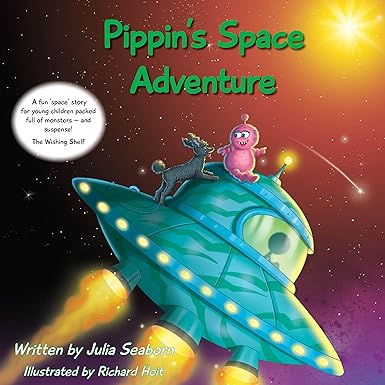
Pippin’s Space Adventure by Julia Seaborn is a delightful tale that whisks young readers on an imaginative journey through the cosmos. The story follows the curious Pippin, a poodle with a passion for stargazing, and his friend Blossom the Possum. Each night, Pippin dreams of traversing the universe, leading to a dream sequence where he finds himself aboard a spaceship, accompanied by Jelly, a friendly monster who turns out to be Pippin’s own stuffed toy.
Seaborn’s narrative is both captivating and educational, striking a balance between whimsy and learning. The adventure is filled with close encounters, like skillfully navigating through asteroid fields, which keeps the pace lively and engaging. This book’s charm is further enhanced by its vibrant illustrations that vividly bring the story to life, reminiscent of watching a cartoon. A unique aspect of this book is its educational content. Lessons about space, including the solar system, planets, and shooting stars, are seemingly woven into the narrative. This informative approach makes Pippin’s Space Adventure a delightful read and a valuable educational resource suitable for classroom settings. The book concludes with a thoughtful addition – a section aimed at testing the readers’ comprehension. This, along with a bonus coloring page, invites young readers to interact with the story beyond just reading, enhancing their engagement and understanding.
Julia Seaborn’s Pippin’s Space Adventure is a charming, imaginative, and informative read that will captivate and educate young minds, making it a worthy addition to any child’s bookshelf or classroom library.
Pages: 33 | ASIN : B0CNST69WL
Hope, Faith, and the Power of Love
Stella and the Magic Stone follows a young girl visiting her grandfather who wants to find a magic stone to help him heal after an accident. What was the inspiration for your story?
Stella and the Magic Stone is primarily inspired by my childhood. Stella’s world is familiar to me in many ways. When you have had the opportunity to live in a scenic village in the Finnish lake district, it touches you for the rest of your life.
In the Stella books, I wanted to describe the safe experience that Finnish children have traditionally been able to experience in their environment. The possibility to move around alone and make your own decisions is perhaps more comprehensive than in many other countries or cultures. I understand that not all of Stella’s activities are suitable elsewhere, so she is not meant as a role model. I just tell readers about Stella’s life and environment as it might be inspirational.
Various experiences related to nature have always been important to me and have also inspired this book. There is summer with thunder, berry-picking, and playing in the middle of the forest – everyday activities for most Finnish children.
Another inspiration for this book comes from the relationships between children and grandparents. I think they can play a significant role in each other’s lives. That’s why I wanted to focus on an extraordinary period of the accident and its effects on the girl and her grandfather.
Was there anything from your own life that you put into the characters in your story?
Stella and the Magic Stone is an important book for me, with many personal experiences behind the story.
As mentioned earlier, Stella’s activities and the surroundings of the events have a solid connection to my own childhood.
I must also admit that the book’s main character carries two versions of myself with her. The first one is the independent little girl riding the little red bike in the home village and the roads around it, and the other one is the adult worried about her seriously ill father.
I was surprised by the power with which the story, my childhood memories, and my worries as an adult intertwined in this fairy tale. In writing the story, I went back to my childhood activities with my father – even though he turned into the main character’s grandfather in the fairy tale.
The situation related to the creation of this book, where I finished the manuscript and put the last point at the end of the text, was a special moment in another sense as well. At that particular second, in real life, I received a call from a doctor from the hospital where my father had just survived a major operation and was transferred to the recovery room.
Is there any moral or idea that you hope readers take away from the story?
A child’s relationship with nature and trust in its power is a central theme in this book, although the main theme is the deep connection between the girl and her grandfather.
When my book came out, some adults pointed out that miracles seem to play a significant role in the story. I think that’s precisely what fairy tales are often about – miracles that lift our experiences above everyday life and encourage us to trust ourselves even when we face difficulties.
For me, the miracles of the fairy tale represent hope and faith in the extraordinary power of love. I like to bring in nature experiences because, at least for me, nature has often offered help in many ways in difficulties. It can sometimes provide a refuge or a friend and support. The magical details nature offers – like the magic stone the girl found in this book – can become a symbol of life forces and give us faith in survival.
However, the most important message of this book is that affection and love between two people – the girl and her grandfather – are patient. From that, the girl in the story gets the strength to visit her unconscious grandfather’s hospital bed again and again.
Even in a fairy tale, I don’t want to claim that the stone healed the grandfather. But I want to show how important it was that Grandpa could feel and sense the girl’s visits on some level. It certainly helped him to regain consciousness and recover.
Where does the next book in the Stella stories go, and what adventures will she have?
I have already written two other books about Stella – Stella and the Berry Bay and Stella and Her Spiky Friend. And more stories about this active girl’s adventures are ready in my head!
In the second one, Stella and the Berry Bay, her life takes a surprising turn when the family moves to another town. Moving away from their old home takes place in a difficult moment because Stella has imagined going to a familiar school with her friends. Now everything has changed: a new home, a new school, and new friends. But together, we can get through this, too!
In the third book, Stella and Her Spiky Friend, the girl meets interesting people in a new environment. In addition to her hedgehog friend, she gets to know the strange pharmacist whom the other children are afraid of.
My Stella books continue along the same line of encouraging children. In these stories, children have much freedom to act independently in a safe environment. I also describe cooperation between different people and people of different ages.
In real life, I learned a lot about this kind of interaction in my childhood. Seeing how different people could cooperate and work together was useful for my upbringing. The community also included those whose actions could not be accepted or who harmed others. Mostly, though, problems were solved together. Small towns and country villages are good teachers!
Author Links: Facebook | Website
No one is quite sure how to help Grandpa until Stella gets a wonderful idea. She will go back to the quarry and locate a magic stone!
Challenging Situations are Valuable Lessons
Do You See Me when We Travel follows a small child who is unsure about new experiences as their family travels to a new city, the parents help the child see new things are not bad. What was the inspiration for the setup to your story?
I think family vacations have always been the best! Many surprisingly small things can influence their success. I have tested my methods in our close circle for decades – and dare to recommend them to others. They guarantee everyone good experiences and happy memories of shared moments.
In my time, I had three children in the same car, plane, ship cabin, hotel, or foreign city. Our family traveled every year to many destinations together. We learned to reconcile different wishes and take care of the needs of travelers of different ages.
I already have two grandchildren, with whom we have also been abroad – my dream is to introduce them to interesting places in the same way I did to their parents when they were children.
What was the most interesting place you ever visited?
This is a difficult question because there have been many unique travel destinations. Our best travel experiences with the family often involve historically significant places or cities. My favorite cities are probably Istanbul, Rome, and the old inland towns of Spain – especially Toledo, Seville, and Granada. The great mountain areas in the Alps and the northern parts of Spain will also remain in my mind forever.
Perhaps my most cherished memory is connected to Toledo and its magnificent Catedral Primada Santa María. My older children could already read, and they had noticed the big streetside ad about the extensive church art exhibition in that incredible building. To my surprise, they suggested that we go there. “You would like to, though, wouldn’t you, Mom?”
Our visit to the Toledo Cathedral lasted hours because the extensive exhibition covered probably twenty different rooms. Even our youngest, just a toddler, was excited about various artwork and didn’t rush away. I remember how my children found a statue that they wanted me to see among the objects. In that special work of art, Baby Jesus tickled Mother Mary under the chin and made her laugh! The message was clear to me, too. A parent and a child need to be close and have fun together – even on trips!
I also want to praise historic hotels – like Paradors all over Spain – which are often incredible buildings full of stories that I have been able to tell my children. That way, traveling gets a deeper dimension. Of course, everything we have done and discussed has been adjusted to suit the children’s age.
What book changed your life or greatly influenced you?
As a child and teenager, I read a lot. The interest changed from children’s to non-fiction books and novels for adults early on. As a memorable book experience, I have cherished Mika Waltari’s ”Sinuhe”, whose narrative and historical background made a great impression on me. Later, I read more of Waltari’s historical novels, but my first experience with ”Sinuhe” remained invincible.
It is important to me that the background of the book is authentic and that the author has both knowledge and the ability to tell the story impressively by using quality language. I am a fan of reflective books. I want to get deep into the thinking of the main characters and try to understand their choices in life.
Waltari’s epic novels are full of incredible events and fantastic adventures, but I think the main thing in them is the main character’s inner life.
Different twists and turns are interesting in children’s books, but I like to write books with small and ordinary events, too. They are just a frame for the personal development and thinking of the main characters.
Will there be more “Do You See Me” books?
My “Do You See Me Series” already has three books. The other two are “Do you see me at home?” and “Do you see me in nature?”
I have already written also the fourth manuscript, where we are in the world of sports activities. Adults and children may look at it from very different perspectives. There will be challenging stunts, noise, rush, and pressure to perform – sometimes even unpleasant surprises.
The “Do You See Me?” Series is quite exceptional among the children’s books I have written. I wanted to make a series where the point of view of a small child would be the absolute focus. I have written these books in a new way, all based on a pure conversation between an adult and a child. The lines have different colors depending on the speaker.
The topics of the “Do You See Me?” books are very familiar to most families with children. Challenging situations where help and understanding are needed can be found both at home and in the nearby environment – or further away as we travel. The adult must have time to listen and consider the concerns and wishes of a small child. It often helps if adults try to remember their own experiences as children. After all, we all carry our childhood experiences still with us.
I have received excellent feedback on the parental and educational aspects of these ”Do You See Me?” books. Many adults have said that the conversations are very realistic, and they recognize the situations of the stories in their family life. Readers have also liked my Mongolian illustrator Majigsuren Enkhbat’s vision, where a small child is often surrounded by new or overwhelming things – and the little ones are often literally presented surrounded by the feet of adults.
I want to give all my experience of everyday family life, travels, and celebrations with children to the use of others. I believe there is a great need for books like these as they can help everybody. The families will develop mutual understanding by reading the books together.
Everyone benefits if challenging situations are resolved in a good spirit. Being and doing things together is valuable!
Author Links: Facebook | Website
When your family takes a trip, it may feel too long; the food may taste strange; and the unfamiliar people may seem scary. A quick visit to the playground, a little taste of food served in a fun way, or a word game on a road trip may be just the thing you need. Luckily, when staying the night in a strange place, you can move your rollaway bed closer to your parents.
Have a wonderful trip, everyone!
A Small Tooth is a Big Change For Kids
Terrific Teeth educates young readers about losing teeth and shows them how to handle it. What is the biggest fear kids have about losing teeth?
The fear of losing baby teeth has many surprising connections. It’s partly a physiological condition as new and unexpected changes happen to your body. Something that you just partially control yourself. Children may also fear that the process might be painful.
But there is some mental pain, too. The period when children’s baby teeth start to fall out is an extraordinary stage in their development. It is a turning point when a small child suddenly grows up to meet new challenges. Children can also be worried that a new kind of witch’s smile greets them in the mirror! And who knows when new teeth will grow to fill the gaps – if ever!
That’s why approaching school age, in particular, often increases the children’s pressure and worries about whether they will learn everything they need in time before school starts. Losing teeth and getting them out one by one is a new task children must face simultaneously with many other matters. They may try to be as competent as possible but still feel small and need assistance and support.
What are some key factors parents should keep in mind when helping their kids deal with losing teeth?
It’s essential to remember that the period of children losing teeth is more significant than you would expect. To deal with it wisely, we’ll better consider all the challenges connected to that particular turning point in children’s lives.
The adults begin to talk to their offspring about starting school. The child might get the first proper bike and practice the route to the schoolyard. Besides that, there a many more new skills to learn at the latest, before school – such as reading, swimming, and dressing all by yourself. A familiar life at home is scaling outward to the unknown.
In rapid changes and constantly facing new things, it is essential that the children feel safe all the time. Adults provide their best support by devoting enough time and patience and taking the little one’s concerns seriously. Don’t rush – removing tiny teeth from a small mouth is a necessary process that lasts several years. Let’s be happy with our child about this new phase as well.
Regarding this matter, too, it is good to remember that things look different when we look at them through the eyes of a child. This is especially true of all fears. What seems like a small thing to an adult may worry a child for weeks.
What is the biggest challenge you had as a parent around dental health?
I’m a mother of three children. Fortunately – based on my personal childhood experiences – I was well aware of the possible dental challenges they might face with their teeth. It has helped me approach my children’s upbringing with patient compassion also in this respect.
Each of my children had a unique approach to this teeth-losing period. One was very scared, and taking the tooth away was a multi-day operation for the whole family. The other was a quiet loner who just needed a little encouragement and, finally, some ice cream treats. Somebody needed some praising after proudly presenting the loose teeth between tiny fingertips.
My father helped me get some of my first baby teeth out. He took me to buy ice cream to celebrate our joint success. It left me with a pleasant memory that I have sometimes applied to my children. It has been nice to celebrate the lost tooth somehow together. With my youngest child, we sometimes had to consult the dentist, and after each visit, we went to the bookshop to buy a book, some paperware, or pencils. Soon he was almost waiting for those visits.
What is the next book that you are working on and when will it be available?
I have many roles in our small publishing company, Wickwick Ltd, and I work with stories along the production chain. That’s why I’m also now involved in the various stages of the books that we publish. There is writing, working with translators, editors, and illustrators.
I have just written many new manuscripts, as spring and summer are fruitful seasons for me. Stories pile up, and they will be published next year. I think the five stories I have written linked to important songs in my life will be fascinating. And I trust they’ll inspire the illustrators, too. Besides, I’m writing manuscripts for two great stories with very specific backgrounds. A family friend living on the other side of the world has “donated” me his unique experiences and suggested that I turn them into children’s books. And I will do it. However, it takes some time before these stories can be published with beautiful illustrations. I hope they will be ready for my readers sometime next year.
Fortunately, there are also books ready for publishing already this autumn. It calms my impatient mind! I’ll give you some examples. Friends and Rivals tells a story of power-hungry prince brothers. The illustration is made by the Croatian Iva Dukić. This is our first book together, and I’m delighted with the result. The book’s insightful pictures convey moods from the brothers’ carefree days as children as well as from the dark years of fighting for power.
Also coming soon is The Bird Prison – a fairy tale set in a beautiful garden with surprising limitations. The book has lovely hand-drawn watercolor illustrations by the Ukrainian Sofia Panchyshyn. A perfect garden turns out to be a difficult place to live for birds of different colors, each chirping their unique song. The stiff gardener, Griselda, is definitely not a fan of birds. I have witnessed with joy how my story has been transferred to paper in Sofia’s skillful hands. I expected wonderful pictures because I’ve seen some of her work before. But the illustration of this book exceeds all my expectations. I’m sure it will get a lot of admirers!
Author Links: Facebook | Website
“Terrific Teeth” is a book about losing baby teeth.
Is Emma about to start losing her baby teeth? What if they won’t come out–will horrible crocodile teeth grow inside her mouth, as her brother says? Luckily, Dad has some ideas in mind to help her.
Help! Emma’s first baby tooth is loose. “I want to keep this tooth. It’s just fine!” Emma insists.
But Emma’s brother is scaring her, telling her those horrible crocodile teeth will grow inside her mouth if she keeps all her baby teeth. Luckily, Dad has some ideas to help, and in the end, she gets to have a tooth party.


