Blog Archives
Mixed-Genre Stories

Aftermath: Into the Unknown follows a woman in a post-apocalyptic world whose home is in danger from a biker gang that has invaded the city and must now make an 800-mile trip with a man she just met to get to safety. What was the inspiration for the setup of your story?
The story’s inspiration came from the first book of the series, The Edge of Life: Love and Survival During the Apocalypse, and my book, The Wish.
When I was writing The Edge of Life (Two acquaintances’ road trip from Seattle to South Dakota in the wake of an asteroid impact with Earth) I didn’t want to kill the characters of The Wish. Instead, they meet my Edge characters on the way to the bunker city in South Dakota. To make the timing work, since one group traveled by car and the other by bike and on foot, I created a delay for the car group mentioned in a line or two of conversation. They stopped in Idaho for a few days to convince someone’s father to join them. He refused because he was waiting for his granddaughters to cross the mountains from the coast.
Aftermath picks up three years later with the grandfather and one of the granddaughters. The biker who accompanies her on the journey seems to be Robin’s opposite, but in the post-apocalyptic world they inhabit, as survivors, they are more similar than different. I liked the idea of opposites being so much the same.
Your characters are interesting and unique, drawing readers into their lives. What things do you find interesting about the human condition that makes for great fiction?
Honestly, I borrow bits and pieces from people I know, add aspects of myself, and include something new to make characters. For example, my husband and I both love music (he’s the inspiration for an audiophile) even if our range of tastes are not the same, they overlap. My daughters are Swifties, as are millions of others and someone Robin’s age could have been one too. Reading is also something people could have in common, even if their tastes are very different. Having hobbies and interests makes characters relatable for readers because they feel more real.
Most people just want to be understood and not be alone.
You flawlessly blend Post-Apocalyptic/Dystopian and Romance in this book. It takes exceptional talent to do this and make the story stand out. How did you go about blending the two genres without disrupting the story?
Thank you. I appreciate that you thought I did this well. I didn’t think about blending the genres so much as, that WAS the story. From the beginning, I envisioned Aftermath as a love story in a post-apocalyptic setting. Each book in this series will be a stand-alone, apocalypse, or post-apocalypse romance. They will connect because I love to have my books linked, but each will feature a new couple who will fall in love while trying to survive in their harsh new world.
All of my books are mixed-genre stories, perhaps because I’ve been an avid reader of so many genres for my whole life.
I hope the series continues in other books. If so, where will the story take readers?
The series will most definitely continue. There is a conflict coming between the Slains and those in Vita Xterra. I’ve written a short story called “Rat Girl,” a prequel for the third book in the series that will be posted on my website later this fall. The third book is in the planning stage and will include the Rat Girl, a man from the bunker complex, and the secondary characters include several from Edge and Aftermath. There will also be a Nick and Jake story (minor but important characters from Edge). Dozens of readers have reached out asking what happened to them when the asteroid hit, which got things swirling in my mind. They need their own book.
I may also write a book about some of the missing family members mentioned in both published books in the series. There could also be other stories, including one set in Canada.
I’m hoping to release one book in this series and one other book every year, though I have two different books written and being published in 2025. I’d love to see Love and Survival 3 published in 2026.
Author Links: GoodReads | Website | Amazon
Robin dreamed of attending Yale and using her brain. Kory lived on the streets of Seattle and relied on his brawn. Without the asteroid, they never would have met.
For three years, Robin and her grandfather have been hiding, trusting no one. When a biker gang moves into town, Robin can no longer scrounge or tend her garden. Because her grandfather is dying, he urges her to join her extended family—800 miles away in a bunker city in South Dakota, but she doesn’t want to leave.
Desperate, her grandfather disappears to force Robin into action and meets Kory, who’s with the bikers but disillusioned. Seeing a man who likes to read and could protect his granddaughter, he convinces Kory he can start over and accompany Robin on the long journey.
Unaware of her grandfather’s plan, Robin exposes her hiding place searching for him, and Kory saves her. On the run, they battle the elements and survivalists, learning to trust each other. If they can’t reach the safety of Vita xTerra, they won’t survive long enough to have a future together.
Prepare for another non-stop, post-apocalyptic road trip in Aftermath: Into the Unknown as they fight for love and survival.
Survival and the Will to Live
The Edge of Life follows two individuals fleeing Seattle who manage to find love once more as they navigate the myriad of dangers accompanying an asteroid that threatens Earth. Where did the idea for this novel come from?
The main idea came from reading online about Vivos xPoint in South Dakota. It’s a decommissioned military base with underground bunkers that they sell as “cabins.” During the early days of the pandemic, they sold like hotcakes. I thought they looked interesting and read more on their website about how the location was intentional, too far from an important city to be a target of a nuclear attack, away from the tectonic activity of the Ring of Fire, and beyond the Yellowstone blast zone. It was somewhere safe.
This made me decide that a global catastrophe would send my characters on a cross-country road trip as society crumbled around them.
What was your approach to writing the interactions between your characters?
I wanted it to be believable that in the face of danger, Kat and Ryan could find the good in themselves, each other, and the world, despite the chaos. I wanted to include simple moments that were sweet and intimate, so they could get to know one another and be vulnerable.
What were some themes that were important for you to explore in this book?
Friendship
Acceptance
Survival and the will to live
Beauty
Courage
Love
What is the next book you are working on, and when will it be available?
I am doing the final line edits for the sequel to The Edge of Life: Love and Survival During the Apocalypse, called Aftermath: Into the Unknown. It takes place three years after the first story and is another road trip to Vita xTerra (my fictional bunker based on the real one). The FMC is looking for her uncle who was a minor character in the first book. It will be published December 19th, 2024.
The third book in the series (Love and Survival #3) is in the planning stage and will take place a few years after Aftermath and is set in the bunker city. The characters in the first two books will be featured, though they will not be the main focus.
I have two additional books being published in 2025, the third and final installment in my Train Hoppers series for April and an all-new sports romance, Racing Towards Destiny (series name: Love on Track) about a woman who abandons her old life, moves to Europe, and takes a job working with professional motorcycle racers on the MotoGP circuit.
Author Links: GoodReads | X (Twitter) | Facebook | Website | Amazon
Warned that a planet-killing asteroid is on a collision course with Earth, acquaintances Kat and Ryan join forces in an effort to survive. Mere hours before impact, they race toward the safety of Ryan’s inherited South Dakota bunker, encountering chaos. A last-ditch effort to nuke the asteroid only manages to fragment it into chunks causing multiple strikes.
Earthquakes, fire, and volcanic ashfall assail Kat and Ryan, who turn to each other for solace. Kat finds someone kind who values her differences and Ryan finds himself falling for Kat’s pluck and quick-thinking. Though jaded, they learn to trust and rely on one another.
Attempting to survive the onslaught of their new world, Kat and Ryan must reach the bunker before imminent food shortages and catastrophic climate change cause society to further unravel.
The Edge of Life shows that survival can include falling in love. With steamy romance and non-stop action, this is one thrilling apocalypse road trip you shouldn’t miss.
The Edge of Life: Love and Survival During the Apocalypse


The Edge of Life, by Lena Gibson, masterfully intertwines romance and survival as it follows Kat and Ryan, two individuals hardened by past relationships, who find love amidst the apocalypse. With a planet-killing asteroid hurtling toward Earth, they flee from Seattle to a bunker in South Dakota, navigating through earthquakes, fire, and volcanic ashfall. As society disintegrates around them, they encounter both allies and adversaries, making their journey as perilous as it is profound.
From the outset, the narrative kept me intrigued, uncertain of its direction, which is a testament to Gibson’s storytelling prowess. Nick, Kat, and Ryan’s mutual friend play an instrumental role in their initial connection. The evolving dynamics between Kat and Ryan captivated me as they transformed into characters driven by a renewed will to live despite the chaos surrounding them.
The sudden emergence of romance and intimacy between Kat and Ryan added an exciting twist to the story, enhancing the overall narrative without overshadowing it. While the story rightly centers on Kat and Ryan, Nick’s fate and his partner’s story sparked my curiosity, adding an extra layer of intrigue. This element did not detract from the core narrative, which remained focused and engaging throughout. The author’s writing style is accessible and immersive, allowing readers to delve deeply into the characters’ thoughts and feelings without ambiguity. Gibson excels in creating obstacles that compel her characters to confront their fears and emotions, ensuring their journey is anything but easy. This depth added a layer of realism and kept me invested in their survival.
The Edge of Life is a compelling read that combines the thrill of apocalyptic survival with a touching romance. Lena Gibson’s ability to balance action with emotional growth makes this novel a must-read for fans of both genres.
Pages: 301 | ASIN : B0BR44SF6G

A War for Resources
The Long Haul follows a woman trying to stop a domineering corporation that is controlling essential resources such as food and water from the population. I think this original idea is intriguing. How did you come up with this idea and develop it into a story?
The worries about resources, including necessities like food and water aren’t new. As the population continues to increase, there will be more pressure to control food and water. Some of the mega-corporations that already exist could become like GreenCorps if the world/country was faced with the collapse of civilization and a war for resources. One of the stories I often read to my fifth-grade class is Among the Hidden by Margaret Peterson Haddix. The society in that book was changed by famines caused by the climate crisis and a government that took advantage of that fear to restrict people and access to food. At some point, I also read an article about the real-life seed vaults that exist to protect the genetic diversity of plant species…these ideas must have connected in my mind.
Were you able to relate to your characters while writing them?
As I write characters, I get to know them and relate to them more as the story goes on. As I relate to them more, I go backward and add details to hopefully flesh them out as individuals. As I write, the characters speak in my mind and hopefully, I do them justice on the pages.
I felt that there were a lot of great twists and turns throughout the novel. Did you plan this before writing the novel, or did the twists develop organically writing?
I make a bare-bones plan or outline before I write, but I change a lot as the story progresses. For example, I didn’t plan Mason being in love with Caitlyn. Learning that about him changed a lot of the story from the point of its discovery. Much of the plot development comes as I write and the characters become more real to me. While I write forward, I also write backward as inspiration strikes. I am constantly moving in both directions in my manuscript.
Can you tell us where the book goes and where we’ll see the characters in the next book?
The characters have not finished their fight and will return to GreenCorps-controlled lands in the third book in the trilogy, Rebels and Saints: Catching Freedom, which will be published on April 19th, 2025 by Black Rose Writing.
I am also in the planning stages for a potential spin-off story about Tatsuda and Ginger and what the future holds for them in the new world they help to create.
Author Links: GoodReads | Twitter | Facebook | Website | Amazon
Elsa has the key to the Doomsday seed bunkers and taking it north to Canada is the only way to ensure its safety.
The rebels send help, but her group is betrayed before their departure. Fleeing in the night, Elsa and her friends disappear into the mountains, only one step ahead of GtreenCorps soldiers.
In Denver, Ginger, the sheltered daughter of the GreenCorps leader, hops a train, escaping her lonely existence imprisoned in her father’s mansion. Encountering hardship and devastating thirst, Ginger experiences the disparity between the starving, oppressed populace, and her life of privilege.
Rescued by Elsa’s group, she vows to help break the corporation’s stranglehold.
As the GreenCorps henchmen close in, the race with the key becomes desperate. If caught, Elsa and her found family face life imprisonment, or worse, execution –their one chance to change their world, lost forever.
Continue the journey from Switching Tracks, a thrilling dystopian train-hopping adventure.
The Long Haul: Pursuit of Hope
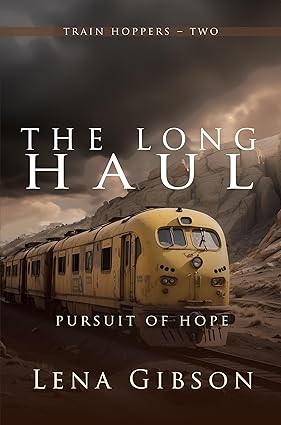
In The Long Haul, the second installment of Lena Gibson’s Train Hoppers series, readers are transported into a gripping post-apocalyptic narrative set in the remnants of the United States. The story centers around Elsa, a pivotal character in the fight against GreenCorps, a domineering corporation controlling essential resources like food and water. Elsa’s mission to distribute hidden seeds and supplies marks her as a beacon of hope amidst corporate tyranny, a journey that commences with her recovery from a near-death encounter with a high-ranking GreenCorps official.
Gibson masterfully crafts a tale of suspense and rebellion, encapsulating a world where the key to liberation lies in Elsa’s hands. The narrative unfolds with a bounty on Elsa’s head, escalating tensions as GreenCorps relentlessly pursues her. The addition of a surprising ally to her team of rebels and friends injects further complexity and danger into their mission, enhancing the story’s sense of urgency and peril.
Set against a dystopian backdrop, The Long Haul is more than an adventure; it’s a reflection on the control of basic necessities and the struggle for freedom. Gibson’s writing style is fluid and immersive, drawing readers into a world vividly painted with descriptive prowess. The pacing of the story mimics a seamless, high-speed journey, allowing readers to lose themselves in the unfolding drama without interruption. Gibson displays a keen ability to balance overarching themes with intricate details, maintaining a narrative focus while indulging readers with thoughtfully crafted scenes. Her characters are not merely players in the story; they are intricately layered individuals, each distinct and memorable in their own right, contributing to the novel’s rich tapestry.
Lena Gibson’s The Long Haul is a remarkable addition to the post-apocalyptic fiction genre. With its immersive storytelling, engaging characters, and expertly crafted plot, this novel is a must-read for anyone looking for a captivating and thought-provoking read.
Pages: 352 | ASIN : B0CSF1FYHT
Grit and Perseverance

Switching Tracks: Out of the Trash follows a starving young woman who discovers maps to secret seed bunkers that, if found, would take power away from the corporatocracy and give people a fighting chance at survival. What was the inspiration for the setup of your story?
The inspiration of the story came from thinking about all the trash today. Many things aren’t made to last and few things are repaired. Things are thrown out and replaced. The second piece of inspiration was about the train itself. My grandfather rode the rails during the Great Depression. His family lost their farm in Kansas and loaded up their car, Grapes of Wrath style, and moved to Utah to live with cousins. He was a young man and couldn’t stand living on charity and being reminded of it constantly. He and one of his brothers hopped a train to California, looking for work so they could send money home. He made the trip several times, back and forth, including one harrowing ride over the Sierra Nevadas trip in freezing weather with one jacket and two young men. His stories stuck with me.
Elsa just wants to survive, until she discovers the maps to the seed bunkers; now, she sees a chance to change things not just for herself but all of humanity. What were some driving ideals behind your character’s development?
Her character development is meant to be like most of us. Most people are just ordinary and trying to get by until they are thrust into a position to do more.
The seed bunkers exist. I didn’t make them up. They are there to hedge our bets against a disaster and crop failure, especially if we lose genetic diversity for our seeds and crops as is the trend. If we ever need these seeds, I hope they would be available to everyone, not just the richest corporations.
What were some themes that were important for you to explore in this book?
It’s a story of grit and perseverance, as well as loyalty, altruism, love, and found family.
Is this the first book in the series? If so, when is the next book coming out and what can your fans expect in the next story?
Yes, this is the first book of three (they are all written and in various stages with my publisher). The series is called Train Hoppers. The second book, The Long Haul: Pursuit of Hope will be published June 6th, 2024 and the final book, Rebels and Saints: Catching Freedom is scheduled for publication April 24th, 2025.
In The Long Haul: Pursuit of Hope, the main characters have been recuperating on a farm in Utah but are found by GreenCorps and have to leave. One step ahead of their pursuers, they head for Canada to make contact with someone with resources to help distribute the bunker seeds. They are joined by two new characters, a pampered daughter of the GreenCorps elite and a long-time rebel.
Author Links: GoodReads | Twitter | Facebook | Website
Elsa scavenges twenty-first-century trash, living on the edge of starvation in this ruthless world through her grit and instincts.
When she unearths a metal tube containing maps to six Doomsday seed bunkers and a silver key, she dreams of renewable sources of food and a life based on more than subsistence, but GreenCorps will stop at nothing to acquire her find. Accused of theft and beaten half to death, she escapes with a handsome train hopper. They seek the long-lost bunkers, hoping to break GreenCorps’ monopoly on food.
Along the way, they receive help from a teenage pickpocket, a solitary widow, and a rebel leader. If this rag-tag group of lonely misfits cannot reclaim the tube and find a way to distribute the seeds, GreenCorps will continue to choke out any chance of a better life.
Hop aboard this thrilling dystopian train-hopping adventure with Switching Tracks.
Switching Tracks: Out of the Trash
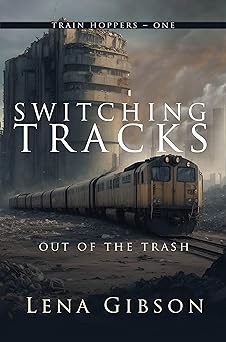
In Switching Tracks: Out of the Trash, the first installment of Lena Gibson’s Train Hoppers series, readers are transported to a dystopian 2195 America. Here, young Elsa navigates a post-apocalyptic landscape where the remnants of a bygone era have become the currency for the impoverished. Amidst the desolation, Elsa’s routine scavenging in Southern California takes an unexpected turn when she uncovers a mysterious tube, setting off a chain of events that intertwine hope and peril.
Gibson’s narrative is set against a backdrop where GreenCorps, a domineering corporation, controls essential resources, creating a stark divide between the powerful and the powerless. This tube discovery presents a glimmer of hope for breaking the corporation’s stranglehold, yet it also makes Elsa the target of a relentless GreenCorps soldier with a personal vendetta.
The novel deftly explores themes of corporate tyranny, environmental degradation, and the human spirit’s resilience. Gibson’s skillful world-building paints a vivid picture of a society in decay, yet her characters’ experiences inject a palpable sense of humanity into the story. Her descriptive prowess is evident, rendering the squalor and emotional intensity of the narrative with remarkable clarity. The characters are meticulously crafted, with Gibson highlighting their defining traits, making them not only relatable but deeply engaging. The novel also excels in developing its supporting cast, each embarking on distinct journeys that add layers to the story and build anticipation for their roles in the unfolding drama. An element of romance weaves through the narrative, adding depth and complexity to the story. The novel also includes include explicit scenes, presented with the same rich detail and narrative care that defines Gibson’s style, adding another layer of depth to the story.
Switching Tracks: Out of the Trash is a compelling read that captures the essence of a dystopian reality while highlighting the enduring qualities of heroism and resilience. Gibson’s narrative is a poignant reminder of the human capacity to seek change in the face of overwhelming odds.
Pages: 364 | ASIN : B0CM4ZMDZC

Facing Your Fears
The Wish follows a woman in an abusive marriage who has not spoken in two years and who travels back in time to try and change her future. What was the inspiration for the setup of your story?
My mother was abused when I was a child. I was helpless to do anything about it, and it is something I have been working through. Also, I’ve often struggled to speak, though not to the same extent as Elizabeth. I have become one of the more experienced teachers on my staff and I often feel an obligation to speak up on important issues, even when it is difficult and may cause conflict.
When I was twelve, I changed schools and couldn’t speak to my classmates for two months. It wasn’t deliberate, I just couldn’t talk. As a teacher and mother, I have also witnessed selective mutism. Recently, I taught a boy who did not speak to adults, though he was in my class for two years. Sometimes he whispered to a trusted friend who would pass along his words or he would write to me on Post-it notes. Instead of writing half a page to a page for his journal each week, he would write volumes. There was so much he wanted to share and couldn’t, and that stuck with me.
Elizabeth gets a second chance to change her path in life; she just has to find the strength to do it. What were some driving ideals behind your character’s development?
Most people have a few regrets in their lives, things they wish they’d done differently. One of the things Elizabeth discovered is that she is still herself, no matter where or when she is. When she traveled back in time, she took her problems with her. To reclaim her voice (literally) and find happiness, she needed to overcome her fears. No magic could fix her, she had to confront her problems rather than avoid them. She needed to find an important enough reason to speak, and saving someone she loved was the right incentive.
What were some themes that were important for you to explore in this book?
I wrote about identity, second chances, facing your fears, speaking up, working through problems instead of avoiding them, love, and accepting differences. Elizabeth didn’t feel connected to anyone at the beginning of the story and was adrift. Through the story, she learns to forgive, to speak up, and to connect with others, especially Christopher, with whom she falls in love.
It was also important to me that Elizabeth represent the legions of women and girls who mask their neurodivergence and struggle to connect. In this way, it was an own voices story. I didn’t realize I was on the spectrum until I was in my late forties and learning this about myself has allowed me to apply a different lens to my life. I coped with this for most of my life without knowing that was why I felt different. It was lonely and exhausting.
What is the next book that you are working on, and when will it be available?
I have just finished writing the draft of Rebels and Saints: Catching Freedom, the third and final book in my Train Hoppers series. The first two books in the series (Switching Tracks: Out of the Trash and The Long Haul: Pursuit of Hope) will be published in February and June 2024. The third book should be available in the spring or summer of 2025. I have also started a second time travel novel as a follow-up to The Wish.
Author Links: GoodReads | Twitter | Facebook | Website
Haunted by her choices, including marrying an abusive con man, thirty-five-year-old Elizabeth has been unable to speak for two years. She is further devastated when she learns an old boyfriend has died. Nothing in her life is right.
That night, Elizabeth wishes for a mulligan. When she wakes, to her surprise, it is no longer 2022, but 2017. Though thrilled to have a chance to fix mistakes, the past is not perfect. She has a stalker and is still voiceless. Just like before, her boyfriend slips into a mysterious coma, so she enlists his brother Christopher’s aid to determine the cause. In their investigation, he becomes her staunchest ally and her unexpected soulmate.
Elizabeth’s stalker threatens her happiness, as do those who wish secrets to remain buried. If she can’t reclaim her voice, her former boyfriend will fade away in a coma and her stalker may claim her life.
Don’t miss The Wish, which mixes the mundane with a hint of magic-a romantic and thrilling ride for anyone who imagines they could transform regret into their best decision.


