Blog Archives
Go Home a Winner

Mathematical Strategies to Winning Short-Term Play Video Poker explores how probability, strategic card selection, and mathematical analysis can help video poker players make decisions and understand their chances during short casino sessions. What inspired you to focus on sessions lasting one to eight hours?
Casinos offer a large variety of games and entertainment options to the players. For the guests who do not wish to stay seated behind the same machine for extended hours, they can select another machine, a different variation of the machine, an entirely different game of chance, watch a show or sports event available at the casino, or even take a break and recollect themself. If a player does not feel the machine is paying at the expected averages for the play duration, he may just be having a “streak of bad luck” and wish to try another machine or an entirely different game.
In my opinion, you should go to the casino to have a good time, enter tournaments, and try your luck at the many different types of games. Sure, to go home a winner is always a plus, but if you don’t and exercise proper money management, you should still have a great experience at the casino.
When analyzing which cards to hold or discard, what surprising mathematical discoveries challenged conventional video poker strategies or your own initial assumptions?
I wanted to do all of the math myself and derive a strategy for the best draw opportunities in each hand. For example, if your initial hand is a Pair, should you draw 1, 2, or 3 cards to form the best hand? Every choice is analyzed from a mathematical perspective, and a suggested play strategy is offered. This strategy may comply with or disagree with conventional wisdom, but is offered from an unbiased mathematical perspective. Also, new opportunities for improving a “junk hand” on the draw are analyzed. Finally, a thorough discussion is presented which allows players to create a drawing strategy of their own and test its effectiveness.
How do differences in pay tables and bonus structures among the six video poker variations influence your recommendations for short-term players?
I suggest that machines that have the highest payouts for the middle-third of the hands (Straight, Flush, and Full House) should be sought to offer the highest returns for the players. The top three hands (Four-of-a-Kind, Straight Flush, and Royal Flush) offer much higher payouts, but are less likely (but not definitely) to appear in a short play session. Bonus payouts are generally considered a very good benefit and can increase your rate of return on the game.
How do you reconcile the mathematical advantages of optimal play with the unpredictability of short-term outcomes, especially when advising readers about bankroll management?
I would consider mathematically derived best play strategies with a touch of luck, as being the best strategy in video poker, even on those machines with a poor pay table. All of the examples worked are done with playing only one bet per play, which should help proper money management for the short-term player, since it is statistically unlikely that he will hit a winning Royal Flush. However, a Royal Flush can, in reality, hit at any time, making you regret that you did not play the full coins. But gambling is all about taking chances and winning and losing streaks. May luck be on your side!
Author Links: GoodReads | Facebook | Amazon
Mathematical Strategies to Winning Short-Term Play Video Poker
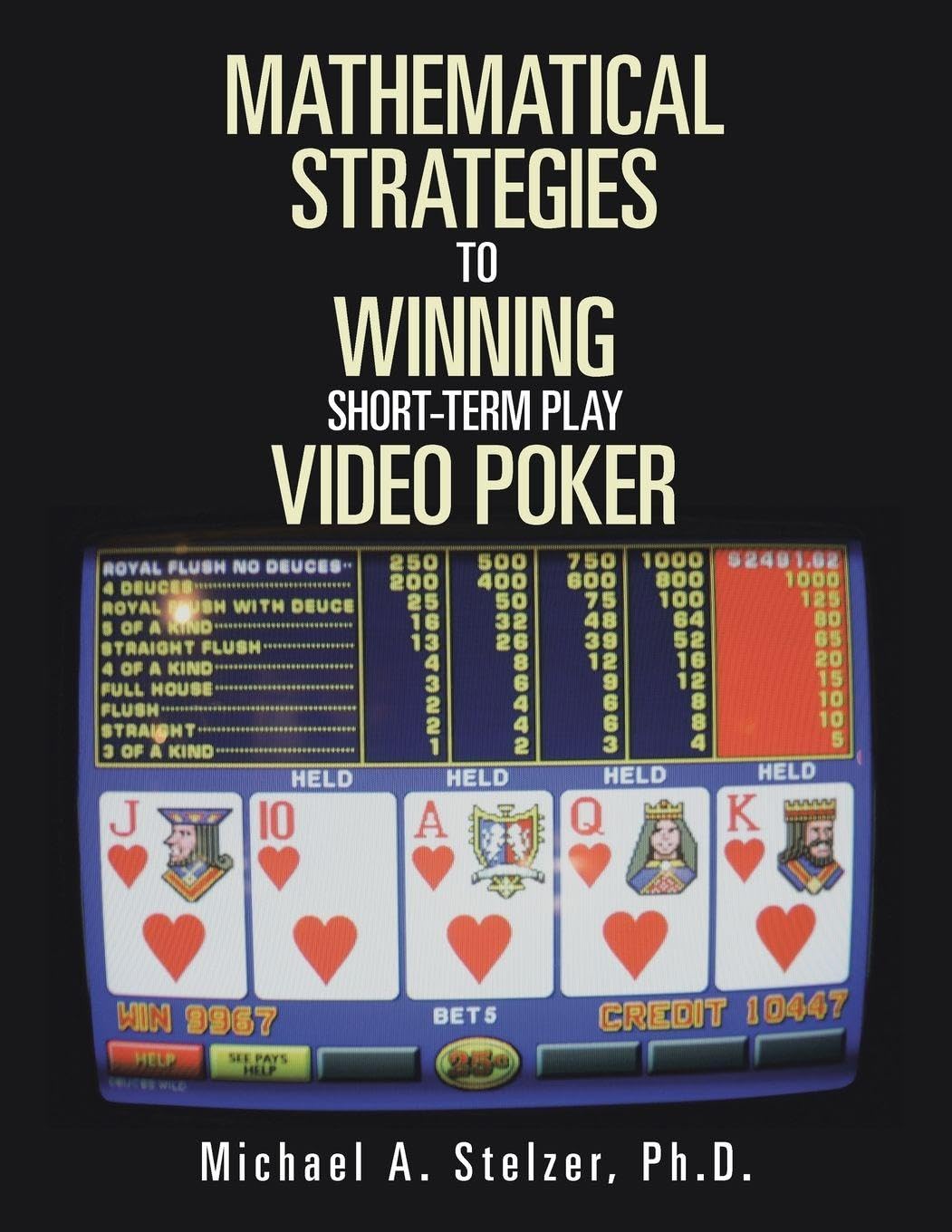

Michael Stelzer’s Mathematical Strategies to Winning Short-Term Play Video Poker takes a fascinating look at the mathematics behind one of the casino’s most popular games. With an emphasis on playing sessions lasting between one and eight hours, Stelzer explores how probability, strategy, and thoughtful decision-making can influence a player’s experience. His approach combines mathematical analysis with practical advice, giving readers a deeper understanding of what happens every time they press the deal button. The book begins with a brief history of gambling and poker before introducing the mathematical principles that drive the game. Stelzer explains combinations, probabilities, and the likelihood of receiving particular hands in a way that establishes a foundation for the more detailed discussions that follow. His enthusiasm for the subject comes through clearly, especially in his determination to turn complicated calculations into information that players can put to use.
The heart of the book examines the decisions players face after receiving their initial five cards. Stelzer breaks down the possibilities for improving pairs, three-of-a-kind hands, straights, flushes, and other combinations. He also explores situations where a seemingly unpromising hand still offers opportunities for a favorable draw. One of the book’s most interesting features is its detailed examination of which cards to hold and which to discard. Through worked examples, formulas, and extensive tables, readers can see how different decisions affect their chances of improving a hand. The discussion of drawing possibilities is particularly useful because it encourages players to consider several potential outcomes before making a choice. Stelzer’s explanations reward careful reading, and the numerical examples give the material a practical purpose. Readers who enjoy examining the reasoning behind a strategy will find plenty to explore.
Another engaging aspect of Mathematical Strategies to Winning Short-Term Play Video Poker is its comparison of different video poker variations. Stelzer examines six games, including Jacks or Better, Tens or Better, Aces and Faces, Bonus Poker, Double Bonus Poker, and ACE$. He explains how differences in qualifying hands, bonus payouts, and pay tables affect the mathematical expectations associated with each game. The book also considers special features such as Reversible Royals and how these bonuses influence potential returns. Particularly interesting is the attention given to short playing sessions, where the frequency of rare, high-paying hands can have a substantial effect on the results. The numerous tables provide a useful reference for readers who want to compare games or study particular situations. Stelzer also invites readers to test their own playing strategies, adding an element of personal investigation to the experience. His methodical presentation makes the book feel like a combination of instructional guide and mathematical workbook.
What makes this book especially appealing is Stelzer’s interest in helping players understand the relationship between skill, chance, and financial expectations. His discussion of casino advantages, bankroll management, and the independence of individual hands provides important context for the strategies he presents. He also acknowledges the unpredictable nature of short-term results, reminding readers that mathematical expectations don’t guarantee what will happen during any particular session. The book’s technical depth makes it particularly rewarding for readers who enjoy numbers, probability puzzles, and detailed comparisons. I’d recommend it most to video poker enthusiasts who already know the basics and want to develop a more analytical approach to playing. It will also appeal to mathematically curious readers who enjoy discovering how probability applies to everyday decisions. For someone who likes to understand why a particular move makes sense, Stelzer offers an extensive collection of calculations, examples, and strategies worth studying. It’s a thoughtful resource for anyone interested in exploring the mathematics behind video poker and making more informed decisions at the machine.
Pages: 142 | ASIN: B0GYMN42LC

Math and Psychological Factors
Mathematical Strategies to Winning No-Limit Texas Hold’em shows players how a changing deck alters familiar odds and how to turn those calculations into decisions at the table. What first led you to question the ideal probability model?
I have watched several videos and read many books which analyzes poker probability, and felt that the stated probabilities seemed much higher than what would be expected, from a mathematical viewpoint. Upon reverse engineering several of these probabilities, I have concluded that the ideal model always assumes that the round is played with ten players and that every ‘out’ is still expected to be in the deck. This is a best-case scenario and rarely occurs in real life. As more pocket hands are dealt, the probability that a desired ‘out’ may be dealt to another player or serve as a burn card increases, removing the probability of it appearing on ‘the board’. But, if you assume that these ‘outs’ are still in the deck, there is an increased probability that they will appear on ‘the board’ due to the smaller number of cards remaining in the deck. On the other hand, for only a few players, the probability that an ‘out’ still remains in the deck is higher, but the probability of it appearing on ‘the board’ is reduced due to a larger number of cards remaining in the deck. This is the effect of transient analysis on the remaining deck. These modified probabilities help the player assess the strength of their own hand as well as that of an opponent’s, thereby allowing them to make better decisions at the table.
How did you decide which depleted-deck calculations belonged in the quick-reference tables and which readers needed to work through in detail?
The book is written as both a math thesis as well as a playing guide. All of the equations are discussed to assist the reader in understanding the reasoning behind the calculations, and to make rough approximations at the table as needed. But they are generally way too complicated to compute during a game. Therefore, they have all been automatically computed and presented in table form for easy reference. These tables are not intended for the player to memorize immense data, but to get a general idea of the probabilities that an ‘out’ will appear on the flop, turn, or river based upon the number of dealt hands. As most players prefer to play the players rather than the cards, the quick reference tables are easily referenced to help the player make the best decision.
When your advanced model suggests a different play from conventional outs calculations, how should players weigh opponent behavior and position?
Poker is not played by mathematical probabilities alone, but through a variety of math and psychological factors. If a player is acting as if they hold a superior hand, they either truly do or are bluffing their way to win the pot. In this scenario, you can examine the board in an attempt to predict which ‘outs’ may be in an opponent’s pocket hand and make your call, fold, or raise decision based upon probabilities that those ‘outs’ are still expected to be within the deck or dealt to the player. Position dictates when it is your turn to act. The value of your pocket hand and your position is the first important decision a player must make. Marginal hands are best played in late position and conservatively, while the best hands are generally played aggressively. This tactic, however, may be altered throughout the game to catch the other players off-guard.
Which assumptions in your advanced model are most sensitive to missing information, and how might players adapt as opponents’ ranges become clearer?
Players generally make big calls and bets when they believe that they hold the superior hand (or wish to portray that image in a bluff). Obviously, the betting ranges are not stated specifically, as that is dependent upon each player’s risk tolerance. Although the tables of pre-calculated probabilities can aid each player in determining the probabilities of his hand winning as well as that of his opponent(s), he must make a risk/reward decision during each betting round.
Author Links: GoodReads | Facebook | Amazon
Designed as a practical guide for the Texas Hold’em player, as well as a research thesis for math enthusiasts, this book gives sound mathematical advice on how to play your best game.
The beginner to advanced Texas Hold’em players will learn how to judge the strength of their hand against the potential strength of an opponent’s hand from a mathematical perspective. Then, using pre-calculated probability tables, reference expected results to give insight into how to best play their hand during each round.
Math enthusiasts will be introduced to a new and advanced model that computes poker probabilities more accurately. This new model considers the probabilities that an out (a card needed to make or improve their hand) remains within the deck, was dealt to another player, or serves as a burn (discarded) card.
This informative book introduces the reader to the basics of Texas Hold’em poker, hand derivations, the effects of a depleted deck, how to pick your best pocket hands, and how to play your hand during each round using sound probability analysis.
Mathematical Strategies to Winning No-Limit Texas Hold’em


Michael Stelzer’s Mathematical Strategies to Winning No-Limit Texas Hold’em approaches poker with the mindset of an engineer: define the system, identify the variables, calculate the possibilities, and then turn those calculations into decisions a player can actually use. The book’s central idea is especially interesting. Stelzer distinguishes between the familiar “ideal” probability model, which effectively assumes that a player’s desired outs remain available, and his own “advanced model,” which accounts for the possibility that those cards have already disappeared into opponents’ hands or the burn pile. That distinction gives the book its personality and purpose. Instead of treating the unseen portion of the deck as an abstract pool of available cards, Stelzer keeps asking what may already be unavailable and how the number of players changes that picture. It’s a practical question with consequences that become increasingly important as more cards leave the deck.
The book builds that argument patiently from the ground up. Stelzer starts with poker history, probability theory, hand rankings, combinations, factorials, and transient analysis before working through the mathematics of two-, three-, four-, five-, six-, and seven-card hands. Those derivations take up a substantial part of the book, and they establish the numerical foundation for everything that follows. What makes the progression useful is that the mathematics doesn’t simply end with a probability table. Stelzer repeatedly brings the numbers back to Texas Hold’em, explaining what a two-card distribution means for pocket cards, what three-card probabilities mean for the flop, and how six- and seven-card combinations affect the best five-card hand after the turn and river. The many tables give the book the feel of both a study text and a reference manual. Readers can follow the calculations to understand where the numbers come from, then return to the tables later when they want the result without retracing every derivation.
The most distinctive material arrives when Stelzer applies those calculations to actual play. His discussion of the depleted deck shows how even one known unavailable card can change the combinations behind specific hand ranks, while his treatment of outs tries to account for the cards that may already be sitting in other players’ hands. From there, he develops pre-flop green, yellow, and red zones based on the strength of pocket hands and the number of players, adds betting regions within the strongest zone, and adjusts recommendations according to table position. Post-flop, he follows possible outs through burn cards, the turn, and the river, comparing the familiar simplified calculations with his advanced model. The appendix then gathers much of this material into quick-reference tables. Stelzer also keeps the mathematics in perspective. He explicitly acknowledges that probability alone doesn’t play the whole game, and that successful poker also involves reading people, bluffing, judgment, and occasionally unpredictable play. That awareness makes the numerical framework feel like a tool for judgment.
What emerges is a poker book with a very specific identity: it wants readers to understand the machinery underneath the odds they routinely hear at the table. Stelzer’s engineering background comes through in the way he decomposes problems, examines assumptions, builds models, and then tests what those models imply for a changing deck. A mathematically curious poker player can spend time with the derivations, while a tournament player can gravitate toward the hand zones, outs calculations, position guidance, and reference charts. Either way, the book encourages a useful habit of mind: don’t simply memorize a percentage, ask what assumptions produced it and whether those assumptions still fit the hand unfolding in front of you. Stelzer turns the poker deck into a living mathematical system, showing players not just what the odds are, but how the cards already dealt can change the odds that matter.
Pages: 158 | ASIN: B0FGTXFW4C


