Blog Archives
An Inevitable Choice
The Romanov Legacy II: Ahead of the Storm follows two Romanov children in the final days of Imperial Russia, who, with the help of loyalists in the White Army, travel to safety in London. What was your inspiration for the wild journey you take readers on in this novel?
As the story continues from the first book in the series, the children are entrusted to the protection of Captain Tupolev and his special company of men for the secret escape from Yekaterinburg east to freedom. He leads them and his attachment along the Trans-Siberian railway as part of the retreat of the White Army toward Vladivostok on the Pacific coast. The actual historical flight of the White Army and their Czech allies is one of the great human feats of the last portion of the Russian civil war. The escape of the children as part of this historic event was an inevitable choice.
Each of the main characters in your novel faces unique challenges and brings different perspectives to the situation. What character did you enjoy writing for? Was there one that was more challenging to write for?
Maxim Petrov was one of my favorite characters because he had to lead the transition of the nation and family from their protected life within Imperial Russia through the revolution and beyond while maintaining his secret life as both a spymaster but as the master of the great plan to free the family from danger and deliver the Tzar’s legacy against all odds. He had to be a master of all roles.
Alexei was difficult to develop because he had to transition from a bright child into a man so quickly under duress. Keeping his role believable and yet having him become a warrior and future leader was challenging.
What were some themes that were important for you to explore in this book?
I wanted to define the conditions that actually existed at the time historically. There were many people struggling to survive during this period. Survival was a necessity, and that tested many people’s courage and loyalty under the worst of situations.
What readers can expect in the third book of the series, and when it will be available?
Readers can expect to see an exciting and satisfying conclusion that leaves them with hope for the future and a feeling of continuity of the story. The third book is written and will be out early to mid-next year.
Author Links: GoodReads | Amazon
Maxim Petrov takes on the role of the White Hand, head of a league of royalist spies, to undermine the new government and clear the way for the children to escape Russia. He also carries out his promise to preserve the tsar’s legacy by preserving the wealth of the empire. He relocates to London to lead the shadow government there.
During the many months of escape across Siberia, Alexei, the heir to the throne, and his adoring sister Anastasia, grow into young adults who can take on the challenges of this chaotic life and gain survival skills they will need for the new empire. Yekaterinburg, Omsk, Irkutsk, Vladivostok, and finally safety for a time overseas.
Will the entourage reach the safety of a new incognito life in London? Will the dreaded Cheka assassins find them again? Will the Romanov legacy be preserved for the Russian people? This is a continuation of the exciting tale of a family thrown from power and desperate to survive to fight another day.
Unexpected Psychologies

Drinking from the Stream follows two young men on the run for different reasons who cross paths and set out together exploring East Africa and their own morals in a world where dictatorship and mass murders are the norm. What was the inspiration for the setup of your story?
I left the US to travel one week after graduating college. When I came back five years later, my mother kept asking me, “What did you really do in Africa?” How to explain what I was thinking, whom I had met, where I had gone, what I had seen and felt and heard, smelled and tasted, what I had learned, what scared me, what made me laugh, and what inspired me? I decided to write a novel, a kind of anthem for the generation that came out of the wreckage of the ’sixties and whom I met on the road. I thought the story I wanted to tell would have more weight if the character who kills his antisemitic persecutor was not actually Jewish, thus forcing him into unexpected psychologies. Having two narrators allowed me to broaden the scope and to develop the characters in many more settings and situations than would otherwise be possible, and through their eyes also to show more of Africa and of the world.
You took your time developing the characters and the story, which had a great emotional impact. How did you manage the pacing of the story while keeping readers engaged?
There are novelist tricks that I had to learn. A novel consists of scenes. Something must happen, or else there’s no reason for the scene to be there. Scenes should ”start late and end early,” not waste time, and leave the reader wanting to know what comes next. I alluded to massacres at the start of the book, which I hoped would give readers a feel for what came next. There is a rhythm to travel which speeds up and slows down, and the action of the book also speeds up and slows down.
What were some themes that were important for you to explore in this book?
A partial list: friendship, long-distance travel on bad roads with little money, politics and history, courage, the world of the early 1970s, East Africa and Ethiopia, judgment, colonialism, revolution, mass murder, dictatorship, insurrection, racism, loyalty, small acts of bravery.
What is the next book that you are working on, and when can your fans expect it to be out?
Next book: A TRIP BY CANOE (short stories) to be published by Koehler Books July 2026.
Author Links: GoodReads | Website | Amazon
Jake Ries, a twenty-two-year-old Nebraska farm boy turned oil roughneck, turns fugitive when he unintentionally kills a homicidal White supremacist on an oil platform in the Gulf of Mexico. On the run, he meets Karl Appel, a restless Oxford dropout and former anti-war activist struggling with his own personal demons. Together they throw caution to the wind and plunge into the Ethiopian and East African hinterland, where they discover that dictatorship and mass murder are facts of life.
Convey Emotion

Tracking Ariana follows a legally documented Afghan immigrant mother torn from her family by ICE, and the desperate race by her husband and unlikely allies to uncover the truth behind her disappearance. What was the inspiration for the setup of your story?
A common question for many authors is “How do you come up with Ideas to write about?” For this book, it was the topic of news reports that had raised my awareness and ire. Witnessing unfairness triggers emotions in most of us, at least it does me. Those emotions were my motivation for Tracking Ariana.
How did you balance portraying political systems with keeping the emotional core grounded in family and character?
Something I’ve had to learn as an author is to convey emotion to my readers. Writing is not just telling a story, it’s giving the readers a reason to become invested in the story. I’m getting better at it, I hope. In the case of Tracking Ariana, the political aspects were just the vehicle to take them there.
Ariana’s internal fear and self-blame feel especially intimate. What guided your approach to writing her interior life?
I think all parents share a love for their children, and it is this love that makes us question our actions when caring for them—to do better. In Ariana’s case, she realized, too late, that by wearing a hijab in the United States, she had endangered her family. Reflecting on that, she uses prayer to regain her footing.
What do you most hope readers carry with them after finishing Tracking Ariana?
I’d hope they find empathy for those having their human rights taken away from them. As Mia said in the book, “You know, we’re all orbiting the sun together on this tiny blue ball. We should be trying to get along, not hating one another.”
Author Links: GoodReads | Facebook | Website | Amazon
When Ariana Wilkinson—a lawful U.S. resident and Afghan-born wife of an Air Force Colonel—is wrongfully detained by ICE during a religious festival in Westchester County, her disappearance sets off a desperate search that exposes the darkest corners of American immigration enforcement.
Returning home from deployment, Colonel Joseph Wilkinson finds his house empty and his wife and children missing. When he learns that Ariana has been taken into custody, he turns to attorney Seth Bodner for help. Together, they fight to get his children back—but Ariana vanishes before her immigration hearing ever takes place.
Enter Dan Burnett, a seasoned private investigator with NYPD roots. As Dan and Seth track Ariana through a labyrinth of detention centers from New York to Florida, they uncover a covert federal program of deportation—erasing them from the system before anyone can intervene.
Meanwhile, Ariana must survive the terror and uncertainty of detention, clinging to faith, memory, and the love of her family. But as her captors move her closer to deportation, time is running out—and the truth threatens to ignite a national scandal.
Told from multiple perspectives, Tracking Ariana is a gripping legal and investigative thriller about one woman’s fight for freedom and a family’s battle against a corrupt system. Fans of John Grisham, Scott Turow, and Lisa Scottoline will be riveted by this story of courage, justice, and the power of love in a nation divided.
The Long Game
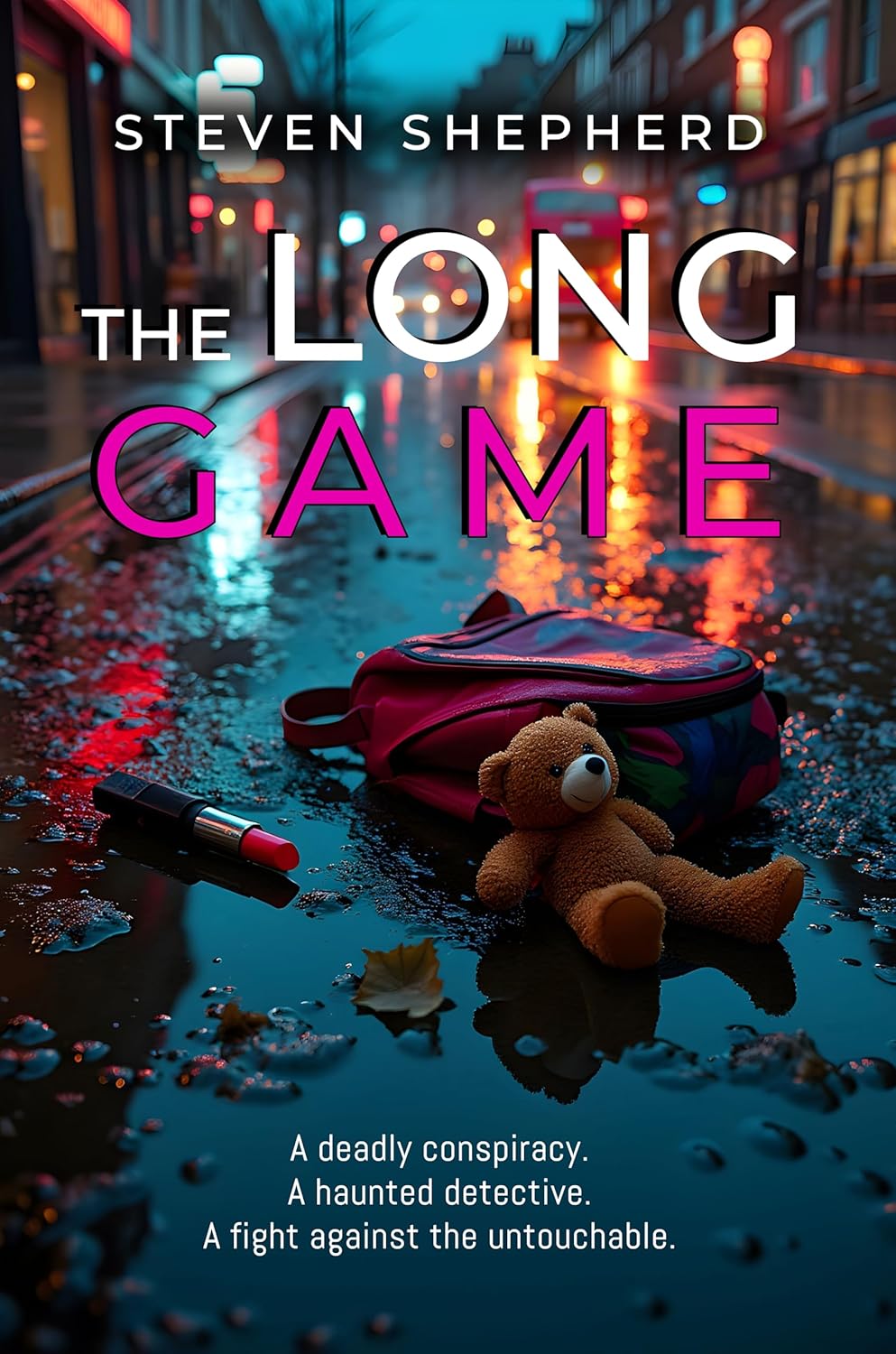

The Long Game is a dark and twisty crime thriller that follows Detective Inspector Michael Dack as he hunts for the people behind a series of disappearances and murders of young girls in London. The story widens fast. What begins as a grim investigation becomes a deep dive into trafficking, corruption, and the awful truth that some monsters hide behind polished shoes and important titles. The book moves through police politics, secret operations, and terrible betrayals, all while pushing Dack into situations that test every part of him.
The writing is punchy and quick, and it doesn’t waste time easing into a scene. It throws you in, cold water to the face. Sometimes the dialogue hit hard and felt real. Other times, it came across a bit theatrical, like people knew they were standing under a spotlight. Still, the energy made it fun. I loved the way tension simmered through even the quieter chapters. I could almost feel the weight on Dack’s shoulders. I caught myself clenching my jaw more than once.
I’ll be honest, though. The book made me uneasy at points. Not because of the writing, but because of the subject matter. It pushes you into rooms you don’t want to imagine. It shows people who feel frighteningly believable in their cruelty. I admired that the story didn’t shy away from horror or emotion. The pacing kept me reading faster than I expected. The emotional gut punches landed, especially whenever the victims came into focus.
The Long Game hits with the same gritty punch as thrillers like The Girl with the Dragon Tattoo and The Reacher series, but it dives even deeper into the shadows where power, corruption, and human cruelty collide. I’d recommend The Long Game to readers who enjoy crime fiction with grit, speed, and a healthy dose of anger at the world. If you like stories where the hero crawls through darkness to drag the truth into the light, this one will keep you turning pages.
Pages 304 | ASIN : B0DYYZ3NY1

The Tao of the Thirteenth God


Robin C. Rickards delivers a paranormal thriller that dives into ritual, belief, and the shadows of human obsession. The Tao of the Thirteenth God follows multiple characters whose paths cross in the wake of strange cult activity, mass suicides, and unsettling visions that blur the line between spiritual yearning and human cruelty. From the first harrowing scene with Amadeus, the troubled seeker, to the storm-battered honeymooners Jack and Alice, and then the grizzled investigator Grantham Savoie with his reluctant partner Dr. Angelica Pali, the story paints a chilling portrait of desperation, mystery, and the cost of pursuing forbidden knowledge.
The opening chapters had this visceral punch, and I found myself hooked by the grit. The style feels unfiltered, raw, almost feverish, and that worked for me because the subject matter itself is so chaotic. At the same time, there were moments where I felt the prose leaned heavily, almost indulgent, and I had to slow myself down. But then a storm or a vision or a horrifying discovery would jolt me back, and I couldn’t look away. I liked that unpredictability. It reminded me of watching lightning: beautiful, frightening, and over before you can process it.
The ideas at the heart of the book resonated deeply with me. The blend of religious myth, Mayan ritual, and modern investigative grit felt daring, and I respect that. I didn’t always know where Rickards was taking me, but that was part of the ride. At times, I felt awe, other times revulsion, and sometimes a little sadness at the broken people caught in the mess. What I liked most was the sense that belief, whether pure or twisted, can drive people to terrifying extremes. The book doesn’t lecture about that. It just lays it bare, and that quiet honesty hit me harder than a long explanation ever could.
The Tao of the Thirteenth God is a gripping read. I’d recommend it to readers who want a thriller that goes beyond surface-level scares and isn’t afraid to weave history, faith, and horror into one unsettling tapestry. If you like your stories strange, stormy, and a little uncomfortable, this one’s for you.
Pages: 290 | ASIN : B006QPEAN6
Patterns of Finance and War

Prophets Of War follows a young financial advisor who stumbles onto a horrifying truth: his own father has created a shadowy business empire that bankrolls Russia’s invasion of Ukraine. What was the inspiration for the setup of your story?
I didn’t sit down one day and decide, ‘I’m going to write a novel.’ Prophets of War came to me gradually, one breadcrumb at a time. For about a year, I carried around the seed of an idea for a compelling story, but it wasn’t until I was working on my Master’s thesis about the origins of national debt that I had my ‘aha’ moment. A thousand years ago, European monarchs borrowed from banks to wage profitable wars — and in many ways, that was the birth of public debt. I began connecting those historical dots to more recent examples and realized I wanted to explore the idea of war as a business model. The Russian invasion of Ukraine became a natural setting, especially since so many of the mechanics — shell companies, offshore secrecy, private military contractors — are real-world systems.
From there, tone became just as important as plot. When I finally read The Wolf of Wall Street (after seeing the film multiple times), I loved its darkly funny, irreverent voice and knew I wanted to channel some of that energy. Tom Wolfe’s Bonfire of the Vanities was another stylistic touchstone. So the book grew out of both history and literature — from centuries-old patterns of finance and war to the sharp, satirical voices of modern storytelling.
What inspired your characters’ interactions and backstories?
Alex is probably the most personal character — he’s a reflection of me, but exaggerated. I gave him many of the same questions I’ve wrestled with in my own life, then pushed them further to see how far they could go under pressure. The other characters came from a mix of real experiences and public figures I’ve studied. Some are composites — Lena, for example, was inspired by several real women, but I wanted her to embody duality: someone magnetic and vulnerable, yet someone you can never fully trust. Devil Bill, on the other hand, was meant to be the incarnation of corruption and power without conscience. And Langston was my chance to write a parody president — larger than life, full of contradictions, but all too familiar.
Some events in the book were chillingly similar to real-life events. Did you take any inspiration from real life when developing this book?
Absolutely — I drew inspiration from real events, but Prophets of War is still very much a work of fiction. You can’t write about finance, politics, or war without noticing the patterns that repeat throughout history. Shell companies, corruption, shadow networks — these things are in the news all the time, but fiction gives me the freedom to connect the dots in ways that journalism can’t. My goal wasn’t to retell any specific headline, but to create a story that feels uncomfortably close to the world we live in. Readers should come away thinking, ‘This could happen… maybe it already is.’ But at the end of the day, it’s still a novel — a thriller built to both entertain and provoke thought
Will there be a follow-up novel to this story? If so, what aspects of the story will the next book cover?
I’ve been asked that a few times now, which is exciting in itself. I do have ideas for where the story could go next. If Prophets of War is about uncovering the financial machinery behind conflict, then the follow-up might explore how those same hidden networks shape politics — through propaganda, dark money, and campaign donations where no one really knows who’s footing the bill. I could see a storyline where a presidential candidate is backed entirely by the business of war. That said, whether I actually write it will depend on how this first book resonates with readers. If there’s demand for more, I’d consider it.
There will also be a podcast coming out soon that you can listen to. I am featured on Read, Beat (…And Repeat) on Spotify but it has not come out yet. It will be posted to my website once it’s live.
Author Links: GoodReads | Instagram | Facebook | Website | X (Twitter) | Amazon
When Alex Morgan, a rising star in wealth management, stumbles onto a trail of cryptic financial clues, he doesn’t just uncover corruption—he unmasks a global conspiracy.
Behind the headlines of the war in Ukraine lies something far more chilling: a private empire of shell companies, black-market trades, and political operatives turning global conflict into personal profit.
The deeper Alex digs, the more dangerous the truth becomes. His own father may be at the center of the scheme. His mentors may be funding both sides of the battlefield. And the woman he trusts most might be the key to it all—or the final betrayal.
From Caribbean tax havens to Wall Street boardrooms to shadowy Zoom calls between oligarchs and ex-presidents, Prophets of War is a pulse-pounding political thriller that rips into the machinery of modern power. Inspired by real systems, real tactics, and real moral failures, it asks a question no one wants answered:
What if the next world war is already on the balance sheet?
The Tempests of Time
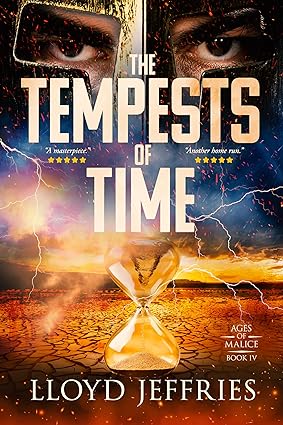
Lloyd Jeffries’ The Tempests of Time, the fourth entry in the Ages of Malice series, is a wild, relentless ride through apocalyptic landscapes, theological conflicts, and the clash of immortals. The novel follows Emery Merrick, a former journalist whose life is tangled with ancient prophecies, political upheaval, and the enigmatic, menacing figure of Cain, the biblical first murderer, now a world-dominating force. The story unfolds with unrelenting chaos: nuclear annihilation, supernatural torment, desperate love, and an ever-looming battle between forces greater than humanity can comprehend.
Jeffries’ writing is sharp, cinematic, and unafraid to dive deep into the grotesque. Some passages feel like a fever dream, especially in the opening where Emery is trapped in a visceral, never-ending cycle of pain and resurrection, torn apart by demons only to be made whole again. The horror is relentless, the descriptions unflinching: “They rip out all my teeth… My mouth fills again with teeth”. It’s brutal, but it lets you know that this story doesn’t do half-measures. While some moments feel excessive in their grimness, they also carry an intensity that makes the story hard to look away from.
Yet, for all its darkness, The Tempests of Time isn’t just about suffering. Jeffries weaves in biting humor and deep philosophical musings. Bill, a stoner with a surprising depth, offers bizarre but compelling insights on existence: “Ever notice how everything starts with nothing?” he ponders. “Take Emery, an artist with the written word, who stares at the nothingness of a blank page.” This contrast between absurdity and existential weight is one of the book’s strengths. Meanwhile, Cain is a fantastic charismatic villain. He’s smooth, chilling, and eerily persuasive, playing the long game with a patience that spans centuries. His interactions with Emery are fascinating, particularly when he dismisses mortal struggles with the nonchalance of a being who has seen it all before.
The book can feel overwhelming at times. There’s so much going on. Biblical mythology, history, dystopian warfare, supernatural horror. The breakneck pacing means that quieter character moments, like Emery’s love for Rhyme, are often overshadowed by the grander conflicts. This isn’t necessarily a flaw, it’s part of the novel’s DNA.
The Tempests of Time is not for the faint of heart. It’s a book for readers who like their fiction dense, intense, and thought-provoking. If you enjoy apocalyptic thrillers with theological depth, visceral horror, and rapid-fire action, this book is for you.
Pages: 359 | ASIN : B0DZ15ZL91
A Lack of Closure

Born of Bombs and Bullets follows a prison psychologist who relocates to Belfast following a brutal murder only to find himself deep within unrest tied to the IRA. What was the inspiration for the setup of your story?
While visiting Belfast, Northern Ireland, a few years ago, I took a political history tour to learn about The Troubles. Although that 30-year conflict supposedly ended with the Good Friday peace agreement in 1998, signs of lingering tension between the Catholic and Protestant communities were everywhere, especially in West Belfast.
Massive peace walls separated the two communities. I saw dozens of murals commemorating attacks and the people who died on both sides—ever-present reminders of the horror and grief and trauma that lasted an entire generation. There were even IRA stickers on street signs warning people not to cooperate with the police. I wondered what it’s like to live with that sort of constant strain. Afterward, when I started reading daily news reports from Belfast, I sensed a lack of closure on both sides of the conflict that haunts people today.
Imaginary characters began to form in my mind, and soon I gave them life through words—with a bit of history mixed in for context. To maintain objectivity, though, I decided to write the story through the eyes of an American psychologist. But first I needed to get him to Belfast, so that murder in the first chapter served as a catalyst.
What kind of research went into putting this book together?
A lot! But first, let me say the characters and the story are entirely fictional. Still, I knew from the beginning I wanted readers—especially here in the States, where The Troubles are less understood—to walk away with an accurate understanding of historical events. So I read countless histories and old press accounts, studied period photographs, and watched a lot of documentaries about The Troubles.
They have different car models and candy brands, for example, in the UK, so I had to research those details, too, to make the descriptions as authentic as possible. I also subscribed to Belfast news media and read the current daily headlines for a couple of years—that really helped me grasp the lingering effects of The Troubles.
At the same time, I wanted to acknowledge the psychological impact of such a prolonged and pervasive conflict. So I researched Northern Ireland’s modern behavioral health trends and reflected those themes in the characters. The descriptions of combat equipment and tactics—then and now—are as accurate as I could make them, as well. I really wanted the story to feel genuine, even though it’s entirely made up.
The hardest part, though, as an American, was trying to master the Northern Irish idioms and accents in the dialogue! I watched a lot of Northern Irish movies and television to get a handle on that—and I apologize now for any times I got it wrong! I’m sure a few “Americanisms” slipped past me.
What elements do you feel are essential for creating a successful thriller?
For me, it boils down to tension, plot twists, and pacing. Conflict between the characters—and of course, setbacks—generates the tension. An ever-present sense of danger fuels it, too.
And plot twists keep the reader guessing and therefore engaged. But above all, in my opinion, the pacing has to be right. The action needs to move forward consistently at a good clip to keep the reader’s attention. Personally, I’m a big fan of short chapters with fewer words per page to promote a feeling of urgency.
Can we look forward to seeing a follow-up to Born of Bombs and Bullets soon? Where will it take readers?
Absolutely! There will be several more books in the series, but I don’t anticipate the next one until late 2026. My niche is travel-inspired thrillers, so the setting will be another country with a fascinating history. I’m presently choosing among Spain, Argentina, and Chile. Maybe your readers can help me decide?!
Author Links: GoodReads | Facebook | Website | Amazon
Psychologist Aaron Thornton is riddled with self-doubt after failing to stop a tragic incident at the American prison where he works. So when his wife, Claire, receives a job offer in her native Belfast, Northern Ireland, he sees a chance to start over by treating hardened criminals in Northern Ireland’s judicial system.
But Thornton’s work soon entangles him in the aftermath of ‘The Troubles,’ a brutal conflict that rocked Belfast for over thirty years. Charged with overseeing the release of the Irish Republican Army’s deadliest bomb maker, Thornton reignites smoldering feuds that threaten to consume him and his family in the flames of political violence.
Alongside a broad cast of characters who reflect the many facets and shifting allegiances of The Troubles, Thornton fights to heal long-standing hatred and prevent another tragedy. But can he save himself?
In the spirit of John le Carré and Graham Greene, writer David A. Dummer has created an everyman hero for our time, and with Born of Bombs and Bullets, a political thriller for the ages.



 LITERARY TITAN