Blog Archives
The Life Lionel Never Chose

Duck It! follows one of the few survivors of a worldwide sickness who documents his journey from Florida to the Midwest and confronts his own past and fears. Why did you choose a notebook-style, first-person narrative rather than a more traditional structure?
I chose to tell the story first-person, notebook-style, because it’s how the character(s) became most real to me. I never start writing until my characters are truly real in my mind; and in today’s world, through social media, most people are always documenting themselves. It’s only fitting that Lionel tells his own story, and fearing the collapse of the worldwide web, he wisely does so old-school: pen and paper.
How does the collapse of society expose the life Lionel never chose for himself?
The collapse of society exposes the life Lionel never chose, because it forced him to finally make a choice. Before, despite not loving his chosen path, Lionel was quite comfortable on it and felt no need, no pull to diverge. Now, having to choose, needing to make his own decisions going forward, he can’t help but look back at his life and all the choices he didn’t make.
The book balances dread with dark humor. How did you decide when to let Lionel joke and when to let things hurt?
The answer to this question, I would have to say is the end result of my answer to the first question. I can’t honestly say that I “decided,” it was more so that, it’s who Lionel is. Dark humor is a part of him, because of his upbringing. He also believed it to be his shield, his superpower, but on his journey, because he finally made a choice, he soon realized he’s just a regular human. And pain, whether mental or physical, hurts. This is the best way I can explain how naturally it was written.
What kind of understanding did you want readers to have of Lionel by the end of the story?
The understanding I wanted readers to have of Lionel by the end of the story is… Honestly, it ties back into my answer to the former question. I want readers to see and understand that Lionel is just a regular person, but without a filter or needing “likes,” because the world we (he) live in no longer exists. So, by the end of Lionel’s exit from his home state, the question that remains is: How truthful would we really be if we really didn’t care about likes and subscribers, if we really didn’t fear being judged and persecuted? And let’s say you did find “your people,” people who hated everything you hated, is that really the world you want to live in, a hate-filled one? Because that’s ultimately what Lionel’s journey is about.
Author Links: Amazon | GoodReads
Join Lionel on his journey to escape a past life, while he continues to struggle with his morality and mortality in a world between purgatory and paradise.
The Illuminated
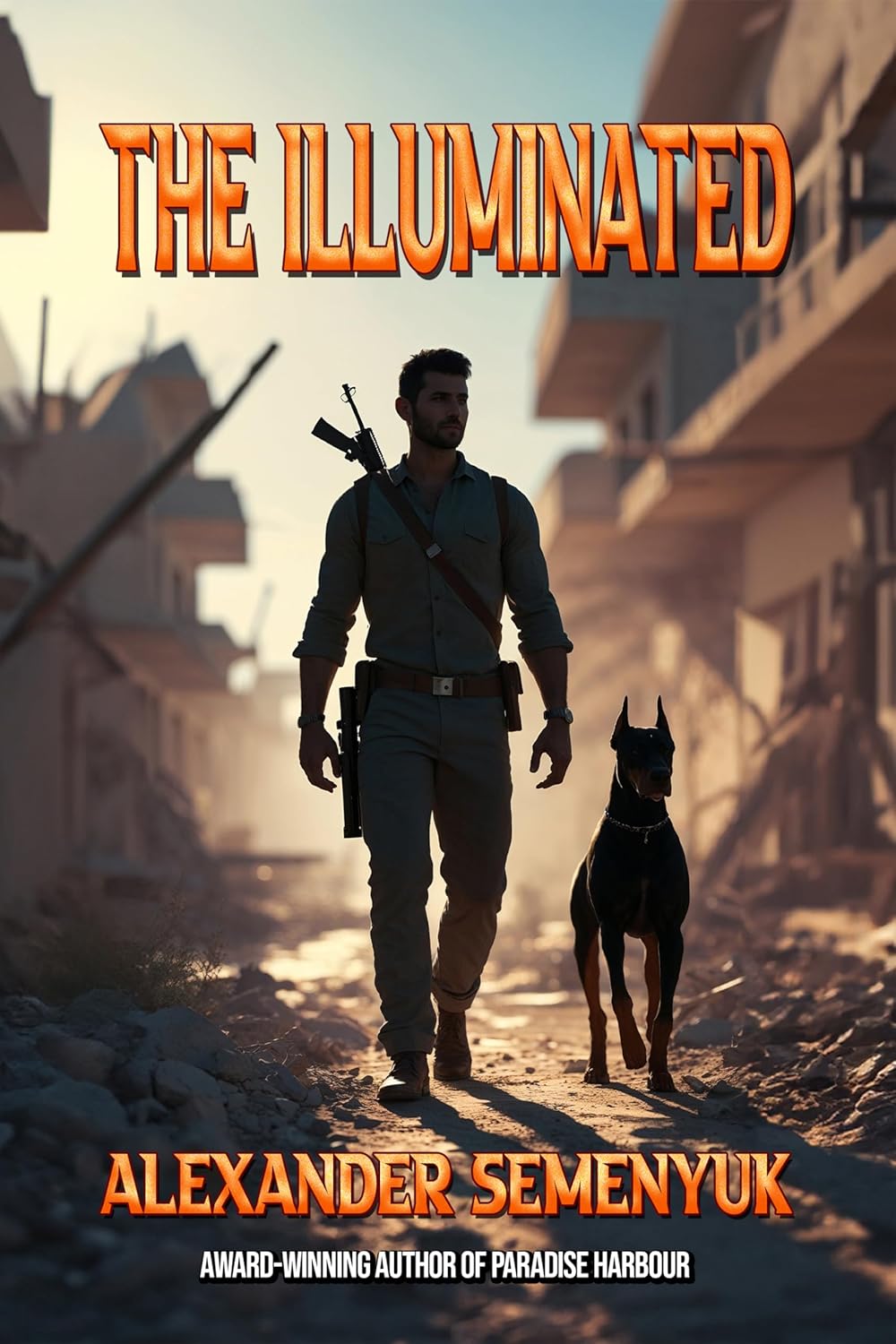

The Illuminated tells the story of a lone survivor crossing a poisoned and broken world with his dog, Toko. The narrator moves from a desert wasteland to strange canyons, dangerous forests, and the ocean. Along the way, he faces mutated beasts, starvation, grief, and moments of rare hope. The book follows his physical journey, but it also dives into his emotional struggle with memory, loneliness, and the faint belief that something good might still exist.
The descriptions of the ruined world are stark. They feel honest without trying too hard. I kept thinking about how tired he was, and the book made me feel that same exhaustion. The writing is simple in a way that makes the emotion hit harder. I found myself pausing when the narrator talked to Toko, because those moments felt tender and raw. The pacing, though slow at times, added to the heavy atmosphere and made the rare hopeful scenes shine brighter.
I also liked the way the story leaned into small, ordinary joys. A berry. A cup of clean water. The way the dog leans against him. Those moments landed with real weight. The ideas beneath the story stayed with me. The book made me think about what people hold on to when everything else falls apart. I appreciated how the author handled grief in such a grounded way. It never felt forced. The emotional beats felt natural, even when they hurt. And they did hurt. The parts with Stella and May stayed with me after I finished reading.
I walked away feeling that this book is meant for readers who like quiet stories that rely more on feeling than spectacle. It is a post-apocalyptic novel, but it is really a story about what it means to keep going when life keeps taking. I would recommend this to anyone who enjoys reflective survival stories, or anyone who wants something that sinks in slowly and leaves a mark.
Pages: 169 | ASIN: B0FH8FS27J

My Story Evolved

The Water Carriers is a climate fiction novel that throws readers into a world ravaged by water scarcity, unrelenting heatwaves, and technological overreach. What was the inspiration for the setup of your story?
Over the past seven years, my family and I moved from California to Florida and then back to California. We experienced hurricanes, droughts, forest fires, and a global Covid lockdown. What stood out to me was that no matter how catastrophic a situation became, people always wanted to return to normalcy. As a result, my story evolved into a post-post-apocalyptic narrative.
During this time, I read more than a few news articles that said climate change would hit poor developing nations first and more severely than first-world nations. What if the opposite happened? I decided to bring the most powerful nations to ruin and handed all the power to two families; one in the Ivory Coast and one in Cambodia.
But In truth, the environment is simply the background in my novel. The world is portrayed as absurd, with all the water falling in only two countries, and yet, this is unnervingly plausible. After all, the earth has been known to do surprising things.
The real tension in the novel lies between two individuals who hold all the power in the world. This narrative encourages readers to reflect on the government duopoly we face in the US today. I want the reader to think about who wins when we are a divided nation.
What are some things that you find interesting about the human condition that you think make for great fiction?
In my novel, set in the near future, libraries exist without books. Characters use their AI companion to create personalized stories, music, and games. What will humans do when AI can create entertainment more easily than humans? This isn’t just a question for the future; it’s happening today.
If you’ve ever doom-scrolled through social media or TV channels, you’ve likely felt the dilemma of experiencing entertainment without a genuine connection. When you read a story written by a human author, you immerse yourself in their imagination for the period of that story. Books are unique in that they allow, and even encourage, you to pause and let your imagination explore different ideas before returning to the main storyline. It is this human connection that makes excellent fiction truly special.
What themes were important for you to explore in this book?
Many science fiction novels portray technology as a villain. We need to recognize that humans, not technology, often make poor and selfish decisions. I believe technology can be harnessed to bring us closer to nature and create a world that is less harmful to humanity. As Star Trek did for the mobile phone, I imagined the solution for a seemingly impossible task: ocean tankers powered by batteries.
Right now, AI and government are evolving more rapidly than we can comprehend. In the short term, this progress can lead to troubling outcomes, which worries me as a parent of young children. However, in the long run, we have the potential to achieve better outcomes for everyone, which gives me hope. As I mentioned earlier, people often seek a return to normalcy.
What is the next book that you are working on, and when will it be available?
The Water Carriers is the second book in a three-part series. My next project will be the start of a YA thriller more than 100 years in the future, exploring a more classic dystopian society theme.
My project name for The Water Carriers series is, quite understandably, Rain. I refer to the young adult series as The Grove. I am a dedicated plotter and have outlined all six stories using the Blake Snyder Save the Cat method. The first book in The Grove series is expected to be ready by 2026.
Author Links: GoodReads | X | Facebook | Website
Multiple Five-Star Reviews from Readers’ Favorite – A trusted source for top indie books.
When two parties control all the water in the world, how far will they go to stay in power?
In a future ravaged by climate catastrophe, water is no longer a human right—it’s a commodity controlled by two powerful families.
Kasemchai Seng grew up in luxury, the heir to a global water empire built on desperation and greed. But while his ruthless father expands their grip on the world’s dwindling resources, Kasemchai dreams of something different—a future where innovation, not exploitation, determines survival. When he meets Liv Anselm, a Dutch engineer developing solar-powered water tankers, he sees a chance to change the game.
But power is never surrendered willingly.
As Kasemchai pushes for a revolution in water distribution, he finds himself locked in a high-stakes battle with Angélique Labonne, the calculating heir to the rival water dynasty. While Angélique weaponizes faith and fear to cement her family’s rule, Kasemchai faces an impossible choice: uphold the status quo or risk everything—including his own life—to build a better world.
With vivid world-building and razor-sharp social commentary, The Water Carriers is a dizzying, dazzling depiction of a thirsty Earth (BlueInk Review). Fans of The Windup Girl and The Power will be captivated by this gripping, character-driven vision of a future where water is power—and those who control it will do anything to keep it.
Read The Water Carriers for free with Kindle Unlimited, or click Buy Now to dive into this gripping sci-fi thriller today!
Red Dirt Part I: The Star Bearer

Red Dirt Part I kicks off in the dusty aftermath of humanity’s fall, where synthetic life forms—called the Vestige—have built their own societies on a Mars abandoned by Earth. It’s a story about memory, legacy, and survival. At the heart of it is Miri, a scrappy, half-synthetic woman with more attitude than caution, and the Star Bearer, a quiet, deeply complex Extant—one of the last organic humans with a mysterious past. Together, they’re caught in the crossfire of an old war being reignited by Commander Sutherland, a terrifying war-machine of a man hellbent on reclaiming Mars for what’s left of humanity. It’s sci-fi with soul. And it’s damn good.
First off, the writing is tight but poetic, with lines that just land. One that stuck with me was when Miri, heartbroken after losing her droid companion Lazer, asks, “What happens when we die?” The Star Bearer answers, “We are remembered by those who miss and honor us.” That hit me. It’s not just pretty language—this book digs into what it means to be alive, to be remembered, to matter. There’s something really haunting about a post-human Mars where machines are the ones asking the big questions. It flips the usual sci-fi trope on its head. And Miri is wild. She crashes a grav bike through a ventilation shaft to save the Star Bearer. Like, that’s the kind of unhinged loyalty and heart you only get when a character is real on the page.
The worldbuilding is top tier. Saint Forsaken is this grimy, neon-drenched underground city filled with holograms, synth food, and old Earth relics. It’s like Blade Runner moved to the outback. There’s this moment when the Star Bearer enters a club full of all women—an ex-military hideaway—and everything is both sensual and surreal. You can feel the tension and the hidden history. Also, the action scenes are solid. They don’t drag, and they don’t try too hard. Just the right amount of grit.
Red Dirt Part I: The Star Bearer is less about machines and more about meaning. It’s for readers who like their sci-fi with heart and grit. If you loved The Mandalorian, Mass Effect, or The Expanse, but wanted a bit more raw emotion and fewer lectures on quantum physics, this is your jam. It’s got action, found family, ethical dilemmas, and the kind of quiet, devastating moments that stick with you.
Pages: 40 | ASIN : B0DVVLXML5
A Hero Of Sorts

The Legacy of a Fool follows a young man who awakens in a post-apocalyptic world to discover harsh truths about his past as he fights to spare the world’s survivors from a devastating military project. Where did the idea for this novel come from?
The inspiration for this novel came from my childhood love of Nintendo games and some of the fantasy movies that were popular during the 1980s, such as The Last Starfighter and The Neverending Story. When I first came up with the idea of writing a novel, I wanted to write something that captured the same spirit that was present in those old video games and movies – I basically wanted to write something that would have inspired a younger version of myself.
The inspiration for the book’s main protagonist, Devin Skye, indirectly came from Eustace Scrubb, a character who appears in The Voyage of the Dawn Treader, The Silver Chair, and The Last Battle, the third, fourth, and final books respectively in C.S. Lewis’ fantasy series, The Chronicles of Narnia. As a kid I was always fascinated by Eustace because he started out as a deeply flawed individual that, as a reader, you couldn’t help but hate, however, after undergoing a radical transformation, he eventually becomes a hero of sorts. I always found his character metamorphosis to be fascinating and even relatable in a very human kind of way.
What is the most difficult part of your writing process?
The most difficult part of writing The Legacy of a Fool was getting into the heads of each of the characters. I wanted to make sure that I gave each of them a standout personality as well as a unique voice without going over-the-top. For example, Sarina’s diary entries come from the perspective of a soft, sweet, and loving young woman. However, as a male, I found writing her thoughts to be somewhat difficult. I owe a lot to my wife’s feedback as it regards getting the female voices and emotions correct.
The science inserted in the fiction, I felt, was well balanced. How did you manage to keep it grounded while still providing the fantastic edge science fiction stories usually provide?
I tried to create and envision a future that was both fantastical yet, to some degree, realistic based on the trajectory that our modern society is currently headed down. The science fiction and fantasy elements that I created were intended to invoke a sense of wonder in the reader without going too far out in left field, so to speak. I tried to introduce just enough realism that, with a little bit of imagination, the reader could see some of these elements as a plausible reality. In short, I wanted to create a world in which humans were able to achieve a great deal of their potential in both the technological and spiritual realms.
Can we look forward to more work from you soon? What are you currently working on?
Yes, I am really excited about my next novel. I’ve decided to step up the sci-fi elements by including more modern-day conspiracies, such as the Mandela Effect, glitches in the matrix, time travel, and mysterious alien encounters. While this novel can stand alone, there will be several occurrences from The Legacy of a Fool that will link into it.
I hope to release my next novel later this year. Please stay up to date by reading my blog on my website: www.jhendersonbooks.com. I usually post once a month about upcoming events. You can also stay in the loop by subscribing to my mailing list found on my website under the contact me tab.
Author Links: GoodReads | Bookbub | Website
Devin Skye wakes up 300 years after accidentally triggering a global nuclear disaster. Thrust into a harsh, post-apocalyptic landscape, he uncovers the truth about his father’s involvement in a dangerous military project: a floating tower occupied by genetically enhanced super soldiers that will be used to subjugate the remaining survivors. As Devin races to prevent its activation, he befriends the resilient villagers of Iron Cove and faces off against mutated creatures while battling his own demons. With each step forward, he unravels a complex web of sinister plots, mysterious technology, and ancient mysticism. When Devin learns of the three crystalline orbs needed to destroy the tower, he finds himself caught in a deadly race against time. As the clock ticks down, he must confront his past mistakes and make an impossible choice. Will he find redemption, or will his quest end in failure, dooming what remains of humanity?
The Legacy of a Fool is the stunning debut from author Justin Henderson. If you enjoy pulse-pounding action, complex moral quandaries, and vividly imagined futures, then you’ll be captivated by this thrilling tale of survival and redemption.
Dissonance Volume IV: Relentless
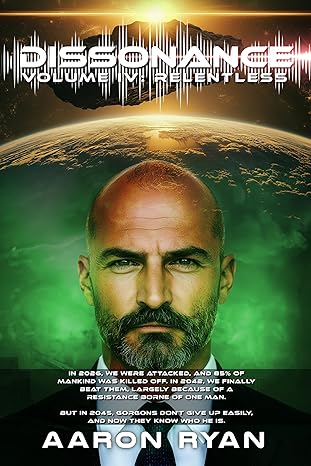
Dissonance Vol IV: Relentless plunges readers into a dystopian future teeming with suspense, sacrifice, and survival. Set in 2045, this sixth installment in the Dissonance series continues the tale of humanity’s fight against gorgon invaders and the daunting task of rebuilding a decimated world. From the remnants of a shattered society to a cautious hope for revival, Ryan weaves together action and introspection, offering a gripping conclusion to his saga. It’s not just about survival; it’s about reckoning with humanity’s mistakes and rediscovering its potential for resilience.
What stood out most to me was Ryan’s ability to blend large-scale world-building with deeply personal stories. The description of Earth’s post-gorgon condition is chillingly vivid: collapsing cities overtaken by nature, underwater subway tunnels, and the haunting remains of iconic landmarks like the Eiffel Tower. Yet, amidst this decay, Ryan doesn’t lose sight of the human element. The scenes of survivors learning to speak aloud again after years of silence gave me chills. It felt so raw, so real, and it made me appreciate the psychological scars left behind. However, at times, these poignant moments risked being overshadowed by the extensive exposition detailing the state of infrastructure.
Ryan’s writing shines most when exploring moral conflicts and relationships. President Cardona’s internal struggle with leadership and the weight of past decisions resonates deeply. His meeting with the disgraced Jean Graham, who oscillates between bitter defiance and hollow regret, was a standout scene. Graham’s sardonic commentary, paired with Cardona’s quiet resolve, created a compelling interplay of justice and accountability. Yet, I couldn’t help but feel that some character arcs, like Pastor Rosie’s, deserved more closure.
The beginning felt like a slow burn, meticulously laying out the consequences of the war and the fragile rebuilding process. While this approach enriched the world-building, it occasionally slowed the momentum. However, once the narrative shifted to the looming threat of Francine 45 and the secrets left behind by Graham’s regime, I was fully hooked. The stakes climbed with every page, leaving me racing to the finish line.
Relentless is a meditation on loss, leadership, and the unyielding human spirit. Aaron Ryan has crafted a world that feels lived-in. I’d recommend this science fiction book to fans of dystopian tales that balance gritty realism with glimmers of hope. Whether you’re a longtime follower of the Dissonance series or new to its universe, this installment is worth your time.
Pages: 382 | ASIN : B0DK5YCPFL
Immortality: Epocalypse
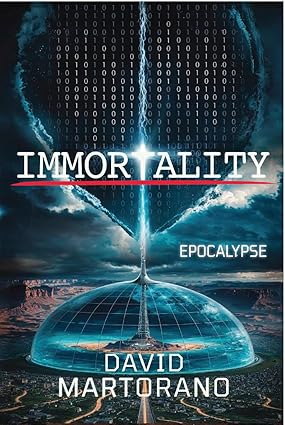
Immortality: Epocalypse by David Martorano is a riveting sci-fi adventure set in a future where technology has fundamentally reshaped society. The story unfolds after the “Epocalypse,” an event that fractured the world into distinct factions. At its center stands Babylon, a gleaming metropolis controlled by two formidable AI entities, offering a version of immortality to an elite few—though not without grave consequences. In stark contrast, the New Amish live outside Babylon, rejecting technology under the leadership of Jeb Thompson. Once the creator of MARTIN, a supercomputer that nearly obliterated humanity, Jeb now renounces the tech-driven immortality and seeks to guide his followers back to a simpler, more spiritual path. However, when his daughter falls into the hands of Babylon’s factions, Jeb faces an agonizing dilemma: whether to revive MARTIN to save her, despite the destruction it once nearly caused.
The novel is a dynamic blend of futuristic adventure and philosophical reflection, echoing the thought-provoking works of authors like William Gibson and Orson Scott Card. On the surface, Immortality: Epocalypse delivers classic sci-fi elements—questions of unchecked technological growth, the perils of artificial intelligence, and the consequences of playing god with humanity’s future. Yet, beneath these familiar themes lies a deeper narrative that challenges readers to think critically about the path humanity is forging. Martorano demonstrates a clear skill for crafting complex characters thrust into moral quandaries, none more so than Jeb. Once a fervent believer in the promise of technology, Jeb now seeks redemption for his past, making his potential reactivation of MARTIN all the more compelling and ironic. His journey reflects the timeless struggle between progress and restraint, a conflict that resonates deeply in our tech-driven world.
The themes explored in Immortality: Epocalypse—humanity’s relentless drive to invent, often at its own peril—are not new, but Martorano tackles them with fresh insight and eloquence. The novel challenges its readers, offering much more than just a fast-paced sci-fi romp. Those who wish to dive deeper will find layers of subtext, rewarding careful reflection on the dangers of a future too reliant on technology. Yet, for those seeking pure entertainment, the book delivers in spades. This is a story that invites both casual enjoyment and thoughtful contemplation, making it a standout addition to the genre.
Pages: 645 | ASIN : B0D9R51RKN



 LITERARY TITAN