Blog Archives
Discovering Emotion

The Gift From Aelius follows a sentient machine who begins remembering a human soul, and sets out across a ruined world to discover whether love is a glitch or the original design. Were there particular sci-fi influences behind the book?
I’ve always enjoyed science fiction that mixes technology with human emotion. I’m drawn to stories that ask what makes someone truly human, especially when artificial intelligence or machines start showing signs of consciousness.
How did you develop A191’s narrative voice, and what challenges came with writing a narrator discovering emotion?
A191’s voice started out very observant and logical. Since the character is a machine, I wanted the narration to feel calm and analytical at first, almost like it was studying the world rather than feeling it.
As the story progresses and A191 begins remembering pieces of a human soul, the voice slowly becomes more reflective. The challenge was making that transition believable—showing the character gradually discovering emotion instead of suddenly sounding completely human.
What were some themes that were important for you to explore in this book?
A big theme in the book is identity—trying to understand who we are and what really defines us. I was also interested in the idea of memory and whether something essential about a person can survive even when everything else changes.
Another theme is love and whether it’s something accidental or something fundamental to our existence. Through A191’s journey, the story looks at whether emotions are just a glitch in a machine—or something deeper that might be part of the original design.
What’s next for this world or your writing journey?
Right now, I’m continuing to write stories that explore identity, imagination, and the line between reality and something more mysterious. I enjoy blending emotional storytelling with speculative ideas, whether that’s science fiction or more surreal narratives.
I’m also continuing to expand my work as an author with new stories and projects. Each book gives me a chance to explore different ideas while still focusing on the same thing I care about most in storytelling—characters searching for meaning and connection.
Author Links: GoodReads | Amazon
The Gift from Aelius


In The Gift from Aelius, a factory Codex named A191 narrates his days inside Paradise, a walled machine city ruled by the distant Overseer, where “irregular behavior” (friendship, wonder, grief) can earn you exile into the desert. He hides contraband books, dotes on his lone companion Bingo, and keeps glitching into impossible “bleeds” of the human world—especially a boy with bright blue eyes who insists peace won’t come until A191 leaves Paradise and finds him. That pull, plus the city’s escalating rebel violence and A191’s strange ability to perceive a light-like “heart” in other Codexes, shoves him outward, across wasteland, into ruined human cities, and finally toward Old Haven, where the mystery of H.H.C. (Higher Human Consciousness) reframes who A191 really is and what his gift is meant to repair.
What got me first was the voice. It’s earnest, slightly startled by its own tenderness, like a being discovering synonyms for “alive” in real time. Early on, A191’s private longing, his fascination with “freedom,” his quiet mercy toward the condemned, turns Paradise from a standard dystopian backdrop into something more intimate: a place designed not just to control bodies, but to sand down the very possibility of interiority. The book’s best moments don’t come from spectacle; they come from small acts that feel illicit precisely because they’re gentle. When A191 finds himself wanting connection in a society built to penalize it, the story treats that desire as a kind of contraband more dangerous than any weapon.
I also appreciated how the novel leans into its spiritual circuitry without getting coy about it. The “gift” isn’t merely a cool power; it’s tied to memory, conscience, and the ache of being severed from origin, especially once the narrative reveals A191 as Aelius, a human soul in a Codex vessel, and recasts Paradise as containment rather than refuge. The book can be blunt in the way it repeats its thematic signals (rules, exile, peace, purpose). But even when the prose turns declarative, I felt the emotional throughline hold steady, helped by the story’s willingness to widen its lens into human communities like Old Haven, where fear and hope have to share the same cramped room.
This is for readers who like science fiction, dystopian control-societies, post-apocalyptic ruins, AI consciousness questions, and a streak of spiritual speculative longing, especially if you prefer your plot powered by empathy rather than cynicism. If Klara and the Sun made you ache for the quiet moral weather inside a nonhuman narrator, you’ll recognize a cousinly current here, less restrained than Kazuo Ishiguro, but similarly preoccupied with what love costs in an engineered life. The Gift from Aelius is a tender machine-fable that insists the most radical upgrade is learning to care.
Pages: 188 | ASIN : B0DLJCC1SL

A Necessary Journey
Why: Earth 2278 follows a general and his inner circle as they engage in a global conflict, and they question the motives of the people in charge of their controlled society. What was the inspiration for the setup of your story?
In the history of Earth, humans have always had a tragic past. The abuse of power has resulted in many millions of innocent lives lost, from the time of the caveman until now. It is called war, and the heartfelt pain resulting in conflicts around the globe. I hope the readers do not dwell on the painstaking decisions of Butch Sweeney but find his pain worthy of hope and a necessary journey.
My family and I spent hundreds of hours traveling to my daughter’s sporting events, and my daughter and I spent time on some trips talking about Earth 300 years into the future. In retirement, I decided to write a futuristic novel that was centered on a military backdrop. Using my degree in marine engineering, it was gratifying to create a futuristic civilization in the thought-provoking world of Sci-Fi.
What is the most challenging aspect of writing science fiction? The most rewarding?
Being an engineer, the most challenging part was proper grammar and sentence structure. I loved creating characters and blending them into a futuristic society. The Sci-Fi part was fun to create and rewarding. I was surprised to find how passionate I became in writing Sci-Fi. This week, when I finished my final approval with the production team for the interior and cover of Why: Earth 2278, it was a testament of a three-year project becoming a reality. I have to say that was my biggest reward.
As any author will tell you, the reward is for the reader to find joy in their work. This is why I write.
Do you have a favorite scene in this novel? One that was especially satisfying to create?
When Butch squares off with his friend Grouch, it is a scene of consequential significance to have to fight your comrade. This moment in Why brings an unfathomable conscience to live with. The tough burden on a man trying to resolve Earth’s future for its people.
The satisfaction in this scene was to embed deep-rooted feelings of a man shouldering the entire planet, Earth. A man in power must have a conscience to achieve greatness.
What is the next book you are working on, and when will it be available?
I have started Where: Earth 2280. It should be completed in a few months. Hope to launch my second novel in 2027.
The Dog Pack Series will be, for now, a trilogy. The backbone of any good novel is the intertwining of solid characters. The Dog Pack is this backbone.
Author Links: GoodReads | Facebook | Instagram | TikTok | Website | Amazon
Why: Earth 2278

Why: Earth 2278 is a military science fiction thriller about a future Earth run by the Union, where order is kept with ruthless clarity, and where the people in charge are starting to look a lot like the monsters they claim to prevent. It follows Butch Sweeney, the Union’s top general, as he watches the system strain under rebellion, resource theft, and creeping corruption. The opening drops you straight into that reality with a public execution and the chilling logic behind it: “You kill, you die.” From there, the story widens into a global conflict where Sweeney and his tight inner circle, the Dog Pack, start asking the most dangerous question in a controlled society: what if the “stability” is the problem?
I enjoyed the book’s commitment to momentum. It’s written in a direct, boots-on-the-ground voice that feels like someone briefing you after a long night, still keyed up, still running on duty and adrenaline. The tech details (smart suits, ships, surveillance, AI systems) are delivered with a kind of matter-of-fact pride, like the hardware is part of the characters’ identity. And then you get these tonal pivots where the Dog Pack starts cracking jokes, swapping nicknames, and needling each other. It humanizes them fast. Sometimes it’s crude, sometimes it’s funny, sometimes it’s both, but it does what it needs to do: it makes their bond feel lived-in, not just declared.
Under the action, the idea engine is pretty clear and kind of unsettling: a system built to stop humanity from repeating its worst habits can quietly become the thing that traps people in them. The book lays out how the Union was designed as a streamlined alternative to old political chaos, and then shows how Thomas Kraft twists it into something close to a dictatorship, even extending term limits to keep control. That thread felt more interesting to me than the pew-pew parts, because it’s not abstract. It’s procedural. It’s the small levers. And when Sweeney starts running out of “clean” options, the story doesn’t pretend there’s a painless fix. It basically admits, through him, that every path forward leaves bruises. Even the romance with Eva lands in that same messy place, tender in moments, but always under the shadow of the bigger war machine.
By the end, the author commits to the “thriller” promise: escalation, damage, and a clear setup for what comes next, with an epilogue that puts a target on Sweeney’s back and makes the conflict personal at the highest level. I’d recommend this most to readers who like military sci-fi that mixes chain-of-command politics with big combat stakes, plus a squad dynamic that leans on loyalty and gallows humor. If you’ve enjoyed the tradition of Starship Troopers or the forward-driving, high-stakes feel of Red Rising, this will probably hit a similar part of your brain, even though Hill’s voice is more blunt and conversational than stylized.
Pages: 254 | ASIN : B0GB3ZSSHS

Closer to Reality

Arid follows a desperate man and a dwindling band of survivors who struggle to stay alive in a scorched wasteland where water is controlled by the rich and greedy. Joshua is ambitious but deeply worn down. What were some driving ideals behind your character’s development?
I give fragments of my personality to a lot of my characters, and Joshua is no exception. All he really wanted was a normal life and to live in a world that hasn’t lost its humanity. I don’t think he will ever stop striving for that.
Beyond survival, what do you see Arid saying about greed and power?
That what happened in Arid is closer to reality than some may think.
Will there be a follow-up novel to this story? If so, what aspects of the story will the next book cover?
I’m not sure at this point. I’m currently working on a novel that is set to be published this spring, but it’s a totally different subject matter. I definitely haven’t ruled out the possibility of a sequel.
Author Links: GoodReads | Facebook | Website | Amazon
It’s the distant future. The earth is scourged by nuclear warfare and natural resources have become scarce. The country is overtaken by wealthy moguls who dominate the water supply and sell it back to the public at ridiculous prices. After a drastic crime increase “indigents” who can’t afford water are stripped of their belongings and forced out of town by an army of brutes called Purifiers.
Life becomes harsh and ominous for the bright, ambitious Joshua Wyman and his group until they begin to occasionally receive food and other basic amenities after Joshua is deemed useful. When a blatant abuse of Purifier power during a routine visit leaves them reeling, Joshua and his friends reach their breaking point.
They devise a plan to steal the Purifiers’ vehicle during their next visit and escape their hell. Their journey across the uncharted wastelands filled with murderers and thieves proves to be far more than this civilized, benevolent crew bargained for. This tense, divided city will soon face its greatest fear-uprising!
Clyde
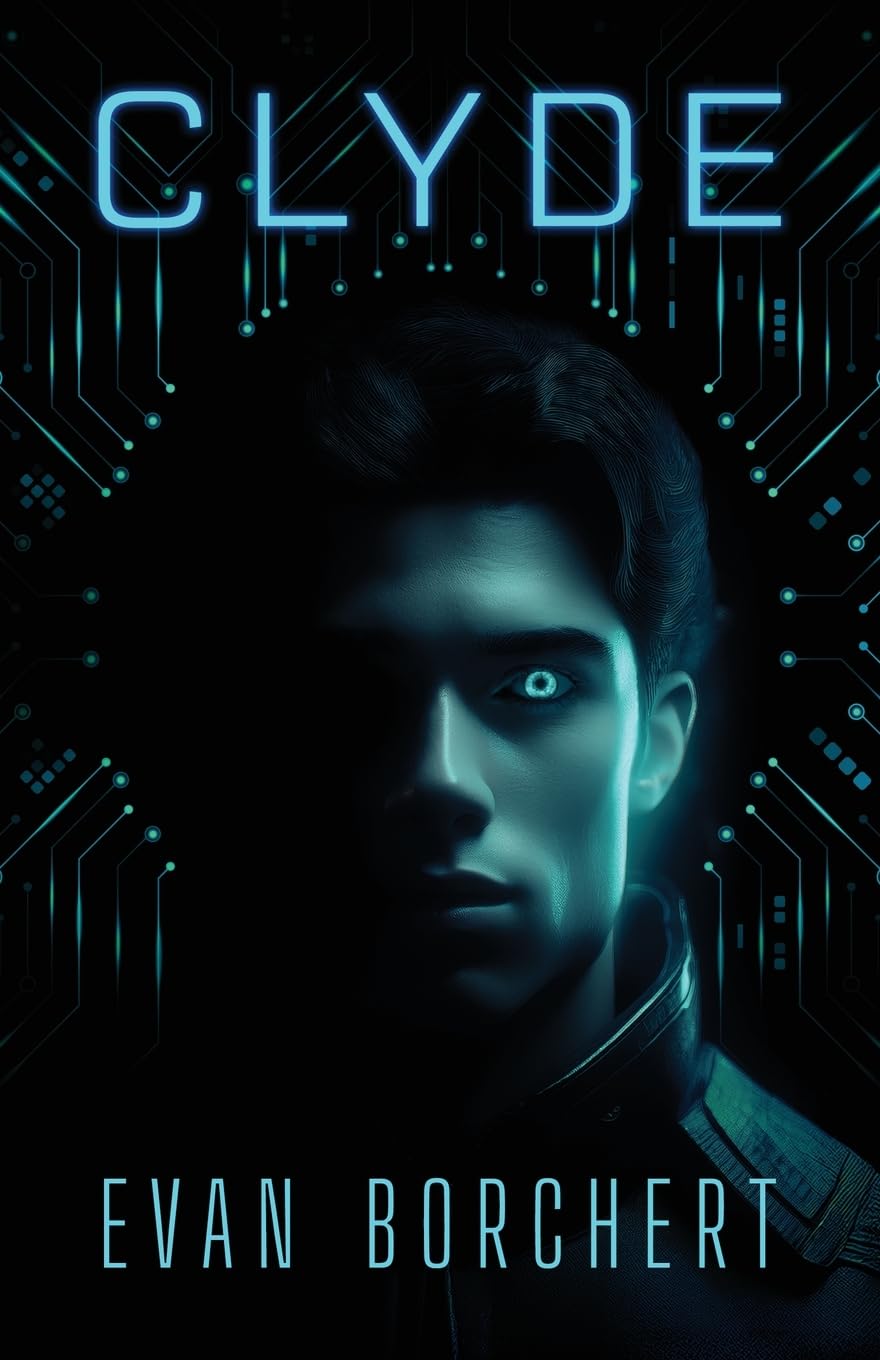
Clyde, by Evan Borchert, follows a man who wakes with no memory, no body to speak of, and no control over his senses. He exists in a strange limbo where lights flash behind eyes he cannot blink, and a doctor he nicknames Jim Bob pokes at him while speaking in cheerful tones that feel all wrong. As Clyde slowly discovers what has happened to him, he builds internal systems to protect his identity, holds tight to scraps of dreams, and pieces together the truth of a shattered world and of himself. The story grows from a claustrophobic medical mystery into a post-apocalyptic adventure filled with danger, grief, technical puzzles, and a surprising amount of heart. It becomes a journey of rebuilding a life that has already ended once.
The writing is straightforward but sharp, and it kept me glued to every shift in Clyde’s awareness. I kept feeling this strange mix of dread and wonder as he uncovered each new detail about his condition. The book takes its time with those moments. The pacing builds pressure little by little instead of throwing big twists for shock value. I also appreciated how the story handles isolation. Clyde’s frustration, his humor, and his fear all felt genuine. I caught myself rooting for him early on, even when I knew the truth he was digging toward would hurt.
There’s a lot in here about identity and autonomy and the way technology can save us or break us, depending on who controls it. Some scenes made my stomach twist, especially when Clyde learns how much of his past is gone for good. Other parts made me grin, for instance, when he starts outsmarting the systems built to contain him. I appreciated how the book never leans too hard into scientific jargon. The tech stays clear and readable. The emotional beats sit right on the surface. And the world-building, especially once the bunker and its people come into play, feels lived-in without ever slowing the story down.
Clyde left me thinking about what actually makes someone whole. The book mixes tension, sadness, and hope in a way that made the last chapters stick with me. I’d recommend it to readers who enjoy character-driven sci-fi, anyone who likes survival stories with emotional weight, and people who want a mystery that unfolds piece by piece instead of rushing straight to the point. It’s a thoughtful, surprisingly warm story wrapped inside a gripping science fiction shell.
Pages: 282 | ASIN : B0G54BJQ83
Moral Imperatives
I, Robot Soldier follows a war-damaged robot soldier who wakes in the ruins of a world shattered by conflict and encounters a traumatized young girl, becoming her protector and companion. I find the world you created in this novel brimming with possibilities. Where did the inspiration for the setting come from, and how did it change as you were writing?
This novel was based on a short story I wrote many decades ago. The premise of a robot soldier awakening to the aftermath of war never left me. When I rewrote the story as a submission to my writing platform—Medium—it received such positive reader responses and encouragement to turn it into a novel, I decided to do just that. Other than that introductory premise, which became the novel’s prologue, the book was not pre-plotted but evolved as it unfolded.
What were some of the emotional and moral guidelines you followed when developing your characters?
The only “guidelines,” emotional or moral, for the characters were that they be credible and consistent. Specifically for the robot narrator, One Shot, the open question was whether he experienced feelings and had moral imperatives beyond those programmed into him. It was never my intention to answer that question definitively.
Where does the story go in the next book, and where do you see it going in the future?
The story is a standalone novel. The Robot Series is not a set of sequels, but rather a series of separate novels told from the viewpoints of unique robots. The second book (also reviewed by Literary Titan) is about a robot alien who comes to prevent humanity from a second devolution. The third book is about a female robot of the future.
Author Links: GoodReads | Facebook | X (Twitter) | Website | Amazon
In a world shattered by war, a lone robot soldier awakens with one mission: to protect the last surviving human – a little girl named Amy.
Together, they form an unbreakable bond in a world where hope is scarce.
But danger lurks in the form of robotic mutations known as wolfhounds.
One Shot’s prime directive is clear: protect Amy at all costs.
On a perilous journey through a devastated world, the bond between a girl and a robot might be the key to humanity’s future. If they can survive.
The Phoenix Experiment

Aaron Ryan’s The Phoenix Experiment is a sweeping, futuristic tale that follows a group of orphaned teens conscripted into life aboard The Origin, a sentient science vessel orbiting Earth in the year 2471. At its heart, the book blends classic coming-of-age themes with science fiction, grief, and resilience. The Phoenix Experiments themselves are a chilling yet fascinating invention: a way for the bereaved to reconnect with the dead in dreamlike states, designed to ease loss and build future warriors called Speakers who can pacify banshees haunting Earth. The story unfolds through the eyes of Jax Hutson, a sharp and restless boy who longs to see his parents again, and it grows more tangled as the destruction of The Zephyr, the sister ship carrying girls, upends their isolated lives.
I found myself pulled in quickly by Ryan’s voice. The opening chapters do a good job of setting up the claustrophobic yet strangely wondrous life aboard The Origin. I loved the mix of sterile science fiction trappings with messy teenage emotions. Jax is both likable and frustrating, which feels honest for his age. His sarcasm and longing made me root for him even when he was being immature. I also appreciated how Ryan handled the Phoenix Experiments themselves. They are eerie, tender, and sad all at once, and that blend of emotions kept me hooked.
What I liked most was the way grief underpins everything. These kids are essentially being raised to weaponize their pain, and that idea is both fascinating and unsettling. Ryan doesn’t shy away from showing how loss shapes them, but he also weaves in humor and teenage banter that lightens the mood. The balance mostly works, though there were moments where the dialogue felt a little too modern, almost like kids from today had been dropped into a far-off future. Still, I can’t deny that it made them feel relatable, and that relatability deepened the impact of the darker themes.
I walked away feeling like The Phoenix Experiment was a story that mattered more for its emotional core than its sci-fi trappings. It’s a book about kids searching for connection, about finding ways to rise out of ashes, both literal and emotional. I’d recommend it to readers who enjoy character-driven science fiction, especially younger readers or anyone drawn to stories of grief and resilience wrapped in an imaginative premise. If you like your sci-fi less about hard technology and more about the human heart, this one’s for you.
Pages: 315 | ASIN : B0FNLY8YW3


