Blog Archives
What Role Would You Play

The Fire Within follows a teen outcast learning to use his unique sensory gift as he navigates life in a post-apocalyptic desert compound. What was the inspiration for the setup of your story?
I’ve always been fascinated by characters who have to overcome a disability or a weakness. Finn’s inability to call on the nova-field makes him a danger to himself and everyone around him in a very dangerous post-apocalyptic world. His disability makes him an outcast. It also forces him to become more in tune with the world than those who practice novamancy. How we turn perceived weakness into strength makes life interesting.
I grew up without a TV, so I read pretty much every sci-fi and fantasy book printed in the 80s and 90s. Stories like Mad Max, the Hunger Games, LOTR, the Divergent series, even 1984, are so fun because they let us imagine a world not too far from our own where everything goes to hell. What role would you play in that new society when the niceties of modern life vanish? This is a question my friend group has been asking for years and was a big part of the inspiration for The Fire Within.
What is it that draws you to the science fiction genre?
Anything is possible. I like to blend sci-fi and fantasy because magic and science of a distant future are essentially interchangeable. I got a degree in physics eons ago and I fell in love with how strange the fundamental rules of existence are, especially when delving into the very small (quantum physics) or the very fast (relativity). The fact that hardened scientists have their assumptions regularly challenged by the mysteries of the real world is incredibly hopeful. We still know so little about how the universe works, which means anything is possible.
What were some of the emotional and moral guidelines you followed when developing your characters?
One of the things I love about young adult stories is the simplicity of the fight between good and evil. In the literature I grew up with, evil was typically one-dimensional. Bad guy=pure evil. YA stories have evolved quite a bit since then as our readers have realized there is nothing more boring than a one-dimensional character. The only guideline I set was to make the characters feel real, relatable. No one is good at everything, we all make mistakes, and bad things happen to everyone. How we respond to those challenges shapes us as people. I have these conversations with my daughters on a near daily basis. For some, these challenges make us hardened and bitter. Others rise above and never lose sight of that childish wonder and hope. I try to show a bit of both in my characters.
Character building reminds me of the old Cherokee story of two wolves: A Grandfather is teaching his young grandson. “It is as if there are two wolves inside me; one wolf is good and does no harm. He lives in harmony with all around him and does not take offence when no offence was intended. He will only fight when it is right to do so, and in the right way. But the other wolf, is full of anger. The littlest thing will set him into a fit of temper.” “He fights everyone, all the time, for no reason. He cannot think because his anger and hate are so great. It is helpless anger, because his anger will change nothing. Sometimes it is hard to live with these two wolves inside me, because both of the wolves try to dominate my spirit.” The boy looked into his Grandfather’s eyes and asked, “Which wolf will win, Grandfather?” The Grandfather smiled and said, “The one I feed.”
As a writer, I get to feed both wolves hearty meals, which is what makes writing so much fun.
Can you give us a glimpse inside the second book in The Ashen Legacy series? Where will it take readers?
Absolutely! Ashara is a divided world—aboveground, a searing desert battered by nova storms and scorched by the terrifying Ignavari; underground, sprawling caverns house the magical Dusker kingdoms, ruled by a feudal society that thrives beneath the frozen glaciers. We spent the majority of the first book aboveground. The second book dives deep into the Dusker kingdoms where Finn will face a new set of challenges, where the threats aren’t as obvious as a giant fire monster trying to melt his face. It doesn’t make the threats any less dangerous however. Finn will need to fall back on his perception and his friends if he is going to survive the political backbiting, the magical monsters, the mystery of the waxers, and make some progress on how to fight the Ignavari.
Author Links: GoodReads | Amazon
Ashara is a divided world—aboveground, a searing desert battered by nova storms and scorched by the terrifying Ignavari; underground, sprawling caverns house the magical Dusker kingdoms, ruled by a feudal society that thrives beneath the frozen glaciers. Finn is unable to manipulate the Grounder energy known as novamancy, but his peculiar ability to sense power sets him apart.
Forced to survive in the underground tunnels between worlds, Finn joins a drillship crew who battle fearsome goblins to rescue a member of a Dusker royal family, and uncover horrifying truths behind the fire-wielding Igni. As Finn hones his skills, he discovers a terrifying secret—a shadow from his past has become a waxer, a being of molten flesh twisted by dark power, and he’s leading an army against everything Finn once called home.
With war looming and his past haunting him, Finn must embrace the fire within or risk being consumed by it. Survival isn’t enough—he must forge his path and fight for those who still believe in him.
Perfect for fans of Red Rising and The Hunger Games, The Fire Within is a pulse-pounding tale of survival, destiny, and the power to shape one’s own fate.
Life After a Zombie Apocalypse
Love and Other Cures for the Recently Undead follows a teenage girl who awakens from a two-year blackout to find she has survived the apocalypse but is now one of the undead. What was the inspiration for the setup of your story?
I was talking to a friend about zombies and zombie apocalypses. She’s more of a horror writer and was working on a post-zombie apocalypse story about an ex-zombie who still had cravings for human flesh. But my thought was that if there were ex-zombies, those people were probably really traumatized—it’s where my mind naturally goes. And it was that thought that made me start to really wonder what life would be like for those left over from a zombie apocalypse, what sort of things they’d struggle with on a daily basis, and how they’d cope with everything they’d gone through and lost. I’ve always been passionate about psychology, so this became something of an interesting thought experiment.
What is it that draws you to the paranormal romance genre?
I like the freedom it offers. As I mentioned before, my main interest is in the psychological and I feel like a treasure trove can be explored in paranormal romance. There are the interpersonal and social issues between the main love interests stuck within the broader context of something extraordinary with its own psychological baggage. In CeCe and Derrick’s case, they had to bridge the gap of trust and forgiveness while navigating the trauma from being ex-zombies.
What was the inspiration for Cece’s traits and dialogue?
I love tennis, so I made her this phenomenal tennis player—the type of player I could only dream to be. Because CeCe is so dedicated to a sport and having this identity as an athlete from such an early age, it shaped everything about her and who she is. For her to lose that, it was like losing half of herself. She doesn’t know who she is anymore and has to get to know herself in a way she never has. It’s this feeling of being disconnected that dictates her traits and dialogue moving forward in the story.
Can readers look forward to a follow-up to this novel? What are you currently working on?
I did leave it open for a sequel, and I really love CeCe and Derrick so I’ve definitely been thinking of how the story would continue. Right now, though, I’m working on another paranormal romance that involves a serial killer, who is definitely not one of the main love interests.
Author Links: GoodReads | X | Facebook | Website
CeCe wakes to a reality she can’t fathom and realizes it’s probably not a good idea to fall for the guy who bit her and made her one of the undead.
But in this post-apocalyptic world, everything she’s known and understood has changed, including the path to love.
This is going to be your next favorite story, so hurry and buy it now!
Love and Other Cures for the Recently Undead


At its core, Love & Other Cures for the Recently Undead is a gritty, emotional, and strangely tender post-apocalyptic coming-of-age tale. We follow CeCe, a teenage girl who wakes up from a two-year blackout only to discover she was among the Infected, essentially the undead, during the downfall of civilization. As she tries to rebuild a life in a world that has changed beyond recognition, she confronts loss, trauma, guilt, and, unexpectedly, the guy who bit her. It’s not just a zombie survival story, it’s about identity, healing, and navigating the ugly mess of grief and rebirth.
I wasn’t prepared for how raw this book would hit. The opening chapters aren’t action-packed in the usual undead thriller way, but they are claustrophobic and gut-wrenching. CeCe waking up in darkness, confused and crushed under bodies, is horrifying, not because of gore but because it’s so human and real. Ramsay doesn’t rush the emotional recovery, and I appreciated that. You really feel CeCe’s pain when she realizes her mother didn’t make it, that her best friend and boyfriend are missing, that she’s been gone for two years and everything she loved (tennis, high school, her future) is shattered. That kind of slow-burn horror hits harder than any jump scare.
The writing style is simple but effective. Ramsay keeps things clean and fast-moving, even when the plot slows down. There’s a lot of introspection, especially in scenes where CeCe returns to her old school as part of the Rehabilitation Program. Those moments of being surrounded by other damaged kids with missing limbs, haunted eyes, and weird silence hit me like a punch to the chest. And the subtle tension with Olivia, the hostile Survivor, is quietly terrifying. But where the book really surprised me was Derrick. The boy who infected CeCe? It turns out he’s been cured, too. And somehow, this book manages to make you feel something when they meet again. Confused anger. Loathing. Maybe even curiosity. I didn’t want to root for him, but I found myself leaning in.
What really stood out was the emotional weirdness of returning to something familiar that’s now unrecognizable. Ramsay captures that eerie feeling of trying to go back to normal when “normal” is gone forever. When CeCe walks through her school, sees her old tennis team photo, or opens her ex-boyfriend’s locker. Those moments are small, but they carry so much weight. And it’s honestly heartbreaking how she’s just expected to rejoin society, do her homework, eat her weird canned spaghetti, and pretend everything’s fine. It’s not. It never will be. And that tension between survival and actual living is what keeps the book from falling into cliché.
Love and Other Cures for the Recently Undead is for anyone who’s ever felt like a stranger in their own life, or tried to rebuild something that doesn’t quite fit anymore. It’s not a light read, but it’s oddly hopeful in its own way. There’s still love. There’s still friendship. And there’s still that weird human ability to keep going, even when everything’s broken. I didn’t expect to care this much about a girl with a zombie bite. I’m glad I read it.
Pages: 235 | ISBN-10 : 1957295821

Army of 29 Cats
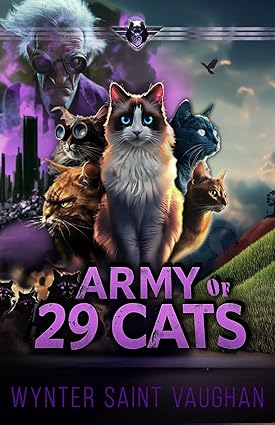
Wynter St. Vaughan’s novel Army of 29 Cats is weird in the best way possible. Army of 29 Cats is a gritty, post-apocalyptic story told through the eyes of street-smart, dumpster-diving cats. The setting is Atomic City, a once-thriving metropolis now drowning in purple fog, feral vibes, and existential dread. Our main feline hero, McGrady, is basically a warrior-poet with claws, and along with his anxious but lovable sidekick Paws, they set out to find out what’s corrupting their city—and their friends. It’s like Watership Down meets Blade Runner, but covered in fur and way more sarcastic.
I was not expecting to get emotionally attached to a cat. But there I was, rooting for him as he leapt rooftops, dodged glowing-eyed mutant dogs, and tried to rescue Felina, a cat gone rogue. The writing has this flow that jumps between poetic and street-wise without missing a beat. Like when Grandma Mittens describes Felina’s haunting purple eyes. That’s some vivid storytelling. The whole world-building around Atomic City is eerie and immersive. It’s a mess of decay, forgotten neighborhoods, creepy raccoons, and weird purple goo that’s turning everyone into mindless husks. I was hooked.
The dialogue is hilarious and punchy. The banter between McGrady and Paws had me laughing. There’s also a moment where Amazing Grace—who totally lives up to her name—pulls a full-on parkour escape from a dog pack and disappears like a silver ninja. And when Professor Waffles showed up with his steampunk goggles, I almost clapped. The characters are so over-the-top but grounded in enough raw emotion that it works.
Sometimes, the book throws a lot at you. Like, every chapter ramps up the action and adds another creepy villain, new neighborhood, or dramatic cat monologue. I occasionally lost track of who was infected and who was just cranky. And the purple-eye infection subplot was super cool and ominous but gets a bit murky in explanation. I wanted a tiny bit more clarity there, especially after the introduction of Mr. Geiger, the ultra-creepy villain.
Still, I had a blast reading this. The mix of high-stakes adventure, grimy urban survival, and cat drama is unique. If you’re into dystopias, underground animal rebellions, or just want something completely unexpected, Army of 29 Cats delivers. It’s great for readers who liked Redwall but always wished the characters were sassier and the setting more cyberpunk. I’d hand this to teens, adult animation fans, or anyone who secretly thinks their cat is plotting world domination.
Pages: 226 | ASIN : B0DPTTHRXV
Always Asking Questions

Rebels and Saints follows a ragtag group of rebels fighting against the oppressive rule of a corporate regime that controls food, water, and livelihoods in a post-collapse America. What was the inspiration for the setup of your story?
America has been riding high in many ways since WW2. The US ended up being the most powerful nation in the modern world. And yet… How then can there be no universal health care? So many gun deaths? Teachers paid a pittance? So much poverty in a country with so much? Such a division between the haves and have-nots, as well as polarized politics?
Maybe it’s my Canadian showing (and we’re no 51st state), but I fear a collapse could happen. I doubt it will be like my books, but there are too many problems for things not to come to a head. It’s easy to imagine corporate overlords running the government when so much is about the bottom line and making money.
The GreenCorps towns were modeled on coal mining towns of the past and the monopoly of the company stores, as was District 12 and the Seam from The Hunger Games. Some of my inspiration came from reading The Glass Castle by Jeannette Walls and watching the movie October Sky, about Homer Hickum and the Rocket Boys. Escaping that kind of life of drudgery was so difficult.
Another inspiration was for the entire series. The train hoppers were modeled on my grandfather, his brother, and a friend who hopped trains from Utah to California and back several times during the Great Depression.
The landfill scavengers of SoCal were inspired by Ada’s Violin: The Story of the Recycled Orchestra of Paraguay by Susan Hood.
I also wanted to set some of my story in Utah because I was born in Ogden. My family moved to Canada when I was two, but we visited every year through my childhood, and we went on several road trips using Ogden as a starting point. I’ve hiked in the canyons, swam in the Reservoir, and visited dozens of towns and cities in the west. I also forced my husband to detour to Craters of the Moon on our Volcanoes Roadtrip in 2010, so I loved that I could picture the landscape and setting of the story.
Your characters are wonderfully emotive and relatable. Were you able to use anything from your own life to inform their character development?
I always borrow bits of myself and people I know when writing. I hope I can get inside my characters and make them feel real. Clark, for example, doesn’t connect well with others and always feels alone. I’ve felt that way often, and like Clark, I went through a short phase when I couldn’t speak around others. Elsa is tough and doesn’t give in to peer pressure and constantly strives to do better, which I can also relate to. Plus, she’s much happier and more secure with Walker. I can relate to having a partner who makes me feel safe and accepted as myself.
I find that, while writing, you sometimes ask questions and have the characters answer them. Do you find that to be true? What questions did you ask yourself while writing this story?
My editor has pointed out that I ask a lot of questions, and I’m working on reducing the number. That said, I have constant questions and things I’m wondering-my head is a very busy place. I used to think everyone was that way, but it seems I might have been mistaken. I think it might be more common with a neurodivergent brain.
When I was writing, I asked myself what would make the story satisfying? What would happiness look like to the different characters? What would they need to show their hope, their belief in a better life? I thought about what would make a rebellion successful. I didn’t want huge battles and a huge war, but I asked myself how else an uprising could work. My answer was that everyone scared to take part needed to choose a side and be brave in their own way.
I hope the series continues in other books. If so, where will the story take readers?
I have two ideas…so far.
1. Wade got away. I think Tatsuda, Ginger, and Wade might meet again in a few years.
2. I have a story on the shelf, one written in 2020, that I plan to revise. It’s set in 2192 across the continent in Salem, Massachusetts. It could be the opening of another series that might connect to the Train Hoppers, showing what’s happening in other places throughout North America post-collapse.
Author Links : GoodReads | Facebook | Instagram | Website
With renewed hope, they return to join the rebels. Some sneak into SoCol to free Elsa’s family, others lead teams to collect seeds from the bunkers, and others bring hope to the populace and free the downtrodden.
Like Elsa, Janna grew up in SoCal, but instead of escaping, her brother sold her as a prostitute. Liberated by the rebels, she plans to fight alongside them.
Clark grew up in rebel Utah and, one by one, has lost his family to GreenCorps. Broken, he hides among the neutral Saints, taking refuge and avoiding his problems—until he meets Janna.
Though cracks have appeared in the Greencorps stranglehold, it will take everyone working together to break them apart. Without them, the rebel cause will fail and the corporatocracy will once more prevail.
Grab your copy of Rebels and Saints: Catching Freedom, the action-packed conclusion to the Train Hoppers series.
Rebels and Saints: Catching Freedom
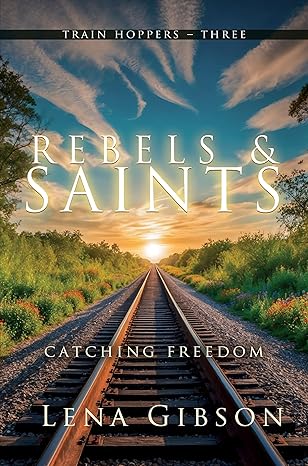
Lena Gibson’s Rebels and Saints is the gripping third installment of the Long Haul trilogy, a dystopian saga that follows a ragtag group of rebels fighting against the oppressive rule of GreenCorps, a corporate regime that controls food, water, and livelihoods in a post-collapse America. Set in the year 2195, the novel continues Elsa’s journey as she leads the fight to distribute long-lost seed reserves that could free people from corporate dependency. With high-stakes train-hopping, underground bunkers, and daring escapes, the book is a thrilling blend of adventure and rebellion, all while exploring themes of survival, autonomy, and hope in a bleak world.
Right off the bat, the pacing had me hooked. This is a full-throttle, edge-of-your-seat kind of ride. One of my favorite scenes happens early on when Mason and his team are sneaking off a train into enemy territory. Gibson has this great way of making every movement feel significant and every risk feel personal.
What really made this book stand out wasn’t just the action it was the characters. Elsa, Walker, Mason, and Caitlyn aren’t just rebels with a mission they’re people with relationships, regrets, and fears. Elsa’s internal struggles, especially in moments where she realizes just how much power she wields, feel incredibly real.
The world-building is superb. Instead of drowning readers in exposition, Gibson reveals details naturally through the rebels’ experiences. The concept of train-hopping as a means of resistance is brilliant, adding a sense of motion and unpredictability to the story. And the contrast between GreenCorps-controlled zones and rebel havens is stark. That contrast makes the fight for freedom feel even more urgent.
By the time I hit the final chapters, my emotions were all over the place. There’s a sense of triumph, yes, but also loss—because the fight doesn’t end just because the book does. That’s the hallmark of a good dystopian novel. If you love fast-paced adventure with heart and if you enjoy stories about found families and underdogs taking on impossible odds, this book is a must-read.
Pages: 371 | ASIN : B0DVNLNMGC
After the Fall: The Engineer and the Apocalypse


After The Fall is a gripping post-apocalyptic narrative that follows Haley, a woman on the run from her recent past, as she attempts to reclaim her distant past across the ocean in the wake of a devastating nuclear war. While the premise might seem like well-trodden territory, Gerry Gainford transforms it into something refreshingly original. His approach reinvigorates familiar themes, defying expectations and conventions with a bold creative flair that stands out, particularly when compared to the genre’s usual offerings.
What sets After The Fall apart is its understated portrayal of the apocalypse. Rather than relying on the exaggerated desolation common in similar tales, Gainford opts for a more subdued yet deeply unsettling aftermath. Civilization has indeed crumbled, and the environment bears the scars of catastrophe, but the world Gainford crafts is far from a clichéd wasteland. Instead, it’s layered, intricate, and vividly rendered, offering depth beyond what Haley’s perspective reveals.
Haley herself is a compelling protagonist. A flawed and deeply human character, she’s driven by a singular goal: to get home. Her journey is fraught with hardship, vividly chronicled in a way that’s both harrowing and rewarding to read. Gainford’s inclusion of a content warning at the outset is a thoughtful touch, ensuring readers are prepared for the more intense moments without feeling blindsided. This deliberate consideration prevents the book from veering into gratuitous territory, striking a balance that respects the reader.
It is worth noting that the novel’s use of non-linear storytelling and frequent flashbacks, though thematically significant, can sometimes disrupt the narrative’s momentum. These shifts in timeline pull the reader away from the immediacy of Haley’s current plight. While the flashbacks provide valuable context, I feel their placement occasionally hampers the story’s flow, creating moments where the pacing falters somewhat.
The overall execution of After The Fall is nothing short of impressive. Gainford’s ability to breathe new life into a genre often saturated with repetition is commendable. His nuanced world-building and rich character development make for an engaging read, even when the timeline hopping proves momentarily frustrating. The conclusion hints at a sequel, which is an exciting prospect. While timeline mechanics may not be my preference, they don’t overshadow the book’s many strengths. I’m eagerly looking forward to the continuation of Haley’s journey and the next chapter in Gainford’s enthralling series.
Pages: 250 | ASIN : B0D8RFJ1ML
A Look at the Future

El aullido de los Invisibles immerses readers into a desolate future where Earth has been devastated by environmental collapse and social decay. What was the inspiration for the setup of your story?
The idea came from a post I saw on social media. It was the seed from which the world and story of Onnyriom emerged, and what was originally going to be one book became three.
I find the world you created in this novel brimming with possibilities. Where did the inspiration for the setting come from and how did it change as you were writing?
Unfortunately, I found inspiration in the world around us and in the way humans treat animals and the earth in general. There is also a deep criticism of the society in which we live.
What were some themes that were important for you to explore in this book?
Above all, social criticism and reflection on the way human beings act today.
The idea was to create a hard story with a message, but one that would engage the reader. The truth is that it is having a very good reception.
Will this novel be the start of a series or are you working on a different story?
´´El aullido de los invisibles´´is the first part of the trilogy Onnyriom. I published the second part (´´Conciencia de hiel´´) in August, and the third part (´´El presagio de la desoñación´´) will be released in December of this year.
Author Links: GoodReads | Book Review
En el despiadado mundo de Onnyriom, un planeta donde las apariencias engañan y el karma se cobra sus deudas con intereses, la realidad es oscura y desgarradora.
Sin embargo, no todo está perdido. Del corazón temerario de unos pocos valientes nacerá el valor para arriesgar su vidapor salvar a los humanos de su inexorable destino.
————————————————————————————————————————————–
En un mundo post apocalíptico, la humanidad se convierte en la materia prima de una nueva raza que ha conquistado el planeta: los onnyrianos. Los humanos, considerados inferiores, se cultivan bajo escalofriantes condiciones y son comercializados de pies a cabeza por la gigantesca empresa Gova.
Alysa, una onnyriana que se verá obligada a seguir el legado familiar e incorporarse a trabajar en Gova, tendrá la oportunidad de cambiar su destino al crear una alianza con uno de los pocos grupos resistentes y embarcarse en la misión más peligrosa de su vida.



 LITERARY TITAN