Blog Archives
Exploring Fear

Fear Struck follows a crime writer who, while writing his latest murder mystery, has his door broken down by police and is arrested for a murder that looks like one of the scenes in his book. What was the inspiration for the setup of your story?
As a writer, I often feel like a conduit for someone else’s ideas, with words flowing so quickly that I sometimes wonder where they are coming from. This experience sparked a question for me: what if a writer suddenly became the instrument for someone else’s story in a very real and dangerous way? This personal connection to the story became the seed for Fear-Struck and its psychological thriller setup.
The truth is, many of my novels begin with a simple “what if.” Whispering Lessons is a good example. I asked myself, what if someone had secretly followed Jesse James and his gang, watched them bury their stolen treasure, and then dug it up after they rode away? Could that be why so many of those legendary treasures have never been found? Those two words, “what if,” open the door to endless possibilities, and they are often the starting point for my strongest storylines.
What are some things that you find interesting about the human condition that you think make for great fiction?
There are so many layers to the human condition that writers need to pay attention to, because those layers are what make fiction feel real. In Fear-Struck, I delved deep into the debilitating impact fear can have on a person. It doesn’t just consume the main character. The suspect gets overwhelmed by it, too. Even the people in the prison around him react out of fear.
Fear is universal. It shapes decisions, drives behavior, and sometimes clouds judgment. Our minds are incredibly powerful, and our thoughts can either protect us or harm us. In this story, fear becomes almost a character in its own right, influencing everyone in its path. That kind of emotional truth, rooted in what people really experience, is what makes fiction resonate.
When you first sat down to write this story, did you know where you were going, or did the twists come as you were writing?
For Fear-Struck, I actually did know the storyline before I began writing. That is unusual for me, as I am not usually a plotter, but in this case, I could clearly see the characters and the journey ahead of them. I knew the ending, and I knew how I wanted to move from the moment of the arrest all the way to the final reveal.
What mattered most to me was exploring fear, not just telling a crime story. I wanted to look at how fear shapes people from the inside out. The reviews have been incredible, and many readers mention how closely they connect with the characters and their reactions. I think that connection exists because fear is something we all face in one way or another. It is a profound human experience, and that truth comes through in the story.
What is the next book that you are working on, and when can your fans expect it to be out?
I am currently writing Book Two in the series. It starts as Kutter is still dealing with the emotional aftermath of what happened in Book One, where he was arrested for a murder that resembled a scene in his own book. These lingering effects push him into a situation unlike anything he has ever faced before. This new challenge forces him to grow in unexpected ways.
In this next installment, Kutter, the main character from Fear-Struck, finds himself sitting across from an unapologetic and prideful serial killer. His personal revulsion toward this man directly clashes with his responsibility to uncover the names of the victims. That internal battle is something many of us understand, because we all face moments where our emotions collide with what we know we must do.
I am thrilled to share that I am aiming to have the next book ready for readers in early 2026. I cannot wait to continue Kutter’s journey and share the next chapter with you all.
Author Interview: GoodReads | BlueSky | Facebook | Pinterest | Website
Detective Tweed believes Kutter’s pages hold the truth. Kutter swears he’s innocent. Yet with each revelation, a darker reality emerges—one bound to him by blood.
Relentless and chilling, Fear Struck will keep you guessing until the final, shocking twist.
Eclipsed by Fate


James Lloyd Brown’s Eclipsed by Fate is an intricate legal and psychological thriller that intertwines professional ambition, personal conflict, and moral compromise. The novel follows Madelyn, a newly minted law graduate, as she joins a small but promising law firm led by Byron Dozier and Edith Devareau, two accomplished attorneys whose shared history carries quiet tension. What begins as a story of legal mentorship and ambition soon unravels into a deeper narrative involving a brutal assault, an elaborate fraud scheme, and a dangerous web of pharmaceutical corruption. At its core, the book examines how trust, loyalty, and hidden desires shape the decisions that define its characters’ lives.
Brown’s greatest strength lies in his ability to merge intimate character drama with the scale of a legal conspiracy. The professional relationship between Byron and Madelyn is depicted with care and restraint, revealing both mutual respect and the unspoken boundaries of power and influence. Likewise, the dynamic between Byron and Edith carries an emotional depth that feels authentic. Their unfulfilled affection gives the story an undercurrent of melancholy that balances the procedural and investigative elements.
The novel’s atmosphere is rendered with striking clarity. The opening chapters, set against a snowbound Minneapolis, set a cinematic tone that immediately draws the reader in. The introduction of Detective Lawrence Melville, who investigates the assault on student Diedrek Thurston, is especially memorable. Melville’s quiet grief, stemming from the loss of his brother, parallels the moral fatigue that runs through much of the book. Brown uses setting, cold streets, sterile hospital rooms, the tense quiet of law offices to reflect the internal struggles of his characters, creating a mood that feels both realistic and unsettling.
At times, the pacing slows under the weight of detailed exposition. Brown’s careful attention to the workings of law and medicine, while impressive, occasionally interrupts the narrative flow. Yet these moments are offset by scenes of real emotional resonance, particularly those exploring Madelyn’s lingering fear of relapse from LeBlanc Syndrome. Her vulnerability, and the moral choices it forces upon those around her, give the novel its emotional gravity.
Eclipsed by Fate is a thoughtful and ambitious work that rewards patient readers. It will particularly appeal to those who enjoy character-driven legal thrillers that probe ethical boundaries rather than rely solely on suspense. Brown’s writing is deliberate, intelligent, and quietly affecting, a story that lingers long after the final page.
ISBN: 9798986000350
My Twelve-Year-Old Wife
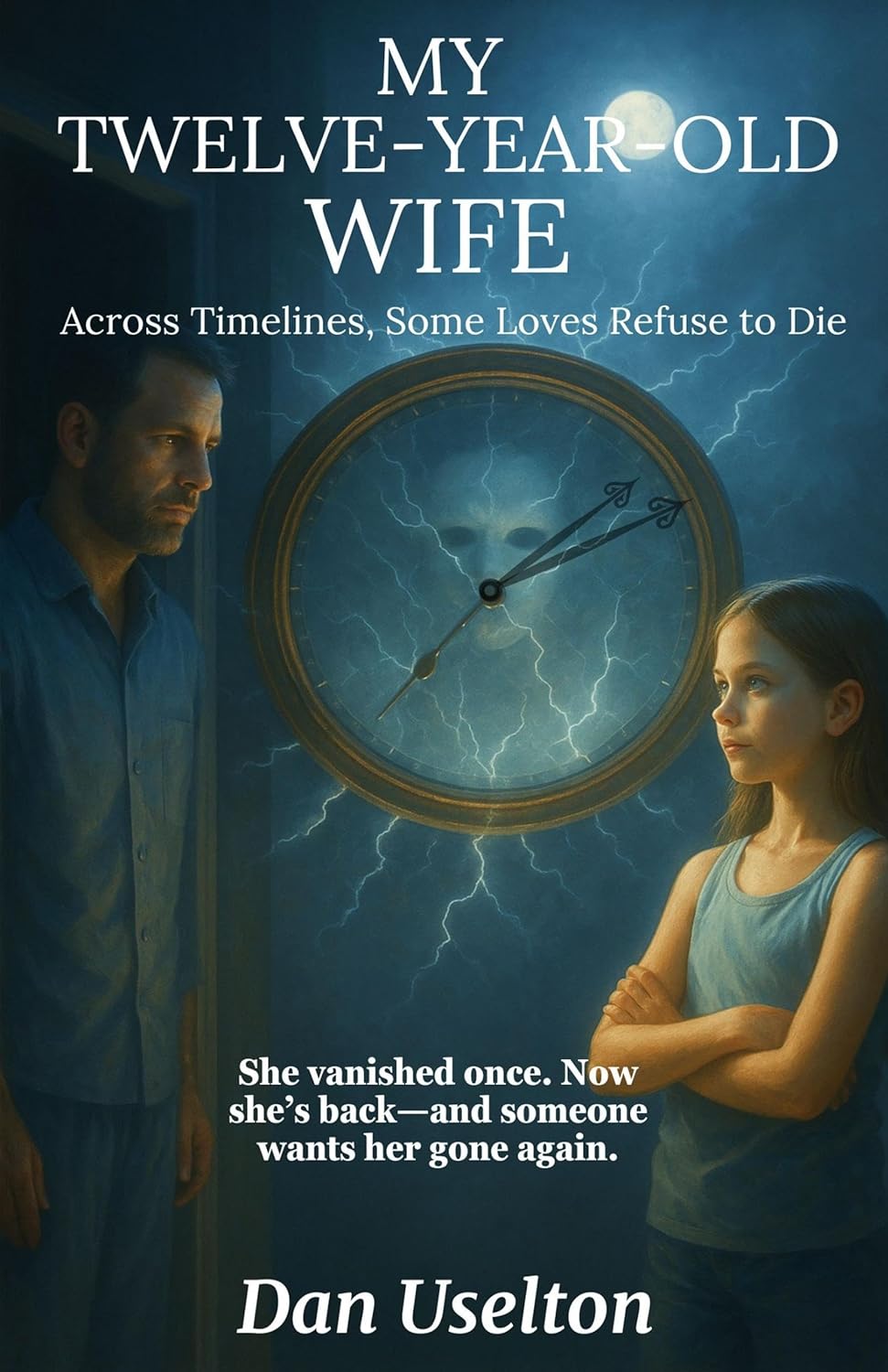
My Twelve-Year Old Wife is a dark, time-bending thriller about love, grief, and the unrelenting pull of fate. It follows Dan Fox, a husband desperate to find his missing wife, Celia, only to have a twelve-year-old girl appear at his door claiming to be her. What begins as a mystery about disappearance spirals into something stranger, a story that slips between timelines and emotions, showing how trauma, memory, and devotion can warp across the years. The book plays with horror and science fiction but stays grounded in its aching humanity. Each chapter peels back another layer of the impossible, until the reader is as disoriented and haunted as Dan himself.
The writing is cinematic and unnerving, full of tight, fast sentences and moments that hit like a punch. I could feel Dan’s confusion and fear, his disbelief when he’s confronted with a version of his wife that shouldn’t exist. The story toys with logic but never loses its emotional truth. The prose has this eerie stillness, a rhythm that feels like breathing in the dark, and the pacing moves between slow dread and heart-hammering tension. I caught myself whispering “what?” out loud more than once, which almost never happens when I read. The author’s control over mood and momentum is impressive. Even when scenes leaned into the surreal, the characters kept me anchored.
But what hit me hardest wasn’t the time travel or the mystery, it was the loneliness. Beneath the weirdness, this is a love story about guilt and obsession. Dan’s desperation feels raw and a little ugly, and Celia’s time-fractured existence is both tragic and strange. Their connection stretches and twists, but it never breaks. I could sense how much the author wanted to explore what happens when love is stronger than reality itself. At times, the dialogue can feel blunt, but it works here, it fits people who are terrified and grasping for sense in the middle of madness.
My Twelve-Year Old Wife is for readers who like their stories unsettling, who don’t mind questioning what’s real and what’s imagined. If you liked Dark, Arrival, or The Time Traveler’s Wife but wished they were more psychological and eerie, this book is for you. It’s weird, bold, and relatable.
Pages: 194 | ASIN : B0FD87Y85R

Fear Struck
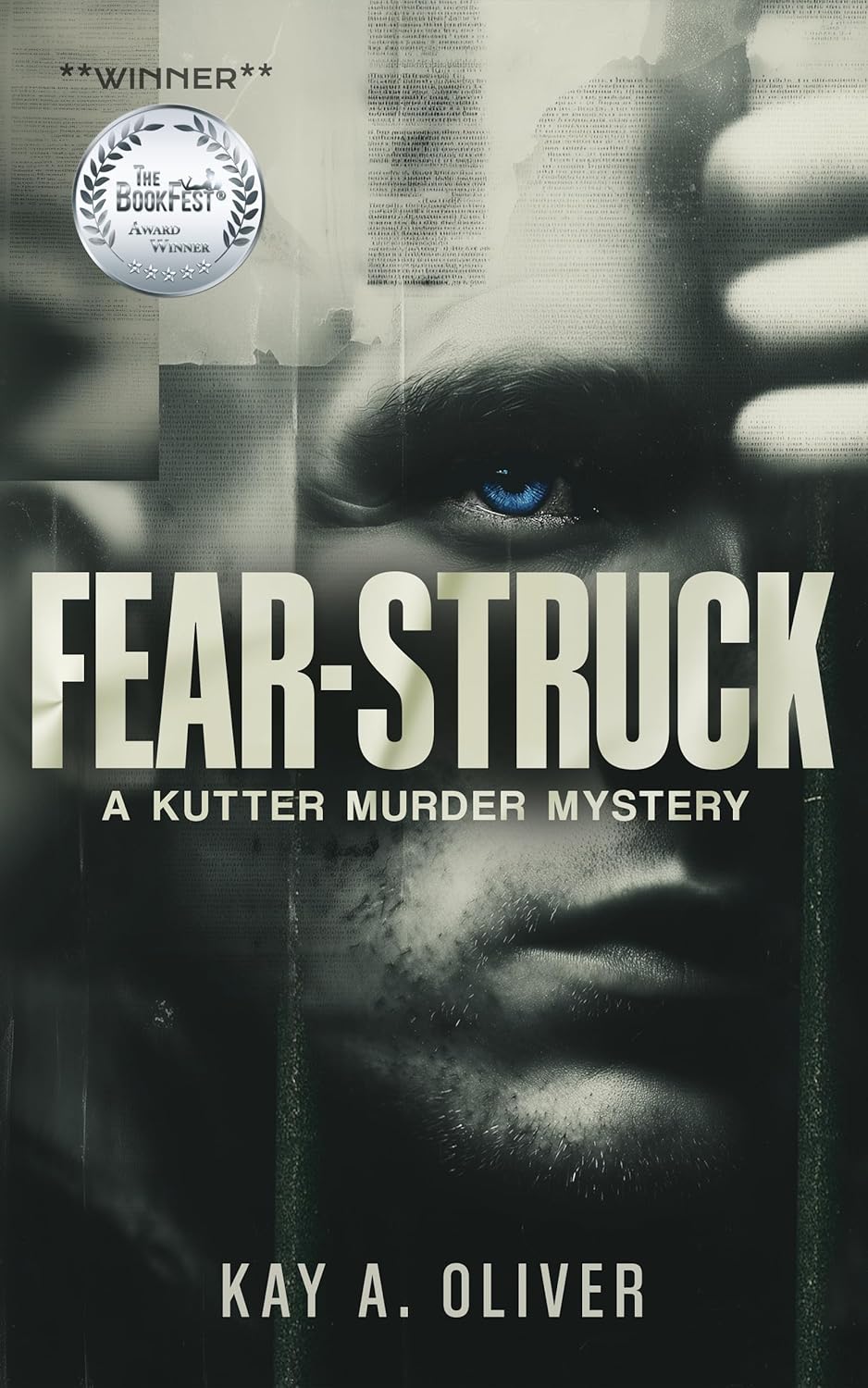

Fear Struck was intense and emotionally powerful, and also kind of creepy. It starts with Orson Kutter, a crime writer whose imagination bleeds a little too close to real life. One minute he’s hammering away on his keyboard, writing about murder and mystery, and the next, the cops are breaking down his door and slapping cuffs on him for killings that look suspiciously like scenes from his books. It’s one of those stories where reality and fiction twist around each other until you’re not sure which one’s real anymore. The whole setup feels like watching someone slowly wake up inside their own nightmare. It’s dark, smart, and honestly a little creepy in that “am I next?” kind of way.
I’ll be honest, this book made me anxious in the best way. I love a good murder mystery, and Fear Struck doesn’t just give you one, it gives you layers of them. I kept trying to guess if Kutter was guilty, if he was being framed, or if he was losing his mind. The writing pulls you into his paranoia so deeply that you start feeling trapped with him. The scenes in the jail, the smell of sweat and fear, the endless echoes, I could almost hear it. The story moves fast, but not in a shallow way. Every chapter left me thinking, “Okay, just one more,” until it was 2 a.m. and I was questioning my life choices. What really hooked me, though, was how Oliver plays with the line between author and character, fiction and truth. It’s almost meta, but not in a pretentious way.
The writing is really sharp. I like how Oliver doesn’t waste time with fancy words or filler. It’s cinematic, full of tension, and just messy enough to feel real. There were moments where I felt sick for Kutter, moments where I didn’t trust him at all, and moments where I wanted to scream at everyone around him for being blind. That’s good storytelling. Some parts slowed a little, sure, and a few twists I saw coming, but the emotion stayed raw. There’s this heavy mix of guilt, fear, and desperation that makes the book feel alive.
If you like stories that make your heart race and your brain spin, this one’s for you. Fear Struck is perfect for murder mystery junkies who like their thrillers dark, psychological, and just a little too close to home. I’d recommend it to anyone who enjoys Gone Girl or Misery but wants something with its own strange heartbeat.
Pages: 392 | ASIN : B0FRRK8HGX
Secretos De Familia

Secretos de familia by Diego Uribe is a dark and atmospheric thriller that begins with the brutal murder of Emilia Blume, a young woman found dead in her bed with a knife in her heart. The novel unfolds through the investigation led by Inspectora Benatar, who digs into the twisted secrets of the Blume family and the eerie village of Fénix, where superstition, religion, and silence suffocate the truth. What starts as a crime story turns into a psychological puzzle, exploring guilt, repression, and the thin line between love and cruelty. Every chapter drags you deeper into a web of lies and trauma that sticks to your skin.
I have to say, the writing pulled me in right away. The opening scene hit me hard. The author knows how to play with tension, silence, and imagery. The prose feels cinematic, almost like you’re standing in the cold hallways of that cursed house. Sometimes it gets dense with description, but it works. The pacing shifts a lot, slow burns followed by quick bursts of violence, but that uneven rhythm fits the story. It mirrors the confusion of the characters. I found myself anxious, even a little angry, at how the family hid behind politeness and religion while something monstrous was rotting inside their home.
What really got to me were the ideas under the surface. This isn’t just about a murder. It’s about control, silence, and what people will do to keep appearances intact. The women in the story, Emilia, her mother, her sister, and even Benatar, carry a kind of pain that feels too real. There’s also this heavy sense of destiny, as if everyone in that village is trapped by something bigger than them. At times it made me uncomfortable, but that’s a good sign. The author doesn’t let you rest easy. You end up questioning morality, religion, and the price of loyalty.
Secretos de familia is a grim, emotional ride that’s not afraid to stare into the dark corners of the human soul. It’s the kind of book you finish and then sit in silence for a while. I’d recommend it to readers who love crime fiction with real psychological depth, people who like stories that mess with your comfort zone and make you think about the things families hide behind closed doors.
Pages: 343
Drenched in Midnight: Three Days of Night
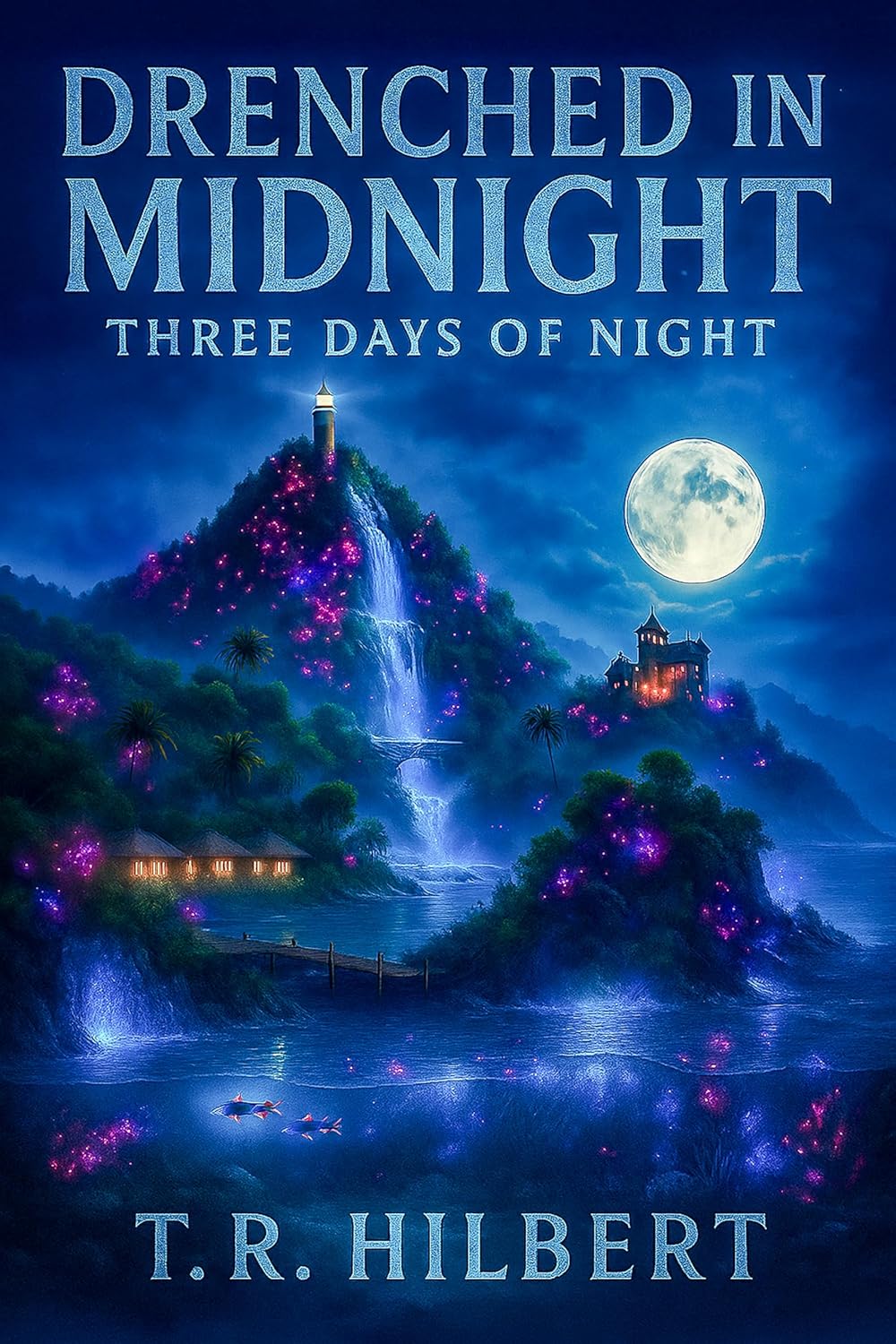
Drenched in Midnight is a haunting, dreamlike novella that drifts between love story, myth, and psychological unraveling. The book follows James and Laura, a couple who accept an invitation to a mysterious island resort called Embra. Their stay begins as an idyllic digital detox but quickly turns into a surreal exploration of memory, identity, and transformation. Guided or maybe manipulated by their enigmatic host, Byron, they find themselves entwined with an island that seems alive, pulsing with strange bioluminescent flowers and whispers of their own family histories.
The writing has that cinematic quality where you can almost smell the salt air and feel the humid stillness of the jungle. When the seaplane lands and the couple is greeted by linen-clad hosts whispering, “Welcome to the Isle of Embra,” I felt the tension coil right there. The author doesn’t rush. Every description of the glimmering tide pools, the glowing flowers, the hushed castle, is deliberate, seductive. It’s a slow burn that rewards patience. My favorite early moment was when James and Laura touch the glowing sand on the beach and realize it’s alive somehow.
What I loved most about this book is how it blurs reality. The alternating chapters between Byron, James, and Laura make you question who’s really telling the truth or if truth even matters here. Byron’s chapters, especially “The Host” and “The Keeper’s Secret,” have this eerie calm, like a cult leader convincing himself he’s benevolent. There is a quiet but unsettling intensity in the way he speaks of “guiding” his guests toward transcendence, and his fixation on the bloom, a luminous, sentient flower that draws life from human emotion, evokes both fascination and dread. But the emotional anchor is really Laura. Her realization that her family’s history is entwined with the island carries profound emotional weight. It’s that classic gothic moment, bloodlines tangled with curses, but reimagined with a sci-fi shimmer.
There are scenes that stuck with me long after I closed the book. When James and Laura find the Night Garden, for instance, the glowing petals, their bodies literally lighting up as they make love under the bioluminescent canopy, it’s both erotic and terrifying. The writing there is electric, unapologetically sensual without being gratuitous. You can feel the island consuming them, memory and identity merging until you’re not sure if they’re still themselves or just vessels for something ancient. Then there’s Byron watching them from the shadows, whispering, “The flower remembers.” That line still echoes in my head. It’s creepy, beautiful, and sad all at once.
Drenched in Midnight lingers long after its final page, not because of shock or spectacle, but because of the quiet reverence it builds for mystery itself. Hilbert crafts a world where memory, desire, and the natural world intertwine in unsettling harmony, leaving the reader both captivated and unsettled.
Pages: 136 | ASIN : B0FP9L8K3G

Life is Messy and Chaotic

The Unassuming Vector follows a gifted ten-year-old child who, after the death of his parents, is taken in by a mysterious organization that fosters exceptional children to further their clandestine agenda. What was the inspiration for the setup of your story?
The inspiration for The Unassuming Vector really came from my frustration with how many stories feel too linear and predictable. Life isn’t neat or perfectly structured—it’s messy, chaotic, and often full of contradictions. I wanted to write something that reflected that truth. For me, the story is less about extraordinary events and more about the human experience within them. I wanted my characters to feel real—to be humans first, defined by their vulnerabilities and emotions before anything else. Through this lens, The Unassuming Vector became a way to explore how people, especially a child with exceptional gifts, navigate a world that tries to shape them in ways that don’t always align with who they truly are.
Gaston and Alex are at opposite ends of the spectrum in terms of their moral compass. What were some of the emotional and moral guidelines you followed when developing your characters?
I wouldn’t necessarily say Gaston and Alex are opposites in terms of their moral compass. To me, Alex is more of a victim of unchecked ambition—a reflection of what can happen when drive and potential aren’t grounded by self-awareness or compassion. Her choices took a drastic turn, but they stem from very human desires: to be seen, to achieve, and to matter. It’s also important to remember that The Unassuming Vector is part of a six-part franchise. What readers see now is only a moment in a much larger journey. While Alex’s path might seem to be at a low point, things may evolve for her later, just as Gaston’s story might take an unexpected detour. My goal was to show that morality isn’t static—it’s fluid, shaped by circumstance, emotion, and perspective.
What were some themes that were important for you to explore in this book?
One of the most important things for me in writing The Unassuming Vector was to create an evolving story—one that takes readers on a genuine emotional journey. I wanted them to experience a full spectrum of feelings as they turn the pages: compassion, pity, anger, love, and even indignation. Life isn’t static, and neither are our emotions, so I wanted the story to reflect that natural ebb and flow. Another key theme was exploring the vicissitudes of life—its constant changes and unpredictability—through the lens of a child growing into adulthood. Seeing the world evolve alongside the character allowed me to examine how experiences shape identity, morality, and resilience over time. Ultimately, I wanted readers to not just follow a story, but to feel it deeply, as though they were living it themselves.
What is the next book that you’re working on, and when can your fans expect it out?
I’m currently taking a short pause from the Vector series to work on a sports thriller that’s packed with twists and unexpected turns. Beyond the thrill and tension of the story itself, it also takes a satirical look at some of the societal issues we often overlook in competitive environments. It’s been exciting to explore a different kind of narrative energy while still staying true to my love for complex, emotionally charged storytelling. Fans of the Vector series won’t have to wait too long, though—Gaston’s story is set to make a comeback in Mid 2027. In the meantime, the sports thriller is scheduled to debut in mid-2026.
Gaston, meanwhile, leads a major Tretfax initiative to create precision-enhancing weaponry, a project that the Pentagon successfully adopts. But when the same technology is distributed to a violent faction in an African nation, resulting in widespread loss of life, Gaston becomes disillusioned. Alienated within Tretfax and wracked with guilt, he leaves the organization and joins Biomer Energy, where he spearheads a revolutionary project that reduces carbon emissions by attracting bees to carbon dioxide. Just as he begins to find purpose again, Alex—having murdered the Tretfax CEO and seized control—sets her sights on acquiring Biomer to exploit Gaston’s discovery.
When Mountains Crumble

When Mountains Crumble tells the story of Faith Ansley, a private investigator haunted by the deaths and loves of her past. After losing her husband Jeremy in a tragic accident, she receives a mysterious letter that reopens old wounds and pulls her into memories of first love, betrayal, and grief that refuses to stay buried. The novel moves fluidly between Faith’s present and her youth, exploring trauma, obsession, and the ways love can both heal and destroy. It’s a blend of psychological mystery and emotional drama, unfolding slowly, like fog lifting from a valley.
Author Claudine DiScala knows how to paint a scene. Every coffee cup, every trembling hand, every heartbeat feels real. There’s a rawness to her style, and at times it’s intimate, like overhearing someone’s private confession. Some passages lingered with me long after I closed the book. The pacing occasionally slows. The flashbacks are intense and vivid, yet sometimes the shifts left me disoriented. But maybe that’s the point. Grief and memory are messy, and the novel captures that confusion better than anything I’ve read in a while.
This is an emotionally stirring book. I ached for Faith. I wanted to shake her and hold her in equal measure. DiScala writes about loss with an honesty that’s brutal but never cruel. The love stories within the story, Faith and Jeremy, Faith and Cole, feel like reflections of the same wound, revisited over decades. The author dives deep into trauma, obsession, and the danger of confusing passion with destiny. It’s not just a story about mourning someone else, but about mourning the person you used to be. By the end, I felt wrung out and oddly comforted, like I’d gone through therapy I didn’t ask for.
I’d recommend When Mountains Crumble to readers who like their fiction dark but relatable. If you’ve ever loved someone you shouldn’t have, or held onto a memory longer than you should, this book will speak to you. Emotionally, it can be heavy, but it’s beautiful in its honesty. For fans of psychological fiction that stirs up old ghosts and asks hard questions about love, guilt, and forgiveness, this one’s worth the read.
Pages: 358 | ISBN : 1509263268



 LITERARY TITAN