Blog Archives
La Llorona: The Awakening


La Llorona: The Awakening is a grief novel wrapped in folklore, family drama, and psychological suspense. Mary Romasanta builds the story around Ruth and Mi-Ra, two women tied together by love for the same family and divided by old wounds, cultural expectations, and the kind of pride that keeps people from saying what they actually mean. From the preface’s plain statement, “Grief is an unwelcome guest,” the book tells you exactly where it’s headed: into the rooms grief takes over, and into the strange things people start to hear, see, and believe when loss has nowhere else to go.
What makes the book compelling is the way it treats the supernatural as both literal and emotional. La Llorona and Mul Gwishin aren’t just spooky figures hovering around the edges of the plot. They’re part of how the book thinks about sorrow, motherhood, guilt, and inheritance. Water shows up again and again as danger, memory, temptation, and purification. The scares work best when they feel intimate, like a drip in the dark or a voice calling from just beyond what a character can prove.
The heart of the novel is really Ruth and Mi-Ra’s relationship. Their early scenes are sharp with resentment, especially around family traditions, fertility, food, and John’s attention. Mi-Ra can be cruel, but the book spends enough time inside her grief that she becomes more than a difficult mother-in-law. Ruth, meanwhile, has her own guardedness and ambition, yet she keeps choosing care when bitterness would be easier.
The pacing is intense, especially after John’s death shifts the book from a tense family gathering into a story about survival after devastation. Romasanta leans into big emotions, and the prose often has a cinematic, high-pressure quality: kitchens feel like battlefields, bathrooms become haunted spaces, and ordinary objects take on unbearable meaning.
La Llorona: The Awakening is an emotionally driven novel about how grief can isolate people, distort them, and still leave room for connection. It’s part ghost story, part family reckoning, and part meditation on the stories cultures use to explain pain. Its strongest moments come when folklore and domestic realism overlap, letting a haunted house, a strained marriage, a mother’s envy, and a grandmother’s longing all feel connected. The book stays with the question of whether sorrow will pull its characters under or teach them how to reach for one another.
Pages: 272 | ASIN : B0DQLXJB83

Stairwell To Silence
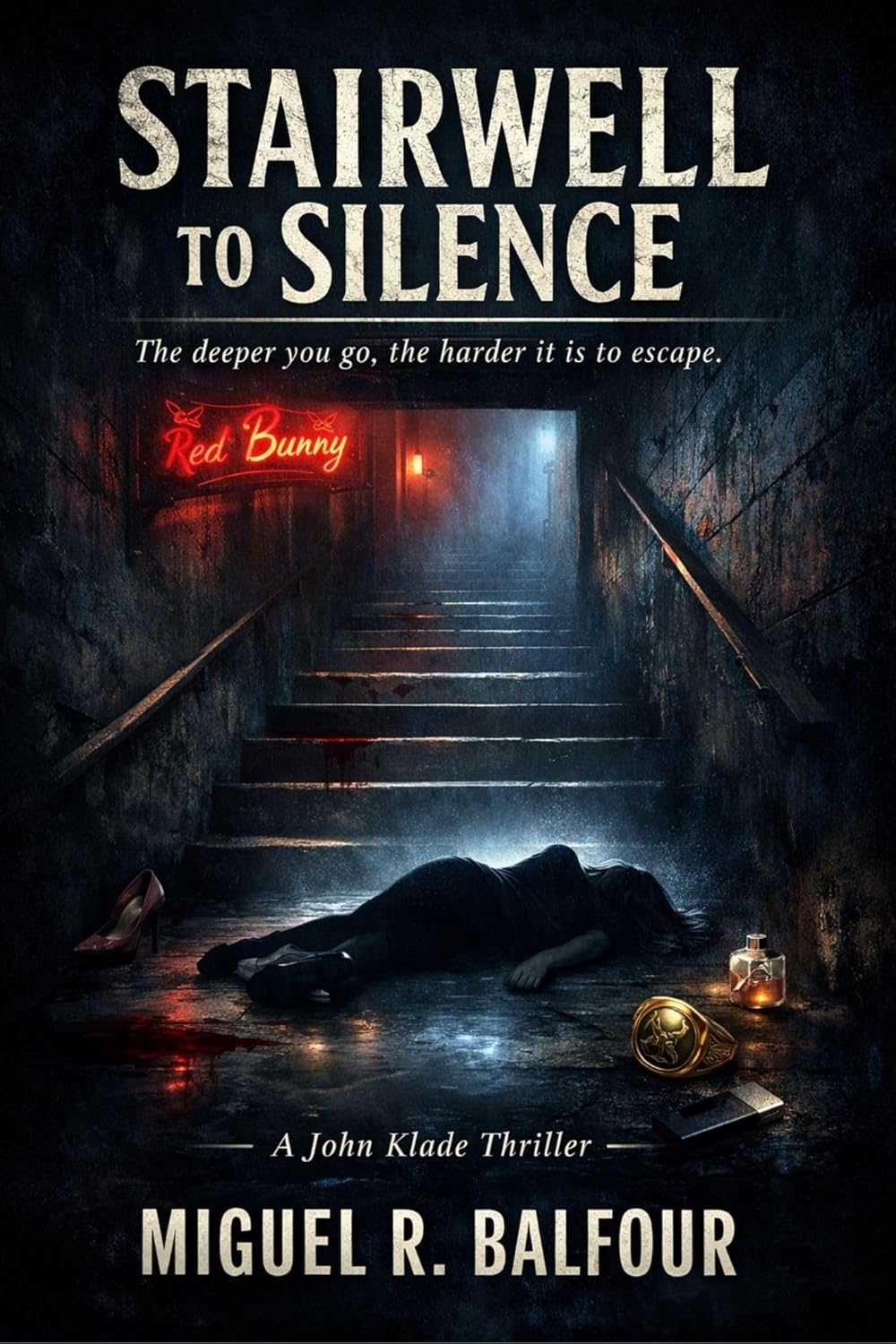
Stairwell to Silence opens with private investigator John Klade being warned away from a case he is destined to take anyway: the suspicious stairwell death of Bella Gaines, a brilliant law student whose “accident” quickly widens into a web of compromised police work, elite vice, military-adjacent secrecy, and family deception. What begins as a murder inquiry hardens into a conspiracy thriller, with Klade following bruises, burner phones, club back rooms, and buried wartime history toward a truth that keeps changing shape even after it seems cornered.
I liked this book most when it trusted its atmosphere, because atmosphere is one of its genuine strengths. Klade’s world is all controlled light, hard angles, quiet threat, expensive perfume, cheap coffee, and the procedural tenderness of someone who notices everything because he has learned what happens when he does not. The prose often leans deliberately hard-boiled, but it is not merely imitating noir; it has a chilly, polished texture of its own. I kept reading not just to know who killed Bella, but to remain inside that vigilant, airless mood the novel builds so well around surveillance, class, and private grief.
What I really reveled in, though, was the book’s interest in masks. Bella is not just a victim but a pressure point between institutions and identities; Marjorie arrives as bereaved mother and slowly reveals a more complicated moral silhouette; Ortiz never settles into a single readable role; and Klade himself is compelling because competence is both his armor and his damage. I did think the novel prefers momentum to stillness, so some emotional turns land more as sharpened revelations than as deep excavations. Even so, the book has real propulsion, and its later reversals give the story an undertow of melancholy instead of mere cleverness. By the end, the investigation has expanded far beyond one death, yet the narrative keeps returning to the intimate cost of using people as instruments.
I’d recommend this to readers of crime thrillers, conspiracy thrillers, detective fiction, noir suspense, and procedural mysteries, especially people who like capable, solitary investigators moving through corrupt systems with equal parts caution and stubbornness. It reminded me a little of Michael Connelly’s cleaner investigative drive crossed with the colder, more shadow-lacquered sensibility of David Baldacci at his most conspiratorial. This is a sleek, bitter-edged thriller that knows how to turn a staircase into a whole architecture of menace.
Pages: 391 | ASIN : B0GFCXT3WF

When Mountains Crumble


When Mountains Crumble tells the story of Faith Ansley, a private investigator haunted by the deaths and loves of her past. After losing her husband Jeremy in a tragic accident, she receives a mysterious letter that reopens old wounds and pulls her into memories of first love, betrayal, and grief that refuses to stay buried. The novel moves fluidly between Faith’s present and her youth, exploring trauma, obsession, and the ways love can both heal and destroy. It’s a blend of psychological mystery and emotional drama, unfolding slowly, like fog lifting from a valley.
Author Claudine DiScala knows how to paint a scene. Every coffee cup, every trembling hand, every heartbeat feels real. There’s a rawness to her style, and at times it’s intimate, like overhearing someone’s private confession. Some passages lingered with me long after I closed the book. The pacing occasionally slows. The flashbacks are intense and vivid, yet sometimes the shifts left me disoriented. But maybe that’s the point. Grief and memory are messy, and the novel captures that confusion better than anything I’ve read in a while.
This is an emotionally stirring book. I ached for Faith. I wanted to shake her and hold her in equal measure. DiScala writes about loss with an honesty that’s brutal but never cruel. The love stories within the story, Faith and Jeremy, Faith and Cole, feel like reflections of the same wound, revisited over decades. The author dives deep into trauma, obsession, and the danger of confusing passion with destiny. It’s not just a story about mourning someone else, but about mourning the person you used to be. By the end, I felt wrung out and oddly comforted, like I’d gone through therapy I didn’t ask for.
I’d recommend When Mountains Crumble to readers who like their fiction dark but relatable. If you’ve ever loved someone you shouldn’t have, or held onto a memory longer than you should, this book will speak to you. Emotionally, it can be heavy, but it’s beautiful in its honesty. For fans of psychological fiction that stirs up old ghosts and asks hard questions about love, guilt, and forgiveness, this one’s worth the read.
Pages: 358 | ISBN : 1509263268
Wednesday Night Whites

Wednesday Night Whites is a taut and provocative thriller set in the chilly backdrop of Chester, Nova Scotia. The story follows Azalea “Zale” Augustine, a determined lawyer drawn into a deep and dangerous conspiracy involving the town’s decades-long epidemic of missing women. What starts as a cryptic WhatsApp message leads her into a hidden war room beneath a beloved library, where truths unravel about white supremacy, political corruption, and the horrifying commodification of women. Zale’s world spirals as she learns one of her own law partners, an arrogant, magnetic, and secretly monstrous man, may be at the heart of it all. What unfolds is a story of fear, betrayal, strength, and the long shadows of history reaching into the present.
The writing is crisp and fast, the kind that doesn’t ask for your attention but grabs it by the collar and won’t let go. The dialogue, especially between Zale and her friend Jett, felt raw and real, like actual women whispering in a kitchen late at night. I found myself rooting for Zale hard. She’s sharp but not perfect, confident but wounded, and so very relatable. Her trauma is treated with care, not glossed over. The tension builds fast and deep, with revelations that made my stomach twist. Melvin does an incredible job layering dread with hope, fear with grit. The pacing is relentless in a good way. No fluff. No drag. Just a relentless storm of plot, character, and emotion.
But what stuck with me most was the guts of this story. The way it dared to look at how women disappear, figuratively and literally, and how society just keeps going like it’s normal. The white supremacy thread was chilling, not just because of its historical roots, but because it’s all too believable. There were moments I had to stop and take a breath. Melvin doesn’t hold back. And while some of the plot elements stretch reality, it never breaks. It just leans into its own dark momentum and dares you to follow. The villains are grotesque in a way that feels scarily possible, which makes the stakes feel even higher. Also, her writing on female friendship and resilience hit a nerve. It’s angry in the right places. It’s tender where it needs to be.
If you’re looking for a story that blends psychological suspense, crime drama, and social commentary with a raw emotional edge, this book is it. I’d recommend Wednesday Night Whites to readers who crave dark, intelligent thrillers with a strong feminist backbone. It’s for anyone who’s ever felt afraid walking alone or felt the chill of being dismissed, doubted, or watched.
Now Wait a Minute
What Lies Buried follows a woman married to a man with Complex PTSD who struggles to support him while protecting herself and their child as secrets from the past come forward. What was the inspiration for the setup of your story?
My characters inspired me. When I finished Secrets In The Mirror (which preceded What Lies Buried), I didn’t think there would be a sequel. However, early one pre-dawn morning, while in that half-asleep/half-awake state, Gavin intervened. He basically said “Now wait a minute. There are loose ends that must be tied up, and it will be dangerous for me to do that. And besides, you think I’m OKAY, after what you put me through in this story??!! Think again.” And he proceeded to lay out the plot. Well, most of it. So I did some research and realized that the emotional abuse and trauma he experienced all during his childhood in that first story probably gave him not just typical PTSD, but Complex PTSD, which is as difficult to treat as BPD (Borderline). As I began writing, following the thread Gavin revealed, his wife Katie – who’d often worried in the first book that the dysfunction in Gavin’s family might eventually manifest in him – came to me and told me her story. Many marriages in which one spouse has PTSD often don’t survive, and with C-PTSD it’s that most don’t, because C-PTSD has three additional symptoms that block the patient’s ability to respond to treatment. Then Katie reminded me that she’d always been SO responsible & selfless after her father died when she was a kid & she had to take care of her mother…so did she ever have passions for herself? Well, that led to a discovery in this book of what she’d buried long ago, and now she wants it back – but taking care of Gavin & dealing with the rollercoaster of his C-PTSD makes it nearly impossible.
What was your favorite character to write for and why? Was there a scene you felt captured the characters’ essence?
This story is a dual POV — Gavin & Katie. I used Gavin’s faithful counselor from high school (a long-time family friend), Dr. Pedersen, to enlighten Gavin, Katie & the reader about C-PTSD, and to show how it is affecting them & their toddler Maggie. Showing that is hard and dark on the reader, and a painful downer. Showing how it affects Katie & Maggie was a downer too, but the joy was in revealing how Katie re-discovers her talent & passion for art and finds new friends who encourage her to re-claim that & her identity beyond only being a caretaker of broken people. Katie’s friend Destiny, an intuitive spiritual artist from Niger, was fun to find & develop as a catalyst to Katie’s self-journey. Bringing Tray back as Gavin’s no-nonsense level-headed yet warmly caring friend was like a family reunion. And realizing Pedersen’s own history of loss & why ensuring Gavin’s well-being was so important to him personally was a meaningful development. Oh, and precocious little Maggie!! She steals the show, doesn’t she? Well, a kid, a one-eyed one-eared rescue dog who rescues this family — All the feels!☺️
The scene where Katie finds the picture of her nine-year-old self with her father posing with her blue-ribbon painting — how it affected Katie was emotional and meaningful for me. And the scenes in which she attempts to paint the light she wants to escape to, out of the darkness all around her – to freedom, to shelter from chaos… And the scenes where Maggie urges Mommy to FEEL, and Destiny urges her to BECOME… even more feels!
When you first sat down to write this story, did you know where you were going, or did the twists come as you were writing?
I had the “bones” of the story, which Gavin told me that early morning. But a story can lose its dynamic energy if you know it all before you begin. My characters take over, go places I hadn’t expected & discover things I hadn’t considered. I never know the end until ~three-quarters or later into writing the book. I hear about other authors getting excited when they finally type “The End”, but I’ve never done that. Because stories never really end. There’s always something that’s not fully resolved, something hanging in the air, in the characters…
What is the next book that you are working on, and when can your fans expect it to be out?
The end of What Lies Buried provides a hint of what is to come for Katie (perceptive readers will get it). So the next book is solely from her POV. Which doesn’t mean that Gavin & the other characters disappear, of course. I’ve begun writing that book – working title ‘Power Play‘ – but I’m also being nagged into writing a straightforward standalone psychological suspense (‘A Rose by any other name’) that keeps tugging at me. Which is a bit distracting. We’ll see which book wins prominence in line. Or maybe readers would like to vote on which they’d like to see, how soon?
Author links: GoodReads | Twitter | Facebook Books | Facebook Author | Website
Scarred by a lifetime of emotional abuse and traumatic violence, Gavin battles the triggers of Complex PTSD. His wife Katie is determined to support him despite the strain of his unpredictable reactions on their marriage.
But returning to Boston to settle his father’s estate reactivates Gavin’s childhood scars, and more triggers. Then when he uncovers his family’s mob history, his volatile reactions put him in the crosshairs of dangerous people. Worried for his safety, Katie packs up their toddler and joins him. While there, she begins sorting through her late parents’ keepsakes, finding evidence of the artistic talent she abandoned after her father died, when she became child caregiver to her disabled mother. Eager to revive her unfulfilled past, Katie copes with Gavin’s increasingly unstable behavior through her painting and new friendships that encourage her journey to self-discovery.
As Gavin resists treatment and goes off the rails, secrets of his family’s past threaten them all. The generational dysfunction in Kain’s award-winning Secrets In The Mirror continues, as Katie faces her own emotional wounds and must choose between saving her marriage or saving their child…and herself.
What Lies Buried

In What Lies Buried by Leslie Kain, the narrative immerses readers in a world shaped by the haunting aftermath of suicide and the complex web of PTSD. Leslie Kain’s writing style is notable for its depth and psychological insight, effectively drawing readers into the protagonist Gavin’s internal struggle. The aftermath of his brother Devon’s suicide, coupled with a suicide note that blames Gavin, propels him into the depths of PTSD. This situation is further complicated when Gavin is summoned to handle his father’s estate, unveiling layers of past trauma and mob threats.
Kain’s approach to character development is robust, particularly in the gradual transition of focus from Gavin to another central character, Kate. This shift adds dimension to the narrative, introducing new perspectives and escalating tension. The dual perspectives in the narrative structure initially position Gavin as the primary character, but as the story unfolds, Kate’s role becomes more prominent, adding depth and complexity to the plot. Katie’s character is resilient yet vulnerable as she navigates through the turmoil of her husband’s deteriorating mental state. The author skillfully transports the reader into Gavin’s mindset, enabling them to vividly experience his anxiety and the constant struggle he faces with PTSD. The book goes beyond traditional thriller elements, offering a nuanced exploration of personal trauma and family dynamics. While it might not align with conventional thriller expectations, Kain’s rich storytelling, marked by well-developed characters and an integrated backstory, provides a thoughtful reading experience.
The author’s ability to create engaging world-building and intricate character arcs strengthens the bond between the narrative and the reader, making What Lies Buried a compelling read that deeply engages with its characters’ internal struggles and the impacts on their relationships.
Page: 346 | ASIN : B0CSWW8CFL
I Love Twist Endings
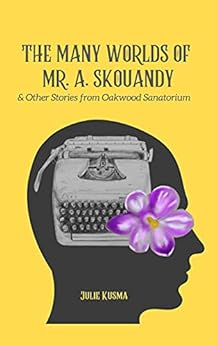

The Many Worlds of Mr. A. Skouandy follows a psychiatrist as he evaluates a patient that was dropped off and, in the process, learns the history of the patients in the sanatorium. What was the inspiration for this collection of short stories?
As my thesis for my MA.E.CW, Fic (Master of Art, English, Creative Writing, Fiction), I selected a collection of short stories instead of submitting a novel. I love to write short stories, and I love twist endings, so pulling a collection together was in my wheelhouse. I wanted and needed a theme to connect each story together. My answer was to bookend the story of Dr. Blanchard on both sides of the collection and connect the stories through the character of Aaron Skouandy and the sanatorium. Of course, the ending has a twist, which hopefully brings the reader full circle about the subject matter of each story and why it was included in my short story cycle.
I really enjoyed the short story “Silence So Deafening.” Do you have a favorite story in this collection, and why?
Silence so Deafening is a favorite of mine too, and it was placed in a contest and received publication, which was beautiful. But my favorite has to be Inseparable because my sister and I really stayed in the cabin this story is based on. I let her be the main character and kill me off. This delighted her to no end. Neither one of us has any plans to ever revisit the cabin. Ever.
What were some themes that were important for you to explore in this book?
The stories were centered around assignments mainly. For example, Baby Makes Three started off as a memory required for the first part of a project. My memory was about the adoption of my eldest son. The second part of this same project was to flip that memory on its head. I did just that and turned my characters into aliens and developed a plot around their baby. My professor immensely enjoyed it and commented that Science Fiction may just be my genre. I’m not sure about that. I haven’t written another Sci-Fi piece since.
What is the next book that you are working on and when will it be available?
I have two books in the final revision stage. The first is a collection of shorts (several previously published online). The majority unseen by the public and written after peers in the writing community asked me to please turn them into full-length stories and make them into a novel. The title is The Crooked Crone and Other Mystifications and is slated for publication this fall. The second novel, We Three: The Ipswich Chronicles, is based on the main character from the book previously mentioned, the Crone, and her sisters. The story is about how they learned they were witches and their journey to find the source of magic, and my Beta readers loved it. So excited to publish this novel, targeted for spring 2023.
Additionally, I have a couple of collaborations with my writing partner, Derek R. King, slated for this summer. First, the second volume, Amore, of our new The Lighter Half Series, which launched in February with volume one, Abracadabra. These are delightful and magical collections of poetry. Second, we have a wonderful poetry collection for children themed around faeries titled The Enchanted Faerie Realm. This children’s book is slated for publication in May of this year.
Author Links: GoodReads | Twitter | Facebook | Website
This short story cycle is a blend of psychological suspense, horror, soft science-fiction, alternate universe, and alternate history, thematically tied together by outcomes that are unanticipated, unintentional, and always unexpected.
The Many Worlds of Mr. A. Skouandy, the title story that bookends nine tales in between, is presented in the postmodern collage style, including admission forms and patient sketches before each piece and doctor’s notes after each. The stories can be read separately, but when read sequentially, a much larger story is revealed, generating this unique psychological horror novella.
The Many Worlds of Mr. A. Skouandy
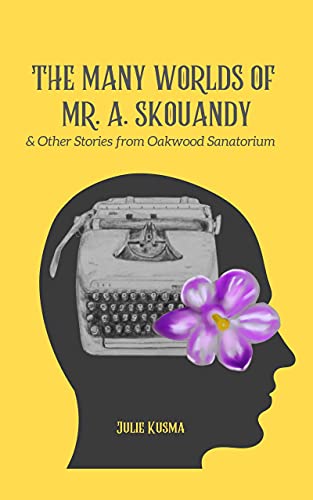
The Many Worlds of Mr. A. Skouandy & Other Stories from Oakwood Sanatorium is an assorted collection of short stories ranging from heartbreaking to horrifying. Author Julie Kusma explores loss, loneliness, grief, and a host of other mental afflictions in these winding, interconnected tales from the titular mental hospital. We follow Dr. Shepard Blanchard as he investigates the curious case of a newly admitted patient, one Mr. A. Skouandy and his mysterious knowledge of other patients in the ward. Dr. Blanchard becomes transfixed with Mr. Skouandy’s claims, and his investigation leads him on a journey through the origins of how the inhabitants of Oakwood Sanatorium came to reside there.
The main narrative takes place in the Oakwood sanatorium in the 1940s. We are not privy to Dr. Blanchard’s interviews with the patients; instead, we are treated to events in their lives that cause them to end up in Oakwood Sanatorium. The patient’s stories of loss or trauma and the resulting mental illness or psychotic break offer an interesting reflection on how the diverse characters deal with grief in their lives.
The author explores many genres: science fiction, fantasy, and horror are all represented here, while most of the stories are steeped in reality, as unsettling as it may be. The novel itself is a vehicle for some of Kusma’s works that have appeared previously. Dr. Blanchard’s prologues and handwritten notes offer a connecting thread to the stories, and it works to varying degrees. I feel some of the stories mesh well together in the setting, but others feel forced at times. “Free of Bees “and “The Writing Room” fit nicely. “Silence So Deafening” and “Baby Makes Three” have a very Twilight Zone-vibe, which works for this collection.
The Many Worlds of Mr. A. Skouandy & Other Stories from Oakwood Sanatorium is a collection of short stories collected from patients in a sanatorium, making it easy to combine elements from multiple genres. Readers who like the unusual, strange, and horrifying aspects of life will find this eclectic book a great escape from the day-to-day realities.
Pages: 172 | ASIN : B09FKCYN44


