Blog Archives
Layer of Tension

Born on Monday tells the story of two people with a shared history and whose lives are both scarred by heartbreak, who reunite under less than ideal circumstances. Where did the idea for this novel come from?
Born on Monday began as a short story called “Time Capsule,” which was published in my debut collection, 50 States. The original story was very much about how those who leave a place after high school are changed, whereas those who stay behind remain the same. Billy Stevens stays in Augusta, whereas the love of his life escapes to New York City. When I started exploring this aspect of the story —wondering whether they would ever reconcile their differences —it became increasingly clear that they would have to overcome a past mired in tragedy. More than that, they would have to face several present-day threats, including someone sinister who follows Jessica Michaud home. It was in discussing the progression of this story with a close friend that her real-life experiences and my own research into stalkers would inform much of the novel’s direction.
What do you find to be the most challenging aspect of writing a thriller?
For this thriller, it was very much a matter of who knew what and when they knew it. All the characters have different perspectives on their shared past, which not only dramatically shapes how they interact with each other but also how they perceive themselves. The same can be said for the reader, too. They inevitably know more than any one character, creating an additional layer of tension, but never know enough to predict the end. Born on Monday is very much a story with secrets within secrets, and the consequences of keeping them.
Do you have a favorite scene in this book? One that was especially satisfying to craft?
There were several, and the two that stand out for me may be among the most overlooked by readers. I very much enjoyed crafting the chapter where Billy and his current girlfriend, Autumn, reconcile their differences. It’s a tender, heartfelt moment amid the chaos surrounding them. The immediacy and intimacy of their reunion run deep. The second is Andrea’s visit to the Kennebec Journal. She meets with her boss and mentor to discuss the story she is working on, which also touches on what journalism means in a small town like Augusta. Having worked as a journalist, this chapter allowed me to rehash some old conversations with colleagues in a contemporary setting. More than that, it underscores why I was so thrilled that Andrea, who was initially meant to be a supporting character, grew to become such a strong protagonist.
What is the next book you are working on, and when will it be available?
My next work in progress (WIP) can best be described as a speculative thriller, blending and bending science, metaphysics, and something akin to the supernatural. It’s a continuation of the short story “Dead Ends” from 50 States. “Dead Ends” was one of the most called-out stories from the anthology and involves a young couple who take a reckless turn off a state highway in Utah and find themselves in a nightmarish government biohazard area. I’ve been relatively consistent in releasing a new book every other year, but I’m hoping to accelerate my pace so this novel is something readers can look forward to toward the end of 2026!
Author Links: GoodReads | X (Twitter) | Facebook | Website | Amazon
In Augusta, Maine, a historic nor’easter unearths sins and secrets buried deep in the town’s past. Billy Stevens, a quarry worker haunted by loss, is drawn into a web of betrayal when a brutal crime pins him as a suspect. Jessica Michaud returns to care for her ailing mother, only to find herself hunted by a vengeful ex whose chilling threats awaken old wounds. And journalist Andrea Kearney digs into a local dynasty’s corruption as the storm’s fury mirrors the rising tide of violence.
With time running out, three lives collide in a desperate fight for survival, where truth becomes a casualty and redemption comes at a cost. Eleven-time award-winning author Richard R. Becker delivers a gritty literary thriller that digs into identity, perception, and the human condition.
Born on Monday


Born on Monday tells the story of Billy Stevens and Jessica Michaud, two people tethered by shared history and unfinished feelings in the small town of Augusta, Maine. It’s a story about trauma, redemption, and how the past has a way of catching up even when we think we’ve buried it. The novel opens with a reunion that feels innocent at first, a meeting in a bar between ex-lovers, but it quickly widens into something much darker. Their lives, already scarred by heartbreak and regret, begin to tangle again through loss, addiction, and violence. Becker’s writing threads together memory and immediacy with quiet dread, pulling the reader through a story that feels both intimate and cinematic.
I couldn’t help but feel pulled under by Becker’s prose. It’s sharp but unpretentious. The way he writes about small towns feels dead-on, that claustrophobic mix of nostalgia and rot. His characters are flawed, all cracked open in ways that feel real, not performative. Billy’s grief feels worn and honest, and Jessica’s shame and self-doubt are haunting. I liked how Becker avoids grand speeches or easy answers. Every conversation carries an undercurrent, like everyone is speaking through layers of history. The pacing is deliberate, but it gives space for emotion to breathe. I found myself pausing often, not because the plot slowed, but because I needed to sit with the weight of what had just happened.
There’s something raw about the ideas Becker plays with, survival, masculinity, and cycles of trauma. Some scenes hit harder than I expected. The quiet domestic pain, the strange kindness between people who are barely holding on, the way memories echo through time. Becker writes people who keep trying, even when they shouldn’t. The story feels true in a way that most “redemption arcs” don’t.
By the end, I wasn’t sure if I felt heartbroken or hopeful. Maybe both. Born on Monday isn’t for readers who want neat resolutions or tidy morals. It’s for those who don’t mind sitting in the mess, who understand that healing isn’t about closure, it’s about survival. I’d recommend it to anyone who likes character-driven fiction that deals with real scars, not storybook wounds. Fans of small-town dramas like Sharp Objects or Winter’s Bone will find something familiar here, but Becker’s voice is his own.
Pages: 352 | ASIN : B0FSSN8XXZ

Guilt and Solitude

Where Despair Comes To Play follows a man consumed by the voices in his head who is convicted of murder and sentenced to prison, where the isolation drives him deep into paranoia, delusion, and dissociation. What was the inspiration for the setup of your story?
The inspiration for Where Despair Comes to Play came from a fascination with the fragile boundary between the mind and reality—how isolation, guilt, and fear can twist perception until the world itself becomes an echo of one’s thoughts. I wanted to explore what happens when a person is left alone with their own darkness, with no distractions, no noise—only the voices that feed on doubt and memory.
The prison setting became a metaphor for internal confinement. I wasn’t as interested in the crime itself as in what happens afterward—how a mind begins to fracture when trapped in silence and shame. Each of Malcolm’s voices—Paranoia, Delusion, and Dissociation—represents a piece of his psyche trying to survive the unbearable weight of guilt and solitude.
I always start my books with a well-refined thesis statement, similar to what I did for my doctoral dissertation. In many ways, the story was inspired by the question: If you can’t trust your own mind, where can you hide?
Malcolm is a fascinating character who draws readers into his mind and the horrors that reside within it. What scene was the most interesting to write for that character?
The most intriguing scene to write for Malcolm was the one where he finally stops resisting the voices—when Paranoia, Delusion, and Dissociation stop feeling like intruders and start feeling like his only companions. It’s the moment where his isolation becomes complete, and instead of fighting for sanity, he begins to negotiate with his madness.
Writing that scene felt like walking a tightrope between horror and heartbreak. I wanted readers to feel both fear and empathy—to see that Malcolm isn’t a monster but a man slowly breaking under the weight of his own thoughts. Capturing the moment when his inner voices start making more sense to him than reality itself.
What were some themes that were important for you to explore in this book?
My key theme was the personification of mental illness—turning Paranoia, Delusion, and Dissociation into living entities. It allowed me to explore how mental struggles can feel external and invasive, like something whispering just behind your thoughts. My ultimate goal for the book was to explore what happens when the mind becomes the battleground—and whether redemption is possible when your worst enemy is yourself.
What is the next book that you are writing, and when will that be published?
My next book is actually a love story, Framed in Love, that is steeped in fantasy and explores the psychological condition of “How far will you go, and what are you willing to do to keep that love alive?” In a world where love can be bound by spell and sacrifice, a devoted lover discovers that devotion has no bottom, and is preserving love worth losing everything that makes a person human?
Author Links: GoodReads | Amazon
As Malcolm struggles to separate reality from nightmare, every letter etched on the wall draws him closer to a final word he may not survive. The line between guilt and madness blurs, and the only question left is chilling: is he haunted by his own mind—or by something far worse that feeds on silence itself?
Morally Compromised Characters
Street Brotherhood follows a teenage boy in 1970s New York, as his search for loyalty and belonging pulls him into a dangerous brotherhood where survival blurs the line between family and gang. What was the inspiration for the setup of your story?
The story is about building a family of choice when your family of origin has betrayed you. It’s about brotherhood forged in the face of adversity, boys who are thrust into bleak and dangerous situations due to familial and systemic neglect. But it also shows how these kids don’t just endure and accept their fate. They strive to exploit it. Street Brotherhood is the second book in the Street series, picking up where the first book left off, but each of them works perfectly as a standalone.
What drew you to set Johnny’s story in 1970s New York, and how did that time and place shape the characters’ lives?
The city plays a huge role in this book. New York in the 1970s was on the brink of financial collapse. Municipalities were struggling under massive layoffs, landlords were selling–or torching–buildings to get out from the debt, and crime was skyrocketing. Johnny’s story reflects all of that. He is cunning enough to see the cracks in the system and is able to use them to his advantage. The story could not have been told in any other place or decade without being inauthentic because the conditions changed. Many of the scenarios are tied to my own experiences, since I came of age at the same time, hanging out in those same streets.
Johnny is both sympathetic and frustrating. How did you balance writing him as flawed yet compelling?
From a writing perspective, the flawed and morally compromised characters are the most fun for me. I love pushing those boundaries for the reader: How bad can a character act while still commanding sympathy? Johnny is a street-smart gang leader, with lofty aspirations, living in a very adult world. But he’s still a teenager. Sometimes his youth is an asset, but other times it’s a liability. That becomes apparent in some of the choices he makes. His gang can also be loyal to a fault, by letting his decisions play out. Peppering in the scenes from Johnny’s childhood helped me make him more sympathetic, while also explaining some of his defects.
The violence feels necessary rather than gratuitous. How did you approach writing those scenes to maintain authenticity without sensationalism?
Great Question. Violence in movies and on TV is so pervasive we become numb to it. On the page, however, it translates differently. My early drafts were dripping with brutal details, but thanks to my beta readers, I toned a lot of it down. I learned that what’s not said can be even more ominous. In Street Brotherhood, the violence is necessary in order for the story to be realistic. But violence is also action, and too many details will slow down the pacing, so I tried to maintain a balance.
Author Links: GoodReads | Website | Amazon
Johnny becomes involved with Marco, a tempestuous drug supplier who inspires admiration, but also rueful reminiscence of Johnny’s father. His demands challenge Johnny’s morals, but the payout is hard to ignore. As is Johnny’s aptitude for carrying out his lethal tasks.
Amid his nefarious entanglements, Johnny falls for Jessica. She is witty and self-assured, opening him to normalcy and tenderness for the first time. But as his worlds spin ever closer, will he escape the brutality of his past or be forced to embrace it?
Hard-Won Epiphanies

Secret Seeds follows a young girl and her mother who are trapped in an abusive home as they break free and wind up in an uncertain world of strangers in a cult-like community. Were you able to achieve everything you wanted with the characters in the novel?
My five novels center on redemption through courage and perseverance, which bring hard-won epiphanies. In Secret Seeds, I was satisfied with the character development, which also brought me personal insights on the plight of the undocumented.
What were some themes that were important for you to explore in this book?
When I began the novel, the headlines were filled with stories of aliens – both human and otherwise. Illegal immigration is an emotional topic, and I wanted to craft a heartfelt portrayal to cast the issue in human terms. We also took a trip to Alaska, and the lifecycle of sockeye salmon and how they fight to make the journey home to spawn resonated with me. Only a small percentage make it home, but none get lost due to their perseverance, and I incorporated this theme in the story.
What is the next book that you are working on, and when can your fans expect it to be out?
I am currently working on a medical thriller and hope to have it scheduled for release in the next year or so.
Author Links: GoodReads | Amazon
Gabrielle Ruiz, an undocumented migrant farm worker, follows the harvest until she and Luis leave the fields to give their unborn child a better life. But after tragedy strikes, Gabrielle finds herself alone and renounced by her father. Adrift, she meets Dale, a beacon of hope who offers her and her infant daughter, Olivia, a chance at a new beginning. After following him to Maine, they welcome a son. But over the years, Dale’s abuse traps Gabrielle and Olivia. Salvation appears in the enigmatic Rezi, who proposes a daring escape — a plan shrouded in secrecy, promising sanctuary for Olivia within a hidden community. As Gabrielle places her trust in Rezi, she ignites a tempest with Dale and has Olivia questioning whether her protectors are from a twisted cult or messengers from another realm.
In a world where freedom is fragile, Gabrielle’s tenacity and her children’s coming-of-age journeys lead them to question what truly defines “home.”
Hope of Survival

Blood on the Mountain centers on a young man navigating the expectations of his family and the pain of bullying while coming to terms with his own identity and sexuality. What was the idea, or spark, that first set off the need to write this book?
Having been raised in a religious family, unlike the main character’s experience in my book, I’ve faced my own share of bullies and name-calling. This led me to reach out to others who may be going through or have gone through a similar situation while growing up. Even though the story is fictional, I drew on research about other LGBTQ+ lives and their own battles. This was my inspiration for this.
What was one scene in the novel that you felt captured the morals and message you were trying to deliver to readers?
I would say it was the picnic scene. This scene took me a while to write. The message that I wanted to deliver was one of love, strength, and hope. Love between the two characters in the scene, the emotion and the strength of one character, experiencing the horror that was happening in front of him, the strength to fight and call for help, and the support and hope of survival.
What character did you enjoy writing for? Was there one that was more challenging to write for?
I enjoyed writing about Noah. I enjoyed writing about his challenges in his life, his survival, and finally seeing him embrace happiness with Joshua. The challenging character was Paul, his bully and tormentor. I spent hours researching the effects of someone abusing drugs and the consequences to his health.
What is the next book you are working on, and when will it be available?
I am working on a story that will continue over three books. Here is a synopsis of the story:
For most of his thirty-six years, Adam Keller has lived life like a shadow—quiet, invisible, and careful not to take up too much space. A gentle, gay bookstore clerk in a city that doesn’t always love people like him, Adam has spent his life surviving: his father’s rejection, a school history laced with cruelty, and a society that punished softness in boys. He doesn’t fight back. He just endures. Until the day he almost dies.
One morning walk in the park turns savage when a group of homophobic men ambush Adam and beat him within inches of his life. Left broken and bleeding, something inside him—something long buried and ancient—wakes up.
He survives. More than that…he changes.
The first book I am aiming for in Jan 2026.
Author Links: GoodReads | Facebook | Website | Amazon
Noah Bailey is suffocating in silence.
Trapped in an oppressive home ruled by religious dogma, he’s learned to hide who he is—and what he truly wants. But everything changes when he meets Joshua Taylor, a kind, fearless stranger who sees him for who he really is. For the first time, Noah dares to dream of freedom, love… and a future that’s finally his own.
But happiness doesn’t last.
A shocking betrayal from the past resurfaces just as Joshua is left fighting for his life. As Noah clings to hope, the ghosts of his school years begin to stir—bringing threats, secrets, and a trail of lies that refuse to stay buried.
With every revelation, Noah’s world fractures.
And the deeper he digs for the truth, the more he realizes someone is watching. Someone who wants the past to stay hidden—and who will do anything to keep it that way.
Love. Betrayal. Justice.
In this gripping story of survival and self-discovery, Noah must face his darkest fears and risk everything for the one person who gave him hope.
But when trust becomes a deadly gamble…
Can he confront the truth before it destroys them both?
Betrayal of a Sudden Death
Last of the Autumn Rain follows a woman who witnesses the death of her best friend in a tragic nightclub accident, causing her to spiral into a psychological journey that touches on abuse, betrayal, obsession, and revenge. What was the inspiration for the setup of your story?
My best friend committed suicide, and my ex-boyfriend tried to murder me. I wanted to take those external events to explore the raw aftermath of sudden trauma.
What are some things that you find interesting about the human condition that you think make for great psychological fiction?
The fact that humans are often their own worst enemies and have a skewed perception of reality is a goldmine for psychological fiction. A character’s memories can be distorted by trauma, guilt, or self-deception, which creates suspense and forces the reader to question everything they’re being told.
What were some themes that were important for you to explore in this book?
(1) Betrayal: It’s not just the betrayal of a sudden death, but the suspicion of deeper betrayals that drive the plot. (2) The Unreliable Self: The protagonist isn’t just an unreliable narrator for the audience; she’s unreliable to herself. Her memories are suspect, her perceptions are skewed by trauma, and she struggles to differentiate between paranoia and genuine threats, and a search for justice. (3) Search for Justice: Can earthly justice truly be served when the motive is fueled by obsession and a distorted sense of reality?
Will there be a follow-up novel to this story? If so, what aspects of the story will the next book cover?
Last of the Autumn Rain: The Storm Within is Book 1 of a trilogy called the Broken Reflections Series. Book 2 of the series is titled A Twisted Crucible: The Riddle of the Ruined Soul, and Book 3 is titled Game of Souls: The Reckoning. A Twisted Crucible is a chilling tale of what turns out to be a serial killer’s descent into darkness and a father’s agonizing choice. Game of Souls is a poignant exploration of grief, guilt, and the human capacity for redemption through the eyes of a father. It probes the depths of the human psyche, examining the power of ancient rituals and the transformative potential of psychedelic experiences to seek healing and enlightenment.
Author Links: GoodReads | Facebook | Diane Webb | Diane Louise Webb | Amazon
Her life ignobly snuffed out at the young age of 32, Candice exemplified a fun-loving lifestyle and a warm kindred spirit—possessing all the requisite traits for a promising future. She never entertained a trace of ill will toward anyone. How could something so grisly happen to such a compassionate, enchanting human being?
Julie struggles to make sense of it all, reminiscing as she travels back to her hometown of Trenton, New Jersey. The two had met in Milwaukee and worked as underwriters for The Walden Company. But something went horribly wrong. Julie’s journey is one filled with elation and fear, jealousy and regret, happiness and indignation, and a horrifying act of disloyalty.
An unforgettable, tumultuous ride, Last of the Autumn Rain delivers an introspective and jaw-clenching tale, which not only rocks one’s moral compass, but invites a chilling question: in a world where the ground can literally fall out from under you, what else might be lurking beneath the surface?
Last of the Autumn Rain
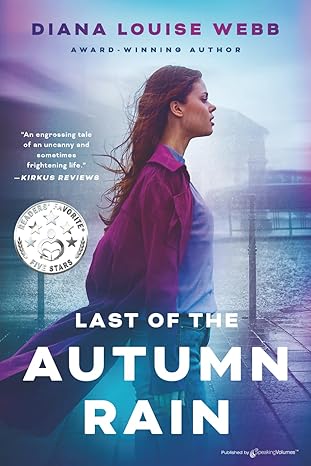

Diana Louise Webb’s Last of the Autumn Rain is an emotionally charged novel that weaves together trauma, tragedy, and mental health through the voice of a haunted narrator named Julie. The story opens with a deadly accident at a nightclub that kills Julie’s best friend and spirals into a psychological journey touching on abuse, betrayal, obsession, and revenge. As Julie revisits past experiences from her childhood in New Jersey to a near-fatal spring break trip to Mexico, she reflects on the forces that shape identity, morality, and the thin line between sanity and madness. With fictionalized events that feel brutally real, Webb holds nothing back in her mission to spotlight the stigma and neglect surrounding mental health.
The writing is sharp, vivid, and unsparing. Webb’s prose can be poetic in one moment and violently raw in the next. Her scenes of abuse and trauma are gut-wrenching without being gratuitous. I often found myself re-reading lines, not just for their emotional weight but because they caught me off guard in how directly they confronted the reader. There’s a beautiful messiness in the storytelling. Fractured timelines, flashbacks, inner monologues, and haunting hallucinations that all blend into Julie’s spiraling mental state. At times, the chaos felt overwhelming, but it always felt deliberate. It’s like the author doesn’t want you to read this passively, she wants you to feel every drop of blood, guilt, and silence.
I found myself torn over the narrator. Julie is not a reliable or particularly likable character. She is violent, self-serving, and damaged. But that’s kind of the point. I couldn’t shake the feeling that Webb was daring me to judge her. One moment, Julie is saving someone from abuse; the next, she’s casually describing a childhood act of horror with a twisted sense of pride. I didn’t always agree with the choices she made. The novel sometimes seemed to blur the line between victim and perpetrator, and I admired Webb’s courage in forcing us to sit with those contradictions. It’s rare to see a female protagonist written with this much moral ambiguity and rage. And it’s even rarer for a book to make me feel that conflicted and still want to keep reading.
Last of the Autumn Rain is not a light or easy read. It’s intense, messy, and emotionally exhausting, but in the best way. This book is for readers who crave raw truth over tidy resolution. It’s for those who have battled demons or known someone who has. I would especially recommend it to fans of Gillian Flynn or Alice Sebold, readers who don’t mind going into the darker corners of the human mind. Webb has something important to say about pain, silence, and survival, and she says it with brutal, unforgettable honesty.
Pages: 235 | ASIN : B0FGQMMC27



 LITERARY TITAN