Blog Archives
So You Want To Be A Psychotherapist


So You Want To Be A Psychotherapist, by Linda Soules, is another excellent addition to the So You Want To Be A… series. Rather than focusing on vehicles, technology, or specialized equipment, this career guide introduces children to a profession in which the most powerful tool is the ability to listen. Soules explains how psychotherapists help people understand their emotions and heal through careful, honest conversation. Written for readers ages ten to fourteen, the book treats children as thoughtful equals while presenting mental health and therapy in a warm, approachable, and respectful way.
The book offers a thorough look at what psychotherapists actually do, where they work, and what a typical day might involve. Young readers learn about the familiar two chairs, the tissue box, the fifty-minute hour, and the surprising “doorknob moment,” when a client reveals something important just as a session is ending. Soules also explores settings beyond the traditional office, including schools, hospitals, video appointments, and barns where therapists work alongside horses. Fun facts, practical listening exercises, a self-assessment quiz, and a kid-friendly glossary make the material informative and engaging.
One of the book’s greatest strengths is its honesty. Soules doesn’t sugarcoat the educational requirements, licensing process, ethical responsibilities, emotional strain, or risk of burnout that can accompany this career. At the same time, these challenges are presented without discouraging readers. The book emphasizes the importance of empathy, curiosity, emotional steadiness, self-awareness, and self-care. It also introduces influential figures such as Carl Rogers, Mamie Phipps Clark, Virginia Satir, Marsha Linehan, Anna Freud, and Derald Wing Sue, showing how different people and ideas have helped shape the profession.
The warm, inviting illustrations and straightforward language make So You Want To Be A Psychotherapist accessible to younger readers while offering valuable insights for teenagers, parents, and adults. It’s especially well suited to the child whose friends naturally turn to them, the quiet listener who offers patience rather than judgment. The book may also reassure young people who feel nervous about attending therapy by showing that psychotherapists are caring professionals trained to listen and help. Realistic, encouraging, and deeply compassionate, this career guide invites readers to consider whether one of those two chairs in a quiet room might someday be theirs.
Pages: 40 | ASIN : B0H7GJDPJV

So You Want to Be A Candy Scientist
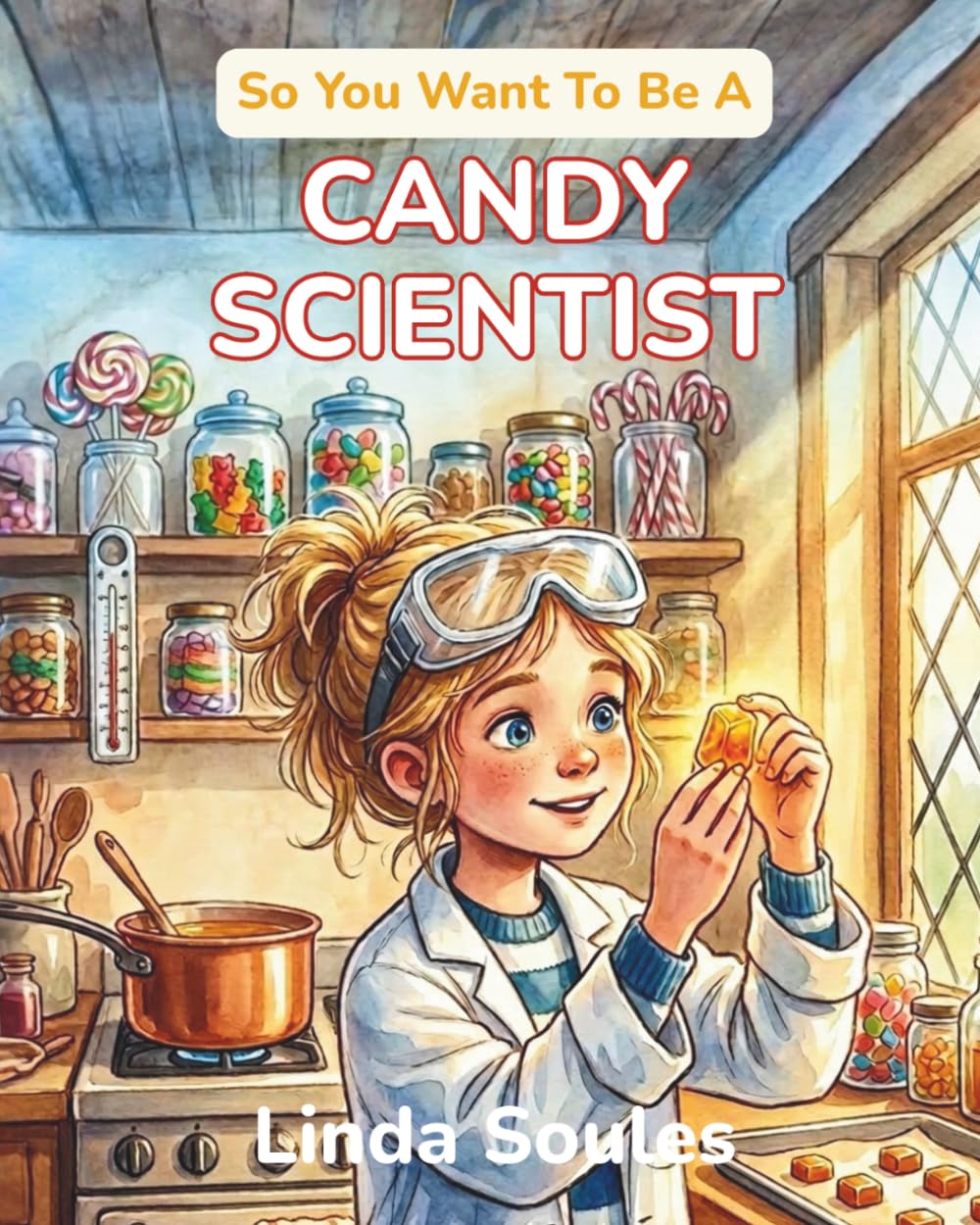
So You Want to Be A Candy Scientist is a delightful and informative children’s book that turns candy into a gateway for scientific discovery. Written for curious young readers, the book explores the fascinating work of candy scientists, showing how chemistry, creativity, and problem-solving come together to make the treats kids know and love. From gooey caramels and crunchy lollipops to chocolate that melts just right, Soules explains how small changes in temperature, texture, and ingredients can completely transform the final product.
One of the book’s greatest strengths is how accessible and engaging it makes STEM concepts feel. Rather than reading like a textbook, the book feels conversational and inviting, helping readers understand topics such as sugar stages, chocolate tempering, sour candy chemistry, and the science behind color and flavor. Young readers learn that a lollipop is technically glass, cotton candy is mostly air, and chocolate gets its satisfying snap from carefully formed crystals. These fun facts make the science memorable while encouraging children to keep asking “why.”
Author Linda Soules also does an excellent job introducing the real people and teamwork behind candy making. Readers meet pioneers such as Harvey Wiley, Milton Hershey, and Rebecca Robbins, whose discoveries helped shape candy safety, shelf-stable chocolate, and food coloring research. The book highlights that being a candy scientist is not just about tasting sweets all day; it takes patience, careful testing, communication, and the willingness to try again when experiments fail. This career-focused angle makes the book especially useful for classrooms, STEM lessons, and career exploration units.
The hands-on experiments and reference materials at the end make this book even more valuable. Activities such as growing rock candy, making edible sugar glass, and testing chocolate snap allow children to turn their own kitchens into mini laboratories. The colorful illustrations, clear explanations, glossary, and next-step resources all work together to inspire curiosity long after the final page. So You Want To Be A Candy Scientist is a fun, educational, and inspiring read for families, teachers, and young learners who want to discover how science helps make the world a little sweeter.
Pages: 38 | ISBN : 978-1972766590
So You Want To Be A Fashion Designer

So You Want To Be A Fashion Designer, by Linda Soules, is an inspiring and highly engaging introduction to the world of fashion design for young readers. Written for kids ages 10 to 14, this illustrated guide follows the creative journey of a garment from the first rough sketch to the runway. Soules presents fashion as far more than glamorous clothes; she shows it as a form of communication, identity, problem-solving, and wearable art.
I loved how the book balances the excitement of fashion with the realities of the profession. Readers learn that designers must think like artists, engineers, storytellers, material scientists, and problem-solvers. The book explores trend forecasting, fabric choices, sketching, sewing, garment production, and the teamwork involved in bringing a collection to life. It also doesn’t ignore the more difficult parts of the industry, including tight deadlines, copied designs, sustainability concerns, waste, and the importance of fair treatment for workers.
Soules fills the book with fascinating history, memorable facts, and stories of creative visionaries such as Coco Chanel, Virgil Abloh, and Issey Miyake. Young readers will be surprised to learn details such as the origins of high heels and the extraordinary amount of handwork that can go into a single haute couture gown. The hands-on activities are especially valuable, encouraging readers to start a sketchbook, drape fabric, redesign or repair garments, and begin thinking like designers right away. The glossary and “The Most Important Qualities of a Fashion Designer” sections make the book feel practical.
This is much more than a simple career guide. Linda Soules writes with warmth, encouragement, and respect for her young audience, never talking down to them while still making complex ideas easy to understand. The vibrant illustrations and lively descriptions make studios, fabrics, and runways feel vivid and exciting. So You Want To Be A Fashion Designer is an excellent choice for creative kids, aspiring artists, and anyone curious about how clothing can help people feel seen, confident, and valued. It is educational, realistic, and wonderfully inspiring.
Pages: 38 | ISBN : 978-1972766347
The Whole Picture

So You Want To Be A Professional Athlete offers young readers insight into becoming a professional athlete, focusing on talent, discipline, and handling the inevitable pressure. Why was this an important book for you to write?
Because the dominant story kids are handed about professional athletes is almost all highlight reel — the game-winning shot, the gold medal, the 10 seconds that make the broadcast — and almost none of the 10 years behind those 10 seconds. I wanted to write the book that lives behind the camera. The 5 AM alarms. The ice baths. The thousand quiet repetitions a coach asks for to get one motion automatic. The work nobody films.
I also wanted to push back, gently, on a phrase I think hurts a lot of young athletes: “natural talent.” The book makes the argument as plainly as I could that the athletes who last aren’t necessarily the most naturally gifted. They’re the ones who take the whole job seriously — recovery, sleep, nutrition, mental preparation, the parts no one applauds. Talent gets you to the starting line. Discipline gets you to the finish. That’s a truer story, and I think it’s a kinder one, because it tells a kid that what they can control is what actually matters.
One of the book’s strengths is its honesty about injuries, routine, and the short length of many sports careers. Why was it important to show those realities?
Because a children’s book that hides those things isn’t really written for the kids; it’s written for the adults who don’t want to disappoint them. I think kids can hold the whole picture, and I think they’re better served when we trust them with it.
So the book tells them the average NFL career is about three and a third years. It tells them careers can end in a single moment of a single race — and then it tells them the Derek Redmond story, where a hamstring tears at the Olympic semifinal and the runner finishes the race anyway, on one leg, with his father’s arm around his shoulders. It tells them Simone Biles withdrew from a final she was expected to win because something inside her body was wrong, and that this was the most professional choice she could have made.
What I want the young reader to take from this is not a warning. It’s an inheritance. Sports give a person something rare: a daily relationship with honest feedback. The clock, the score, the tape from yesterday’s practice — none of them flatter you, and none of them lie. A child who grows up inside that kind of feedback learns early what most adults spend decades trying to learn: how to see themselves clearly, how to take in hard information without falling apart, how to separate effort from outcome and keep showing up to both. That self-knowledge is the real gift of the work, and it travels with the athlete long after the uniform comes off. I wanted kids to see that whole, because the trophy is the smallest part of what they would actually be earning.
The book also has a page about retirement that I’m proud of. Almost every career book ends at the peak; this one walks a few steps further, to the empty stadium and the question of what comes next. I wanted children to understand that an athletic career ending in your 30s is not life-ending. It is the beginning of a second act that the first act has been quietly preparing you for the whole time. The discipline, the resilience under pressure, the ability to be coached, the habit of showing up before dawn when nobody is watching — none of that disappears when the career does. It becomes the foundation for whatever comes next, whether that is coaching, building a business, raising a family, returning to school, or something nobody, including the athlete, can yet imagine.
How did you approach explaining sports psychology, pressure, and mental preparation in a way that younger readers could connect with?
I tried to give them the actual vocabulary. Flow state. The prefrontal cortex going quiet so trained instinct can take over. Visualization. Pre-performance routines. Body intelligence — the ability to tell the difference between productive soreness and the early signal of injury. Once a child has those words, they can describe experiences they’ve already been having on the soccer field or at the piano bench but didn’t have language for.
I also leaned hard on the idea that the mental side isn’t separate from the physical side. It is the physical side, at the level where competitors are most evenly matched. In the 100-meter dash, gold and fourth place can be one one-hundredth of a second apart. Less than a blink. Everything an athlete does — every nutrition decision, every recovery session, every breathing protocol — exists to find that one one-hundredth of a second. Once a kid sees that, they understand why the mental work matters, and why a sports psychologist isn’t a luxury or a sign something is wrong. It’s part of the job.
What is one thing you hope young readers take away from So You Want To Be A Professional Athlete?
That athlete is not a job they have to wait to be given. The book ends with this line, and I mean it as plainly as I can: professional is a destination, but athlete is an identity. A kid lacing up shoes on a front porch, about to go outside and find out what their body can do — that kid is already an athlete. Nobody has to certify it.
Most professional athletes will tell you the same thing in their own words: the love of moving, of testing yourself, of getting measurably better at one specific thing through focused work — that’s what carried them. The contract came later. If a reader closes this book and goes outside, that’s the whole thing. The rest of the work, they can begin tomorrow morning.
And the deeper takeaway, whether or not sport ever becomes their chosen profession, is that the way a serious athlete learns to live is the way any serious person learns to live. Showing up before dawn when no one is watching. Doing the boring repetitions because that’s where mastery actually resides. Losing, looking honestly at why, and trying again. Trusting a coach. Trusting a team. Being patient with a body, or a skill, or a goal that is improving on a timeline you cannot rush. Those habits not only build athletes. They build doctors, engineers, teachers, parents, and citizens. A child who learns them through sport carries them into every room they will ever enter. The trophy on the shelf is a small thing. The person formed in the pursuit of it is the whole point.
Author Links: GoodReads | Website | Amazon
This illustrated nonfiction guide takes young readers ages 10 to 14 inside the real world of elite sports — not the highlight reels and trophy ceremonies, but the thousands of hours of training, discipline, and sacrifice that happen long before the arena lights come on. From pre-season conditioning and sports science to in-season competition and recovery, this book shows kids what professional athletes actually do every single day to perform at the absolute edge of human capability.
You will discover how athletes build their bodies through periodized training programs, nutrition science, biomechanics, and carefully planned sleep and recovery. You will learn how they develop the mental toughness and psychological resilience to handle pressure, failure, and the relentless scrutiny that comes with competing at the highest level. And you will see why mindset and discipline matter just as much as speed, strength, or natural ability — because at the professional level, the margin between winning and losing is smaller than most people can imagine.
This is also a book about what a sports career really costs and what it gives back. It covers the full arc of an athletic life — its intensity, its brevity, and how the best athletes build confidence and prepare for what comes after the final game. It explores the team behind every athlete: the coaches, trainers, nutritionists, and sports psychologists who work in careful coordination so that one person, in one moment, can do something extraordinary.
Packed with vivid illustrations and real stories of what elite training looks like from the inside, this guide treats young athletes as equals. It does not talk down. It does not oversimplify. It brings kids all the way into a world most children only see from the stands — and gives them honest, specific answers about whether this demanding path might be their calling.
Whether your young reader dreams of competing in baseball, soccer, basketball, swimming, or any sport that demands everything they have, this book was written for the boy or girl who is never just playing. The one who is always competing, always measuring, always reaching for something just beyond their current best.
Somewhere right now, in a gym or on a field or in a pool, the next great athlete is doing the work that no one sees yet. This book is for the kid who wants to know exactly what that work looks like.
So You Want To Be A Coder (Computer Programmer)

So You Want To Be A Coder, by Linda Soules, introduces children to the world of computer programming in a thoughtful and expansive way. The book explains what coders do, where they work, the tools they use, the joys and frustrations of the job, and the qualities that make someone suited to it. Rather than treating coding as a flashy mystery, it presents programming as a patient craft built from problem-solving, curiosity, communication, and a willingness to keep trying when things break.
What I appreciated most was the book’s honesty. As a parent, I’m used to children’s career books that make every job sound shiny and effortless, but this one gives coding texture. It talks about failure without making it feel scary, and it explains that much of programming is reading, testing, fixing, asking better questions, and learning how to sit with not knowing. The writing has a calm confidence to it, and at its best, it makes coding feel less like a secret language for a certain kind of kid and more like a patient conversation between a curious mind and a machine.
The artwork gives the book a warm, almost storybook glow that softens a subject that could have felt dry. I liked the cozy desks, city windows, libraries, bedrooms, and team spaces, because they make the work feel relatable and lived-in. Some pages are more text-heavy than I’d expect for a traditional picture book, so younger children may need an adult beside them to slow the pace and talk things through. But that also gives the book substance. It doesn’t just skim the surface. It respects kids enough to explain real ideas, from debugging and version control to open-source communities and the quiet importance of writing clearly.
I found this to be a sincere, intelligent, and encouraging children’s book that treats children as capable thinkers. It’s a book to read together, especially with a child who likes puzzles, games, building things, or asking how everything works. I’d recommend it to curious elementary and early middle-grade readers, particularly those who might enjoy computers but need a clearer picture of what coding actually feels like.
Pages: 332 | ASIN : B0GX2ZQG3V
So You Want To Be A Vaccine Developer (Immunologist)

As a parent, I’m always looking for books that can take a big, complicated topic and make it feel exciting instead of overwhelming. So You Want To Be A Vaccine Developer does exactly that. This children’s book introduces readers to immunology, vaccine science, and medical research in a way that feels smart, honest, and accessible. It explains how vaccines help the immune system learn to recognize dangerous germs before they cause illness, using clear examples of memory cells, antibodies, and the body’s natural defenses. The book trusts young readers to handle real science and gives them the tools to understand it.
So You Want To Be A Vaccine Developer shows the actual work behind vaccine development. Young readers learn that vaccines don’t simply appear overnight. They come from years of careful research, antigen design, lab testing, clinical trials, data analysis, manufacturing, regulatory review, and global distribution. The book also introduces the many people involved in this process, including immunologists, virologists, statisticians, structural biologists, manufacturing scientists, and public health experts. I loved how this broadens a child’s view of science careers because not everyone thinks of this specific career path. And after COVID, I think it should be at the top of career lists.
This book shows that discovery is not just one person in a lab coat having a sudden idea, It’s teamwork, patience, problem-solving, and responsibility. The layout is student-friendly as well and reminds me of the “Who Is” style books that many kids already enjoy. Sections like “A Day in the Life,” the best and hardest parts of the job, surprising facts, career paths, and the glossary make the information easy to revisit and discuss. The bold scientific terms are helpful for building vocabulary, and the many illustrations add color and clarity to complex ideas like immune responses, ELISA testing, clinical trials, and lab work. I can see this book being especially useful for upper elementary and middle-grade readers who are curious about biology, medicine, or how scientists help protect communities.
What I liked most is the encouraging tone. The book connects science to real life by showing that the greatest reward of vaccine work is often invisible: the sickness that never happens, the outbreak that never spreads, and the child who stays healthy. It also handles vaccine development with a thoughtful and balanced approach. So You Want To Be A Vaccine Developer is informative, inspiring, and full of respect for young readers. I would gladly recommend it to curious students ages 10 to 14, and even younger children could enjoy it as a read-aloud introduction to scientific thinking.
Pages: 38 | ISBN : 978-1972766415


