Blog Archives
The Cost

Codename: WARLOCK follows a teen who, after a hit-and-run, awakens with supernatural abilities, but every life he saves leaves behind a trail, drawing the attention of governments who see him as either the ultimate weapon or an uncontrollable threat. What was the inspiration for your story?
I wanted to explore what happens in the real world if someone had Tom’s abilities. The book is not so much about the fantasy of having the abilities but about the cost of having them. And I lean into second-order effects for realism. For example, early in the book, Tom detects that an unconscious classmate is pregnant. He prevents the EMTs from giving her the wrong IV. But he’s the only person in the school who knew she was pregnant. So what’s everyone do? They assume he must be the father of the baby – how else could he know? That in turn affects his social life. That’s the sort of consequence that I wanted to explore. And as interventions scale, so does the cost.
Despite his unusual abilities, many of Tom’s early struggles are very recognizable teenage problems. How important was it to preserve that ordinary side of him?
Tom would like to be ordinary. His abilities make that difficult because he can intervene in situations where nobody else can. But doing so risks revealing just how extraordinary he is. Gail is important – she grounds Tom. Gail is much more than just the “Covert Asset’s Girlfriend”. Gail doesn’t have Tom’s abilities, but she is a full partner in the relationship. That ordinary relationship is what he wants to protect.
Once the government becomes aware of Tom, the novel begins asking whether he is a person, an asset, a weapon, or a threat. Which aspect of that conflict interested you most?
It was actually the interplay of all of them. Because different people want Tom to be different things. It’s part of that cost-of-power concept. The Cambodia incident in book 1 combines these conflicts – different interests want different things and not all of them can coexist. Book 2, No Limits, explores this conflict in more depth – with some twists.
The novel leaves considerable room for Tom’s abilities and role in government to evolve. How much of his future did you already know while writing this book?
The next book leans more heavily into the cost of doing what Tom can do. And it leans into Tom’s growing understanding of how doing what he does has unexpected ripple effects. Honestly, there are some places in book 2 that were hard to write, emotionally. But to answer the question, I knew the general direction of book 2 at the end of book 1. But characters in books do have a way of asserting themselves, sometimes in ways the author couldn’t predict.
Author Links: GoodReads | Website
At first, he uses his abilities to help. An impossible rescue. A life saved. But every time he helps, he leaves evidence. Evidence that comes with a price.
In the 1970s, in the midst of the Cold War, that evidence doesn’t go unnoticed. Governments start connecting the dots. Our government. And others.
He is a weapon. Or a threat.
Stakes rise from hometown interventions to geopolitical risk. Missions scale from domestic incidents to foreign covert operations. And Tom’s wife, Gail, gives him one rule:
Come home at any cost.
Because both of them have to live with the consequences. But what’s the cost?
Codename: WARLOCK


Codename: WARLOCK by Zack Volker is a coming-of-age science-fiction novel that gradually turns into a government and espionage thriller. It begins in 1975 with sixteen-year-old Tom Newell waking in a hospital after being hit by a car. Soon afterward, Tom realizes the accident has left him with extraordinary abilities. He can sense emotions and intentions, recognize lies, perceive things inside the human body, manipulate objects through telekinesis, and eventually do things that stretch far beyond those early discoveries. Volker takes his time with this transformation. Tom doesn’t wake up and immediately become a costumed superhero. He experiments, makes mistakes, tests limits, and spends a surprising amount of time worrying about who might notice. That patient approach gives the early part of the book an appealing sense of discovery. The question isn’t simply what Tom can do. It’s what a seventeen-year-old is supposed to do with abilities that can affect almost every part of his life.
Tom’s powers become especially interesting because they change the way he understands other people. He can’t easily ignore anger, fear, deception, or malicious intent because he can literally sense them. That makes high school drama, family conflict, relationships, and even casual conversations different for him. One of the strongest stretches of the novel involves the collapse of his family life. After discovering his father’s affair and being pushed out of his parents’ home, Tom returns to the family property on his seventeenth birthday and realizes, “I wasn’t sure where home was, but it wasn’t here anymore.” It’s a simple line, but it captures something important about the character. For all the extraordinary things Tom can do, many of his problems are painfully ordinary. He’s a teenager trying to figure out who he can trust, where he belongs, and what kind of adult he wants to become. His abilities may protect him physically, but they don’t spare him from abandonment, loneliness, or disappointment.
Gail becomes central to that process, and her relationship with Tom gives the book much of its emotional continuity. Their romance develops quickly, including marriage while they’re still young, but Volker spends considerable time showing them negotiating what life with Tom’s abilities actually means. Gail isn’t simply someone Tom rescues or someone who accepts every decision he makes. She establishes boundaries, particularly once she understands that Tom can sense her feelings, detect lies, manipulate nerve signals, and protect her in ways she can’t reciprocate. Their discussions about honesty, consent, secrecy, money, and danger make the relationship feel like a working partnership. That’s important because the scale of the story keeps expanding. High school problems give way to flying, government investigations, intelligence work, hijackings, kidnappings, counterintelligence operations, and missions overseas. Gail provides a personal center while Tom’s life becomes increasingly unusual.
The second half of the novel leans heavily into Tom’s evolution from unusually capable teenager to classified national asset, eventually receiving the codename Warlock. This section has the feel of a procedural thriller. Volker is interested in how extraordinary abilities might actually interact with ordinary institutions, so there are briefings, cover identities, aircraft, security classifications, debriefings, government handlers, operational rules, and arguments over jurisdiction and secrecy. Tom’s powers also continue developing in practical directions. He learns what he can accomplish by combining perception, mental tracking, telekinesis, and his instinctive awareness of danger. That makes many of the missions enjoyable because the solution often comes from Tom applying a familiar ability in a new way. The pacing is episodic, with one challenge often following another fairly quickly, but the episodes steadily build the consequences of Tom’s visibility. The more useful he becomes, the harder it is for him and the government to keep Warlock from leaving a trail.
What I enjoyed most about Codename: WARLOCK is the way it combines wish fulfillment with persistent questions about responsibility. Tom becomes immensely powerful, financially secure, highly skilled, happily married, and valuable to the government, so the book clearly enjoys letting him become exceptionally competent. At the same time, it repeatedly asks what that competence obligates him to do. He can walk past a problem and protect his secret, or he can intervene and risk exposing himself. Again and again, he chooses to help. By the final chapters, that pattern circles back to Sheriff Stockton, one of the first people to suspect that there was something impossible about Tom, asking him to risk exposure to save a child during a storm. The ending then brings the story back to family in a much more hopeful way, with Tom sensing that Gail is pregnant before she can tell him. It fits the book well. Codename: WARLOCK is ultimately a story about a young man discovering enormous power while building a life around it, and its most memorable moments come from watching Tom decide what kind of person that power will allow him to be.
Pages: 340 | ASIN : B0FVD3VDT5

Andromidus: A Bond of Brothers Thriller
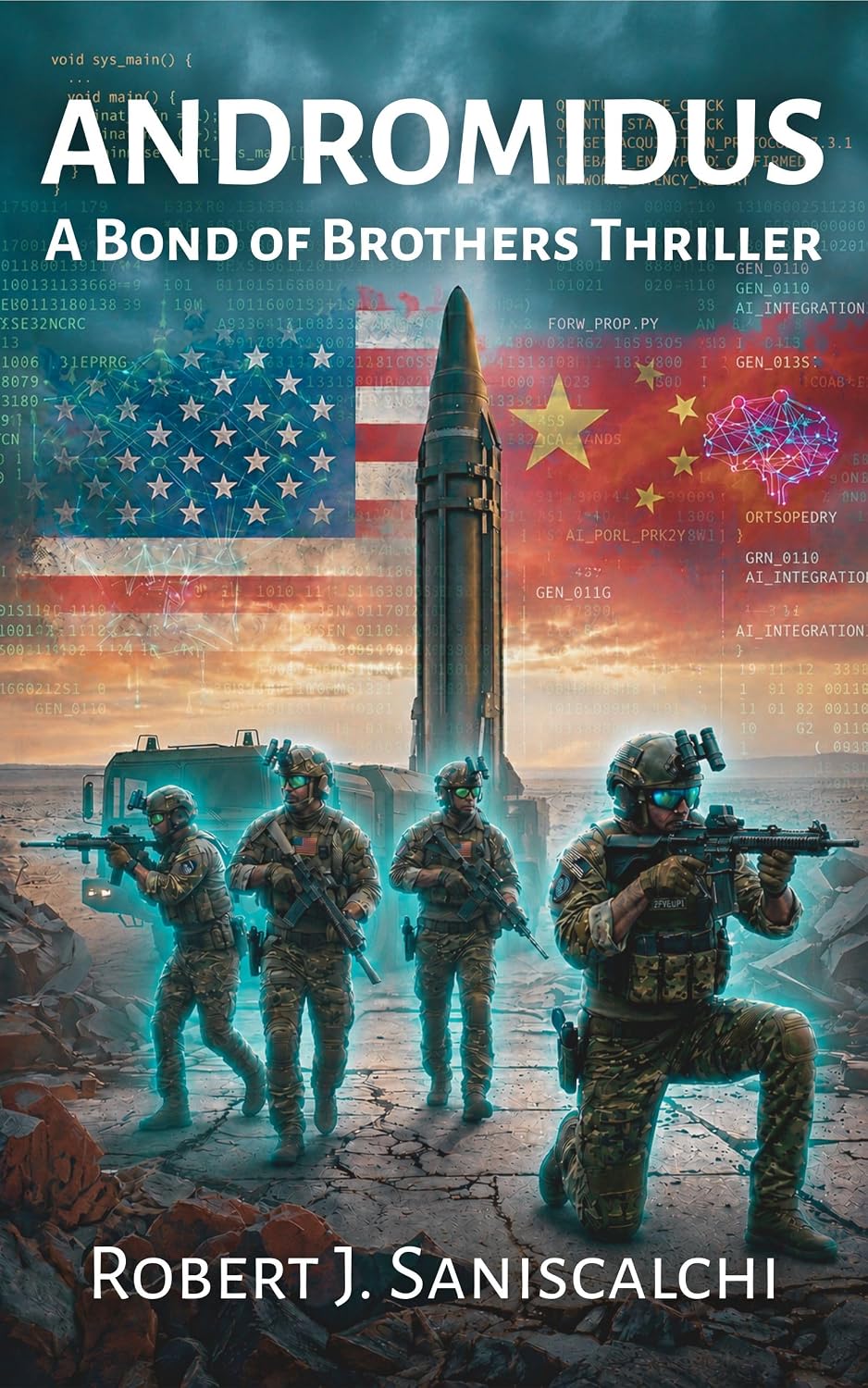

Robert J. Saniscalchi’s Andromidus is a military-tech thriller with its sights set on a future where artificial intelligence, battlefield innovation, espionage, and global power are tightly connected. The story builds on the Magnanotron technology of the earlier Bond of Brothers books, but the arrival of Andromidus gives this installment its own identity. Peter Androvski’s breakthrough is an AI system capable of learning, reasoning, recognizing people, protecting computer networks, and eventually helping direct sophisticated military technology. Saniscalchi pairs that scientific storyline with Special Forces operations, intelligence work, international maneuvering, and the increasingly dangerous determination of Chinese operatives to obtain America’s most closely guarded technology. The result feels less like a single mission and more like a widening conflict in which every new invention changes the stakes.
One of the book’s strengths is the way Saniscalchi moves between the big machinery of the thriller and the everyday lives of the people operating it. Delta Team’s joking, meals, family conversations, friendships, romances, Christmas gatherings, illnesses, and thoughts about retirement give the military action a personal context. That matters because this is very much a story about loyalty. Tex Larson reminds a newer member of Delta that the team is “all in it together,” relying on and protecting one another, and that idea runs through the larger cast as well. Scientists, soldiers, intelligence officers, political leaders, and families form different versions of the bond promised in the series title. Saniscalchi clearly enjoys spending time with these characters, and that familiarity gives the novel an easygoing warmth in between firefights, briefings, experiments, and emergencies.
The technology becomes especially engaging once Andromidus stops feeling like an experiment and begins affecting events on its own. Its confrontation with China’s Toknowa system turns cyberwarfare into a genuine contest between artificial intelligences, with Andromidus detecting the intrusion, defending X-Star’s systems, and locking its opponent out. From there, the novel gathers momentum around the theft of classified Magnanotron and Andromidus data and Wilu Phoyong’s attempt to escape America with it. The final pursuit brings together nearly everything the book has been developing: intelligence gathering, AI, satellites, aircraft, Magnanotron propulsion, the Patelaton missiles, and President Jameson’s long-running fear that the technology he’s responsible for protecting could fall into hostile hands. When Andromidus finally calculates the target’s location and helps guide the response, the invention that began as Peter’s ambitious project has become an active force in the story.
What stays with you after the final explosion is the sense that Andromidus is interested in people deciding what powerful technology should be used for and whom it should serve. The climax gives the AI a decisive role, with Andromidus making split-second choices that help stop the stolen technology from reaching China and finally lift the burden President Jameson has carried throughout the story. The quieter closing pages bring the novel back to family, friendship, service, and the passage of time, with Jameson looking back on the soldiers, scientists, intelligence officers, and friends who shared the responsibility with him. It’s a fitting destination for a thriller that combines combat hardware and futuristic AI with an abiding faith in human loyalty. Andromidus turns tomorrow’s technology into today’s battlefield and gives the machines plenty of power, but never forgets that courage, loyalty, and friendship are what make the mission matter.
Pages: 194 | ASIN : B0H4B7WBNB
Red Scorpion: Rising

Red Scorpion: Rising by Patrick Greenwood is a sprawling geopolitical techno-thriller that combines cybersecurity warfare, covert intelligence operations, military action, political intrigue, and a surprisingly warm family story. As the third and final Jack Kendall novel, it brings the series’ long-running themes of sacrifice, loyalty, grief, and service into one high-stakes conclusion. Greenwood draws on his Marine Corps background and decades of cybersecurity experience, which gives the book’s digital threats and intelligence conflicts a convincing sense of urgency.
The plot moves across the United States, China, Taiwan, Japan, Hungary, Switzerland, and other international locations as several crises begin feeding into one another. China prepares to move against Taiwan, the criminal hacker Dimi Zosh targets the Green Kyoto cryptocurrency network, and NSA Director Valerie Jones activates the secretive Red Scorpion program. Jack Kendall and his children, Regina and William, are pulled into a conflict involving stolen billions, blockchain vulnerabilities, assassins, deep-cover agents, military brinkmanship, and competing national agendas. This blend makes the novel a strong fit for readers searching for a cybersecurity thriller, military thriller, espionage thriller, political thriller, or international action novel.
What gives the story its personality is the way Greenwood keeps returning to the people caught inside the machinery of governments and intelligence agencies. Jack is a veteran and troubleshooter, but he’s also a father, grandfather, grieving partner, and man wondering how much of his life should still belong to danger. His developing relationship with Li Cao adds tenderness without disconnecting from the larger suspense plot, while Regina and William get meaningful roles in both the technical and emotional sides of the story. Valerie Jones, Red Scorpion One, Poppy Ledger, Hai Ming, and Dimi Zosh add different shades of secrecy, ambition, trauma, and obsession, creating a large cast whose choices continually reshape the crisis.
The book’s greatest strength is its scale. It reads like a season of an international espionage series, with short chapters, frequent location changes, technical problems, political confrontations, and action sequences that keep the pressure building. At the same time, its final movement understands that Jack’s real destination isn’t simply another successful operation. His quiet reunion with Li in Basel, where he chooses the life in front of him even though Dimi remains at large, gives the ending emotional weight. Red Scorpion: Rising is an ambitious geopolitical thriller with cyberwarfare, military suspense, romance, and family loyalty at its center, offering the Jack Kendall series a tense and heartfelt conclusion.
Pages: 320 | ASIN: B0H47Z6GBJ
Cyber Case Prima

Cyber Case Prima, by Ken Tentarelli, is a cyber-technothriller about a self-driving truck demonstration that turns disastrous when Prima Ace strikes a cyclist and keeps going. What first looks like a technical failure becomes something darker as Seph Carano and her CSA team dig into corrupted software, corporate pressure, autonomous vehicle testing, and a hacker whose motives are tangled up with grief and revenge. The story moves between government cyber work, startup ambition, and the uneasy question of what happens when smart machines fail in very human ways.
As someone who enjoys technothrillers, I liked how grounded this one felt. Tentarelli doesn’t treat the technology like magic. The lidar, software versions, testing procedures, and agency politics all feel connected to real systems, but the book stays readable. I never felt buried under jargon. The opening accident is a strong hook because it is visual and unsettling. A truck that simply does not “see” a cyclist is scary in a clean, modern way, and the book understands that the fear is not just the crash itself. It’s the silence after. The machine keeps moving.
I also appreciated the author’s choice to make the villain’s motive personal rather than cartoonish. The revenge thread gives the cyber plot an emotional pulse, even when the investigation is moving through code comparisons and agency approvals. Seph is a steady lead, curious and humane, and I liked that she doesn’t solve problems by acting like the smartest person in every room. She listens. She worries about mission drift. She notices people. Some scenes are more procedural than tense, and readers looking for constant explosions may find the pace measured. For me, that worked because the book is interested in process, not just payoff.
Cyber Case Prima is a thoughtful and accessible technothriller with a strong cybersecurity angle and a timely concern about autonomous vehicles. I would recommend it to readers who like Michael Crichton-style “what if this technology goes wrong?” stories, but with more investigative teamwork and less spectacle. It will especially appeal to readers who enjoy cyber thrillers that feel plausible, careful, and human at the center.
Pages: 266 | ASIN : B0D1BYLCFM
Minority And Female Action Characters

Address follows three sharp, secretive investigators as a campus murder tied to nanotechnology spirals into a geopolitical conspiracy threatening the President’s State of the Union. What was the inspiration for the setup of your story?
My inspiration was a negative inspiration. I noticed the lack of minority and female action characters in the literature who are also intellectuals (I am a Brown Belt in Taekwondo and fancy myself a developing scholar). I also noticed in the literature the marginalizing and trivializing of minority and female voices and achievements. I therefore set out to create larger than life minority and female characters who would in the end, save America.
Henry, Braum, and Camilla have very different voices and temperaments. Which character came to you first, and which was the hardest to write?
Camilla came to me first because I am a young African-American woman, fluent in Spanish and a student of Hispanic culture. Braum was the hardest voice to write simply because I am not a male Navy Seal law professor in his mid to late 30’s.
The novel balances grief, banter, violence, and political danger. How did you approach tone in a story that moves between personal loss and geopolitical stakes?
That is a wonderful question. I didn’t think about it as I was doing it. It seems that the following process happens for a lot of the writing that I have done. I simply put myself in the moment (inside the head of the character, the physical location of the character etc) and then the writing happens. The next time I write finds me in a different moment. The tone is therefore defined by the moment in the book that I happen to be writing about at that time. Once I’m done with Moment A, the next time I write, I will be in Moment B. I have never found myself trying to write in Moments A and B simultaneously.
The book has a very cinematic sense of escalation. Were there particular thriller writers, films, or real-world events that influenced its structure?
The most important real world event that is relevant to the book is the political tension that exists between the US and Russia/China. That tension drives the novel. “A Few Good Men” is one of my favorite movies and I feature it in the book. Other than that, I wrote the book against a mental backdrop of a lifetime of watching the standard action thrillers (e.g., James Bond, The Avengers etc). I wrote the book in the hopes that it will be adapted into a movie.
Author Links: Amazon | Website
Killing Einstein

Killing Einstein is a historical thriller with a wonderfully eccentric brainpan. Author Morris Hoffman imagines a wartime FBI surveillance operation around Albert Einstein and Kurt Gödel, then yokes it to espionage, philosophical argument, and an assassination plot. The story is told by Charlie Richards, a Bureau man whose first task is to trail the two thinkers through Princeton and eavesdrop on their walks, only to find himself drawn into their friendship, their ideas, and finally a lethal tangle of divided loyalties. It is, improbably, a novel about spies, logic, friendship, betrayal, and the terrifying gap between truth and proof, and it makes that odd compound feel deliberate rather than gimmicky.
Charlie is funny without being cute, self-deprecating without becoming shapeless, and just vain enough to feel human. Hoffman gives him a conversational intelligence that can pivot from deadpan Bureau satire to genuine wonder, and that tonal agility keeps the book buoyant even when it wanders into difficult intellectual country. The Einstein-Gödel scenes are the live wire here: Einstein comes off as playful, porous, almost meteorological in his energy, while Gödel is all fretful rigor and haunted exactitude. Their friendship has real charge. I didn’t feel that I was being handed two monuments in overcoats; I felt I was trailing two singular men whose minds alter the weather around them.
I was also surprised by how confidently the novel lets abstract thought matter. Many books flirt with big ideas and then retreat to plot when things get difficult. This one keeps its nerve. It asks me to care not only whether Einstein survives, but whether Charlie can understand what Gödel is trying to show him about incompleteness, and whether such understanding can actually change a life. That ambition gives the novel its splendor. The exposition is generous. Readers allergic to mathematical or philosophical detours may feel the gears showing. But I would rather read a book that risks density than one that trims its own mind to look more streamlined. Killing Einstein is thoughtful and contains more than a standard thriller usually dares.
I’d hand this to readers of historical thrillers, espionage fiction, alternate-history-adjacent suspense, and anyone who likes novels where ideas have teeth. Fans of Philip Kerr or Umberto Eco would probably find familiar pleasures here, though Hoffman is less noir than Kerr and less baroque than Eco; the closest comparison might be a wartime spy novel written by someone who genuinely enjoys the metaphysics. This is a book for readers who don’t mind being asked to think while the window glass is breaking. Killing Einstein is a thriller that makes the mind feel like a battlefield.
Pages: 218 | ASIN: B0GPHMMVPM
I kept pulling that thread.

Verified follows a journalist, an FBI agent, and a rebel broadcaster who uncover the truth behind a verification system meant to stop the spread of disinformation, but in reality is a form of control to decide people’s worth. What first sparked the idea of a society built around biometric “verification” as truth?
It started with Mark Zuckerberg’s January 2025 announcement that Meta was dismantling its entire third-party fact-checking program across Facebook, Instagram, and Threads—replacing it with a crowdsourced “Community Notes” system modeled on what Elon Musk built at X. Not because fact-checking had failed, but because the political winds shifted. One man, unelected, accountable to no regulatory body that could actually touch him, deciding what two billion users would no longer be protected from.
I kept pulling that thread. A few months earlier, Musk had used his Department of Government Efficiency operation to target the CFPB—the very agency that had been considering regulating X. The fox didn’t just enter the henhouse. He got a government ID badge. And I realized: if the information environment gets bad enough—and I think most people would agree it already has—then the demand for someone to fix it becomes overwhelming. And whoever answers that demand gets to define what “fixed” looks like.
The biometric verification system in the novel isn’t a dystopian invention. It’s a customer service solution. That’s what made it frightening enough to write about.
I wanted to write the version of authoritarianism that arrives with a thank-you email and a user satisfaction survey.
Maya is neither naive nor rebellious at the start—how did you build her internal conflict as she begins to see the system differently?
Maya was the character I was most afraid to write, because she’s the one who looks the most like the reader. She’s not ignorant of what the system is. She’s talented, credentialed, doing important work. She wins awards. And every one of those awards is given to her by the machinery she thinks she’s holding accountable.
Her internal conflict had to be slow because real complicity is slow. I didn’t want a dramatic red-pill moment. I wanted the accumulation of small compromises—a source she doesn’t follow up on, an angle she decides isn’t worth the risk, a story she kills because it would make the wrong people uncomfortable. She doesn’t change her mind about the system in one conversation. She changes it over dozens of conversations she chose not to have.
She’s every reporter at the Washington Post who watched Jeff Bezos kill their own paper’s presidential endorsement in October 2024 and went to work the next day anyway. That’s what complicity looks like in practice—not a dramatic betrayal, but a quiet Monday morning.
I built her conflict by making her good at her job. That’s the cruelest thing I could do to her. If she were bad at it, leaving would be easy.
The novel suggests that eliminating misinformation can come at the cost of freedom. What does the novel ultimately argue about how people accept systems that limit them?
I think the novel argues that people don’t accept limiting systems despite their intelligence. They accept them because of it. The Verification system works. It does, measurably, reduce misinformation. It does make daily life more navigable. And the people who designed it aren’t cartoon villains—they’re problem-solvers who got exactly what they asked for and couldn’t stop the machine once it started solving problems they hadn’t intended.
That’s not fiction. India’s Aadhaar system has enrolled 1.4 billion people in biometric verification. It works. It has reduced fraud. An eleven-year-old girl in Jharkhand also starved to death because her family’s food rations were cancelled when their Aadhaar link failed. China’s social credit infrastructure blacklisted over 200,000 people in 2025—46 percent for something as ordinary as a contractual dispute, not crimes. The EU’s Digital Services Act—genuinely well-intentioned—enabled platforms to make nine billion content moderation decisions in the first half of 2025. Nine billion decisions. Ninety-nine percent made by algorithms, not humans. The Green Zone isn’t a metaphor. It’s a design pattern that already exists in at least three different versions on three different continents.
The novel’s argument, if it has one, is that comfort is the most effective form of control. Not fear, not violence—comfort. The moment a system makes your life easier, you develop a stake in its continuation. And once you have that stake, every critique feels like a threat to your own stability. The zones in the novel—Green, Yellow, Red—aren’t enforced primarily by surveillance. They’re enforced by the fact that Green Zone residents have good coffee and reliable Wi-Fi and genuinely cannot imagine going back.
That felt like something worth writing about honestly, because I don’t think the answer is simple, and I didn’t want the novel to pretend it was.
What do you hope readers will question about their own relationship to truth and information after reading Verified?
I hope they notice the next time they feel relieved that someone else has decided what’s true.
Not outraged. Not suspicious. Relieved. Because that’s the feeling the novel is actually about—the gratitude we experience when a platform removes a post we find objectionable, when an algorithm filters our feed into something manageable, when a system promises us that the information we’re receiving has been checked, verified, approved. That relief is real, and it’s rational, and it’s the exact mechanism by which we hand over the authority to define reality to institutions that may not deserve it.
I don’t have a clean alternative to offer. The novel doesn’t either. The information environment is genuinely broken, and the people who say “just think for yourself” are underestimating the problem as badly as the people who say “let the algorithm handle it.” What I hope the book does is make that tension uncomfortable enough to sit with. Not to resolve, but to feel.
If a reader finishes Verified the same week Meta officially shut down fact-checking on Facebook and Instagram—not because the system failed, but because Mark Zuckerberg decided it was no longer politically convenient—and feels a flicker of something they can’t quite name, that’s the book working. That flicker is the moment before you decide whether the absence of a fact-check banner is freedom or abandonment. The novel lives in that pause.
Author Links: GoodReads | Website
Fourteen years after the Verification Act reshaped American society, a biometric implant behind every ear broadcasts who you are, what you’re worth, and whether you belong. The system was built to end an age of disinformation — and it worked. The deepfakes stopped. The conspiracy theories died. So did the freedoms no one thought to miss until they were gone.
Maya Chen is a star journalist at the Washington Herald, winning awards inside a system designed to make her work harmless. When a classified document crosses her desk, she begins to see the architecture of the cage she’s been decorating. Marcus Webb, a decorated FBI agent haunted by his father’s role in building the Verification system, follows a thread of falsified data into its rotten foundations. And in the Red Zone — where the Unverified survive without status, without medicine, without names — a former federal prosecutor named Emma Brennan runs a pirate broadcast network, willing to sacrifice everything for the revolution. Everything except the daughter the state took from her three years ago.
As their paths converge, Maya, Marcus, and Emma must decide what truth is worth when the system that defines it can erase you with a single scan. In a world divided into Green, Yellow, and Red — where your zone is your destiny and compliance is your currency — the most dangerous act left is to speak.
Verified is a novel about surveillance and complicity, about the seductive comfort of certainty and the terrible cost of letting someone else define what’s real. For readers of Kazuo Ishiguro’s Never Let Me Go, Dave Eggers’ The Circle, and Christina Dalcher’s Vox.


