Blog Archives
Kindness and Humanity

Killing Einstein follows an FBI agent assigned to surveil Albert Einstein and Kurt Gödel during World War II, only to be pulled into their friendship, ideas, and a deadly web of espionage, loyalties, and danger. What was the inspiration for the setup of your story?
I was a math nerd in a former life, and I’ve always been fascinated by Gödel’s incompleteness results. I’ve also always been fascinated by the fact that Einstein and Gödel walked together for so many years, and no one really knows what they talked about. So I thought I’d mix those two fascinations into a spy story.
How did you balance the demands of espionage plotting with the novel’s philosophical and mathematical ideas?
Great question. I am what they call in the fiction world a “pantser,” meaning I do not outline, I do not know who the characters will be, and I do not know how the story will proceed. I just get a core idea and start writing from the seat of my pants. That made balancing the spy story and the metaphysical ideas especially hard for me, and I ultimately found the balance during the long editing process. The original versions had a lot more math and were much less page-turning!
What were some themes that were important for you to explore in this book?
As a pantser, the themes bubbled up through the writing process rather than being planned in advance. Once everything settled, the themes I saw included Gödel’s insight that there are true things that cannot be proved true, but also the difference between right and wrong, and the difficulties all of us face when we confront that difference. The book also became about how some things are not what they seem, while the most important things are often exactly as they seem.
What did you most want to capture about the friendship between Einstein and Gödel?
Their energy, their love for one another, their kindness and humanity, and their shared devotion to the idea that there are deep truths—including moral truths—that are real and not relative. That may seem strange coming from the father of relativity, but Einstein’s theory is actually built on a remarkable invariant truth: the speed of light never changes, regardless of one’s frame of reference. Morally, against the backdrop of Nazism’s profound evil, neither man lost confidence in the reality of good and evil, though each remained sensitive to the challenges we all sometimes face in choosing between the two.
Author Links: GoodReads | Facebook | Website | Amazon
Killing Einstein


Killing Einstein is a historical thriller with a wonderfully eccentric brainpan. Author Morris Hoffman imagines a wartime FBI surveillance operation around Albert Einstein and Kurt Gödel, then yokes it to espionage, philosophical argument, and an assassination plot. The story is told by Charlie Richards, a Bureau man whose first task is to trail the two thinkers through Princeton and eavesdrop on their walks, only to find himself drawn into their friendship, their ideas, and finally a lethal tangle of divided loyalties. It is, improbably, a novel about spies, logic, friendship, betrayal, and the terrifying gap between truth and proof, and it makes that odd compound feel deliberate rather than gimmicky.
Charlie is funny without being cute, self-deprecating without becoming shapeless, and just vain enough to feel human. Hoffman gives him a conversational intelligence that can pivot from deadpan Bureau satire to genuine wonder, and that tonal agility keeps the book buoyant even when it wanders into difficult intellectual country. The Einstein-Gödel scenes are the live wire here: Einstein comes off as playful, porous, almost meteorological in his energy, while Gödel is all fretful rigor and haunted exactitude. Their friendship has real charge. I didn’t feel that I was being handed two monuments in overcoats; I felt I was trailing two singular men whose minds alter the weather around them.
I was also surprised by how confidently the novel lets abstract thought matter. Many books flirt with big ideas and then retreat to plot when things get difficult. This one keeps its nerve. It asks me to care not only whether Einstein survives, but whether Charlie can understand what Gödel is trying to show him about incompleteness, and whether such understanding can actually change a life. That ambition gives the novel its splendor. The exposition is generous. Readers allergic to mathematical or philosophical detours may feel the gears showing. But I would rather read a book that risks density than one that trims its own mind to look more streamlined. Killing Einstein is thoughtful and contains more than a standard thriller usually dares.
I’d hand this to readers of historical thrillers, espionage fiction, alternate-history-adjacent suspense, and anyone who likes novels where ideas have teeth. Fans of Philip Kerr or Umberto Eco would probably find familiar pleasures here, though Hoffman is less noir than Kerr and less baroque than Eco; the closest comparison might be a wartime spy novel written by someone who genuinely enjoys the metaphysics. This is a book for readers who don’t mind being asked to think while the window glass is breaking. Killing Einstein is a thriller that makes the mind feel like a battlefield.
Pages: 218 | ASIN: B0GPHMMVPM

Boy of Heaven
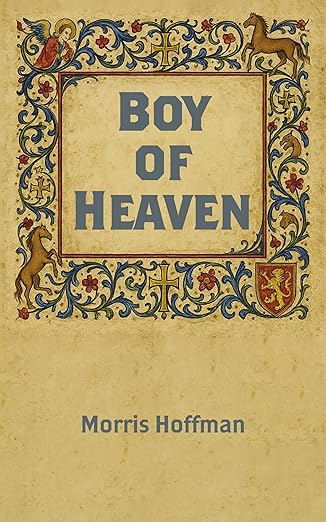

Boy of Heaven, by Morris Hoffman, tells the story of an orphan boy in 17th-century Milan who discovers a fading mural, Leonardo da Vinci’s The Last Supper, hidden in what has become the stables of a Dominican priory. As the boy labors among horses, he has named after constellations; he alone sees the painting’s slow return to clarity. What unfolds is a lyrical meditation on suffering, faith, grief, and vision. Hoffman’s novel blends historical fiction with a mystical edge, threading deep emotion through a richly imagined world.
Reading this book pulled something quiet but insistent from me. Hoffman’s writing is unusual, almost liturgical in rhythm. It doesn’t always make for an easy read, but it makes for a rewarding one. There were passages I reread just to feel them again. The boy’s interior world is raw and lonely, but never melodramatic. There’s very little action in the conventional sense. Instead, the story unfolds through daily labor, small kindnesses, and sacred echoes. And yet, I found myself emotionally swept up in the boy’s grief for a horse, his awe at a fresco, his quiet yearning to be seen.
I feel the book drifts at times. There were sections where the pace slowed, where there were long descriptions of the priory or repeated imagery. Everything is so reverent. Still, what the book lacks in momentum, it makes up for in heart. The blend of the sacred and the mundane, the way the horses become mythic, the mystery of the fresco, that’s where it shines. It doesn’t explain itself, and that made it feel more honest and more relatable.
Boy of Heaven isn’t just about art or faith or even memory. It’s about seeing what others miss and holding on to what shouldn’t be forgotten. It’s a quiet book, but it left a loud feeling. I’d recommend it to anyone who loves poetic writing, historical fiction with a spiritual bend, or stories where nothing much happens on the outside but everything changes on the inside. This is not a book to speed through. It’s one to sit with, one to cherish in silence.
Pages: 90 | ASIN : B0F7C4BSRP
Pinch Hitting

Morris Hoffman’s Pinch Hitting is a heartfelt tribute to baseball, woven into a narrative that explores the profound struggles of disability, grief, trauma, and loss. The novel artfully blends the emotional weight of these themes with the exhilarating intensity of baseball, creating a compelling and multi-layered story. The structure of Pinch Hitting is particularly intriguing, as it features a story within a story. The novel’s central character, Joe Skelton, becomes an unlikely narrator when he is diagnosed with a life-threatening brain tumor. This tumor manifests in an unexpected way—Joe begins narrating a vivid and original story in his sleep, surprising both himself and his wife, Katherine. They start documenting this tale, which evolves into Tales of Harold. As Joe races against time to finish Harold’s story before his own life ends, an invisible clock ticks away, adding tension and urgency to the narrative.
At the heart of Joe’s tale is Harold Fungo, affectionately known as the “Joltin’ Janitor.” Harold is a disabled janitor who unexpectedly finds himself thrust into the national spotlight as a professional baseball player, thanks to his remarkable pinch-hitting abilities discovered by a minor league team. The reader is taken on an emotional journey through Harold’s life, from his challenging childhood with a loving, deaf mother to the discrimination and betrayal he faces as an adult in the world of professional sports.
Hoffman enhances the storytelling with each chapter, beginning with a newspaper clipping that updates the reader on the latest happenings in Harold’s baseball world. This clever device adds authenticity to Harold’s rise in the sports world, while the alternating narratives of Joe and Harold create a rich, layered experience. The emotional journey of Joe and Katherine as they confront his illness is paralleled by Harold’s tumultuous path in baseball, where themes of racism, discrimination, and the deep bonds of teamwork come to the fore.
Pinch Hitting, by Morris Hoffman, offers something for everyone, whether you’re drawn to its deeply touching emotional core or the gripping excitement of baseball. Even those with little interest in the sport will find themselves captivated by the novel’s powerful storytelling and complex characters. This is a book that will resonate with readers, winning hearts regardless of their familiarity with the game.
Pages: 349 | ISBN : 978-1685134389


