Blog Archives
Ramparts of Winter Iron: When Frost Hammers the Gate
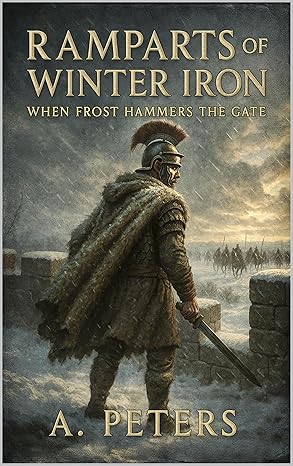

Ramparts of Winter Iron is a gritty and tightly woven historical fantasy set on the snowy fringes of a fading Roman frontier. The story follows Flavius Marcellinus, a seasoned Roman officer tasked with holding the fortress city of Caesarea against a rising tide of nomadic Alan invaders. With only raw recruits, improvised weapons, and the bitter cold at his back, Marcellinus must forge discipline out of desperation. The novel tracks his struggle through military drills, political tension, and a climactic night raid meant to cripple the enemy’s supply line. It’s both a tale of war and a meditation on duty, leadership, and the endurance of civilization under siege.
What I loved most was the sheer sense of place. The cold felt like a character all on its own. It was biting, unforgiving, and always present. Peters’ writing style is direct and powerful. There’s no fluff here, no purple prose. Every sentence pulls its weight. I appreciated how the author balanced action with introspection. Marcellinus isn’t a superhero. He’s tired. He doubts himself. But he pushes on. That kind of worn determination struck a chord with me. The battles are gripping, the tactics believable, and the stakes always feel real.
The book asks a lot from the reader. You’re dropped right into a cold and crumbling world with little time to catch your breath. At times, I found the sheer amount of logistical detail overwhelming, especially regarding the tactics. It’s clear the author did his homework, and I admire that. This book is a great pick for readers who love diving into the gritty, boots-on-the-ground details of Roman combat, from shield formations to siege engines and everything in between. But the details slow the story in moments when I wanted the story to move. Still, those slow patches are outweighed by the raw emotional honesty of the characters. Antonus, the reluctant farmer-turned-soldier, especially stood out. He gave the story a human core beyond all the spears and orders.
Ramparts of Winter Iron surprised me with its depth. It’s about building something worth protecting when the world seems bent on tearing it down. I’d recommend it to readers who enjoy Roman-era fiction, military history buffs, and anyone who’s drawn to stories of quiet bravery and stubborn hope.
Pages: 259 | ASIN : B0F71QK934

Ultimum Judicium The Last Judgment

David Navarria’s novel, Ultimum Judicium: The Last Judgment, is a gripping narrative that reimagines the end times as a brutal reality. The book stands apart from typical sci-fi or doomsday stories by grounding it in a world spiraling toward Armageddon. The author meticulously builds this world over a span of more than two centuries, detailing how society collapsed due to humanity’s moral transgressions fueled by media, corruption, and the worship of evil.
The story begins over two hundred years after civilization has fallen, with no remnants left behind. In this lawless and chaotic world, a prophet chosen by God, Mochè, rises as the leader or “Manhig”. His mission is to guide God’s remaining followers on an odyssey to a place of redemption. The journey is a constant struggle against a world now dominated by savage, nonhuman beings and evil humans.
Mochè is the heart of the story. He’s portrayed as a formidable warrior and a priest who leads his people with a deep sense of love and devotion. The book delves into his inner turmoil, particularly the temptation he faces in his love for Zipporah, an intelligent and captivating woman he rescues from a life of slavery. Zipporah is depicted as a strong and influential partner to Mochè, helping to build their new society.
The novel is rich with a diverse cast of well-developed characters. The story shines in its depiction of the subtle and not-so-subtle romances that develop, with the love stories of Zipporah and Mochè, Eliza and Matthew, and Gabriela and Benjamin forming a strong emotional core. These relationships provide moments of tenderness and hope amid the pervasive brutality of their world. The book also introduces other key figures, such as Goliath, a kind-hearted giant who serves God, and Nikanyiso, a formidable Zulu warrior.
The author excels at creating a constantly changing and suspenseful storyline. The narrative features intense and exciting battles that showcase Mochè’s strategic brilliance. The writing style is both clear and eloquent, effectively conveying the horrors of this fallen world while also capturing moments of profound beauty and spiritual reflection. The subtle yet powerful ways in which characters are introduced, alongside the detailed and vivid battle descriptions, contribute to a truly immersive reading experience.
Ultimum Judicium is a compelling and thought-provoking novel that subverts typical genre expectations. It is a story of love, faith, and resilience that navigates the complex and often brutal realities of a world on the brink of its final judgment.
Pages: 348 | ASIN : B0FL4K6K6M
Moral Compromise
Rhino follows a research scientist who discovers her father has terminal cancer and is entangled with poachers and smugglers, leaving her in a race against time to find a way out for him and a cure. What was the inspiration for the setup of your story?
The inspiration for the setup came from wanting to explore the collision of two very different worlds: the clinical, evidence-based world of modern medicine and the desperate, high-stakes world of the international wildlife trade. I was fascinated by the question of what could push a fundamentally good, logical person to cross a line they never thought they would.
I made Linh a research scientist for a specific reason. Her entire life is governed by data, ethics, and reason. By putting her in a situation where science and medicine seem to be failing the person she loves most—her father, an oncologist, which adds a layer of tragic irony—her foundation is shattered. This is what opens the door for a desperate, irrational choice.
The rhino horn itself is a powerful symbol. It represents this clash between ancient belief and modern conservation, between a daughter’s desperate hope and a global ecological crisis. It’s not just a simple illegal act; it’s a moral labyrinth. For Linh to even consider it, she has to betray her own scientific principles and become entangled with the very darkness that characters like Inspector Le and Nguyen Vu are fighting.
So, the setup—the scientist, the dying oncologist father, and the criminal underworld—was designed to create the ultimate moral pressure cooker. It’s a story born from the question: How far does love compel us to go, and can we find our way back once we’ve
crossed into the dark?
Linh is a woman with strength and determination. What do you think makes her a valuable and worthy heroine?
Thank you, I’m glad her strength and determination come through. For me, what makes Linh a valuable and worthy heroine isn’t that she’s perfect or always makes the right choice, but precisely because she doesn’t.
Her heroism is rooted in something incredibly human and relatable: the fierce, unconditional love for a parent. She isn’t a trained operative or a hardened detective; she’s a scientist thrown into a world she doesn’t understand, armed only with her intelligence and a desperate need to save her father. Her initial strength isn’t about physical power, but about her refusal to accept defeat, even when all logical paths are closed to her. But what truly makes her worthy, in my eyes, is her fallibility. She makes terrible, morally compromising decisions. She lies, she steals, and she gets involved with a ruthless criminal. This is where her real journey begins. A perfect heroine doesn’t have to grow. Linh is forced to confront the darkest parts of herself and the devastating consequences of her choices.
Her true strength isn’t just the determination to save her father at any cost, but the courage to face what she has done and actively work toward redemption. By the end of the novel, when she joins Nguyen Vu’s conservation efforts, she isn’t just running from her past; she’s trying to build a better future, both for herself and for the cause she once harmed.
So, Linh is a heroine for our complex times. She’s not an idealized figure on a pedestal. She’s a real person who gets lost in the dark and has to fight her way back to the light. Her worthiness comes from that struggle—from her capacity for both terrible mistakes
and profound redemption.
What were some themes that were important for you to explore in this book?
That’s a great question, as the themes were really the foundation of the story. There were a few that were very important for me to explore.
First and foremost is the theme of moral compromise born from desperation. I wanted to put a good person, Linh, in an impossible situation. She’s a scientist, someone who believes in logic and ethics, but she’s faced with the absolute, emotional terror of losing her father. The central question I wanted to explore was: How far will love push you past your own moral boundaries? It’s about that slippery slope—how one desperate decision can lead you into a world of darkness you never imagined.
Building on that, another crucial theme is systemic corruption. The antagonist isn’t just the ruthless gangster, Khanh Pham. He’s a symptom of a much larger disease. The corruption infects the hospital through Dr. Duc, it threatens law enforcement, and as we eventually learn with Wong Min, it reaches the highest levels of international power. It was important for me to show that this kind of evil isn’t just the work of a few bad men; it’s a network that thrives in the shadows of our institutions, making it incredibly difficult for individuals like Inspector Le and Nguyen Vu to fight.
Finally, despite all the darkness, a key theme is the possibility of redemption. Linh’s journey doesn’t end when the main conflict is resolved. She has to live with her choices. Her decision to join the conservation efforts is her way of atoning, of trying to heal some of the damage she contributed to. It suggests that even when we make terrible mistakes, the path forward isn’t about erasing the past, but about using our experiences to build a better future. It’s a difficult and painful hope, but it’s hope nonetheless.
What is the next book that you are working on, and when can your fans expect it to be out?
I’m so glad you asked! It’s an incredibly exciting time, and I have a lot of new stories I can’t wait to share with readers across different age groups.
For my younger readers, I’m thrilled to announce that my publisher, Fabled and Bound, is releasing my new Zoo Collection. The first book, Bat Rocket Boogie, which is for ages 6-8, will be out in the very near future. And that’s just the beginning! We’re expanding that universe with two spin-off series starring more anthropomorphic animals. The first is Forest Friends Mysteries for ages 6-9, which we hope to release around September or October of this year. Following that will be Myths & Legends, a historical fiction
series for kids 8 and up.
And for my adult readers, I’m so excited to be working on a historical fiction novel, tentatively titled The Women of Ravensbrück. It’s set to be published in the UK by Legend Press in the spring of 2026, so there is definitely a lot coming down the pipe!
People sometimes ask how I’m able to work on so many different projects. As many of my readers know, I’m a retired ICU RN, and I live with PTSD from my time on the front lines. For me, writing every day isn’t just a job; it’s a form of therapy. It’s been profoundly healing and has become a vital part of my life. It allows me to build new worlds and channel my experiences into stories, and I’m so grateful to be able to share them.
So, all these stories are brought to you by a very busy, very proud, and very left-handed Canadian!”
Author Links: GoodReads | X (Twitter) | Facebook | Website | Amazon
Her search ensnares her in a bloody web of poachers, smugglers, and killers who traffic in extinction. As bodies pile up and evidence vanishes, a relentless inspector and a passionate conservationist close in from opposite sides.
Stalked by shadowy figures and haunted by impossible choices, Linh discovers a terrifying truth: saving her father may cost her soul—or both their lives.
In this high-stakes game where everyone is both hunter and hunted, survival demands crossing lines that can never be uncrossed.
Rhino


This gripping novel blends raw emotion with a high-stakes narrative centered around the illegal wildlife trade and the desperate search for a cure. At the heart of the story is Dr. Minh Tran, a respected Vietnamese oncologist secretly battling terminal cancer, and his daughter Linh, a determined research scientist who uncovers both her father’s illness and his entanglement with dangerous players in the illicit rhino horn trade. As the story unfolds across the chaotic streets of Hanoi and the sterile corridors of hospitals, it morphs into a race against time, where hope, love, ethics, and desperation collide.
I was surprised by the book’s emotional intensity. Smith writes with a quiet force, capturing the nuance of human vulnerability without overplaying the drama. I felt Linh’s panic, Dr. Tran’s despair, and the moral ambiguity pressing down on them like a physical weight. Their relationship was equal parts strained and tender. It felt authentic. The prose was direct and often lyrical, but never flowery. Scenes moved at a brisk pace, though Smith allowed just enough time for introspection. I appreciated that restraint. Nothing felt indulgent. Still, there were moments I wished for more exploration, more of Linh’s internal unraveling as she drifted from scientist to would-be conspirator.
That said, the ideas themselves were bold and uncomfortable in the best way. The book dares to ask: what would you sacrifice to save someone you love? Your career? Your values? Your freedom? It doesn’t preach. Instead, it presents complex choices and lets the reader wrestle with them. The rhino horn trade, with all its grotesque implications, is not only central to the plot but a metaphor for desperation itself. Smith clearly did his homework on conservation and corruption, and I came away both enlightened and unsettled. Still, I felt some shadowy characters lacked the same depth afforded to the protagonists, which slightly dulled the narrative’s realism.
RHINO is a powerful and emotionally charged story that will appeal to readers who crave moral tension, human drama, and international intrigue. It’s especially moving for those interested in medicine, environmentalism, and family dynamics. I’d recommend it to fans of medical thrillers and character-driven suspense alike. For me, it was a heartfelt and unforgettable ride.
Pages: 385 | ASIN : B0FCP11VB4

The Last Rival: A time of our Choosing
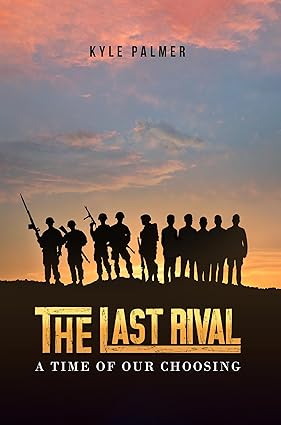
Kyle Palmer’s The Last Rival: A Time of Our Choosing is a gripping and intellectually compelling novel set in the turbulent aftermath of World War II. At its heart are Jim Bolden and Lew Weinman, covert operatives navigating the shadowy world of intelligence. Their mission is perilous, their existence unacknowledged by any government, and their enemy a hidden remnant of the Nazi regime seeks to seize power and reshape history in its own sinister image.
Palmer’s prose is sharp and evocative, balancing high-stakes action with moments of profound introspection. Suspense builds with relentless intensity, yet the novel’s true strength lies in its exploration of moral ambiguity. Themes of sacrifice, redemption, and the battle between duty and conscience weave seamlessly into the narrative, elevating it beyond a conventional spy thriller. The action grips, but it is the philosophical depth that lingers, prompting readers to ponder the complexities of right and wrong when allegiances shift and ideals collide.
Far from mere instruments of espionage, the characters emerge as deeply human figures wrestling with personal demons and ethical dilemmas. Their struggles, whether to seek vengeance or embrace forgiveness, add a rich emotional undercurrent that resonates beyond the confines of their mission. As they confront impossible choices, their internal battles become as compelling as the external threats they face.
For those who appreciate historical fiction infused with intellectual depth, The Last Rival delivers an immersive and thought-provoking experience. Palmer masterfully blends real-world history with speculative intrigue, crafting a novel that feels both immediate and timeless. Though the pacing slows at times to allow for introspective moments, the payoff is well worth it. This is more than a thriller; it is a journey into the heart of human conflict, both on the battlefield and within the soul.
Pages: 500 | ASIN : B0DM6H5TD8
Master Version 1.1
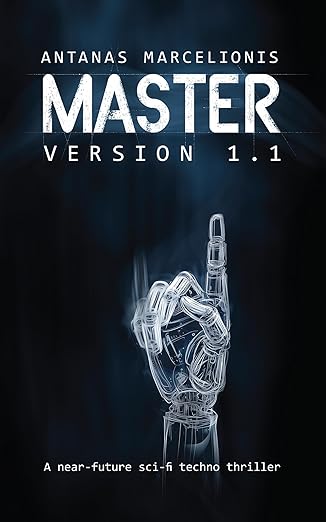
The year is 2028. The setting: a war-scarred Ukraine. Decades of conflict have shaped the landscape, but nothing could have anticipated the arrival of its newest players. A wave of military streamers has descended upon the region, each driven by motives as varied as they are polarizing. Some come with humanitarian aspirations, while others chase fame, followers, and views. Among them is Master, a soldier outfitted with cutting-edge, experimental technology. Armed with a prosthetic arm, a computer-brain interface, and mind-controlled drones, Master embarks on a mission to locate missing fellow streamers. What he uncovers shocks both him and the global audience following his every move.
Antanas Marcelionis’s Master Version 1.1 is a gripping sci-fi action epic. Drawing comparisons to Tron and Ender’s Game, the novel thrusts readers into a hyper-connected, digitally charged battlefield. The premise feels simultaneously far-fetched and eerily plausible. Social media and platforms like Twitch have already transformed spectatorship into a global phenomenon, where millions tune in to watch others play video games while being urged to “smash that like button.” Marcelionis extrapolates this trend to its extreme, creating a world where combat itself becomes content.
Master is a compelling protagonist, torn between genuine purpose and the intoxicating allure of online notoriety. While his psychological complexity adds depth, the true standout feature of the novel is Marcelionis’s meticulous attention to technical detail. The descriptions of experimental technologies are vivid and immersive, from the mechanics of mind-controlled drones to the nuances of augmented combat. Marcelionis’s worldbuilding is further enriched by diagrams and illustrations interspersed throughout the text, bringing his vision to life with startling clarity. This hybrid style—combining narrative with visual aids—sets the novel apart but may not appeal to all readers. The detailed, almost clinical prose might feel dense for some, yet it signals a bold evolution in science fiction. Younger readers, attuned to multimedia storytelling, may resonate most strongly with this approach.
Master Version 1.1 is a glimpse into a near-future shaped by technology, media, and the human need for connection. Marcelionis delivers a thought-provoking and visually striking science fiction novel that challenges conventions and invites readers to consider the fine line between entertainment and reality.
Pages: 287 | ASIN : B0DQQCZKZ2
Montjoy
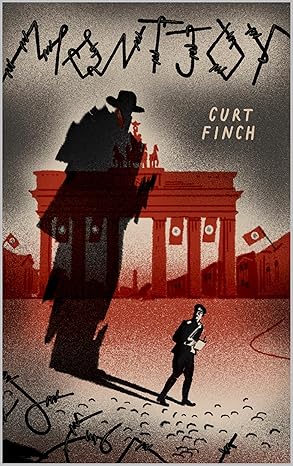
Curt Finch’s Montjoy is a narrative shaped by loss, memory, and the weight of history. Told through the reflective lens of its protagonist, Owen Schoenberg, a historian grappling with personal and professional crises, the novel traverses Europe, exploring Manchester, Vienna, Berlin, Linz, and finally a return home. Finch weaves together themes of grief, identity, and the search for meaning against the backdrop of Holocaust history and contemporary existential malaise.
One of the most striking aspects of the book is Finch’s writing style. It’s intricate, even meandering at times, with sentences that seem to mirror the protagonist’s restless and pensive state of mind. There’s an early scene in Manchester where Owen receives a phone call from Ella Grunebaum that sets the story in motion. Finch writes with a blend of dry humor and melancholy that hooked me immediately. Owen’s ruminations—on the collapse of his marriage, the death of his son, and his Baillie Gifford Prize for a book that feels hollow in hindsight—strike a deeply human chord. Finch captures the emotional weight of these experiences without tipping into melodrama. The balance between Owen’s sharp wit and his palpable sorrow made him a compelling, if occasionally infuriating, narrator.
Vienna—the second “verge”—is where the novel truly shines. Here, Owen immerses himself in the archives of the Mauthausen Memorial, unearthing both historical and personal truths. The city becomes a character in itself, with its wintry streets and grand cafés reflecting Owen’s internal isolation. Finch excels in painting Vienna as a place of contradictions: cultured yet haunted, vibrant yet subdued. A particularly vivid moment is a dinner with Ella and her husband Noah, where the conversation spirals into philosophical debates about memory, history, and the ethics of storytelling. This scene epitomizes the book’s intellectual richness, though at times, the dialogue can feel academic. Still, it’s these dense exchanges that give the narrative its weight and texture.
One aspect I found challenging was the novel’s pacing, especially in Berlin and Linz. While Finch’s prose remains evocative, the plot occasionally feels bogged down by Owen’s introspection and the historical detail. For instance, Owen’s discovery of the mysterious “merkbuch” in Linz—a journal buried at the Mauthausen site—is a fascinating thread, yet its unraveling is slow and laden with tangents. That said, the merkbuch’s contents—recounting acts of defiance and despair during the Nazi era—are haunting and memorable, raising questions about the interplay of fact and fiction, morality and survival.
By the time Owen returns “home” in the final verge, the novel feels like it’s circling back on itself, much like its protagonist. The ending is understated yet poignant, leaving more questions than answers. I found it fitting for a story so concerned with the elusive nature of truth and reconciliation. Finch doesn’t offer easy resolutions, and that’s precisely what makes the book linger in your mind.
Montjoy is a novel for readers who enjoy thought-provoking literature steeped in history and philosophy. Fans of W.G. Sebald or John Banville will likely find much to admire here. For me, it was a moving and intellectually rewarding read, though one that demanded patience and reflection. Finch has crafted a novel that’s as much about the stories we tell ourselves as it is about the ones we uncover in the world around us.
Pages: 147 | ASIN : B0DLLHSTY7
Contending With the Aftermath
To Bloom Like a Tulip follows a family separated by two continents during WWII and their efforts to survive as a Jewish family. What was the inspiration for the setup of your story?
I have known quite a few people who survived World War II in Europe. One of the toughest aspects of the war was that people didn’t always know where their relatives were, or what was happening to them if they were separated in different countries by the war. Communications between warring Allied and Axis nations were completely stopped. So in this story, the mother had taken her two youngest children to America to settle her late father’s estate. Her three oldest children and their father stay behind in the Netherlands so the kids can go to school and the father can run his business. They think their country is going to remain neutral as it did in World War I, so they’re not initially worried, although the Nazis are already gearing up to be on the march. Settling the estate takes longer than the mother thought it would, the war comes to Holland when the Nazis invade, and then, they can’t be reunited for years. Right there, that’s a cause for a lot of concern and worry on both sides. So that was the initial setup. Add to that, this is a Jewish family, so the ones under Nazi occupation are in peril. Imagine being in America and having to wonder what’s happening to them! Horrific. Yet it’s exactly what went on with a whole lot of families during that war.
What were some ideas that were important for you to personify in your characters?
The time period of this story is completely crazy so that in itself adds a lot of intriguing drama into the mix. Nazis turned normal life on its head in every one of the countries they took over, and, worse, state-sanctioned murder was legal. The Jewish characters are a nice family that’s just trying to survive and they find themselves in extraordinary circumstances. There are some very good people in this story, like the ones who hide the three children in a movie theater when matters become worse, and there are also some absolutely atrocious folks, hideous ones. A lot of prejudice came to the surface after the Nazis arrived on the scene, and the worst of the civilian characters suddenly think they have a green light to persecute others, in their own small ways. Others are just nosy and are watching their neighbors to see what they’re up to, but that’s terrifying to those they’ve got under scrutiny. So there was a lot to work with there.
What were some themes that were important for you to explore in this book?
I’ve heard that for many, many people who survived the war, the worst part of it wasn’t the war itself, incredibly, but contending with the aftermath. In this case, some of the characters are betrayed. They don’t know by who, and they don’t know why. Imagine making it through, yet having to live with a question like that! It would be like the “whodunit” from Hell, and it happened, for real, to scores of survivors. So that’s the big question they’re all trying to answer in this story, once the hostilities are over and they’re trying to go forward. Who did it?
What is the next book that you are working on, and when will it be available?
I’m in the middle of writing another mystery, and this one is set in the neighborhood where my dad grew up in Elizabeth, New Jersey. The characters in this one are Catholics. Two little boys find a baby abandoned on the steps of their church. It’s also set during World War II, but on the American homefront. I’m enjoying writing it to the hilt because my father grew up in a very colorful area with a lot of interesting personalities and I was told so many wonderful stories about it. The book should be available sometime this winter. Stay tuned!
Author Links: GoodReads | X (Twitter) | Facebook | Website | Amazon
The Van Der Graafs, Bram and Charlotta, took the risk of hiding Rika, Henk and Kees Spranger, concealing them in their movie theater. All went well – until they were betrayed. Who could have done it?
TO BLOOM LIKE A TULIP is the unforgettable story of good people in a bad time, their efforts to survive the war, and their ultimate determination to find out the identity of the informer.



 LITERARY TITAN