Blog Archives
Eramus of Hares End


Eramus of Hare’s End is a deeply heartfelt and surprisingly rich tale about survival, grief, and finding purpose when everything around you seems to be crumbling. It follows Eramus, a humble village farmer, who’s burdened with the task of saving his drought-stricken village from starvation. The journey that follows is as much inward as it is outward — full of painful memories, reluctant hope, and unexpected encounters that pull you into something much larger than you’d expect from the first few chapters.
What hit me first was how real Eramus felt. The writing here is simple in the best way — no fluff, no fancy prose trying to impress. Just raw emotion, hard choices, and lived-in characters. When the Ruling Hand decides to trade daughters for food, I swear I had to put the book down for a second. It’s brutal, but not in a shock-value way. It’s just the kind of awful decision people might actually have to make when hope is running on fumes. You feel the desperation — not because the author tells you to, but because it leaks from every word.
As the story unfolds, what really hooked me wasn’t just the survival stuff. It was the quiet, personal grief behind Eramus’s drive. The scenes where he visits his wife’s grave were emotionally difficult but in a good way. There’s this one part where he’s laying in the field at night, looking up at the stars, and you can just feel how much he misses her. It’s simple. Poignant. Beautiful. And then, boom — dreams, visions, whispers of something bigger stirring underneath the dirt and drought. The fantasy elements creep in softly, like mist, and I loved that slow burn. When he encounters Lewatollma — the mysterious, pointy-eared healer — I was fully in.
The book starts slow. It meanders a bit, especially in the early travel sections. But stick with it. There’s a subtle shift from a grim survival story into something laced with myth and destiny. And somehow, it works. The pacing feels intentional — like the world is slowly cracking open for both Eramus and the reader. When the wolves show up and Eramus is on death’s door, the story suddenly kicks into another gear, and I couldn’t stop reading. His hallucinations, his panic, that haunting moment where he thinks he’s being eaten by a demon — it’s weird and intense.
In the end, I was moved. Not just by Eramus’s journey, but by what the story says about pain, memory, and resilience. It’s not flashy fantasy. There are no sword fights, no magic duels. But there is magic — the quiet, earthy kind that shows up in healing hands, dream-visions, and the bonds between people. This book would be a great fit for readers who love character-driven fantasy, grounded world-building, and stories that feel like oral histories passed down by firelight.
Pages: 392 | ASIN : B0CW1D8T81

The Whore Saint
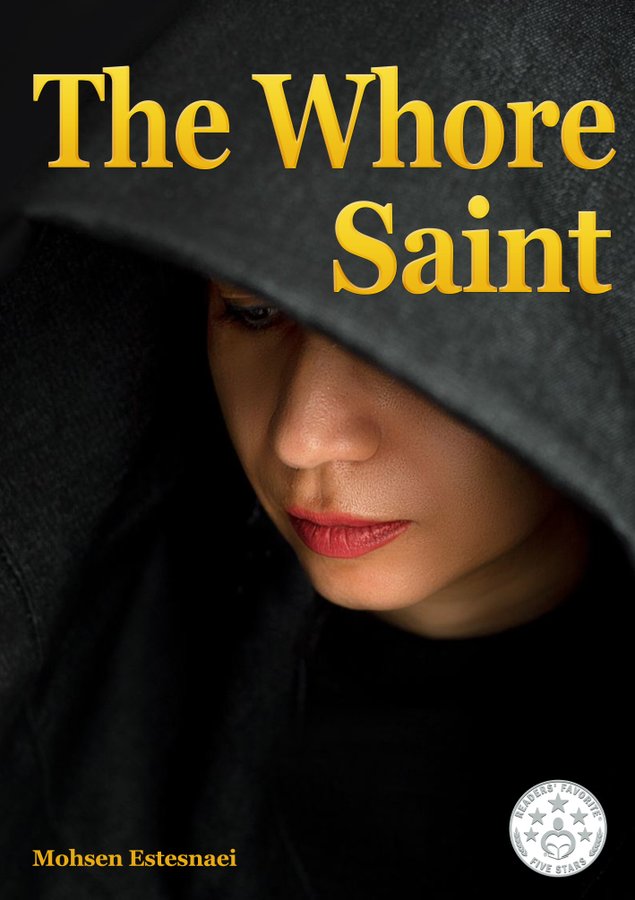

The Whore Saint by Mohsen Estesnaei is a compelling literary work that dances between history, mysticism, and the painful realities of a war-torn Afghanistan. Through a journey of self-discovery, truth-seeking, and a search for spiritual enlightenment, the narrator sets out to understand the essence of love, truth, and the unbreakable human spirit. Rich with anecdotes about Rumi, Hallaj, and the haunting yet resilient stories of Afghan women, Estesnaei intertwines history and narrative to ask and ponder profound questions about existence and humanity.
The writing stands out for its immersive storytelling. Estesnaei crafts a vivid world, from the dusty streets of Balkh to the fearful tension of encounters with the Taliban. I was particularly moved by the chapter on Rabia Balkhi, a tale that juxtaposes love and tragedy in ways that evoke a deep emotional response. The author weaves this history with vivid imagery, making the characters’ suffering and strength feel real and heartbreaking. Another aspect I found remarkable was the raw and unfiltered emotional tone. The author does not shy away from illustrating the darkness surrounding the Afghan people’s struggles, particularly women. The teacher in the clandestine poetry class left a lasting impression on me. Despite facing oppressive regimes, these women came together to keep the spirit of Rumi alive. The whore’s story, in particular, struck me with its heart-wrenching themes of betrayal, loss, and ultimate transformation. It was hard not to admire her bravery and vulnerability, especially when she whispered Rumi’s verses, planting seeds of love amidst a backdrop of desolation. Still, I couldn’t help but feel a sense of injustice for her. Estesnaei effectively conveys how systematic oppression reduces people to mere shadows of themselves, and it’s a reminder that love and mysticism sometimes serve as the last bastion of hope. The thematic exploration of truth and the mystics’ philosophy is both thought-provoking and challenging. The narratives about Hallaj and the discussions of existentialism were impactful but heavy. When the narrator grapples with whether he is a fanatic or a true seeker, Estesnaei cleverly uses these moments to critique societal norms. The story of the American woman who meets Gurdjieff also had me thinking for days. While these philosophical musings were deep and reflective, at times, they felt like detours that slowed the story’s progression. Yet, I understand that these sections are meant to reflect the narrator’s internal journey and question the very nature of reality.
The Whore Saint is a book that challenges the reader’s mind and heart. It’s a thought-provoking read that will resonate with those interested in spirituality, Persian mysticism, or the socio-political struggles of Afghanistan. If you appreciate stories that require emotional investment and philosophical reflection, this book is for you. Be ready for a narrative that is as emotionally demanding as it is enlightening. While not a light read, it is undeniably powerful and unforgettable.
Pages: 116
Humans are Living Mysteries
Scars of The Heart is an influential collection of short stories that delve into the profound impacts of physical war and the psychological impact of violence on humanity. What made you write a story about this topic? Was anything pulled from your life experiences?
I have been a travel writer from 1990 to 2003 and wrote New Journalism texts about conflict zones in the world (contributions that report on events taking place, but in a literary, subjective way). I visited Somalia, Liberia, Bosnia, Sudan, Gaza, Iran, Iraq, Mozambique, Kosovo, Lebanon, and Myanmar… to name a few. I got very close to the atrocities of war, its physical but also its mental consequences. I thought I could handle them, but these days I have PTSD symptoms. They have become more bearable with time, but I can’t forget people’s suffering in war circumstances. In my eyes, I was a “war tourist” who shared their life for a couple of weeks and disappeared again while they were doomed to stay in hellish places. My anger, my shame, remorse, sadness, and despair fuel my stories.
What are some things that you find interesting about the human condition that you think make for great fiction?
When you think about it, humans are living mysteries: contradictory, unpredictable, chaotic. Great fiction tries to create a holistic image of our ambiguity. I believe no other art form is more proficient for this task. Great fiction asks the reader to feel what is hidden between the words so that the voyage into the depths of our being – the maze in our souls, if you like – is an honest, compelling exploration for the reader and the writer. Therefore, great care must be given to the choice of words, their ambiguity, and the rhythm of the sentences. This mixture is called style, and it is necessary to pick up glimpses of the hermetic, sometimes angelic, sometimes demonical, poetry that drives our lives. Great literature is a mixture of empathy, relentless challenges, and mighty victories, yet already tainted with the treason of our egos.
What themes were important for you to explore in this book?
Although they take place in different eras and countries, the background of the stories deals with violence, greed, sexual conquest, and our amazing capability to lie to others and ourselves. Probably you’re thinking now: “And love? Where is love?” Oh, it’s there, sometimes at the brink of obsession or tragedy, sometimes fueling our inner loneliness and addiction to happy dreams and delusions. It is said that readers like happy endings. So sorry to disappoint: when I wrote this collection, the tragic and sad endings even took their toll on me, so I want to advise the reader to read each story at intervals and not right after each other.
What is the next book that you are working on, and when can your fans expect it to be out?
“The Firehand File,” my next book, is set in Berlin in 1921. Let me give you the blurb of the Dutch mother version of the novel so you have the broad outline.
1921. Berlin is a city of extremes. Political violence plagues the streets during the day. A serial killer whom the media call “The Skinner” roams the streets at night. It is suspected that he is a rabid World War I veteran, but he remains untraceable. In this human pressure cooker, the relationship between the famous Flemish DADA poet Paul Van Ostaijen and his impetuous girlfriend Emma Clément is on edge. Like hundreds of thousands of others in Berlin, they live in poverty and are addicted to cocaine and other drugs.
When Van Ostaijen, on a high whim, steals the Feuerhand Obsession file in the apartment of the spy Elise Kraiser, the poet sets in motion a series of dramatic events that shed surprising light on a politician who is rapidly gaining influence: Herr Adolf Hitler.
Carly Rheilan, my translator, scores a fantastic – and poetic! – job. However, the novel’s second part is hard to translate because I tried to use the same manner of Van Ostaijen’s spoken language, a mixture of Antwerp dialect from the twenties with French and German words. “The Firehand File” is a literary suspense novel but also a homage to Paul Van Ostaijen, who revolutionized poetry in the Roaring Twenties. We hope to have the translation finished at the end of this year so that the novel can come out in 2025.
Author Links: GoodReads | X | Facebook | Website
Through ten stories set in different countries and eras, Van Laerhoven takes us through the destructive consequences of our passions as a common thread, from contemporary Syria to Algeria in the 1950s, and the civil war in Liberia to the uprising in Belgian Congo in the 1960s.
The ten stories in SCARS OF THE HEART highlight the dark side of love, which fuels our violence, inner loneliness, and greedy egos.
Scars 0f The Heart


Scars of The Heart by Bob Van Laerhoven is a compelling collection of short stories that delve into the profound impacts of war. The initial stories, set in various war eras, are particularly devastating, highlighting the unquantifiable effects of war on the human psyche. Through these narratives, Van Laerhoven transports readers to the shattered worlds of war-torn individuals, offering poignant glimpses into their lives and struggles.
The author takes a unique approach to representing human nature, weaving tales that feature a diverse cast of characters, including aliens, painters, friends, enemies, and exploring themes of betrayal, loyalty, greed, love, and revenge. This eclectic mix adds depth and variety to the collection, ensuring that each story is distinct and memorable. Van Laerhoven’s writing style is reminiscent of the macabre and powerful prose of Roald Dahl. His stories shock and captivate, blending mysticism with stark reality. Although fictional, these tales resonate with truths about the human condition. Not all stories are set on battlefields, but the sense of war—whether physical or psychological—permeates the collection. The settings range from the war-torn Middle East to World War II and Nazi Germany, bridging past and present to create relevant and relatable narratives. I finished the book with immense respect for the author’s raw and heartbreaking portrayals of reality. The non-war stories are equally compelling, showcasing Van Laerhoven’s versatility and skill in crafting riveting tales.
Fans of Roald Dahl or Edgar Allan Poe will appreciate the beautifully crafted stories in Scars of The Heart. For those who enjoy well-constructed plots and complex characters, this collection is a must-read. I highly recommend this book to anyone who can endure the psychological turmoil and pain depicted, as it offers profound insights into the atrocities and resilience of life.
Pages: 245 | ASIN : B0CX5S8NJZ
My War at Windsor School

Marilyn Estes Quigley’s My War at Windsor School blends historical accuracy with the engaging elements of a coming-of-age narrative set against the backdrop of World War II. The novel draws on Quigley’s own experiences as a schoolgirl in the 1940s, presenting a tapestry of both real events and imaginative fiction. Central to the story is Sally, a young girl navigating the trials of adolescence and the harsh realities of war after an accident forces her to repeat a year at Windsor School, a situation that leaves her feeling isolated and out of place.
As Sally grapples with making new friends and the heartache of her uncle going off to war, she encounters moral dilemmas that test her values, particularly around honesty—a virtue deeply esteemed by her family. These personal battles coincide with her academic challenges and the blossoming of an unlikely friendship that introduces an element of mystery to her life. Despite the war’s shadow over her everyday existence, Sally’s internal and external struggles reflect a poignant journey of resilience and growth. Approaching this historical fiction, I appreciated the nuanced portrayal of life in the 1940s, which Quigley articulates through both the ordinary and the extraordinary aspects of the era. Initially, the narrative’s casual tone seemed at odds with its historical context, yet this choice ultimately complements Sally’s youthful perspective, enhancing the accessibility of the events and emotions she experiences. The simplicity of the storytelling, coupled with well-paced chapters, facilitates a smooth and engaging reading experience. The characters are distinctly crafted, each bringing a unique presence that enriches the narrative. Particularly compelling is Sally’s relationship with her family and her uncle, whose character, though not as deeply explored as one might hope, adds a significant layer to the emotional landscape of the story. Sally herself is a character of commendable depth, her passion for horses and her dedication to her principles painting a portrait of a young girl whose strength and kindness shine even in the face of adversity.
My War at Windsor School not only offers a window into the impact of war on the lives of ordinary people but also serves as a testament to the strength required to navigate such turbulent times. Quigley successfully captures the essence of the era and the indomitable spirit of its people, making this novel a thoughtful and informative read for enthusiasts of historical fiction.
Pages: 315 | ISBN: 979-8-218-40551-9
The Mole Vol XIV: In the Olive Grove (Book II) A Quintet

This collection of poems by Ron Raye in The Mole Vol. XIV: In the Olive Grove (Book II) presents a poignant exploration of the 1948 tragedy in Daer Yassin, Palestine, through the perspective of Abdullah, a survivor. The narrative delves deeply into the harrowing experience of war, effectively illustrating the destruction of homes and the irrevocable loss of entire generations. Raye’s portrayal of the soldiers is stark, highlighting their lack of empathy amidst the chaos.
Further, the poems offer a glimpse into Abdullah’s personal agony, underscoring his profound loss of family and friends. This personal element adds depth to the overarching themes of war’s relentless devastation, its psychological toll, and the seemingly endless cycle of violence. Through Abdullah’s eyes, readers witness both the immediate brutality of conflict and its enduring impact on the human psyche. In a turn towards hope, the collection concludes with themes of reconciliation and peace.
Raye’s closing reflections resonate with a universal message about the inherent destructiveness of war and the imperative to pursue peace. Based on historical events, specifically the Tantura Massacre, these poems are not just a recounting of history but a call to remember and learn from it. Raye’s skillful storytelling and vivid imagery transport readers into the heart of the historical moment, encouraging empathy and reflection. This emotional resonance is a testament to the poet’s ability to blend historical detail with the nuanced portrayal of human experiences.
For those who enjoy poetry that explores the themes of war, history, and human resilience, The Mole Vol. XIV: In the Olive Grove (Book II) is a highly recommended read. It serves as a poignant reminder of the past while also offering hope for a more peaceful future.
Pages: 320 | ASIN : B0CWLR9L7D

A Mental Healing Place

Shmehara is a poignant exploration of human emotions and experiences through poetry, illustrations, and reflective notes, focusing on human experiences during times of conflict. Where did the idea for this collection come from, and how did it develop over time?
The genesis of this project traces back to my therapist’s office. Recognizing my enduring love for poetry, my therapist proposed leveraging this passion as a tool for healing from childhood trauma. It worked. It brought me peace and the ability to move on. This event also triggered a deeper self-reflection on my life and my identity.
From this initial spark, the project went on an extraordinary odyssey exceeding the bounds of my imagination. Let me guide you through each step of this remarkable voyage.
Self-reflection unearthed the profound influence of my maternal grandfather on myself. He was a very resilient man. Escaped from transportation to a concentration camp, and survived torture during the Second World War, and the tragic death of his first wife. He was the first to acknowledge me as a poet and encourage me to be myself. Therefore, I thought it was just the right thing to do to dedicate this book to him.
I started to dig more into my family’s past and discovered that I have a connection to the Ukrainian soil on my Mom’s side. It was at the time when the Russian invasion of Ukraine started. Consequently, you can find themes of war and peace rooted in personal and global narratives in my poetry.
While preparing for this book I attended readings by other poets. I noticed that they often tell stories about their poems during these live events. That gave me an idea to incorporate into the book a short, written story preceding each poem. A proem to a poem, you may say.
Researching books of other poets brought to my attention a fact about how visual art can enhance a poetry book. I recalled magnificent illustrations in my childhood books. Therefore, I decided to add visual art to my book as well. I reached out to over 40 different artists from all around the world and ended by selecting seven of them, based on their style, skills, abilities, and unique life stories. I also added to the book their short stories describing the process of making the art for the book showing this way the flow of creativity.
Next, came the idea of Dynamic Illustrations™. I once saw in a liquor store animated labels of some wines, and an increase use of QR codes in the post-COVID restaurants. I remember asking myself: “Why not animate the illustrations in my book using QR codes?” I’m so glad I decided to do that because this approach opened new doors to poetry. I was told that Dynamic Illustrations™ allows the neurodivergent members of our society or people with disabilities to enjoy poetry. This is so exciting.
Another unforeseen, yet gratifying development was a venture to the realm of independent film festivals. The Dynamic Illustrations™ are short animations, therefore we submitted some of them to independent film festivals. As we are conducting this interview (mid-April 2024) AIE has gathered 9 laurels so far at various film festivals across the globe, from Hong Kong through Dubai, Berlin, and Chicago to Chile to name a few. Receiving these accolades is beyond my imagination.
The next development was the inception of Amicus Librowitz (a play of words on a lover of books). In my written realms, distinction between reality and fiction is blurred, and Amicus is my alter ego on the other side. He appears in some of the Dynamic Illustrations™ yet, importantly, he appears also in this world and introduces my books to you. On the front cover of Shmehara, you will find a QR code, which will bring you to a short animation of the Amicus avatar telling you a story about the book. Amicus, and how he appears on the book’s cover is a unique trademark of my books.
Hopefully, you will find Amicus on the front cover of my next books. i’d like to briefly mention three books here: one coming later this year (2024), which is based on Plato’s Dialogues where I discuss fundamental questions regarding humankind with AI; a sci-fi novel in which I address the future evolution of human prejudice, and provide a satirical commentary on current social and political systems; and a novel based loosely on the life of my mother, who should be a feminist icon due to her grit, wit, and resilience in male-dominated medical field in communistic Poland. With the last one, I’m hoping also to bring to a Western reader intriguing, absurd, and funny realities of life behind the Iron Curtain.
The next, (and the last) development is very important. Shmehara started as a way of fighting my inner wars but evolved into addressing also real wars. It was paramount for me to provide long-lasting help to victims of these wars. Therefore, I decided to donate part of the proceeds to a great humanitarian organization, the Polish Center for International Aid (PCPM). PCPM uses these funds to provide scholarly and psychological support to Ukrainian children refugees forced to flee their country by the Russian army.
As you can see, this project went in some unforeseen directions and developed beyond my dreams, making this journey so full of thrill, excitement, and good deeds.
The title Shmehara is unique and memorable. How did you come up with it for this collection, and what is its meaning?
Thank you for this question. The title of this book, Shmehara has a special meaning. I coined that term by reaching out to ancient languages: Sanskrit and the Proto-Indo-European language. I combined sh from ikshana in Sanskrit meaning to look after, with me which is a part of the Proto-Indo-European (PIE) root s(mer) of to remember, and with hara from Sanskrit dharā meaning a flow of a stream. Sh-me-hara. Shmehara thus represents a mental healing place, a very special place in your mind where you are letting go of troubling memories. A special name for a very special place.
Creating a place like this was suggested to me by my therapist. When I started to explain to her my vision of this mental healing place, the explanation turned into a poem. I thought that this concept is very important and you may feel its presence in other poems throughout the book, therefore I decided not only to put Shmehara as the very first poem in the book but also to use it for the book’s title.
By the way, If you need shmehara for your own mental health, please feel free to use this term.
Many talented authors and artists were involved in this multimedia project, including the interactive experiences. What was the collaboration process like to put this book together?
The collaboration behind Shmehara was nothing short of extraordinary. All together seven visual artists contributed to this project, each extremely talented. Let me start with the cover art. The cover is so important. The cover is the very first thing that draws your attention to the book. I feel so fortunate that a gifted artist from Denmark, Caroline Bergstrom-Scheibel, agreed to design the cover for Shmehara. I think Caroline understood immediately and profoundly the fundamental message of the book and made the cover encapsulating it in a beautiful, mesmerizing way.
Illustrations were created by the following artists (in alphabetical order): Sofia Chantra, Katya Mayorova, Arina Nikolenko, Katerina Patak, Sofia Lo Pinto, and Polina Pluslem, who are living in several countries around the world including Ukraine. I’ve selected them based on their artistic skills and personal stories. The selection process was meticulous, with an initial interview allowing me to get to know each illustrator better as an artist and also as a person. Next, I selected a poem (or poems) for each artist, which in my opinion, would resonate with them the best. So matching a poem and an artist was not a random process. I wanted to bring the most of artistic prowess and authenticity out of each artist. I think each of them did a fantastic job.
I would like to emphasize that none of the artists worked before on creating Dynamic illustrations™ – a concept I have developed for this book. In most cases, that would require creating several GIFs for each poem. The GIFs needed to be done in a specific way, allowing me later to edit and stitch them to create a short, animated film. I have nothing but accolades for each of the artists. Their openness to suggestions fostered a collaborative spirit that elevated the project to new heights.
I would like to mention also collaboration efforts during creating soundtracks for the Dynamic illustrations™. Each soundtrack consisting of the main melody as well as special sound effects. In most cases, I went through hundreds of tunes to select the one. Sometimes, it required obtaining copyrights. Securing these permissions provided an unprecedented opportunity to collaborate with some amazing people in the music industry. I had the great pleasure of working with Ed Rakowicz from KMC Records to obtain permission to use a clip of music of Kvitka Cisyk for the Dynamic illustration™ of the poem Melancholia. Similarly, when obtaining permission to use a clip of music by Vivaldi performed by Jakub Jozef Orlinski for the Dynamic illustration™ of the poem AIE I had an amazing interaction with Guillaume Tabeau and Liza Rannou from Radio France, as well as with Jakub’s agent – Solal de Castillo.
I would like to add that the collaborations did not stop. I’m very fortunate to work currently with a very talented jazz musician and composer, Tyler Lustek, and his jazz ensemble on creating unique jazz compositions to some of the poems from Shmehara. We probably will make them available to the public next year, so stay tuned!
I think, that you can’t put a price tag for these direct, collaborative interactions. Meeting these amazing artists, extraordinary human beings and kind souls is breathtaking. Working together with them and seeing a flow of creativity between different artistic genres is astounding and unforgettable.
What is one thing you hope readers take away from this experience that you have created?
I hope this book will provide a reader with a deep, transformative experience. I observed that during reading events. I like reading events because they are a fantastic opportunity to have direct contact with the audience. Seeing firsthand people moved by my words, and coming to me after the event with tears in their eyes is deeply humbling and inspiring. I hope that Shmehara will invite every reader to embark on this emotional journey, and that after putting the book down, the reader will find themself more attuned to their inner self and the world around them.
Author links: Website | GoodReads | Facebook | Instagram | X | TikTok

This immersive multimedia project shows a flow of artistic vision and gives you a transformative, one-of-a-kind experience. You will run your fingers through the scars on the author’s soul and feel pain, sorrow, and outrage. You will also find solace and empowerment. And you will experience pure joy in watching (and endlessly rewatching) Dynamic Illustrations™. If you appreciate cutting-edge art, which addresses existential issues this is a must-read, must-watch experience.
Shmehara is a multi-layered book. In its core there are 21 thought-provoking poems. Each poem is accompanied by an author’s note describing creative process behind the poem. In addition, each poem comes with an illustration, as well as thoughts of an artist creating the illustration describing their work on that illustration. This way we show a flow of creativity from one artist to another.
On top of that, you can access an animated version of the illustration, called Dynamic Illustration™, by clicking on a QR code located next to the illustration. When watching Dynamic Illustration™ makes sure the volume on your device is up, so you can enjoy a unique soundtrack created for each Illustration. Dynamic Illustrations™ are similar to short, animated films. You can see some still images from each dynamic illustration in the poster product section.
Foreword is written by brilliant Steven Komarnyckyj, a UK-born distinguished British-Ukrainian writer, linguist, poet, translator, and a recipient of English PEN awards.
10% of sales go toward a humanitarian organization helping Ukrainian children refugees.
Shmehara
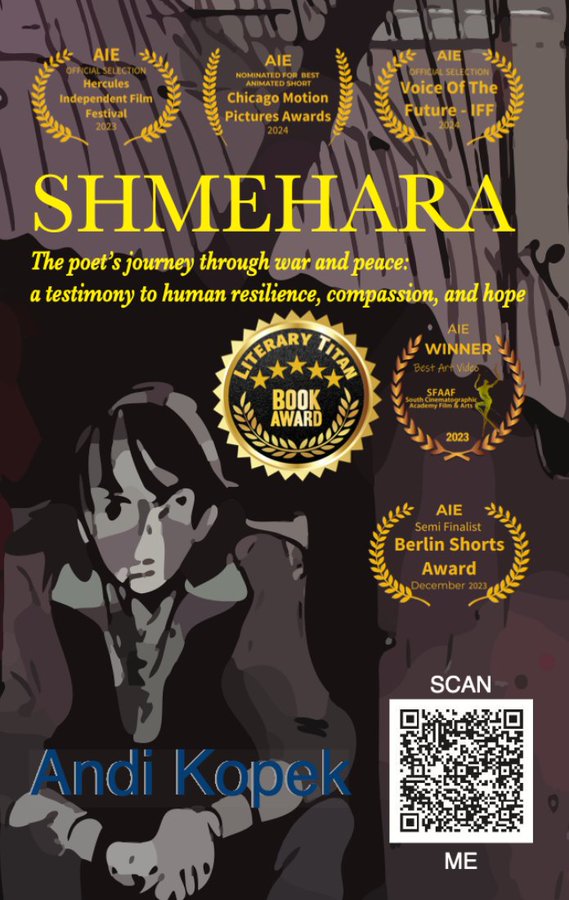
Shmehara, by Andi Kopek, is a poignant exploration of human emotions and experiences through the mediums of poetry, illustrations, and reflective notes. Kopek’s work is deeply rooted in the context of the Russia-Ukraine war, yet its themes of resilience, the human spirit, compassion, war, peace, and hope transcend the specific conflict, touching on universal aspects of the human condition.
Kopek skillfully blends poetry with visual art to offer a multifaceted reflection on the aftermath of conflict. The poetry in this collection is not just a mere arrangement of words but a lyrical journey that captures the essence of survival and the unyielding strength of the human soul. Accompanying these verses are illustrations that do more than just accompany the text; they deepen the emotional resonance of each poem, adding a visual dimension that enhances the reader’s experience. Perhaps one of the most distinctive aspects of this collection is the inclusion of notes that provide insight into the artist’s creative process. These notes add a layer of transparency and depth, fostering a deeper connection between the reader and the content. They offer a window into the mind of the creator, revealing the motivations and intentions behind each piece. Shmehara strikes a balance between acknowledging the harsh realities of war and nurturing the seeds of hope. It stands as a testament to the power of art in transcending boundaries and uniting people through shared experiences and emotions. This collection is more than just a response to a specific event; it’s a timeless exploration of how individuals and societies navigate through and emerge from adversity.
This book is a compelling read for those who are moved by the complexities of human experiences during times of conflict. It’s an invitation to understand and feel the journey of humanity amidst the turmoil of war, and the enduring spirit of hope that prevails. Shmehara is recommended for readers who seek a deeper understanding of these themes, as well as an appreciation for the interplay of poetry and visual art in expressing the inexpressible.
Pages: 115 | ISBN : 979-8-9889670-1-9


