Blog Archives
Lenswoman in Love – a novel of the 1960s & ’70s


Lenswoman in Love follows Maddy, a gifted young photographer coming of age in the upheaval of the 1960s and 1970s, as she moves through Berkeley activism, UCLA film culture, music scenes, political awakening, and an enduring, half-tormenting, half-sustaining love for Jake. What struck me most is that the novel isn’t just built around romance. It’s really about a sensibility forming under pressure: grief after her father’s death, the thrill of learning to see through a lens, the moral charge of documenting history, and the slow, uneven process of becoming herself. The early material alone gives that shape vividly, from Maddy filming police violence at an antiwar protest, to photographing the Free Speech Movement, to meeting Jake at her family’s folk club, where art, politics, and desire begin to tangle together in ways that define the rest of her life.
I liked the writing for its warmth and immediacy. Author Kim Gottlieb-Walker has a way of narrating feelings that is unabashedly romantic without becoming weightless. Maddy’s first attraction to Jake has that feverish, slightly humiliating intensity that actual young longing has. It’s not cleaned up for elegance. It blushes, stumbles, aches. I especially liked the scenes in which emotional awakening and artistic awakening mirror each other: the moment Jake opens her ears to electric music after she dismisses it as unserious, the candlelit Bob Dylan sighting, the way she notices faces, light, posture, gesture before she fully knows what any of it means. Those moments make the book feel less like a conventional love story than a record of consciousness being sharpened. The prose can be earnest, and at times that earnestness edges close to old-fashioned, but in this case, I found that more affecting than limiting.
I was more interested in the book’s ideas than in its romance, which is saying something because Jake is very skillfully drawn as a formative figure. The novel keeps circling back to a tension that feels genuinely alive: how a woman can be swept up in love without surrendering the self she is still building. Maddy’s mother gives some of the book’s wisest emotional counterweight when she insists that women don’t need men to be complete and warns her daughter not to kiss every clever frog. That note matters because the novel is clearly fascinated by longing, but it doesn’t finally confuse longing with fulfillment. I also admired the way politics are woven into the fabric of personal memory rather than pinned on as historical decoration. Andy Goodman’s murder, the antiwar marches, the police brutality, the sense that art can bear witness, all of that gives the book a pulse beyond nostalgia. I think the novel’s closeness to lived experience is both its strength. It produces texture, conviction, and vivid social detail.
Lenswoman in Love is appealing because it knows that youth is rarely one clean story. It’s heartbreak and glamour, self-invention and confusion, politics and vanity, courage and naivete, all happening at once. I came away feeling that the novel’s real subject is not simply whether Maddy and Jake belong together, but how a woman learns to trust her eye, her appetite, and her own unfolding life. I’d recommend it especially to readers who enjoy coming-of-age fiction, artist-novels, and period stories that care as much about atmosphere and inner weather as plot. It’s a tender, intelligent book for anyone who has ever fallen in love while trying, at the same time, to become a person.
Pages: 320 | ISBN : 978-1916966833

Residual PTSD

The Meaning of Okay follows a woman healing from a sexual assault who meets a man that she connects with and wonders if she can heal enough to be open to a new relationship. What was the inspiration for the setup of your story?
I read lots of romance novels, and it seemed like a certain situation was underrepresented. I’ve read novels where the focus is the assault, but I haven’t found many where the residual PTSD is the focus. I wanted to show that women still struggling, consciously or subconsciously, can still find their happy ending.
Kennedy and Rhys are both looking to start over and heal from their pasts. Were you able to achieve everything you wanted with the characters in the novel?
I’ve received a lot of positive feedback about Dillon – more than I’ve received about Rhys. Also, Rhys is the only character I’ve received negative feedback about. I thought I achieved everything I wanted with the characters, but apparently Rhys is not as developed as I aimed for.
What were some themes that were important for you to explore in this book?
Sexual assault and PTSD were the main themes, but I also wanted to touch on how people treat others with mental health issues, specifically how it can be hard to recognize and hard to understand if you’re unfamiliar with the signs and symptoms.
What is the next book that you are working on, and when can your fans expect it to be out?
I’m not working on a book-length piece at the moment. I’m finishing up a short story dealing with time and decision-making. I don’t have an anticipated release date yet.
Author Links: GoodReads | Website | Amazon
Rhys Curran moved to Texas to refocus on his career and start a new life not soured by his past. Soon after he meets Kennedy, his open mind and big heart unravel her ability to distance herself. As their friendship evolves, Kennedy’s secrets begin to surface and she’s forced to face each one. Will she ever be able to overcome her past―and will Rhys stick around if he finds out the truth beyond her story?
How We Value Service

Through Her Lens follows a woman working as a photographer and British Intelligence agent who struggles for personal autonomy during a period of history where women are often overlooked. What was the inspiration for the setup of your story?
I have long loved history, but it doesn’t take much looking to realize that much of what has been kept and written about is men. One evening I was watching an episode of NOVA, a PBS program, called “3D Spies of World War II.” They talked about the V1 and V2 bombs and the pilots who took the images, but they also spoke about the women who worked at RAF Medmenham. Many of them outranked men because the creator of the 3D approach thought women would be better at analysis than men. A woman is credited for finding the V1, Constance Babington Smith. I had a short story with a character named Millie, who was being evacuated from London at the start of the war. My writing group had been encouraging me to explore a longer story for Millie and with this nugget of information about RAF Medmenham, I had my path and one that I wouldn’t have to work to fill in too many gaps. Women did the important analysis work. I only had to learn about them to create a more well-rounded Millie and the world that she would inhabit. It was a chance to tell a true and little-known story about one of the many important things women did to help the Allies’ efforts in defeating the Axis powers.
What were some of the trials that you felt were important to highlight the character’s development?
For a single woman working in the time, the trials were many. It was important to me not to gloss over that fact. For that reason, I made her family rich. Money wasn’t something I wanted her to struggle with. I did want to highlight the limited choices women had. The British government wasn’t going to give her a gun or let her take her camera into the fight for that matter, but they expected her to contribute all the same and with little or no credit. Every day Millie was going to open her beloved newspaper to see honor bestowed on the men of her day. She was going to have to risk everything, remember Britain was regularly being bombed, and get no credit at all. How was an ambitious person to manage something like this? How this would shape Millie interested me. It was also critical that her father not treat her like his sons. He could want things for and from her, but only within what his peers would find acceptable. William may have had progressive ways, due to the influences of his wife—Millie’s mother, Margaret—but they didn’t naturally flow to Millie. They would both need to bend and the conflict between them would need to shape them. Finally, I couldn’t create a world without grave personal loss. No one escaped the war without pain of some sort. Millie couldn’t be an exception.
What were some themes that were important for you to explore in this book?
The thought I kept coming back to was this: There are things we want to do and things we should do, but unfortunately they are rarely the same things. Every character in Through Her Lens struggled with this fact. I believe most of my readers do as well. In this way I was able to take an old story and pull it into the present.
I also wanted the reader to grapple with how we value service. Why is a surgeon more valuable than a garbage man? Why is a man’s work, in the case of my novel, more noteworthy than a woman’s? Why have there been countless stories told of Winston Churchill, the men who stormed the beaches at Normandy, the men who endured the Battle of the Bulge, but few if any of the intelligence work the women did on Churchill’s behalf, the women who worked alongside him in his bunker in London, or the nurses and other women who followed the men into France, or of those who worked without a gun in the Ardennes? I do not mean to diminish the work and sacrifices of the men, only to ask why not the women too.
What is the next book that you are working on, and when can your fans expect it to be out?
I found writing flirtatious banter quite fun. I have an idea swimming in my imagination of a group of female whiskey trippers, the folks who hauled booze during prohibition, and have written a few short stories to unearth my heroine. As you might imagine women were overlooked at the time and the 1920s were pretty bad for women. So perhaps an alternate reality of the time or maybe a more modern setting like revamped Smokey and the Bandit, populated by women, of course. I’d like to spend my time with a lighter topic and give my sense of humor a bit of a workout. I’ve visited a few spots in Appalachia to start getting a feel for possible characters and see who I can unearth for more inspiration. And I am constructing a cast with short stories and essays which is my second favorite part of the writing process. As to when it will be ready, who can say—soon, I hope! But research is my favorite part of the process, and it can take some time.
Author Links: GoodReads | Facebook | Website
Three years ago, Millie dutifully packed away her cameras and began her career in Secret Intelligence after discovering her surrogate mother’s flat leveled during the Blitz. Her commander has reassigned her to help verify and destroy the Nazis’ long-range vengeance weapons program before D-Day. Amidst the urgent demands of her work, a Royal Air Force pilot named Callum won’t let her forget who she is. He is always there – sneaking her a camera and tempting her with a life spent with him instead of her fiancé, Elliot.
Melissa Bacon masterfully captures Millie’s struggle to choose between her dreams and her duty to family and country. Through Her Lens chronicles a piece of history based on actual events surrounding Operation Crossbow, a top-secret intelligence investigation tasked with stopping the V1 flying bomb and V2 rocket program. This exploration of women’s empowerment is a must-read for those interested in untold stories of the heroes of World War II.
On the Wings of the Red-Tailed Hawk
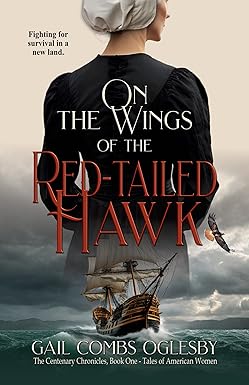
Gail Combs Oglesby’s On the Wings of the Red-Tailed Hawk is a historical fiction novel that delves into the journey of Sarah Bailey and her husband, Jonathan, as they embark on a life-changing voyage to the New World. Filled with aspirations, their journey takes an unforeseen and hazardous turn. The narrative dramatically shifts when Jonathan’s demise is caused by a severe winter illness, leaving Sarah widowed and in charge of her brother-in-law.
In this trying period, Sarah stands out as a formidable and resilient character. Oglesby’s narrative highlights the strength and perseverance of women during this era, underscoring their significant, yet often overlooked, contributions to history. The author adeptly intertwines historical themes within the story, offering a glimpse into the lives of ordinary women who faced extraordinary challenges. The book is marked by its compelling blend of engaging storytelling and meticulous historical detail. Oglesby’s vivid and descriptive writing style immerses readers in the struggles and triumphs of colonial life, fostering an emotional connection with characters, particularly the tenacious Sarah Bailey. The author excels in depicting Sarah’s emotional depth and steadfast determination, showcasing her evolution from an optimistic newcomer to a courageous survivor. The novel’s pacing is dynamic, and its swift plot developments add to the vibrancy of a richly woven narrative full of historical insight. It concludes with a poignant and hopeful note that resonates deeply with its audience, leaving a lasting impression.
On the Wings of the Red-Tailed Hawk is an enriching read for those interested in historical narratives, especially those that highlight women’s experiences. It offers a detailed and empathetic portrayal of immigrant life and the struggles faced by women in the past. The novel’s vivid storytelling, memorable characters, and insightful exploration of colonial history come together to create a touching and compelling journey, exemplified by Sarah’s poignant and resilient story.
Pages: 361 | ASIN : B0C79JX7FY
Through Her Lens

Through Her Lens, the debut novel by Melissa Clark Bacon, introduces readers to the intriguing world of Millicent (Millie) Trayford, a photographer turned British Intelligence operative during World War II. Millie’s journey begins with her profound commitment to documenting the critical role of women in society through her photography. However, the transformative impact of the Blitz propels her into a new role in the Women’s Auxiliary Air Force, a decision influenced by her father.
The narrative meticulously unfolds Millie’s mission to uncover Hitler’s secret vengeance weapons. Amidst this pursuit, she confronts a personal longing for autonomy, challenging the expectations imposed by her father, fiancé, and superiors. As the plot progresses, the stark realities of war and its human cost become increasingly evident, leading to deeply affecting losses for Millie. Bacon masterfully highlights women’s often unheralded yet vital contributions in wartime, drawing attention to their critical roles in achieving victory. Millie’s poignant observation, “Women are always doing interesting and important things that are overlooked,” underscores this theme. Bacon’s narrative prowess is evident in her ability to blend historical authenticity with rich, lesser-known details about the teams tasked with discovering hidden wartime weapons. The novel’s standout feature is its portrayal of Millie as a multifaceted character. Beyond her roles as a photographer and operative, her struggle with the dichotomy of personal goals and societal duties offers a compelling examination of female empowerment during a tumultuous historical era.
Through Her Lens not only presents an engaging story set against the backdrop of World War II but also invites readers to reflect on the complex dynamics of women’s roles in both public and private spheres during a critical period of history.
Pages: 312 | ASIN : B0CSB77NT3


