Blog Archives
Quiet Revelation

The Soul Octopus Analogy is a spiritual meditation that uses the image of an octopus to rethink the soul, reincarnation, the afterlife, past lives, and the mystery of human suffering. What first inspired the image of the octopus as a metaphor for the soul?
The octopus came to me as an image long before I understood why. It surfaced in a moment when I was trying to make sense of why a single human life feels larger than its own story – we carry memories that seem older than our years, emotions that feel inherited from somewhere unseen, and intuitions that arrive like echoes from another room of the self.
The octopus offered a kind of quiet revelation. One being, many arms – each exploring its own path, each sensing its own world. I recognized something essential about the soul: its multiplicity, its extensions, its ability to live many experiences while remaining one consciousness.
The octopus image was offering a lantern from the deep, crystallizing how the soul moves through existence with many gestures at once. In its presence, I recognized that consciousness is not a single flame but many lights, each reaching outward to touch a different corner of experience.
The octopus metaphor didn’t feel invented. It felt remembered. As if that ocean creature had always been a map of the soul’s architecture, waiting for someone to notice.
How does your understanding of reincarnation differ from more traditional beliefs?
I see reincarnation as a widening, not a returning. Traditional views imagine a soul stepping from one life to the next, like pages turning in a long book. My impression is quieter and more fluid: one soul extending itself into many lives at once, each a living arm of the same consciousness.
In this view, past lives are not behind us – they are beside us, moving in parallel, learning in their own landscapes. What we feel as intuition or Deja vu may simply be the faint ripple of another limb of the same soul brushing against our awareness. Reincarnation becomes less a cycle and more a constellation of experiences held by one center.
How do you respond to readers who approach the book from a skeptical perspective?
I welcome skepticism. The Octopus Analogy was never meant to be a doctrine. It is a metaphor – a way of seeing the soul that can be held lightly, exploring gently, or set down without consequence. Skepticism is simply another form of curiosity wearing a cautious coat.
I tell readers that they don’t need to believe in the metaphor for it to be meaningful. They can treat it as a thought experiment, a symbolic map, or a quiet invitation to consider the possibility that the self is larger than it appears. If the image resonates, wonderful. If it doesn’t, the reader still engaged in a new way of thinking, and that alone has value.
Are there aspects of consciousness or spirituality you hope to explore in future books?
That’s a particularly good question – because there are many to explore. The Octopus Analogy opened one chamber of the soul’s architecture, but there are others – the nature of intuition, the origins of memory that feel older than our years, the quiet mechanics of suffering and how it shapes the evolution of the self.
I want to explore the coherence of spiritual identity: how souls remain whole while expressing themselves through many lives, relationships, and emotional histories. I’m drawn to the role of Spirit Guides – not as mystical beings, but as structural companions within the soul’s larger system of learning.
Future books will continue mapping these unseen geographies. Not to offer answers, but to enlarge our understanding of consciousness and the subtle ways our inner lives may be far more expansive than we imagine.
Author Links: GoodReads | Amazon
In The Soul Octopus Analogy, readers are invited on a journey that is part story, part meditation and part mirror. This is not a book of easy answers – it is a philosophical fiction that asks us to sit with questions that shape our lives, identity, grief, memory and the shifting currents of transformation.
Through imagery and imagination, the narratives explore how we come to know ourselves in a world that constantly remakes us. The Octopous – fluid, elusive, and infinitely adaptable – becomes a living metaphor for the human condition; stretching into the unknown,retreating into the shadows, and surfacing with new forms of meaning.
This is a book for readers who crave depth, who want fiction that lingers after the last page. It is a voyage where philosophy and story interwine and where readers may find a reflection of their own hindden chambers.
The Octopus Analogy – The Soul’s Endless Dance Across the Web of Creation


The Soul Octopus Analogy is a brief but expansive spiritual meditation that uses the image of an octopus to rethink the soul, reincarnation, the afterlife, free will, soulmates, past lives, and the mystery of human suffering. Bud Megargee imagines the soul not as a single traveler moving neatly from one lifetime to the next, but as a vast, many-limbed consciousness whose tentacles may live, learn, wound, heal, and remember across different times and dimensions. The book moves through that idea with a kind of dreamy insistence, from the “Chamber of Threads,” where a soul reviews love, fear, peace, hate, divine intention, karmic events, and the overseer, to later reflections on soul guides, time slips, near-death experiences, and the strange mercy of beginning again.
The octopus metaphor could have felt gimmicky in less sincere hands, but here it becomes a surprisingly elastic vessel for questions that are difficult to hold in ordinary language. I found the sections on the blueprint of a life and free will especially affecting because they give pain a shape without reducing it to punishment. The example of abandonment as a wound that might lead someone toward bitterness, therapy, or healing work felt emotionally honest to me. I don’t need to accept every metaphysical claim literally to appreciate the compassion inside the idea. The book keeps returning to the possibility that our lives are not random debris, but neither are they locked scripts.
The writing is at its best when it leans into image and atmosphere. I liked the way Megargee asks the reader to “pack light but pack deep,” to bring questions rather than answers, and to imagine the afterlife as an ocean rather than a fortress. There’s a lyrical, almost trance-like quality to those passages, and the recurring language of tides, threads, vibrations, and chambers gives the book a distinct inner weather. The discussion of evil as unintegrated pain is moving and humane, but I wanted a deeper wrestling with the real brutality of suffering. Still, I admired the book’s willingness to be strange. It doesn’t apologize for its mysticism, and that gives it a certain fragile courage.
I came away from The Soul Octopus Analogy feeling both challenged and quietly soothed. It’s rewarding for readers willing to sit with metaphor as a doorway into reflection. Its conclusion leaves the soul feeling less like a fixed object and more like a living current, unfinished, porous, and deeply connected to others in ways we may only sense in flashes. I’d recommend it to spiritually curious readers, seekers drawn to reincarnation and afterlife speculation, and anyone who enjoys reflective books that treat mystery not as a problem to solve, but as a companion to walk beside.
Pages: 92 | ASIN : B0H1PFXZ1H

The Octopus Analogy – The Soul’s Endless Dance Across the Web of Creation
The Soul Octopus Analogy offers a spiritual model of reincarnation in which the soul is imagined as an octopus with each tentacle representing a separate soul-extension, all connected to a larger core consciousness. Why was this an important book for you to write?
I wrote Soul Octopus Analogy because I wanted to explore the human soul without the usual spiritual shortcuts or psychological reductions. The soul, as I have come to understand, is not a static essence – it is a living, multidimensional intelligence that extends far beyond the narrow frame of the ego. The book became necessary when I realized that most people are trying to understand themselves through the smallest part if themselves. They look through the keyhole of the mind and assume they are viewing the whole house. The Soul Octopus Analogy allowed me to widen the view and to show that the self is not a single point but a network of awareness.
The spiritual and philosophical backbone of the book emerged from a single radical question: What if the soul is not something we possess, but something we participate in? That shift changes everything. It moves away from the idea that the soul is a fragile object toward the idea that the soul is a dynamic field of learning. Authoring the book required me to step outside my ego’s insistence on certainty and identity. In that sense the book is much more a philosophical rendering as it is a metaphysical exploration.
Were there any ideas in the book that challenged your beliefs while writing?
Absolutely, – and the challenge was not just intellectual but existential. I’ve always been a skeptic, someone who questions assumptions rather than inheriting them. But skepticism is not the absence of belief; it is the discipline of refusing to settle for shallow explanations. As I developed the Soul Octopus Analogy, I found myself confronting the limits of my own frameworks. I had long believed that consciousness could be understood through psychology and neuroscience. The soul, in its complexity, however, demanded a broad spiritual and philosophical lens.
The greatest challenge came from recognizing how ego often distorted our understanding of the soul. The ego wants simplicity, control, and a coherent narrative. But the soul is not bound by those constraints. It learns in nonlinear ways, remembering without words, and perceives without the filters of identity. To write honestly, I had to loosen my grip on the ego’s need for definition and allow the soul to reveal itself on its own terms. That meant accepting that some truths are felt before they are understood. And some insights are realized when the ego steps aside. This was not easy – it required both spiritual and philosophical humility.
The Afterlife review section offers a detailed perspective. How did you differ from traditional interpretations of life review experiences?
Traditional interpretation of life reviews – especially those shaped by near-death experiences – often describe a dramatic replay of one’s life, as if consciousness becomes a spectator to its own history. While these accounts are meaningful, they rely on a model of the self that is fundamentally retrospective. They assume that the soul waits until the end to understand what it has lived. My view is different. I believe the soul is reviewing life continually not episodically. The review is not an event; it is a process woven into the fabric of living.
Theoretically, this shifts the conversation from cosmic judgement to a dramatic unfolding of awareness. Instead of imagining the soul as a passive recipient of a final revelation, I see it as an active participant in meaning-making. The soul does not wait for death to understand life; it understands live as it is happening. This perspective aligns more closely with the act of becoming than traditional narratives – which I understand is quite different than most. It treats consciousness as a living system rather than a static observer. In the Soul Octopus Analogy, the life review is not a finale – it is the soul thinking in real time.
If the reader remembers only one lesson form the book, what would that lesson be?
If the reader remembers only one lesson, let it be this: you are not the small self you have been taught to believe. Beneath the ego’s narrow lens lies a vast living intelligence that has been learning from every moment of your life. The soul is not fragile, not incomplete, not waiting for permission to exist. It’s already here – sensing, integrating, and reaching into the world with a wisdom the mind can barely comprehend. When you recognize this, you begin to understand life in ways you never realized.
At the core of this book is the idea that the soul is not a passive essence but an active participant in your becoming. Every joy, every wound, every quiet moment you thought went unnoticed – the soul noticed. It gathered it, learned from it, and wove it into the tapestry of who you are. Nothing has been wasted. Nothing has been lost. Where the ego saw failure – the soul saw growth. To remember this is to reclaim a deeper sense of dignity, on that does not depend on perfection but on participation. Remember – you are far larger than the story you tell about yourself.
Author Links: GoodReads | Amazon
The Soul Octopus Analogy – The Soul’s Endless Dance Across the Web of Creation

The Soul Octopus Analogy, by Bud Megargee, presents an unconventional spiritual model of reincarnation, afterlife review, soul guides, free will, past lives, and multidimensional healing. Its central image is striking: the soul is imagined as an octopus, with each tentacle representing a separate incarnation or soul-extension, all connected to a larger core consciousness. Rather than treating life as a single linear progression, the book asks readers to consider existence as a vast web of simultaneous learning, energetic resonance, karmic repair, and spiritual remembering.
The octopus metaphor gives the material a tactile, living shape; it is not a dry metaphysical chart but a creature with motion, mystery, and reach. The chapters on afterlife review, soul-splitting, time slips, and near-death experiences are especially engaging because they turn familiar spiritual ideas sideways. I did not always need to accept the framework literally to appreciate its imaginative force. The book feels less like doctrine and more like a lantern lowered into dark water.
What also stayed with me was the book’s insistence that spiritual growth is not tidy. The author makes room for fear, hate, confusion, shadow, repetition, and unfinishedness without reducing them to failure. I appreciated that the book treats free will as meaningful rather than decorative; the blueprint may exist, but human response still matters. The prose has a devotional intensity that suits the subject. The result is a work that feels earnest, curious, and unusually oceanic.
This book will appeal most to readers of spiritual nonfiction, metaphysical philosophy, reincarnation, afterlife studies, soul journey books, New Age spirituality, and mystical self-discovery. Readers who enjoyed the expansive spiritual imagination of Michael Newton’s Journey of Souls may find a more metaphor-driven, poetic cousin here. The Soul Octopus Analogy is a sincere and memorable invitation to see the self not as a single thread, but as a living weave.
Pages: 90 | ASIN : B0H1S58JTP
The Afterlife Experience
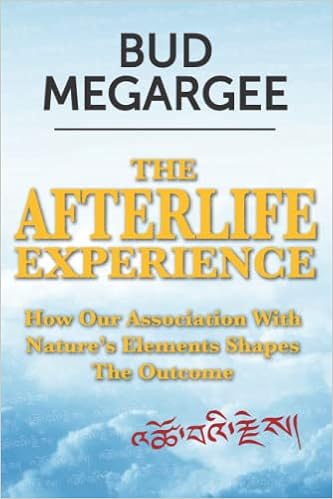

Bud Megargee, in his enlightening book, helps readers reflect on life, and ponder about their choices and their connections with nature. His book The Afterlife Experience: How Our Association with Nature’s Elements Shape Our Outcome contains the information you need to help you understand life and the outer world. I appreciate Bud Megargee’s method of writing as he makes the reader feel like they are part of the conversation. The author introduces readers to his book with an Albert Einstein quote. ‘Look deep into nature, and then you will understand everything better.’ In the introduction, the author gives the reader a hint of what he will discuss and also shares a bit about his persona.
The reader is then introduced to Laz, the author’s soul guide, whose words of wisdom stick throughout the book. In The Afterlife Experience, we follow a conversation between Laz and Bud. The two converse about an array of topics that touch on life, energies, and souls. I enjoyed the conversation not just because of the wording but because of the open-mindedness between the two. Reading about personal tales and encounters was not only fascinating but also informative. This is the book you need to have if you want to have a better understanding of the meaning of life and beyond. Simple conversations answer complex questions that one may have about soul ties, life, and the afterlife.
I like that as much as the discussion in the book is about life, the author also incorporated interrelated topics. Reading about spirituality, energies, Buddhism, and life’s complexities was eye-opening and interesting. Laz and Bud have appealing minds and an exceptional way of thinking that will make you engrossed in the diverse subjects being discussed. It is an easy read that has a great flow of conversation. I applaud the author for the smooth change of subjects in every chapter. Bud Megargee understands the art of integrating topics and how to move from one theme to another without losing the reader.
At the end of the reading, readers will better comprehend certain moments of their life and life in general. Readers will also be enlightened on spirituality, the afterlife, and how components of air, fire, earth, and are tied to a soul. The reader also learns the connection between particular traditions and philosophies. Bud Megargee’s fascinating use of analogies and shrewd sayings cannot go unmentioned. The analogies in the book made the reading more exciting and more fun.
Pages: 142 | ASIN : B0BDS19KL5
Soul Afterlife


“What happens after we die? Is there a life after death?” These are the questions that have plagued humanity since times immemorial. Unfortunately, most religions, faiths, and cultures try to answer these questions differently, while some stay silent on this. Every human at some point has worried about this, whether with the curiosity of a child or with the wisdom of old age, but no one really knows. Bud Megargee explores this fascinating topic through interviews with those that have experienced brushes with death.
Soul Afterlife: Beyond the Near-Death Experience is Bud Megargee’s journey on an unorthodox quest to find answers to these questions for himself. It seeks to satiate the author’s curiosity about questions of life, death, soul, and reincarnation through the state of being as close to death as one possibly can: Near-Death Experiences or NDE.
In this journey, to seek answers to non-traditional questions that make him question his Catholic schooling, the author seeks out the help of his spiritual guide – Shirlet Enama. Shirlet is a psychic/oracle who lives in the mountains of Berwick, Pennsylvania. The thought-provoking book’s format is light and palatable as it is a mixture of text and interviews, which keep the book interesting. However, sometimes this complex book gets hard to understand due to references to his other books without including footnotes or endnotes to explain to readers.
Soul Afterlife: Beyond the Near-Death Experience is a compelling work that seeks to answer the question of what happens to the soul when we die. Readers that enjoy personal transformation, spirituality, and self-help books would find this a valuable read. Also, this intriguing book is recommended for anyone who, like many others before us, seeks an answer to the questions about life and death. Even though the book is a companion to Megargee’s previous works, it is still understandable to any beginner, even as a stand-alone work.
Pages: 233 | ASIN : B085GM3HNP
The Consciousness of Bud Megargee

Soul Afterlife shares your personal journey and the discoveries you have made along the way. What were some key ideas that you wanted to explore in this book?
That is an excellent question. Over a ten-year period, I noted more than a few explanations regarding the meaning of the phrase, “spirit of man”. It was, in part, an attempt to clarify the mind/body/spirit treatment concepts that were expressed in the psychiatric/behavioral health hospital industry. I explored medical, psychological, traditional religious, as well as philosophical justifications for using the word “spirit” – both in the positive and negative. In addition, I studied at a Taiwanese Buddhist monastery in Northern Virginia to understand deep-thinking Eastern philosophical views of the subject of human consciousness. At this holy place, I was introduced to the Buddhist/Sanskrit doctrine of anatman, also described with the Pali term anatta. My Buddhist friends argued that nothing is constant, everything changes through time – that we all have a constantly fluctuating stream of consciousness. In essence, there is no underlying substance that can be called a human soul or an independently fixed spirit.
I was conflicted over this when comparing it to everything that I was discovering. My latest book – “Soul Afterlife -Beyond the Near-Death Experience” – begins by documenting this debate: How can I bring into focus the Buddhist doctrine of anatman in the middle of everything I was uncovering? Ultimately, it required the discipline to look beyond obvious explanations – to remove the veil that seemingly walled in my superficial understanding. Only then could I begin to balance the scales concerning what was behind my continuation – that which I understand to be the consciousness of Bud Megargee.
My key ideas or strategies to explore all of this were:
First, if I place aside the doctrine of anatman, can I find my answers to the “spirit of man,” outside traditional interpretations of the human spirit and in a metaphysical account of what a soul and soul life might look like?
Second, in taking such a voyage I wanted companions – I did not want to travel alone. I wanted readers to become “co-pilots” and journey along with me into uncharted waters to challenging the authenticity of what we all have been taught about a life, death and our consciousness. The only requirements and tools that would be required? Our questions.
Have your spiritual ideas changed or evolved after your time studying at Wat Yaranna Rangsee?
I do not think that they have changed or evolved in dramatic fashion. Perhaps they simply have been categorically enhanced. Let me explain: My Buddhist monastery experience has not been one of deep philosophical enlightenment. Rather, I would classify it as settling on what “core” life beliefs, insights, and actions are essential to whom I have chosen to grow into. The voyage to become deeply self-aware is a weighty challenge. I found that Vipassana meditation – the dedication to self-examination and observation – provided the impetus to consider what I might need to change or adjust to become less flawed.
Confronting the notion that we are significantly more than we can imagine requires the courage to be self-forgiving, less imperfect and more compassionately aware. Perhaps, upon reflection, they would be the spiritual changes I would comfortably recognize.
What is one piece of advice you wish someone had given you before studying at the Buddhist Monastery?
I do not believe that there is a standard training pamphlet that exists prior to visiting a monastery but, here are several of my observations.
I remember initially standing in the entrance to the morning meditation room frozen by the level of respect that was on display between the monks, nuns and early morning visitors. Fashioned within the sounds of chanting and the periodic sound of the striking of an ancient bell, attentive monastic individuals were seeking the challenge of hunting for a moment of sincere enlightenment. Concentration, empathy and understanding are not just expressions for belonging within a Buddhist community. They are the needed building blocks for a heedful way of living.
So, to answer your question more directly – I would like to have been more prepared to understand that I would be an eyewitness to the heart of monastery attentiveness. That laced between the hum of an Om mantra, I would uncover the focused concentration necessary to grasp that, absent of my ego, I am more than I could possibly imagine.
What is the next book that you are working on and when will it be available?
For the record, in the beginning, I never intended to write or publish anything as unconventional as life within the spirit world. Yet, with five alternative memoirs now in publication, including “Soul Afterlife – Beyond the near-Death Experience”, I am in the middle of organizing a sixth.
One theme that is universal throughout my mystical narrative accounts is the storybook temperament and collaboration of all energy. Within the literary limitations of “Soul Sins,” “Soul Mechanics,” “Soul Imprints,” and “Soul Afterlife,” there is an interconnection of energy with the natural elements that shape how we eventually act as a community.
It is becoming increasingly clear that stockpiled energy defines specific outcomes – individually, ecologically or within the intimate fabric of our society. As a result, I have begun to examine a detailed spiritual explanation of how the roles of water, fire, earth and air affects all life.
In “The Chaotic Energy of the Soul” I knowingly engulf my mystical narratives into the turbulence created by positive and negative chaos. Not everything that we experience is tilted toward disorder, but we need human warriors – those individuals who possess the indispensable energy to actively set the scales within nature’s basic elements, and in doing so, ensure that we all live inside a balanced world.
“The Chaotic Energy of the Soul” will be available in paperback, eBook and audiobook formats beginning Spring 2022.
Author Links: Amazon | GoodReads
And saints and sages throughout the ages have given their interpretation of what awaits us on the other side.
But few have taken this inquiry as far as Bud Megargee, a corporate-executive-turned-soul-explorer whose latest book explores in exquisite detail the mechanics of what happens to our souls before, during, and after our lives on earth.
Megargee’s questioning started decades ago as a psychology grad student when he found himself listening to a man in a hospital bed describe his near-death experience. The story was powerful enough to make Bud — who was raised Catholic and later became a practicing Buddhist — consider the existence of a soul and thus, an afterlife.
Driven by extreme curiosity and his growing belief that we are more than what we can imagine, Bud began searching for answers.
He found them, and then shared his discoveries with the world through his books.
From the award-winning author of five unconventional spiritual memoirs comes Megargee’s latest book in the series, Soul Afterlife: Beyond the Near Death Experience. Through a series of dialogues with “a voice from the beyond”, we bear witness to his thought-provoking questions, the detailed and unorthodox answers he receives, and his attempt to come to terms with them. The book tosses conventional understanding of what happens when we die to the wayside to tackle tough questions about the near-death experiences so many have witnessed and lived to tell:
What exactly does the soul think, feel and experience once it’s through the spinning tunnel?
How long does it stay there?
Does it undergo a life review of sorts?
Where exactly does the tunnel lead?
Is reincarnation next and, if so, how does it work?
Each conversation is detailed and complex, but through our guide’s capable telling of this otherworldly life of the soul, we are free to grasp onto as much as our egos dare to allow. Megargee makes no pretenses and is quick to point out his own skepticism, but it’s that rare sense of honest uncertainty from a corporate-executive-turned-spiritual-voyager that is so refreshing for anyone who remains open-minded and curious about what comes next.
Soul Afterlife: Beyond the Near-Death Experience

Soul Afterlife: Beyond the Near-Death Experience, by Bud Megargee, is the author’s journey of spiritual self-discovery. The book is an account of the authors opinions and experiences while figuring out what happens to an individual’s self and soul after life. Many concepts are introduced throughout this book that explain what a soul is and how it is affected throughout many lives. Some topics discussed throughout the book include reincarnation, becoming human, and transcendence. One important concept discussed throughout the book is awareness. You must have awareness of yourself and your actions and how they affect your soul in this life and the next. The author’s purpose was to explore his self and soul through this life and the next, and I believe this goal was met and depicted in an interesting way throughout the book.
Megargee has a writing style that is comforting and relatable. Throughout the book, Megargee offers his own opinions and feelings about a soul in the afterlife. There is dialogue between the author and a channeled soul guide “Laz”. The dialogue present helps the reader understand the concepts being introduced throughout the book. Megargee has a way of exploring spiritual ideas that are foreign and presents them in a way the reader can understand.
I was able to easily get into this book and gain a deeper understanding of my own soul. I felt it easy to connect with the author and it was easy to engage in his spiritual journey. The reader never feels like an outsider looking in and instead you feel as though you are side by side with the author applying the knowledge to yourself to find your own truth.
Soul Afterlife: Beyond the Near-Death Experience is one book worth giving a chance. The writing style was comfortable, and if you enjoy this genre, this book will be an enlightening read. If you enjoy concepts in spirituality, a personal writing style, and looking within this book is for you.
Pages: 235 | ASIN: B085GM3HNP