Blog Archives
The ADHD Awakening: A Woman’s Guide to Thriving After Diagnosis


The ADHD Awakening tells the story of a woman piecing together a lifetime of confusion, emotional intensity, and masked struggle into a clearer picture shaped by a late ADHD diagnosis. The book moves from her childhood experiences of impulsivity, shame, and missed signs into the chaos of undiagnosed adulthood, where relationships, parenting, and self-worth tangled together. It blends research with lived stories from many women, creating a guide that feels both personal and universal. The arc of the book shifts from raw memoir to a practical roadmap for self-understanding. It shows how ADHD weaves itself into every corner of life and how clarity can open the door to self-compassion.
The writing lands with this honest, almost disarming warmth, and I kept feeling like I was eavesdropping on someone telling the truth they never had the chance to say aloud. I liked that the author didn’t try to polish her past into something neat. The stories of hiding in plain sight, of dealing with rejection, of feeling intense emotions that others shrugged off hit with real weight. Some chapters made me stop and think for a moment. The moments about growing up in instability and learning to mask emotions resonated with me. They showed how misunderstood ADHD in girls can be and how easily the real story gets buried under labels like “dramatic” or “too sensitive.”
I also appreciated how the book layered science into the narrative without slipping into cold textbook talk. The explanations of executive dysfunction, emotional flooding, time blindness, and dopamine seeking were human and straightforward and strangely comforting. Sometimes I wished the pacing slowed down so that specific ideas could be explored more deeply, but the emotional honesty kept me hooked. There’s a tenderness in the way the author speaks to her younger self and to the reader. It made the book feel less like advice and more like an invitation to stop fighting your own brain.
I’d recommend this book to women who suspect they might have ADHD or who were diagnosed later in life and are now trying to make sense of the past. It’s also a great read for partners, friends, or anyone who wants to understand the emotional world behind the symptoms. If you like books that explain things with real stories instead of stiff jargon, this one will feel like a warm hand on your shoulder. It’s heartfelt, accessible, and practical, and it gives anyone navigating ADHD a sense that they’re not alone.
Pages: 319 | ASIN : B0G4SP8L38

Empathy and Support
A Different Lens follows a young skunk who struggles with his morning routine and schoolwork leading to feelings of frustration and isolation. What was the inspiration for your story?
As an educator and a mother, I have the privilege of connecting with many children. A few years ago, an extraordinary boy with ADHD was going through a particularly challenging period. One day he told me, “Don’t you understand? It doesn’t feel good at all to have a hard time!” It was at this moment my understanding of what Dr. Ross Greene has said, “Kids do well when they can,” moved from my head to my heart. I witnessed how empathy and support changed this child’s life. I also became keenly aware that so many people with invisible disabilities are negatively impacted because their challenges are misunderstood. I wrote this book so that readers of all ages could have the opportunity to see the world through the eyes of someone with an invisible disability. Given this experience, I hope they will see this population through “a different lens,” and be inspired to show patience, empathy, and support.
The art in this book brings the emotions of Simon to life so even younger children can understand what he is experiencing. What was the art collaboration process like with illustrator Zoe Bendoff?
Partnering with Zoe was a fantastic experience! It was a close collaboration. We live in the same town, so we met throughout the process. I shared hopes for each page, requesting simple images that focused on the emotions of the characters. Zoe blended in her ideas and added her signature style creating beautiful illustrations that truly capture the feelings of each character. She also embedded many personally meaningful “hidden nuggets.” For example, the handwriting in Simon’s journal and the word “Different” in the title are my son’s handwriting. She is extremely talented and was truly a joy to partner with.
What were some ideas that were important for you to share in this book?
As Dr. Stuart Shanker said, “When you see a child differently, you’ll see a different child.” What may appear to be off-task, attention-seeking, or defiant behavior is often the symptom of an invisible disability and outside the child’s control. Everyone wants to do well. When we assume positive intent and aim to support all children in a way that is individualized to their needs, they can be the best version of themselves. When this happens, those children and everyone around them benefit.
Is this the first book in the series? If so, when is the next book coming out, and what can your fans expect in the next story?
Book number two is in process and will be published in the spring of 2025. It is about a day in the life of one of Simon’s classmates- Robyn. Check back in the spring to find out more!
Author Links: GoodReads | Adori Publishing | Amazon
“A Different Lens” is:
A must-have for every elementary school’s Diverse Book Club list
A book for educators and administrators of 1st-5th grade classrooms supporting social-emotional learning
A resource for parents to teach children about empathy, neurodiversity, and invisible disabilities, such as ADHD.
A tool for enhancing adults’ understanding of the diverse abilities of children within their families, schools, and community
Simon struggles to complete simple tasks at home and school, leading everyone in his world to feel upset and annoyed. Inevitably, Simon’s frustration reaches a boiling point and he makes a huge mistake in front of everyone! How will Simon ever recover? Why can’t he just do better? In the end, readers will realize that Simon, like everyone, is doing the best he can, and with a little support, the world can become a better place for all.
Neuroaffirming Support

In Nurturing Neurodivergence, you provide neurodivergent individuals with practical advice and guidance for navigating a neurotypical world. Why was this an important book for you to write?
Nurturing Neurodivergence is actually birthed from a group therapy program that I wrote not long before deciding to publish it in book form. That was a big step for me, but I wanted to do my part in making neuroaffirming support more accessible. In my years working with neurodivergent people (both as a teacher previously and now a psychologist), I find that one of the biggest challenges is to explain some ultimately abstract concepts that are essential for building healthy relationships (e.g., emotional accountability, healthy boundaries, even emotions in itself) in very concrete ways. To do that, I always try my best to ground any new learning that I’m presenting someone in everyday things or events that are already very familiar and relatable for that person. And it’s not that this need for making connections between old and new knowledge in learning is exclusive for neurodivergent people – rather, it’s a shared humanity, really. But I do think that this need is taken up a few notches for many neurodivergent people. Growing up, most kids somehow seemed to simply understand new concepts taught just by listening to the teacher reading from the textbook. I’d be as lost as Alice, but if someone were to whip out everyday objects – oranges, apples, toy figures… – and explain it to me again using those things, often, I’d get it.
Every neurodivergent person is different, but many of us are concrete thinkers. It’s a myth that all of us aren’t capable of understanding metaphors or analogies. We know from developmental psychology that the concrete learning phase needs to happen before abstract thinking can develop, which is why almost every child goes through a phase where they have and need much more certainty in what’s good and bad, right and wrong. As we grow, it’s not that we completely ‘graduate’ from concrete thinking altogether, but that we generally start requiring less of it and become more accustomed to moving onto more abstract thinking at a much quicker rate.
The way I see it, neurodivergent people are the same, but we just have a higher need to stay grounded in the concrete before we can incorporate the abstract. So, to explain to my clients why our attempts to ‘control’ our undesired emotions could instead magnify the very same emotion, for example, I might do a psychodrama experiment with them where I wear a tag that says “big anxiety” around my neck, and ask them to do their best to “get me out of the room” while listening to a played recording that is supposedly their loved one confiding in them about something important, before discussing their experience of whether they really were engaging with their “here and now” during the experiment, or with me, aka their anxiety.
I’d argue that learning life skills, including how to build healthy relationships, is just as important as learning fundamental literacy and numeracy skills, but there is never a school for it. And perhaps some folks who manage to learn things without explicit teaching could pick them up as they go and apply them in their lives to build healthy relationships, but the rest of us would be as lost as I was in classes where teachers read from the textbooks (except in this case, it’s more like teachers who told you to figure it out yourself without providing anything). This is why it’s so important for me to write this book.
Neurodivergence has so many facets. Did you find anything in your research for this book that surprised you?
Neurodivergence is incredibly multi-faceted, indeed. My lived experience and years of clinical experience are the main reasons why I’d be surprised if I found anything from my research for the book that still surprises me because neurodivergence research has always been quite a few steps behind what we encounter in practice (talk about being thrown in the deep end). So, in answer to your question, no, unfortunately, I didn’t, but rather, it was what I did not find that surprised me. Before writing Nurturing Neurodivergence, I had not done research to this breadth and depth since leaving the university, and I suppose I was expecting to see more new additions to the research literature on different aspects of neurodivergence, especially around alexithymia, for instance, than what I’d found. Then again, in the very beginning, I was trying to read more laypeople articles, instead of just academic journals, in hopes that it’ll help me with writing in layperson’s terms, which is what’s intended, but was rather surprised to find the amount of misinformation on neurodivergence that’s being floated around on the Internet and social media. Many seemed to quote random (legit academic journal) articles, but completely distort findings, or add in their own claims that are nowhere to be found on the cited source. I could see the potential of some of those misinformed claims doing significant harm. So, with the exception of referencing a few high-quality blog articles written by people with lived experience, I returned to scientific sources and allowed myself to write a thesis (I mean, that’s how we were trained to write) before rephrasing everything.
What is one thing you would like readers to take away from Nurturing Neurodivergence?
That a healthy relationship with ourselves as a full package, complete with parts we like and don’t like, is just as important as, if not more than, our relationships with the rest of the world around us.
What is the next book you are working, on and when will it be available?
To be honest, I don’t know what I was thinking – continuing my usual clinical and supervisory work and writing a book simultaneously. I’ve learnt my lesson that doing so doesn’t exactly leave much room for me to have a healthy relationship with myself, and did make my close circle promise to shake some sense into me, shall I ever feel tempted to do it again. So, I don’t know if there’ll be a next book for me. But IF (a big ‘if’) there should be one, I’ll probably dive into another aspect of healthy relationships with the self that I’ve only skimmed over in Nurturing Neurodivergence.
Author Links: GoodReads | Facebook | Website | Jasmine Loo Psyschology | Amazon
In it, you’ll find thought-provoking questions or activities for guided reflections, engaging infographics (in FULL COLOUR!) unpacking key concepts in accessible ways, as well as practical strategies to support you with navigating the day-to-day of a late-identified adult. Drawing on a range of evidence-based psychotherapy models, including Acceptance & Commitment Therapy (ACT) and Cognitive Behavioural Therapy (CBT), it is a fantastic resource for mental health practitioners. With a fierce commitment to helping late-identified adults avoid neurodivergent burnout and develop a sustainable way of living, Nurturing Neurodivergence gifts readers with the essential tools for building healthy self-view and relationships in their lives.
Nurturing Neurodivergence: The Late-Identified Adults’ Guide to Building Healthy Relationships with Self and Others
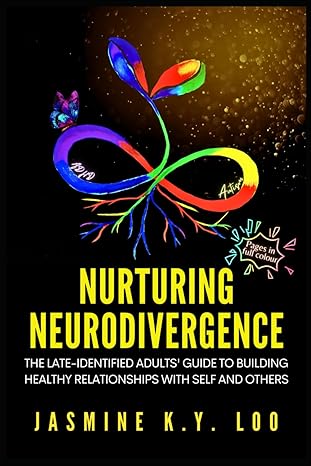

Nurturing Neurodivergence: The Late-Identified Adults’ Guide to Building Healthy Relationships with Self and Others, by Jasmine K. Y. Loo, serves as a practical and insightful guide for neurodivergent individuals, particularly those with Autism and ADHD, navigating a world predominantly designed for neurotypical individuals. Loo addresses the notable gap in literature for adults who discover their neurodivergence later in life. Through a blend of personal anecdotes and experiences from her professional interactions, the author provides a roadmap to help these individuals transition from unawareness of their neurodivergence to understanding and navigating life with this new self-knowledge.
The book is enriched with introspective questions and guided exercises, which are thoughtfully integrated either for in-book reflection or use in a personal journal. This approach not only deepens the reader’s comprehension of the topics discussed but also facilitates a more personalized journey of self-discovery and understanding.
An especially commendable feature of Loo’s work is the organization of the chapters. The book begins with an overarching introduction before delving into specific discussions on Autism and ADHD. Each section thoughtfully examines the emotional, executive functioning, and sensory processing challenges associated with each condition, along with other unique characteristics. This book is a significant resource for those interested in psychology as it highlights the reality that awareness and understanding of neurodivergence in adulthood are still emerging concepts. This realization, combined with a lack of adequate professional guidance and existing stigmas, underscores the importance of Loo’s work.
Nurturing Neurodivergence stands out for its accessibility, empathy, and the careful balance it strikes between being comprehensive and personalizable through the included exercises and queries. The book resonates as a voice for many undergoing similar experiences, offering valuable insights for neurodivergent individuals, mental health professionals, and those seeking to broaden their understanding of neurodiversity.
In essence, Jasmine K. Y. Loo’s book is a significant contribution to the field of neurodiversity and mental health. Its practical guidance and empathetic tone make it a valuable resource for a wide audience, fostering greater understanding and support for neurodivergent adults.
Pages: 148 | ISBN : 978-0645896084

You Are Worth Attention And Recognition

Let’s Help You Self-Help! shares with readers your story about overcoming various challenges and the twelve steps you found to help you achieve the success you dreamt of. Why was this an important book for you to write?
I felt the book was important because it was something I truly wanted to accomplish in my life. I have always wanted to leave a mark on the world that’s positive before I die. So, I told myself that if I truly cared for my well-being that I would write and complete a book. Though it’s self-published, I am proud of what I set out to do. I believe I nailed it because this book is tailored to my mind and because it’s a guided journal/workbook that if I find myself going through a mental break I can, always turn to the words that helped me through the worst of times. It’s helped me and it’s helped at least one other person, that’s what I felt was most important.
What were some ideas that were important for you to share in this book?
I wanted the book to read and feel as though I was reading it to you in a spirit or tone that is highly encouraging to those in a fragile state of mind. I was adamant about the book being a quick guide to grand topics,, and nothing too complicated or confusing as to not give dangerous advice. I wanted a book anyone could use even if they’re not mentally ill.
What is a common misconception you feel people have about mental illness and being successful?
A common misconception is the blanket statement of “mentally ill.” There is a vast number diagnosis’ that fall under mental illness but would hardly be noticeable to others and sometimes even yourself. So, to say someone is mentally ill throws you in with psycopaths, not to mention each disabilty or disorder effects others differently. I have Bipolar 1 and I know others with Bipolar 2, we have some similarities but entirely different personalities and struggles. A mistake I made was deciding and believing something was “wrong” with me. Once I deemed something was wrong with me, you start the downhill spiral of believing you’re inadequate and never trying. My thoughts on success are perhaps different from the masses but maybe I’m wrong. In the book I say something like, “I believe success is being overjoyed or at peace after completing anything you set out to do.” Yes, the common consensus is that success is shown in fiscal form, but I believe true success lies within someone’s own goal and ability to reflect on what they enjoyed doing. Peace of mind, body, and heart is where success resides.
What is one thing you hope readers take away from your story?
That they are worth attention and recognition that their feelings or emotions are valid to some degree. I want those who read the book to understand they are truly suffering and should never be ashamed longer than half a second. The shame must go away before you can spread your wings. Never be ashamed of something completely out of your control, change what you can when you can and keep trying until you can reflect and be at peace.
Author Links: GoodReads | Twitter | Website
Let’s Help You Self-Help!

Anthony Braaten expertly navigates his journey of overcoming multiple diagnoses and redefining the odds in this book, Let’s Help You Self-Help!. In this book, he generously shares the pillars of his success. These consist of a cocktail of mastered willpower, practiced gratitude, forgiveness, kindness, and a myriad of other skills. The essence of Braaten’s narrative highlights that no one is inherently born for success. Still, with dedication and the right strategies, success can be attainable by even the most unlikely individuals. Braaten ingeniously constructs an immersive space where he and the reader share experiences and lessons drawn from the twelve skills dissected in the book.
The book’s intimate and authentic tone stems from the author’s deliberate choice of first-person narrative, further emphasizing the personal resonance of the content. Braaten’s ability to share personal experiences and find the delicate balance between humor and the subject matter’s gravity enhances his content’s relatability and engagement. By adopting the unique approach of writing “from a patient to a patient,” Braaten imbues the book with an empathetic and understanding tone, providing much-needed solace for those facing similar life hurdles.
The integration of practical exercises within the chapters catalyzes readers to actively implement the discussed concepts and skills. The book serves as a personal development tool, challenging individuals to introspectively identify gaps in their lives and strategize how to fill them. This evaluation, aligned with the twelve skills, underpins Braaten’s pragmatic approach.
Despite its conciseness, the book stands as an empathetic companion and a possible gift for those grappling with mental health challenges. The practical guidance within its pages, coupled with its accessible presentation, makes it an essential resource for readers aiming for healthier and more fulfilling lives. Braaten’s narrative fosters an important dialogue about managing everyday life amidst mental illness, posing the crucial question, “What happens after diagnosis and treatment?”
In its simplicity, this book’s content is easily digestible, and the skills are straightforward to learn. It is highly recommended for those seeking to enhance their productivity and well-being. Through Anthony Braaten’s story, we are reminded that life does not stop at a diagnosis but rather continues in a transformative journey toward personal triumph.
Pages: 116 | ASIN : B08BPHV3M3
These Are My People

Edgar Allan Know and His Big Busy Brain follows an intelligent young boy with an active mind who must find a way to focus to learn to ride his bike. What was the inspiration for your story?
I am a mom and a family therapist. My son was the kind of kid who was always asking questions, experimenting and loved to tell people about all the great things he knew. As a therapist, I have had many brilliant child clients who are articulate, inquisitive, and sometimes a little impulsive. They often are chastised for blurting out answers in class etc. These are my people, and I love them, so I developed a mindfulness exercise that I use with my son and my clients. I was inspired to write this story by these wonderful children, and I hope it speaks to children and adults everywhere.
The art in this book is fantastic. What was the art collaboration process like with illustrator Barbara Owczarek?
This was by far my favorite part of the book process. I looked for an illustrator for over a year before I found Barbara. At our first meeting, I knew we were a great fit. I had a specific look I wanted for the book, a little bit gothic, a little bit rock n roll, and a lot cozy. I told her I wanted the main character to look like a combination of a young Jack White(musician) and Edgar Allan Poe. She totally got it, and Edgar came to life. We discussed each page with a free-flowing exchange of ideas, and she was amazing.
I find something to delight in every time I look at the illustrations. Barbara really understood the story and had the same aesthetic that I wanted for it.
What were some educational aspects that were important for you to include in this children’s book?
I wanted children to be excited to explore science and history through reading, which is why Edgar has so many different types of books in his room. I also hoped readers would learn about the power of mindfulness and how being different can be a positive trait.
Will this children’s book be the start of a series, or are you working on a different story?
I am working on another Edgar Allan Know book, hoping to make it into a series. I am also working on other stories on different subjects.
Author Links: Facebook | Website
there is one thing he doesn’t know – how to ride a bike.
Despite lots of attempts, Edgar’s brain is too busy and he just can’t figure it out! But when Mom helps Edgar learn how to focus, will it finally be what he needs to master bike riding? And what does a hot chocolate have to do with it? Join Edgar in this heart-warming story to find out! Full of quirky facts, mindfulness techniques and emotion, this beautifully illustrated story is perfect for both children and adults to enjoy.
Edgar Allan Know and his Big Busy Brain
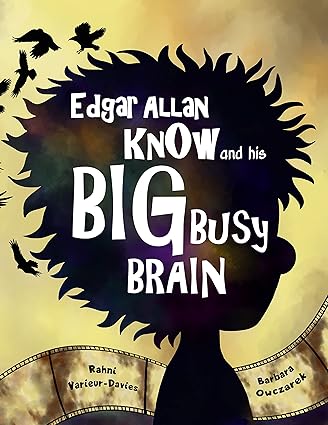
If you want to know it, ask young Edgar Allan Know. There is nothing he cannot figure out or explain. He is an expert on virtually everything. From paleontology to the length of time it would take to bike to Australia, Edgar is the expert of all experts. His young mind is always thinking, processing, and questioning. Edgar is both learning and sharing knowledge every minute of his day–so much so that he has neglected to figure out how to properly navigate riding a bike on his own. With a little help from his mother, Edgar is able to conquer the one bit of knowledge that has eluded him.
Edgar Allan Know and His Big Busy Brain, written by Rahni Varieur-Davies and illustrated by Barbara Owczarek, is the story of a little boy with an exceptionally adept mind. Edgar Allan Know represents every awkward elementary student who manages to wow everyone with book knowledge and an innate understanding of the world around him, but lacks the ability to conquer simple fears. As I read this book, I could definitely picture it as a wonderful resource for school guidance counselors as they plan units to teach young students empathy.
While the focus of Edgar Allan Know and His Big Busy Brain is mindfulness, I can see the lovable and relatable main character as an excellent one for further books all with different lessons in tolerance, respect, responsibility, and integrity. Owczarek’s illustrations are stunning; Edgar Allan Know is a fantastic representation of a child mesmerized by the world around him and an appealing blend of the man himself. I enjoyed watching for all of the nods to Poe throughout the book.
I recommend this incredible author/ illustrator team to any teacher or parent looking for a book that addresses how to master mindfulness, overcome fears, and learn to help others fighting their own internal battles.
Pages: 39 | ASIN : B0BXQ2J52L



 LITERARY TITAN