Blog Archives
The Rocking Horse Agreement


In The Rocking Horse Agreement, Scott Everett brings together Arthurian legend, political intrigue, supernatural powers, and environmental catastrophe in an ambitious novel that moves between personal discovery and a crisis of global proportions. The story begins with an extraordinary premise: a secret agreement signed in 1939 by President Franklin D. Roosevelt and King George VI has remained hidden for nearly nine decades. When circumstances bring this forgotten arrangement back into focus, Emmy Pen, a young kindergarten teacher whose life has recently taken an unexpected turn, discovers that her ancestry connects her to a remarkable historical legacy. Meanwhile, troubling changes in the world’s oceans suggest that an ecological disaster is unfolding. Everett develops these seemingly separate mysteries into an expansive narrative involving ancient secrets, government institutions, and a growing confrontation between humanity and the natural world.
The novel draws much of its personality from its central characters, especially Emmy, her lifelong friend Myrla, and Aliki McCord, a determined teenager whose investigation into her parents’ disappearance uncovers disturbing evidence about the oceans. Their relationships give the story an emotional foundation amid its increasingly extraordinary circumstances. Myrla’s irreverent humor and fierce loyalty provide some of the book’s most entertaining moments, while Emmy’s practical outlook offers a relatable perspective on events that challenge everything she understands about her identity. Aliki brings a different energy to the narrative, combining scientific curiosity with the persistence of someone seeking answers to a personal mystery. Her declaration, “I believe it never stopped,” captures both her determination and the unsettling implications of her research. Everett also gives supporting characters meaningful responsibilities, creating an ensemble whose friendships, disagreements, and competing priorities shape the developing story.
Everett’s storytelling is cinematic, with brisk dialogue, sharply defined settings, and frequent transitions between locations. Scenes unfold in classrooms, government offices, historic estates, military installations, and remote environments, establishing a sense of scale that grows steadily throughout the novel. The author incorporates marine biology, oceanography, military operations, and geological processes into a fictional world where ancient mythology has an immediate bearing on contemporary events. These elements create an unusual combination of speculative science and fantasy, often delivered through detailed conversations and operational briefings. At times, the amount of technical explanation and the speed of the transitions demand considerable attention, especially as new characters and developments enter the narrative. Still, the book’s energetic approach gives its central mystery a sense of urgency. One character’s warning, “If Myrla tells you something impossible, don’t dismiss it,” serves as an effective invitation to enter Everett’s imaginative world.
Beneath its supernatural encounters and international intrigue, The Rocking Horse Agreement is concerned with humanity’s responsibility toward the planet and the consequences of environmental neglect. Everett explores these concerns through a story in which questions of inheritance, power, loyalty, and personal obligation become inseparable from the future of civilization. The novel also considers the burdens placed on individuals who find themselves responsible for decisions far beyond their experience, giving its larger conflicts a recognizable human dimension. Its blend of ancient mythology, ecological speculation, and contemporary geopolitical tension creates a distinctive reading experience, especially for those who enjoy genre-crossing fiction with substantial world-building and high stakes. With its emphasis on friendship, stewardship, and the possibility of profound change, The Rocking Horse Agreement presents an imaginative vision of a world approaching a critical turning point.
Pages: 296 | ASIN : B0HM23NT45

The Pulse of Past Generations

Way Keeper follows a compassionate boy in tenth-century France whose growing connection to the Old Ways tests his family bonds as he learns to protect a sacred inheritance he does not yet understand. What was the inspiration for the setup of your story?
Since Way Keeper is the first book of a prequel series to The Evensong Enchantments, my debut trilogy, its inception sprang from those stories. The characters that I had created seemed to want more…their lineage, the magic system, and the Druidic prophecy—the undercurrent that drives those first three books.
The roots of the stories are deeply entwined with my fascination for the untold Druidic legacy and its intersection with early Christian beliefs. I wanted to convey how ancestral memory shapes identity, especially through sacred places like Chartres. This setting serves as a crucible for Lucian’s journey, where the past is not just remembered but felt in every stone and stream.
What guided your use of stones, water, and woodland sensations to make ancestral memory feel present in Lucian’s everyday world?
I aimed to create a world where the landscape is a living memory. Stones represent permanence, water signifies memory, and the earth itself embodies the spirit of the Old Ways. By weaving these elements into Lucian’s daily life, I hoped to illustrate how our surroundings can hold and transmit the pulse of past generations.
How did you develop Lucian’s understanding of when to use magic, when to exercise restraint, and what caring for others requires?
Lucian’s journey mirrors the path from instinct to wisdom. His early experiences with magic are not yet fully understood by him. In fact, at times they frighten him as he is yet a child. But as he leans into trusting his ancestral gifts, he learns that true power lies not just in wielding elemental forces but in understanding and compassion—and even more importantly, the intention behind his actions. This evolution is central to his character arc and will continue to unfold in the coming books.
What drew you to recurring images of breath, blood, and light, and how did you balance their ceremonial rhythm with emotional immediacy?
Breath, blood, and light symbolize life force, connection, and the divine. These images recur to remind readers of the sacredness of existence and the interconnectedness of all beings. Balancing the ceremonial with the personal was key; I wanted readers to feel both the ritual and the rawness of Lucian’s experiences.
Author Links: GoodReads | Amazon
Atmospheric, lyrical, and steeped in the mysteries of the ancient world, Way Keeper is a coming-of-age tale of brotherhood, loss, destiny, and the enduring memory of the earth.
For readers who crave historical fantasy with depth—where magic is ancient and sacred, history feels lived-in, and the boundary between the mortal world and the unseen grows thin.
In tenth-century France, twelve-year-old Lucian has been raised in the Old Ways, learning the quiet mysteries of the earth. But when his grandfather dies, an ancient legacy becomes a burden Lucian was never prepared to carry.
Far from home, he discovers the old stories are not stories at all. Forgotten Roads still wind beneath the mortal world—and something within them remembers him. When everything he loves is threatened, Lucian must follow a path no Druid has walked in generations, and discover why the Old Ways have chosen him.
Way Keeper begins The Moonstone Magicks, prequel to The Evensong Enchantments.
If you’re drawn to the lyrical fantasy of Juliet Marillier’s Daughter of the Forest, and the visceral, mythic scale of John Gwynne’s The Shadow of the Gods, enter the forgotten Roads of the White Dragons. Discover Way Keeper today.
Reluctant Keeper of the Old Ways
Coming of Age
Otherworldly Roads
Sacred Runes & Forgotten Enchantments
Elemental Magic
A Realm Where the Land Remembers
A Different Time and Space

Fae of Legacy and Lies follows a seemingly powerless priestess who leaves her home and discovers that her fae heritage, hidden magic, and even her identity have been shaped by secrets, and she now has to decide what path her destiny will take. What first inspired Magdalene of Avalon and the world surrounding her?
I read The Mists of Avalon during a rough transition right after I got out of the U.S. Military. The book had a way of pulling me into a different time and space that I deeply needed. That escape inspired me to go on a sacred sites tour of southwest England, where the heartbeat of King Arthur influenced me and the mysterious Black Madonnas scattered throughout the territory fed into a story developing in my head. Coupled with my lifelong love for Tolkien and a deep fascination with my Welsh heritage, the Magdalene of Avalon series was born.
Magdalene can be stubborn, insecure, devout, impulsive, and humorous. How did her personality develop as you wrote her?
I have to confess there might be a bit of myself in her—okay, a lot of myself. I’ve always used humor to soothe my nerves and unwind when tension piles up. Because of that, I ended up drawing on my own life’s progression to imagine how Magdalene would react, stumble, and grow as she faces the monumental challenges throughout the series.
The story repeatedly asks whether protection can become a form of control. How did that theme develop?
It naturally emerged as I wrote, but I’m no stranger to the theme itself. Whether people realize it or not, we often try to control the people we love. Be it out of fear or affection, we tend to place heavy influence on their choices in hopes of keeping them safe or close. I wanted a theme that readers could relate to from both sides of the coin—because we’ve all experienced being held too tightly, and we’ve all inadvertently held someone else too tight.
Without revealing too much, what aspects of Magdalene’s heritage and abilities are you most excited to explore as the series continues?
Oh my gosh, there is so much! I love writing her adventures because they lean heavily into Welsh folklore, which is where her true fae nature comes from. Her heritage as an elemental fae is just the beginning after Book One. I’ve packed this series with loads of power progression, deep magic, and plenty of surprises that I can’t wait for readers to uncover.
Author Links: GoodReads | X | Facebook – Author | Facebook -Books | Website | Instagram | TikTok
Priestess Mary has lived a shadowed life on Avalon, silenced by her vows. Determined to awaken her dormant fae magic, she defies ancient law and ventures to the mainland of Ancient Wales-an act that shatters her world.
Exiled for her actions and cast into the hands of her manipulative, estranged father, the druid Cyrus, Mary is no longer just a priestess; she is a target. Pursued by the blood-drinking Grymadder, she faces a perilous journey where visions foreshadow war, magic is unbound, and a forbidden attraction to a dangerous warder with a shifting nature threatens the wrath of the goddesses.
Caught between meddling deities and protectors she cannot trust, Mary must stop listening to the whispers of what others expect of her-and seize the power within her own blood, taking control of her journey. This isn’t just about returning home-it’s about survival. And as an imprisoned fae tribe calls for freedom, Mary must embrace her heritage, which is her greatest weapon and deadliest curse.
Perfect for fans of the high-stakes Fae magic of Sarah J. Maas, the capable heroine in From Blood and Ash, the intrigue of Outlander, and the mythic atmosphere of Daughter of the Forest. This immersive, slow-burn historical romantasy explores the struggle for identity and the courage to forge a path of one’s own.
With themes of prophecy, forbidden love and fated mates, this epic fantasy-where Welsh whispers within the fraying mists-is an essential read for those who crave origin stories that expand the heart of Avalon and Arthurian lore with Welsh mythical beings and beasts.
Ancient magic never truly dies.
It simply waits…
For someone desperate enough to wake it.
Fae of Legacy and Lies

M.J. Azinger’s Fae of Legacy and Lies is a historical romantasy built around identity, inherited secrets, Welsh mythology, and one young woman’s uncomfortable discovery that almost everything she understands about herself has been shaped by someone else. Mary begins the story as the Maiden of Avalon, devoted to the Triple Goddess and convinced that the island is where she belongs. She’s twenty-three, half-fae, apparently powerless, and still grieving her mother, Caerllion. When her estranged father, Cyrus, arrives and takes her away from Avalon, the world Mary has carefully organized starts coming apart. Even her name eventually changes. She becomes Magdalene of Avalon, and that choice says a lot about the novel. This is a story about a woman slowly deciding which pieces of her inheritance she wants to carry and which ones she wants to define for herself.
One of the book’s strongest features is Magdalene herself. She’s curious, funny, stubborn, insecure, devout, impulsive, and frequently arguing with herself, her father, the gods, animals, insects, and occasionally the weather. Her internal commentary gives the story an unexpectedly playful personality even when the larger plot deals with death, manipulation, imprisonment, sacrifice, and violence. Her relationship with Cyrus is especially effective because it refuses to stay emotionally simple. Magdalene resents him for abandoning her after Caerllion’s death, yet she still wants his attention and approval. Cyrus loves her deeply, but his version of protection depends on secrecy and control, which makes him part of the very problem he’s trying to solve. Caerllion is just as complicated. Even from the Otherworld, she remains a major presence, and the gradual discovery that she suppressed Magdalene’s abilities and even kept her mentally subdued in the name of protecting her gives the word “legacy” a much sharper meaning.
The mythology gives Fae of Legacy and Lies its particular flavor. Azinger draws heavily from Welsh folklore, filling the story with the Tylwyth Teg, the Gwrach y Rhibyn, the Llamhigyn y Dŵr, the Gwyllgi, standing stones, ley lines, druids, spirits, gods, and competing interpretations of magic and divination. Welsh language is also worked throughout the dialogue and world. That density makes the setting feel culturally specific and gives Magdalene’s journey a sense of moving through an old landscape full of stories that are still alive. The multiple viewpoints help widen that world. Cyrus, Caerllion, Talorc, Cadfan, and others reveal schemes Magdalene can’t yet see, so readers often understand just how dangerous or ironic a situation is while she’s still trying to piece it together. That structure creates a fun tension between what Magdalene believes, what other characters believe, and what the truth might eventually turn out to be.
The book reminded me most of Marion Zimmer Bradley’s The Mists of Avalon in its fascination with Avalon, priestesses, feminine divinity, spiritual power, and the way religious duty becomes tangled with politics and personal identity. Azinger takes those ingredients into a more contemporary romantasy direction, with fae factions, supernatural bonds, playful banter, hidden powers, and a developing attraction between Magdalene and Talorc. Their romance is a slow burn. Talorc is drawn to her long before they properly meet, while Magdalene experiences him through strange dreams, energy, scents, and half-understood encounters. That makes their connection feel tied to the same mysteries governing her emerging abilities. The novel spends considerable time inside its characters’ thoughts, particularly as they reconsider secrets and past decisions, so its pace is patient and deliberately accumulative. Readers who enjoy watching revelations alter a character’s understanding piece by piece will probably get the most from that approach.
What stayed with me most after finishing Fae of Legacy and Lies was the question of whether protection can remain loving once it takes away another person’s ability to choose. Nearly everyone around Magdalene believes they know what should happen to her. Caerllion hides her power. Cyrus hides her heritage. The druids see potential value in her abilities. The fae have their own claims and needs. Even the goddesses seem to be steering her toward a destiny she barely understands. Against all of that, Magdalene’s growing curiosity becomes one of her most important strengths. By the time she reaches Oak Hallow, she still has a great deal to learn, but she’s thinking more freely, questioning the stories she inherited, developing frightening abilities, and forming a purpose beyond the boundaries of Avalon. The cliffhanger ending leaves the major conflicts intentionally open, particularly the threat posed by the druids, the stolen fae map, the imprisoned Tylwyth Teg, Cyrus’s departure, and Magdalene’s connection with Talorc. As the opening novel of the Magdalene of Avalon series, it establishes a mythology-heavy fantasy about a heroine learning that claiming her own life may require understanding every lie that helped create it.
Pages: 430 | ASIN : B0HFR4CYT2
Prince Adam’s Quest


Terrence W. Walsh’s Prince Adam’s Quest is a comic fantasy that turns the traditional dragon-slaying adventure into a sustained examination of pride, truth, power, and earned distinction. Prince Adam begins as Leftovria’s celebrated champion, a man whose identity rests on the assurance that he always wins. The opening declaration, “Prince Adam always won,” quickly becomes the premise the story will test through a series of contests, tolls, legal proceedings, and social encounters. Adam sets out to kill a supposedly murderous dragon, accompanied by Minnow, an apprentice bard charged with witnessing and documenting the quest. Their journey gradually reveals that the official account of the dragon’s crimes is unreliable and that Adam’s confidence has been protected by privilege rather than supported by judgment.
The book’s most effective decision is to make Minnow the intellectual and moral center of the adventure. She observes closely, composes songs, negotiates with trolls, insists on professional rules, and recognizes the significance of details Adam dismisses. Her belief that “Words matter. Words have power. There is no Truth with ambiguity” defines both her vocation and the novel’s larger concern with language. Adam uses declarations to impose his version of reality, while Minnow uses questions, evidence, and art to discover what’s true. As the quest progresses, her competence earns respect across cultural boundaries, making her rise from apprentice to Bard of Distinction feel like the natural result of sustained ability.
Walsh builds the fantasy world through playful rules, songs, word histories, guild bylaws, and comic reversals. The bridge trolls are not disposable monsters but members of a developed society with customs, families, occupations, and a strong attachment to proper procedure. King Biter’s court expands that society further, giving the story room to address labor, recognition, gender, prejudice, migration, and political misinformation without abandoning its humorous tone. The narrator frequently addresses the reader, comments on storytelling conventions, and pursues puns or linguistic digressions. This creates the atmosphere of an expansive oral tale, with comedy arising as much from the telling as from the events themselves.
Prince Adam’s Quest is ultimately a satirical story about accountability. Each consequence Adam encounters exposes a different weakness in his self-created legend, while Minnow’s growing authority demonstrates the value of curiosity, preparation, empathy, and precise language. The episodic structure gives the book the energy of a sequence of comic trials, and its recurring rules and verbal motifs bring those episodes together. Beneath the farce, the novel offers a coherent vision of heroism as something established through conduct rather than title, spectacle, or repetition. Its lasting achievement is Minnow, whose artistic skill and commitment to truth transform a prince’s misguided quest into her own persuasive coming-of-age story.
Pages: 168 | ASIN : B0H4MJCLFM
The Fullness of Time
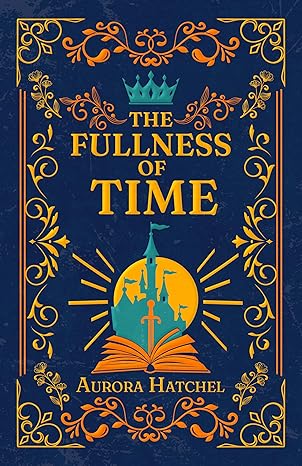

Do you have a favorite book or story that you read repeatedly until you know it by heart, making the characters feel real? Have you ever wished you could dive into a book and become part of the adventure, perhaps even change a few things and leave your mark on the storyline? This is exactly what happens to a twelve-year-old boy named Finn. He spends most of his time with his nose in a book, shutting out the outside world. His reading companion is his grandmother, who currently lives in a nursing home and is thought to be rapidly declining. However, what no one knows is that she holds a secret—one that Finn literally falls into. They are Storytellers: individuals who can enter books, participate in the stories, and even alter the plotlines, sometimes permanently.
Aurora Hatchel’s novel, The Fullness of Time, is the first book in her series titled The Storytellers. In this story, Finn finds himself transported into his favorite Arthurian novel, where he befriends a young Arthur and Lancelot, before Arthur pulls Excalibur from the stone. While there are many books about the legend of Excalibur, Hatchel’s novel stands out due to its human portrayal of Arthur and Lancelot as teenagers, living their lives without any knowledge of their future destinies. In contrast, Finn believes he already knows how the story will end.
The conversations among the three young men, as well as with Zoe and Merlin, are particularly engaging. The personal connections that bridge the worlds of the book and Finn’s real life highlight the universality of themes such as fear and self-doubt. Additionally, the world-building is more complex than one might initially expect. The sky shifts in colors of black and red, serving as a physical representation of Finn’s realization that the story is in flux and that the “Heart of the story” is i jeopardy. This changing sky mirrors Finn’s own emotions and uncertainty about how to navigate the unfolding situation around him
The Fullness of Time offers a fresh perspective on the teen and young adult Fantasy genres by taking a classic story and giving it a unique twist that appeals to readers of all ages. Who wouldn’t want to be there when Arthur discovers his destiny and pulls Excalibur from the stone? This book is perfect for anyone who sees reading as an escape and hopes to leave their mark on a story. I can’t wait to see what adventures Aurora Hatchel will create in this series; it will undoubtedly be an experience readers won’t soon forget.
Pages: 233 | ASIN : B0CV4MRJKV
A Memory of Song: First Verse of The Last Ballad

Scott Palmer’s A Memory of Song is a sweeping Norse-inspired fantasy that melds visceral action with tender character moments. This first installment in The Last Ballad series plunges the reader into a world unraveling—a place where the elements have stilled, magic stirs, and the dead linger. Following James, a haunted soul pursued by monsters, and Wulfee, a hardened warrior battling her own ghosts, the story weaves an intricate tapestry of loss, vengeance, and faint glimmers of hope amidst chaos. Palmer’s world is vast yet intimate, brimming with dark beauty and a sense of impending doom.
I was captivated by Palmer’s ability to create immersive, gut-punching scenes. The opening chapter, where James runs from the horrifying Hawka, grips you with its vivid urgency. Every slosh through icy mud, every scream in the silent woods felt raw and immediate. Yet, it wasn’t just the thrilling chase that hooked me—it was the aching regret coursing through James’s inner dialogue. “You should have died with her by your side,” lingers, a refrain that sets the tone for the entire novel. Palmer’s prose is sharp and poetic, but never overwrought, making the intensity feel grounded. The characters are unforgettable, though not always likable—and I mean that as praise. Wulfee’s unyielding thirst for vengeance left me in awe and frustration. Her interactions with Gen, a towering yet naive figure, add moments of bittersweet levity, as when she deflects his eagerness for her stories with gruff affection. The relationship dynamics are messy and human, with emotions bubbling just below the surface. I couldn’t stop thinking about Maggie, a character steeped in tragedy, whose sickness mirrors the dying world. Her brief, intimate moments with James were heartbreakingly fragile, offering a respite from the relentless darkness. Palmer’s worldbuilding is as rich as it is grim. The elements—literally lifeless in this setting—infuse the narrative with an eerie stillness. The nytewood trees, with their glowing blossoms, and the cursed Fever Stones evoke a sense of old magic that feels both majestic and terrifying. Yet, the novel doesn’t drown in lore. Every detail, from the humming dead to the strange customs of the Feldarra, feels purposeful and alive, enhancing the emotional stakes.
Fans of grimdark fantasy will revel in the moral complexity and stark beauty of A Memory of Song. If you enjoy John Gwynne’s Bloodsworn Saga or Joe Abercrombie’s First Law series, Palmer’s work will scratch that itch. It’s for readers who aren’t afraid to sit with pain and grapple with hope. I’ll be eagerly awaiting the next installment—despite knowing it’ll likely break my heart all over again.
Pages: 489 | ASIN : B0D5BWH1NS
TWO CROWNS, THREE BLADES
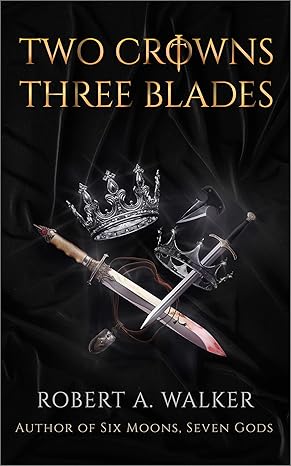
In the wake of Madam Dunn’s death, Sibil declares her intent to join the army, openly vowing to strike against The Guild. Whispers of a young woman wielding a dagger adorned with a red-jeweled bone handle, slaying giants, tangle with rumors of the Wisperal’s return. Are these two tales connected? The narrative unfolds as an unlikely duo—a determined girl and an aging man—embarks on a perilous journey through a tumultuous world. Together, they navigate dangers and surprises, pursuing separate but intertwined goals.
Two Crowns, Three Blades, which is book two in The Legends of Baelon by Robert A. Walker, delivers a sprawling and intricate plot, anchored by engaging characters and formidable challenges. From a deadly pact to eliminate two kings to the intricacies of battle strategies, the novel seizes readers’ attention with its high-stakes missions and life-or-death gambits. The war strategies stand out as a highlight, evoking the grandeur of Tolkien’s beloved fantasy epics like The Hobbit and The Lord of the Rings. Discussions of medieval tactics—from bracing for volleys of arrows to weighing the risks of cavalry against spiked barriers—are rich with detail and lend authenticity to the book’s action sequences.
Walker’s prose vividly captures the world through his characters’ eyes, immersing readers in the unfolding drama. His ability to bring even minor characters to life is evident through meticulous descriptions, such as the “small curved nose, taut cheeks, and thin lips” of a striking female figure. These details ground the fantastical setting in a sense of realism. The Wisperal herself is a standout element, shrouded in an aura of awe and menace. Rumors paint her as a giant slayer, a figure who hunts the wicked and delivers them “to Baelon below.” Her mythic presence elevates the stakes and deepens the intrigue, making her one of the story’s most compelling elements.
The abundance of characters—kings, enemies, and allies—woven into an intricate web of missions and alliances will appeal to readers who seek a rich, character-driven saga. Walker crafts a tale brimming with twists, suspense, and engaging fantasy elements. Fans of intricate political intrigue, thrilling action, and clever strategic planning will find much to enjoy. Two Crowns, Three Blades offers a captivating blend of epic adventure and imaginative storytelling.
Pages: 393 | ASIN : B0DRFF2V9D


