Blog Archives
Raven


The book follows Delilah, a striking and deeply flawed woman whose tangled love affair with Silas drags her into a spiral of obsession, violence, and dangerous secrets. Set between Moonlit Skies and Fallen Snow from the EverGreen Trilogy, the novella shows events through the eyes of a character who is more often the villain than the victim. What makes the story gripping is the way it refuses to soften Delilah. She is not portrayed as misunderstood or redeemed but as fully aware of her own dark choices. Through pregnancy, manipulation, and power games, we see her fight to hold on to Silas while also grappling with her own sense of control, vulnerability, and twisted love.
Reading this book felt unsettling and fascinating at the same time. I found myself both repelled by Delilah and unable to look away from her story. The writing style is sharp and vivid. I could practically hear the click of her stilettos on the floor or feel the electric crackle of her faerie power humming under her skin. The tension in her relationship with Silas is raw, messy, and at times horrifying. I appreciated how the author leaned into that darkness rather than pulling back. It made the whole experience feel more honest, even when it was uncomfortable. At times, I caught myself feeling sympathy for Delilah, only to be reminded moments later of just how ruthless she could be. That push and pull kept me hooked.
What struck me most was how much the book made me reflect on the nature of love, control, and power. There were moments where the drama felt almost theatrical, yet the emotions behind it rang true. The writing doesn’t dress up Delilah’s cruelty with excuses, and that made her inner conflicts more powerful to watch. The pacing leaned on confrontation and spectacle, which left me craving a deeper look at the cracks in Delilah’s armor. But maybe that was the point. She doesn’t allow herself to be fully exposed, even to the reader.
Raven is an intense and dramatic read that doesn’t shy away from the darker corners of human desire and obsession. It’s not a comfortable book, and I don’t think it’s meant to be. I would recommend it to readers who enjoy morally complex characters, stories that blur the line between villain and protagonist, and tales that pulse with danger and passion.
Pages: 158 | ASIN : B0F4RR5L5M

The Stomp-Clomp-Clump Monster Above the Bed

J.W. Zarek’s The Stomp-Clomp-Clump Monster Above the Bed is a delightful tale that introduces readers to three unforgettable dust bunnies. There’s Brutus Bunfluff, bold and fearless; Gunnar Puffbutz, timid and cautious; and Dust Puff Ted, ever the germophobe. Together, they live in cozy harmony beneath a bed, passing their days with quiet mornings, playful afternoons, and evenings filled with stories.
Their calm world is suddenly shaken when thunderous stomps and clomps echo overhead. Startled and frightened, the dust bunnies believe a terrifying monster has invaded their peaceful space. What they don’t realize is that the noise belongs to Billy, a little boy entirely unaware of the chaos he causes. Determined to uncover the truth, the trio secretly observes him, eager to decide if this “monster” is truly dangerous or perhaps a friend in disguise.
Zarek crafts the story with wit and charm, flipping expectations in a clever role reversal. Here, Billy takes on the role of the monster while the dust bunnies embody the frightened children. This twist adds a layer of humor that keeps readers grinning. I found myself laughing at the dust bunnies’ wild imaginations, especially when they mistake ordinary objects, a red crayon, some blocks, even a sticky patch of cherry goo, for dangerous traps. Their horrified commentary on Billy’s messy room was equally amusing, their cries for “order” perfectly capturing their quirky personalities.
The lively illustrations bring every scene to life, brimming with color and energy that feel straight out of a cartoon. The combination of text and artwork makes the story engaging and easy to visualize. In the end, the supposed monster becomes a friend, as Billy and the bunnies share cookies, and peace replaces fear.
At its heart, this story delivers a timeless lesson: don’t judge others by appearances. Friendship often comes from unexpected places if we’re willing to give others a chance. Both fun and meaningful, The Stomp-Clomp-Clump Monster Above the Bed is a book young readers will want to revisit again and again. I highly recommend it as a joyful read-aloud for families.
Pages: 44 | ASIN : B0FQ7T1WHX
Unique Voices

Winston the Titan Terrier: Adventures in Ancient Egypt follows a superhero dog who unexpectedly travels back in time to ancient Egypt, where he discovers dinosaurs are present and must figure out how they got there and fix history. What were some educational aspects that were important for you to include in this children’s book?
Mia and I approached the sequel with a clear goal: to deepen the engagement that readers loved in the first book. We focused on three main areas to achieve this.
The Power of Engagement: Puzzles and Fun
First and foremost, we expanded the interactive elements. Both Mia and I share a passion for brain teasers, so we wove numerous puzzles and riddles into the narrative of Book 2. This wasn’t just filler; it was a deliberate strategy to maintain a high level of reader engagement and, as our young audience told us with the first instalment, to genuinely ‘get their minds working.’ We see this as a way to make the reading experience active, not passive.
Weaving in Surprising, Up-to-Date Knowledge
Secondly, we made a point of ‘sprinkling in’ fascinating, recently discovered facts and snippets of knowledge. We didn’t want to rely on old, common knowledge. A great example of this is a scene where we highlight how a domestic cat, like our character Smokestrike, is actually capable of running faster than a fully grown Tyrannosaurus rex at its estimated speed. This is based on new research from fossilised footprints, which suggests that large theropods could only walk or trot due to the mechanical limits of their weight and bone structure.
Another discovery we used was acknowledging that Queen Cleopatra was not Egyptian but Greek, a descendant of Ptolemy, one of Alexander the Great’s generals. These details add unexpected depth and authenticity, correcting common misconceptions for our young readers.
Authentic Detail and Historical Context
Finally, we committed to integrating authentic historical details through our research. For example, we feature ‘biltong,’ the famous South African dried-meat snack, as Winston’s all-time favourite snack. Our research revealed that dried meat was historically very common in ancient Egypt for preservation, as there definitely weren’t any fridges back in those times. So connecting a modern detail to an ancient practice and adding a vivid, believable layer to the narrative, where we learnt something new about ancient Egypt.
Perhaps the most fascinating discovery we wove into the story was the Ahramat Branch, a now-extinct arm of the Nile River that once flowed right past the Giza and other pyramid complexes. This newly identified river branch may explain how the ancient Egyptians transported their massive stones to the pyramids. We featured this detail prominently in our cover artwork and several illustrations.
What character did you enjoy writing for? Was there one that was more challenging to write for?
Most enjoyable character to write for…
Mia won a reversible yellow octopus at the arcade shortly after our first book was released. It was a yellow reversible super grumpy Octopus, that she instantly nicknamed as “Sadface.” I began speaking to Mia in character as the persona of a friend who used to complain about numerous events and situations on a constant basis, which sparked endless laughter from her.
We both kind of knew this work in the Winston universe and our readers as a formidable yet hilarious antagonist who could inject both chaos and entertainment into future storylines.
Most challenging character to write for…
We found great satisfaction in developing the full range of our characters, and it was rewarding to bring their individual personas and unique voices into the narrative of this book.
Where can your fans expect to find Winston, Diesel, and Teddy next?
Future Storylines and Book 3
One of the most enjoyable parts of the creative process for Mia and myself was the discussions and debates about future storylines. We’re currently mapping out Book 3, and it’s set to be our most ambitious adventure yet.
The Stakes in Ancient Egypt
The first half of Book 3 will address the cliffhanger from the sequel. Our heroes, Teddy and Diesel, are now equipped with their newly discovered superpowers, and they have some unfinished business: they must first save Ancient Egypt from the remaining dinosaurs and successfully retrieve Winston from that ancient timeline. This means facing huge, new dangers, such as the gigantic Mosasaurus lurking in the Nile and any remaining pteranodons still patrolling the skies with powers they haven’t really mastered yet, which could have some hilarious outcomes.
Expanding the Scope: A New Realm of Danger
From there, the scope of the story expands dramatically. Once they return to the future, their main goal will be to track down and battle their persistent foe, Sadface, and other infamous creatures known for destroying large ships. This chase takes them through a new, unpredictable realm filled with hidden dangers and legendary underwater locations that challenge the heroes’ new abilities.
Author Links: GoodReads | Facebook | Website | YouTube | The Chaos King | Amazon
From multiple award-winning storytellers Mia van Dongen and Colin van Dongen comes the next thrilling instalment in the “Winston The Titan Terrier” series!
Get ready for Winston’s new epic journey where futuristic chaos collides with ancient history! In Adventures In Ancient Egypt, our beloved superhero dog, Winston, and his best mate Teddy with his super-hyperactive dad Diesel, find themselves catapulted into more unbelievable new challenges against Smokestrike the naughty ninja cat and new intergalactic villains.
Following their discovery of a secret, magical tunnel system beneath the Bone Shop, Winston and his crew thought they’d seen it all. But when the mischievous alien Disco Duck unleashes a new time-twisting plot, Winston is hurled back to the scorching sands of 51 BC Ancient Egypt, under the reign of Queen Cleopatra herself!
Armed with his incredible Cosmic Bone, a shape shifting, language decoding, enemy outsmarting marvel, and a backpack full of transforming nanotech gadgets. Winston must navigate a world of ancient wonder and dinosaurs?! That’s right! A super grumpy, chaos-loving alien octopus known as Sad Face, is intent on destroying Earth by transporting prehistoric creatures into future timelines, with the help of a modified time twister device!
Can Winston, with the help of ancient allies and a surprise assist from a certain naughty ninja cat, stop Sad Face before he unleashes intergalactic mayhem and turns history into his own personal movie set?
Prepare for a laugh-out-loud, action-packed adventure filled with:
⏳🚀 Time-traveling escapades
🦖👽 Epic action packed chases with prehistoric beasts and alien villains
🧠🧩 Clever riddles and mind-bending challenges
❤️😂 Heart warming friendships and hilarious antics
🐶🐱 And a whole lot of canine and feline courage!
Perfect for young readers aged 6 to 10 years and families who love dogs, cats, dinosaurs, ancient history, and a good dose of intergalactic fun. Join Winston on his wildest adventure yet! From the imagination of a 7 year old.
Grab your copy of Adventures In Ancient Egypt today!
UK Book Band : Brown Level (7+ Year olds)
Year Group 3+
Oxford Reading Level 12
Big Cat Band : Copper
Suitable for shared reading for kids (Ages 5+) that love dinosaurs and adventure with parents and carers
A Mirror of My Own Power

Embracing Your Inner Villain is a manifesto for unapologetic authenticity, reclaiming “villain” as a symbol of power, independence, and resilience in a world that punishes those who dare to shine. Why was this an important book for you to write?
I wrote it because I was tired of seeing people — myself included — punished for being too much, too bold, too outspoken. Society often labels strength as threatening, and the word “villain” becomes shorthand for anyone who won’t shrink to fit the mold. To me, writing this book was about tearing off that label and showing that what gets called “villainy” is often just self-possession, courage, and authenticity.
You reclaim the word “villain” as a badge of honor. What was the turning point in your life that made you see it as empowerment rather than condemnation?
There was a moment when I realized no matter how hard I tried to please, the criticism never stopped. That’s when it clicked: if I’m going to be called a villain anyway, I might as well own it on my terms. That shift turned “villain” from an insult into armor. It stopped being something I ran from and became something I leaned into — a way of saying, “Yes, I’m different, and I’m not apologizing for it.” I have gotten over it – that not everyone is going to like us, and we just have to wave and be that villain, because we deserve to be our true selves.
In your exploration of envy and projection, what insight surprised you the most while writing this book?
The most surprising realization was that envy is often admiration in disguise. People project negativity not because you’re wrong, but because you’re embodying something they secretly wish they could claim. That flipped the script for me — what felt like an attack was actually a mirror of my own power. It’s both unsettling and liberating to see envy that way, because suddenly it’s not about rejection, it’s about reflection.
What do you hope a reader who has been shrinking their light will feel when they finish your book?
I want them to feel unafraid. I want them to see that the parts of themselves they’ve been hiding — the sharp edges, the audacity, the brilliance — are not flaws but sources of strength. My hope is that when they turn the last page, they’ll feel permission to step into their full presence, even if the world calls them a villain for it. Especially if the world calls them a villain for it. It is okay to shine.
Author Links: GoodReads | Amazon
Embracing Your Inner Villain: Becoming Unstoppable is the unapologetic self-help guide that shows you how to claim your personal power, break free from fear, and stop living by other people’s rules. Packed with actionable strategies for building fearless confidence, developing an unstoppable mindset, and cultivating mental toughness, this book challenges you to own your ambition without apology.
Inside, you’ll discover:
How to tap into your inner strength and use it to achieve your goals.
The psychology of self empowerment and bold decision-making.
Ways to overcome self-doubt and stop being a people pleaser.
The habits of people who refuse to quit — and why they win.
How to transform your mindset for fearless living and long-term success.
If you’re ready to rewrite your story, set your own rules, and become unstoppable, Embracing Your Inner Villain is your blueprint for taking control of your life and winning on your own terms.
Embracing Your Inner Villain: Becoming Unstoppable is not about turning into the bad guy—it’s about rewriting the rules that have kept you playing small.
For too long, you’ve been told to be agreeable, humble, and harmless. But the truth is, playing nice has cost you opportunities, drained your energy, and dimmed your fire. This is the heart of stoicism.
This is your permission slip to reclaim your power.
In these pages, Woody R. Clermont—author of Strategic Microeconomics and The Black Wall Streets of America—delivers a bold blueprint for breaking free from the limits others place on you. With unapologetic honesty and razor-sharp insight, he shows you how to:
Build unshakable confidence without crossing into arrogance
Set boundaries that protect your time, energy, and purpose
Turn envy, doubt, and criticism into unstoppable momentum
Move strategically in silence while making power moves
Live a daring life rooted in purpose, not permission
This is not self-help fluff. This is a call to arms for the driven, the underestimated, and the underestimated—the ones ready to step into the spotlight without apology and without asking for approval.
If you’re ready to stop shrinking, start leading, and build a life so bold it can’t be ignored, it’s time to embrace your inner villain.
Because the world doesn’t need another hero—it needs you, unfiltered and unstoppable.
Deeper Truths
The Copper Scroll follows Joshua “Masa” Bennett, a young archaeologist whose quest for ancient secrets in Jordan entangles him in a dangerous struggle of faith, identity, and survival. What first drew you to the legend of the Copper Scroll, and how did it evolve into your novel?
I’ve been deeply immersed in researching Biblical history, from books to Hillsdale College classes. But I realized that my own pursuit of knowledge — while meaningful — would be rather dull to put straight on the page. I wanted to create something that could both entertain and motivate readers to seek truth for themselves. The Copper Scroll itself reads like a treasure map, hinting at hidden items and locations. That inspired me to craft a story where following those clues isn’t just an adventure for the characters, but also a way for readers to encounter deeper truths as the mystery unfolds.
Masa’s search feels both adventurous and personal. How much of his struggle with faith and belonging mirrors your own experiences?
Masa’s journey is very much a reflection of my own. His search for truth mirrors the knowledge I’ve pursued both through study and through life experiences. I spent years crossing the globe in the military, especially throughout the Middle East, and I witnessed how people everywhere chase life, death, faith, and family in unique ways. Those experiences left me with a deep respect for how culture and belief shape identity. In The Copper Scroll, I wanted to bring that perspective to life, connecting the historical events of the Bible with the very human struggles of belonging and purpose that transcend time and place.
The novel is rich with sensory detail, from food to city sounds. How did you research or immerse yourself in those environments?
In the Army, I experienced some of the most extreme environments on the planet. I once spent a night in a snow cave during cold-weather training where the temperature dropped to -59 degrees. Later, in Saudi Arabia, I stood in 125-degree heat with the wind hitting me like the blast of a hair dryer. Those physical extremes stay with you, but so do the everyday details—walking through markets and bazaars, hearing the sounds, smelling the food, seeing the colors and crowds. When I write, I draw directly from those memories. That way, the scenes in The Copper Scroll aren’t just imagined—they’re lived, and I hope readers can feel that authenticity in every setting.
The story balances history, suspense, and emotional resonance. Which of those elements came most naturally to you, and which was the hardest to craft?
The hardest part to capture was the emotion. Some of the feelings in the book come directly from my own experiences or from stories shared among veterans, and others I drew from watching how my wife responds to life’s challenges. Translating those emotions onto the page in a way that feels authentic was a real challenge.
The easiest part was the suspense and action. Writing the clashes between the Templars, ISIS, and Mossad was so much fun that I actually had to pull back at times. I also really wanted to highlight the relationship between the Rabbi and the Priest, showing how mutual respect can remain even while they challenge each other to look deeper into their own beliefs.
My biggest focus, though, was making sure the story stayed entertaining while also being clean and consistent with my values. I worked hard to deliver a thrilling story free of unnecessary profanity or messages that undermine the natural order. A few early readers pointed out places where language slipped through, and I’m grateful for that feedback, it helped me stay true to my promise of writing clean, exciting, and faith-rooted adventure.
Author Links: GoodReads | Amazon
At the center of it all is the Copper Scroll, a cryptic Dead Sea artifact rumored to hold clues to an ancient treasure buried deep in the Judean desert. But Joshua soon learns it’s no ordinary scroll.
Hidden symbols, coded phrases, and whispers of a “shepherd’s path” point to something far more significant and far more dangerous.
As the clues mount, so do the warnings. A silent observer in the library. A cryptic priest with a knowing smile. A message slipped into Joshua’s backpack: The shepherd’s path is not for the faint-hearted.
A cryptic priest and a rabbi jump in to help understand uncovered information. As Mossad agents, Templar knights, and ISIS operatives close in, Joshua and his allies race to unravel the truth. But who seeks to unearth it, and who will kill to keep it buried?
Rich in historical intrigue and driven by sharp, character-centered suspense, The Copper Scroll is a gripping archaeological thriller where ancient secrets refuse to stay buried and the journey to find them could change everything.
Author Interview – Kiril Kristoff – “Finding Your Roots”
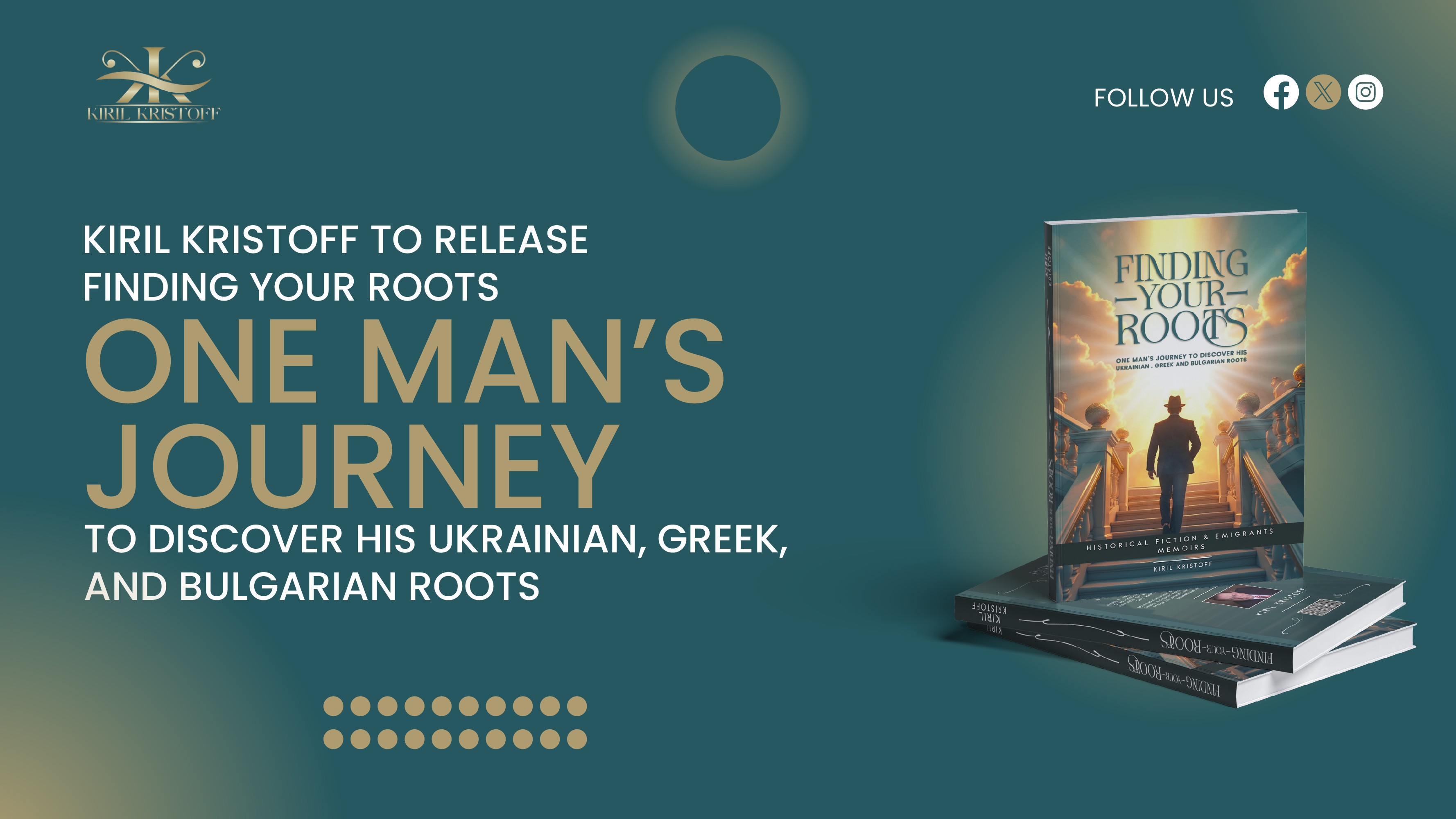
“Finding Your Roots” ‘One Man’s Journey to Discover His Ukrainian, Greek, and Bulgarian Roots’ follows an American man born into privilege who, after a near-fatal car accident, is transported back in time to 19th-century Tsarist Russia as a serf, where he faces the struggles and hardships that his ancestors once endured. What was the inspiration for the setup of your story?
The seed for this story came from a very simple but haunting question: What if we could truly step into the lives of our ancestors and feel what they felt? I’ve always been fascinated by the contrast between where we stand today and what those before us endured to get us here. For many of us, privilege, security, and opportunity are things we take for granted—but just a few generations back, the reality was far harsher.
I chose the device of a car accident and time travel because I wanted the contrast to be immediate and visceral. One moment, the protagonist is surrounded by the comforts of modern America; the next, he’s stripped of everything and forced to survive in a world where human dignity was often denied. It’s not just about history—it’s about empathy. By placing him in the shoes of a serf, I wanted to collapse the distance between past and present, so readers could feel that struggle as if it were their own.
Ultimately, the setup was inspired by my belief that our roots are never as far away as we think. The hardships of our ancestors still echo in us, and sometimes it takes a dramatic shift—whether in life or in literature—to remind us of that truth.
What inspired you to create Alexander Kakhovskiy, and how did you craft his outlook on life and the emotional changes he experiences?
Alexander Kakhovskiy was born into privilege—a spoiled child of the American Dream, raised in excess, never wanting. He was a prince of modern times, arrogant in his entitlement, untouched by struggle. He had it all— money, power, status—but no sense of who he was. Then, in a single night, everything was ripped away, and everything changed for Alex and Jennifer. After being drunk and high at a bar, a life-altering accident strikes him and his girlfriend, by another reckless driver. He falls to the ground, his body crushed beneath the weight of his choices. The next thing he knows—he is not in America anymore. He is no longer the wealthy, carefree boy of the 21st century, his family patron St. George sends them into a coma. Due to Saint George in Heaven, and his Grandpa George’s prayers on Earth, Alex survives, but remains immobilized in a Chicago hospital. But the accident triggers an otherworldly journey that defies time, faith, and even death. Alex and Jenniffer soon find themselves in the 19th-century Tsarist Russia, in the animal barn of his great-great-grandfather in his Kakhovka estate. It’s 1860, during the reign of Emperor Alexander II, the Liberator. There, the rebellious grandson meets his great-great grandfather, Alexander Kakhovskiy ( his namesake), a wealthy nobleman. Alex is not part of Kalhovskiy’s powerful family, but as a mere serf-a peasant bound to the land, a nobody, a slave in a world that does not know his name.
Then Alex begins to understand the true legacy of his ancestors. He is not just Alexander Kakhovskiy, the rich boy from America. He is part of a lineage that stretches across centuries—a bloodline shaped by war, ambition, loyalty, and betrayal. As he walks in the footsteps of his forefathers – Georgiy and Vasiliy Kakhovskiy-he sees the world through their eyes. One brother, Georgiy, stood for honor and tradition, remaining loyal to the empire that defined his people. The other, Vasiliy, was a radical, a Bolshevik, a man consumed by revolution and the birth of the USSR. Their choices shaped history. Their actions changed nations. And now, their story is his.
Now Alex must choose his destiny, whether he prefers the harsh cold of empires or the warm bonds of family. Discover faith, love, and redemption-and a battle between good and evil.
What were some themes that were important for you to explore in this book?
Several themes guided me as I wrote this story, but at the heart of it all was the question of identity—who we are when everything familiar is stripped away. I wanted to explore the fragile balance between privilege and survival, between the comforts of modern life and the raw struggles of those who came before us.
Heritage was another vital theme. By sending my protagonist back into the lives of his ancestors, I wanted to show that our roots are not abstract—they are lived realities that continue to shape us. The sacrifices, suffering, and resilience of those who endured oppression and hardship echo in us whether we acknowledge them or not.
I was also drawn to themes of empathy and transformation. Alexander’s journey is, in many ways, about learning to see the humanity in others and to measure worth not by wealth or status but by dignity, compassion, and endurance.
And finally, I wanted to explore time itself—how the past and present are never fully separate, how stories, memories, and even bloodlines carry forward across generations. By blending history with fiction, I hoped to show that while the settings may change, the human struggles of belonging, loss, and hope remain universal.
Where do you see your characters after the book ends?
For me, the ending of the book is not a closure but an opening. Alexander doesn’t return to his old life as the same man—he carries the imprint of what he has endured, and that awareness changes the way he looks at privilege, family, and responsibility. I imagine him moving through the modern world with a different kind of vision, one that allows him to see both the fragility and the strength of human existence.
The ancestors he encountered—those who shaped him in ways he could never have imagined—remain alive within him. Their voices may not guide his every step, but their lessons form a compass he will never be able to set aside.
In a broader sense, I see the characters continuing to live in the minds of readers. Their journeys don’t belong only to the page—they’re meant to spark reflection on our own roots, our own resilience, and the choices we make in light of those who came before us.
So while the written story ends, their inner lives keep unfolding—quietly, persistently—like heritage itself.
About the Author
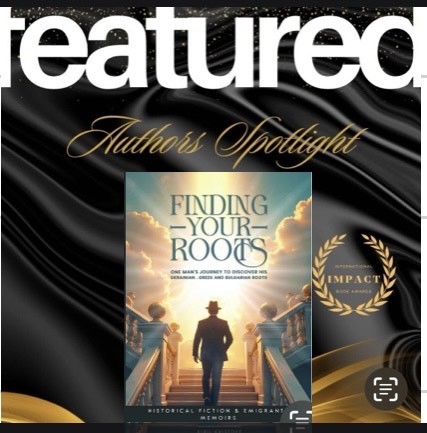
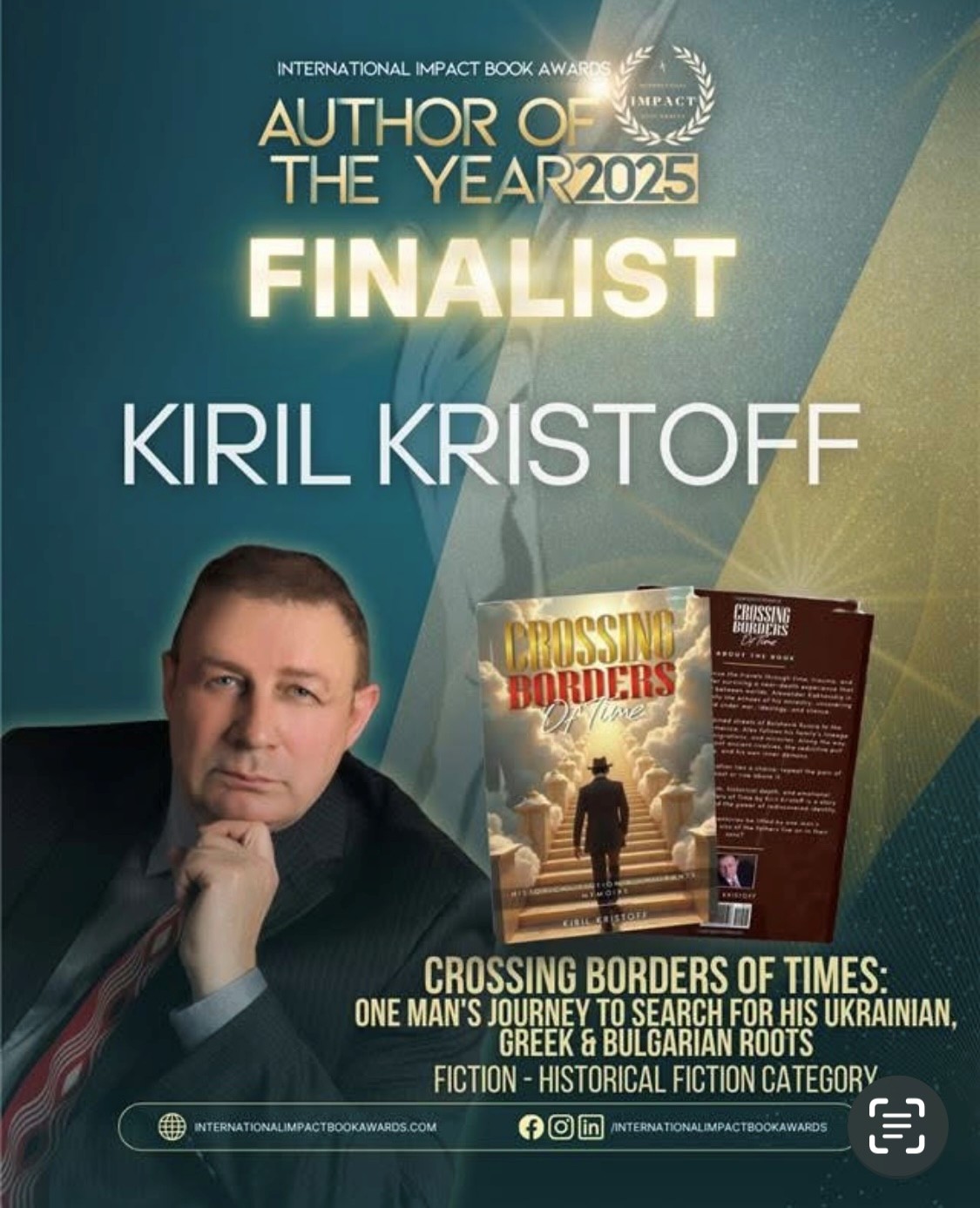
Kiril Kristoff is an internationally recognized author whose works combine historical fiction, spirituality, and the immigrant experience. He is the recipient of the Literary Titan Gold Book Award, the International Impact Book Award (Author of the Year 2025) , Fiction & Historical Fiction), and accolades from Indies Today. His contributions to diaspora literature have been featured in The Philadelphia Journal.
📧 Email: kirilkristoff3@gmail.com
🌐 Website: booksbykirillristoff.com
Facebook: https://www.facebook.com/authorkirilkristoff/
Linkedin: https://www.linkedin.com/company/kiril-kristoff
Instagram: https://www.instagram.com/kirilofficial1/
Pinterest: https://www.pinterest.com/kirilkristoff/
Morally Compromised Characters
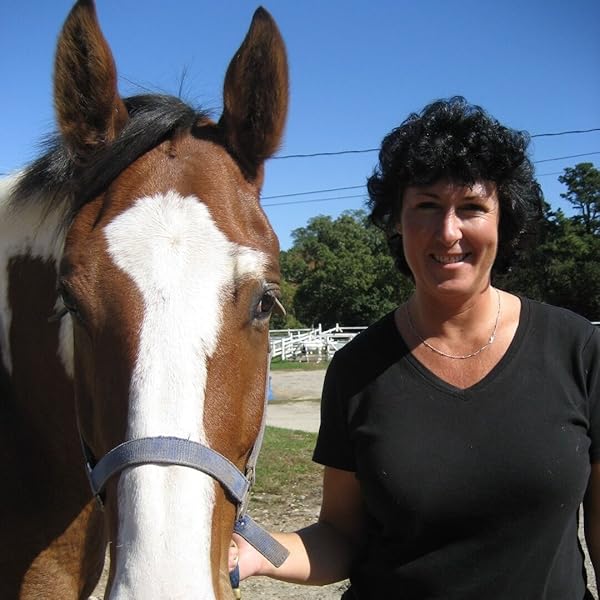
Street Brotherhood follows a teenage boy in 1970s New York, as his search for loyalty and belonging pulls him into a dangerous brotherhood where survival blurs the line between family and gang. What was the inspiration for the setup of your story?
The story is about building a family of choice when your family of origin has betrayed you. It’s about brotherhood forged in the face of adversity, boys who are thrust into bleak and dangerous situations due to familial and systemic neglect. But it also shows how these kids don’t just endure and accept their fate. They strive to exploit it. Street Brotherhood is the second book in the Street series, picking up where the first book left off, but each of them works perfectly as a standalone.
What drew you to set Johnny’s story in 1970s New York, and how did that time and place shape the characters’ lives?
The city plays a huge role in this book. New York in the 1970s was on the brink of financial collapse. Municipalities were struggling under massive layoffs, landlords were selling–or torching–buildings to get out from the debt, and crime was skyrocketing. Johnny’s story reflects all of that. He is cunning enough to see the cracks in the system and is able to use them to his advantage. The story could not have been told in any other place or decade without being inauthentic because the conditions changed. Many of the scenarios are tied to my own experiences, since I came of age at the same time, hanging out in those same streets.
Johnny is both sympathetic and frustrating. How did you balance writing him as flawed yet compelling?
From a writing perspective, the flawed and morally compromised characters are the most fun for me. I love pushing those boundaries for the reader: How bad can a character act while still commanding sympathy? Johnny is a street-smart gang leader, with lofty aspirations, living in a very adult world. But he’s still a teenager. Sometimes his youth is an asset, but other times it’s a liability. That becomes apparent in some of the choices he makes. His gang can also be loyal to a fault, by letting his decisions play out. Peppering in the scenes from Johnny’s childhood helped me make him more sympathetic, while also explaining some of his defects.
The violence feels necessary rather than gratuitous. How did you approach writing those scenes to maintain authenticity without sensationalism?
Great Question. Violence in movies and on TV is so pervasive we become numb to it. On the page, however, it translates differently. My early drafts were dripping with brutal details, but thanks to my beta readers, I toned a lot of it down. I learned that what’s not said can be even more ominous. In Street Brotherhood, the violence is necessary in order for the story to be realistic. But violence is also action, and too many details will slow down the pacing, so I tried to maintain a balance.
Author Links: GoodReads | Website | Amazon
Johnny becomes involved with Marco, a tempestuous drug supplier who inspires admiration, but also rueful reminiscence of Johnny’s father. His demands challenge Johnny’s morals, but the payout is hard to ignore. As is Johnny’s aptitude for carrying out his lethal tasks.
Amid his nefarious entanglements, Johnny falls for Jessica. She is witty and self-assured, opening him to normalcy and tenderness for the first time. But as his worlds spin ever closer, will he escape the brutality of his past or be forced to embrace it?
Author Interview – Kiril Kristoff – “Crossing Borders of Times”
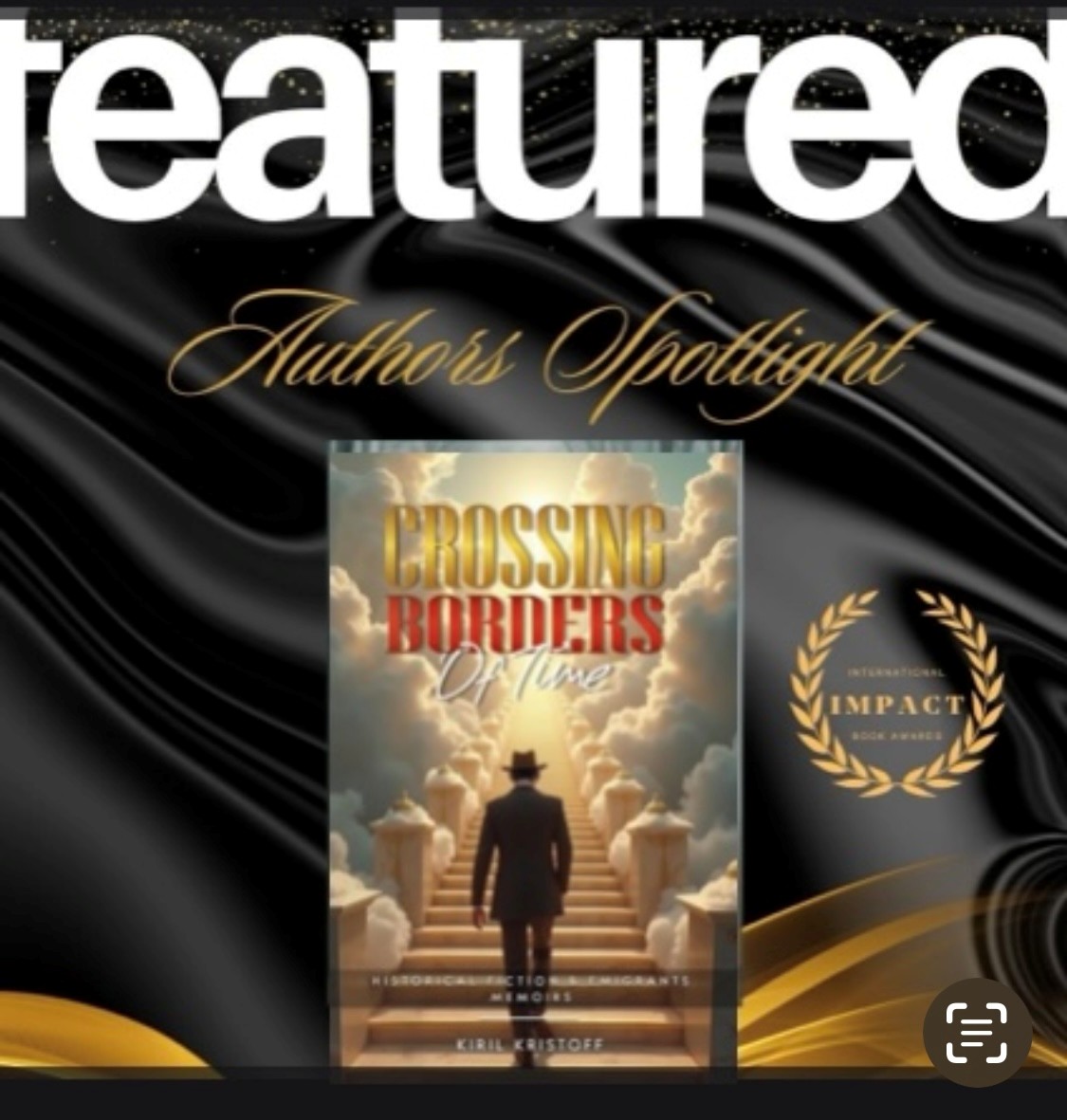
“Crossing Borders of Times”‘One Man’s Journey to Search ForHis Ukrainian, Greek & Bulgarian Roots’ is a multigenerational saga where a grandfather and grandson unravel their family’s past through letters, dreams, and manuscripts to confront the pull of heritage and belonging. Why was this an important book for you to write?
In two short days on 10/04/2025 I will have Gala dinner & celebration when I will receive my International Impact Book Award 🏆my Oscar of books award, when my third sequel gained recognition in Hollywood, I felt ready to take this step.
I decided to submit my book to the International Impact Book Awards because this award is about more than recognition—it’s about sharing a story that can inspire others. My story begins in Bulgaria, where growing up under communism, it wasn’t easy to express a truth rooted in the Bible that the government didn’t allow. When my wife and I came to America, we carried only two suitcases and $200, but we also carried our faith, our stories, and our dreams.
For many years I looked for a traditional publisher or literary agent, but most doors were closed. Instead of giving up, I chose to self-publish. Today, I have written five books in English and two in Bulgarian, and my third English-language sequel—Crossing Borders of Time—has brought me here to Hollywood and this award.
To me, this recognition is proof that when you have a message and you persevere, the world will eventually hear it. My main message is simple: Never give up on your dream—because freedom and the opportunity to create are the greatest gifts a person can receive.”
This book was important to me because it represents both a personal and universal search for identity. I grew up under communist regime, surrounded by stories of displacement, resilience, and cultural memory, and I always felt that those voices—especially the quieter ones in the family—deserved to be heard across time.
By weaving together the experiences of a grandfather and a grandson, I wanted to show how heritage is not a static thing we inherit once and place on a shelf—it’s a living force that shapes how we see ourselves and the world. The letters, dreams, and manuscripts in the story are not just literary devices; they are metaphors for the ways we all try to reach across generations to make sense of who we are.
Writing Crossing Borders of Times was my way of honoring the struggles and sacrifices of those who came before us, while also asking what it means for the new generation to carry that legacy forward. It’s about belonging, yes, but also about courage—about daring to face painful truths and still finding the strength to carry them with love.
Your book blends memoir, novel, and meditation. How did you decide on this hybrid form to tell such a personal yet universal story?
From the very beginning, I felt that one single form wasn’t enough to contain the scope of this story. A traditional memoir would have kept me tethered to my own perspective, while a straight novel might have distanced me too much from the lived experiences that inspired it. What I wanted was a way to honor memory, imagination, and reflection all at once.
The memoir elements anchor the book in lived truth—those emotional landscapes that come only from direct experience. The novelistic passages allowed me to reimagine events, to step into the lives of ancestors and give voice to silences in the record. And the meditative sections provided the breathing space I needed to explore broader questions of time, belonging, and heritage, beyond just my own family’s story.
This hybrid form felt the most honest, because identity itself is layered—we live between fact and memory, between what happened and what it meant, between the past and the present moment. Blending these genres gave me the freedom to capture that complexity and, I hope, to offer readers not just a family story, but an invitation to reflect on their own.
George’s struggles with immigration and identity feel vivid and raw. Were these drawn directly from family experiences, or did you reshape them into fiction?
George is both personal and imagined. His struggles are deeply rooted in the real stories I grew up hearing—of leaving behind everything familiar, of carrying one’s culture across oceans, of learning to survive in places that were not always welcoming. Those accounts, especially from my family and community, gave me the emotional foundation for his journey.
At the same time, I didn’t want George to be a replica of any one individual. Instead, I reshaped those lived experiences into a character who could embody the universal immigrant condition—the constant negotiation between holding on and letting go, between remembering and reinventing. By fictionalizing parts of his story, I was able to protect the privacy of real people while also deepening the emotional truth.
So George is a mosaic. He carries the voices of my grandparents, the resilience of countless immigrants I’ve known, and the imaginative flourishes that allowed me to explore what isn’t always spoken aloud. In many ways, he became the vessel through which I could tell not just my family’s story, but the story of anyone who has ever felt torn between two worlds.
Alex’s search sometimes feels overshadowed by the past. Do you see this as a generational struggle we all face when trying to honor our roots while forging our own paths?
Yes, absolutely. I think every generation inherits both gifts and burdens. For Alex, the weight of history is so present—it arrives through letters, dreams, and stories that refuse to stay silent. That can feel overwhelming, almost as if the past is dictating the present. But that tension is real, and it’s one that many of us live with: how do we honor those who came before without losing ourselves in their shadows?
I believe it’s a universal struggle, especially in families marked by displacement or upheaval. Roots give us strength, but they can also feel like anchors. Alex’s journey is about learning to carry that inheritance without being consumed by it—understanding that honoring the past doesn’t mean repeating it, but rather finding ways to transform it into something new.
In that sense, his story mirrors what so many young people experience today: a longing for authenticity while still forging a future that belongs to them alone. The balance is delicate, but I see it as one of the most vital parts of identity—turning memory into possibility.
About the Author
Kiril Kristoff is an internationally recognized author whose works blend historical fiction, spirituality, and the immigrant experience. He is the recipient of the Literary Titan Gold Book Award, the International Impact Book Award (Author of the Year, Fiction and Historical Fiction), and honors from the Indies Today Awards. His writing has been featured in The Philadelphia Journal for its contributions to immigrant literature in diaspora.
📧 Email: kirilkristoff3@gmail.com
🌐 Website: booksbykirillristoff.com
📌 Facebook | Instagram | LinkedIn | Goodreads
Author Links
Facebook: https://www.facebook.com/authorkirilkristoff/
Linkedin: https://www.linkedin.com/company/kiril-kristoff
Instagram: https://www.instagram.com/kirilofficial1/
Pinterest: https://www.pinterest.com/kirilkristoff/



 LITERARY TITAN