Blog Archives
A Man Driven By Greed

The Kingdom Thief follows Princess Sitnalta as she races to undo a thief’s reality-warping wish, becoming the lone keeper of the truth in a world that no longer remembers who she really is. What was the inspiration for the setup of your story?
The Sitnalta Series finds itself focusing a lot on this coin- its origin, its powers, and the power of wishes. Through the first book, with Sitnalta’s relationship with the troll, Najort, we look into the consequences of wishes done with the right motivation, and by good people. For the sequel, I wanted to look at the reverse. Wilhelm is not Najort. He is not Sitnalta. He is a man driven by greed, and what would that look like, if he were to acquire the coin and make a wish.
Sitnalta and Navor’s relationship holds so much emotional weight. How did you approach balancing romance with the fast-paced plot?
For someone their age, the idea of a budding romance can be what drives a person. In a way, it is the plot. Navor wants to help Sitnalta, and Sitnalta wants her home back. This should be in balance with what is happening outside of their little bubble. For them at least, their feelings are just as important as magic, and politics, and stopping the mad man who has stolen a kingdom. When you look at the world through the lens of two young people and their feelings, one thing is never more important than the other. As a parent of teenagers, I’m surrounded by that on a daily basis, and that was my approach.
If you could expand one section of the story, give readers more time in any particular place or emotional moment, what would it be and why?
I would love to spend a lot more time in Navor’s head. He has a lot on his plate right now. Writing his dreams, his fears, and his hope for the future was a lot of fun, and I would love to have done a lot more of that.
What can readers expect in book three of the Sitnalta Series?
Oh, without giving too much away, I can say that we have tragedy, a very different type of romance, and so many questions about the past get answered. In a way, this is almost a prequel, but still very much Book Three. Sitnalta would not have been ready for these answers before now. I hope that wasn’t too cryptic.
Author Links: GoodReads | X | Facebook | Website
Princess Sitnalta has been living happily ever after with Queen Aud and King Gerald as her adoptive parents, enjoying the peace in her world. Her growing friendship with the mysterious Prince Navor leads her on a journey to visit his island kingdom. While there she receives the horrible news that her kingdom has been conquered and cruel King Wilhelm is responsible.
With King Gerald and Queen Aud imprisoned, Prince Navor and a secretive network of spies as her only allies, Princess Sitnalta feels lost and adrift. Nothing about Colonodona’s takeover seems right, and Sitnalta suspects magic may be to blame.
Far from home and unsure of whom to trust, Sitnalta must find a way to save her kingdom, and return her beloved Aud and Gerald to their rightful thrones.
The Knight at the Top of the Stairs


The Knight at the Top of the Stairs is an unsettling and emotionally resonant piece of psychological horror masquerading as a classic coming-of-age story. Set against the turbulent backdrop of 1968, the novel centers on nine-year-old David, a boy whose world, already fractured by historical tragedy, becomes increasingly governed by mythic struggle. His childhood home in Pine Hill, Massachusetts, becomes a metaphysical battleground, haunted by the rigid, silent vigilance of the ‘Knight at the Top of the Stairs’ and actively threatened by the ‘Buzzing Man,’ a creature of sickening, honey-sweet temptation that seeks to corrupt loyalty and exploit fear, particularly through David’s older brother, Steven. The narrative intricately weaves real-world chaos with deep-rooted occult evil, forcing David to discard the safe, simple rules of childhood for the complex, brutal code of knighthood, compelling him toward a final confrontation where he must determine the price of protecting the helpless.
My strongest emotional response stems from the author’s ability to juxtapose the cosmic horror with such tangible, domestic fear. The novel’s central theme, that historical trauma and moral failure do not fade but become inherited burdens, is articulated through the question, “Will you stand, or will you kneel?” It is a choice that hangs over every character, particularly David, whose journey from naive fear to resolute courage is genuinely moving. The inclusion of real-life upheavals, such as the distant, televised horrors of the Vietnam War and national assassinations, anchors the internal, supernatural dread, suggesting that the true source of evil is not the entity in the cellar, but the willingness of men to be whispered into betrayal. I felt a palpable sense of dread build throughout the middle chapters, not just because of the encroaching monster, but because of the agonizing realization that David’s own family history is intrinsically bound to this ancient conflict, leaving me utterly immersed in the moral weight of his inheritance.
The craftsmanship of the writing itself is exceptional. The prose possesses a rare lyrical intensity that elevates the narrative beyond typical genre fare. Author Brett Bacon employs an effective rhythm, utilizing both sharply concise sentences and sweeping, descriptive passages to maintain an almost unbearable tension. The voices of the children are rendered with startling clarity. David’s attempts to form new “rules” to govern the terrifying unknown, Kevin’s wide-eyed innocence and subsequent psychic sensitivity, and Steven’s rapid, chilling descent into malevolence, all felt tragically real. I found myself sympathetic to David’s father, whose own buried wartime experiences mirror the ancient knight’s legacy, adding layers of sorrow to the final, necessary fight. It is a text that demands, and rewards, careful reading.
The Knight at the Top of the Stairs is a dark and philosophical powerhouse that successfully merges the psychological depth of a domestic drama with the existential threat of epic fantasy. I highly recommend it to readers who appreciate character-driven horror that focuses less on jump scares and more on the slow, corrosive influence of evil, particularly fans of Stephen King’s early, atmospheric works (like It) or those who enjoy stories about inherited guilt and the cost of moral vigilance.
Pages: 225 | ASIN : B0FVP5KP5L

Stolen Secrets-Book 1 (Deadly Secrets Texas Trilogy)

In Denise Diana Huddle’s first installment of the Deadly Secrets Texas Trilogy, Stolen Secrets, we are plunged into the volatile world where West Texas ranching meets the high-stakes drama of the oil and gas industry. The story centers on Sarah Chandler, a determined ranch manager with a deep-seated distrust of oil companies, and Ethan Tanner, an enigmatic landman sent by the formidable White Stag Exploration to manage the local drilling conflicts. After a catastrophic blowout on a leased property, Sarah and Ethan find themselves reluctantly bound together, navigating threats that rapidly escalate from vandalism and corporate deceit to murder and a full-blown manhunt. The novel deftly weaves a modern-day conflict over water and land rights with a historical treasure hunt tied to Jim Bowie and the legendary Lost Silver Mines of San Saba, forcing the protagonists to race against the clock and the local corrupt power structure to uncover the truth behind a missing brother and a vast, generations-old conspiracy.
I found the book’s pacing and narrative momentum to be exceptional. It captured my attention immediately and held it throughout the story. The author’s background as a landman and private investigator shines through in the detail of the setting. From the descriptions of caliche roads and the challenges of managing exotic game to the specific, technical realities of an oil rig blowout, it all felt rich and authentic. This expertise lends a tangible grounding to the plot. It makes the world of Logan County, Texas, feel less like fiction and more like a lived-in reality. The dialogue is often sharp and witty (especially Sarah’s quick, sardonic comebacks), but occasionally veers toward heavy exposition, particularly when delivering crucial historical context or complex backstory. This is a small price to pay for the sheer depth and complexity of the conspiracy being unveiled.
What resonated with me were the ideas explored beneath the thriller’s surface. Huddle takes on themes of forgiveness, personal scars, and the damaging cycle of bitterness. I was moved by the emotional core of Sarah and Ethan’s relationship. Sarah’s refusal to let go of the past, her anger stemming from the loss of her father and the devastating car accident, is a powerful counterpoint to Ethan’s quiet quest for redemption following his own tragic history. Watching their layers peel back, particularly in moments of high stress like the harrowing escape from the burning house, allowed me to genuinely root for their connection, even as I was conflicted by Ethan’s initial deception. The book succeeds not just as a mystery, but as a tender look at how two damaged people, both scarred emotionally and physically by irresponsible actions, find healing in mutual reliance and truth.
Stolen Secrets is a triumph of plot over pretense. It is a perfect read for fans of Texas-based romantic suspense and corporate thrillers, specifically those who enjoy the blending of contemporary action with intriguing historical mysteries. If you enjoy authors who build genuine chemistry between competent, high-stakes protagonists while providing a deep dive into an authentic and well-researched setting, this book is for you.
Pages: 206 | ASIN : B0DDJ8B7QG
Nurse Dorothea® presents Mindfulness Based Stress Reduction and Why Mindfulness is a Key Coping Skill
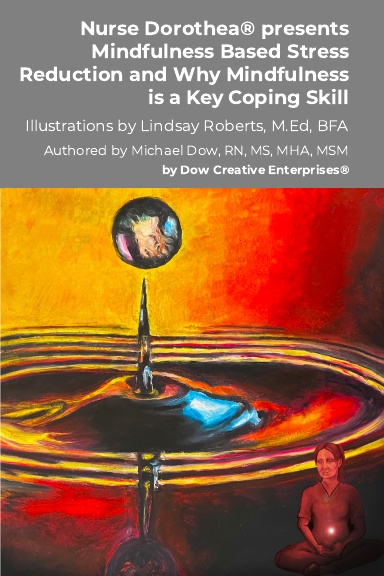
Nurse Dorothea Presents Mindfulness-Based Stress Reduction and Why Mindfulness Is a Key Coping Skill by Michael Dow is a warm, inviting introduction to mindfulness presented through a fictional after-school class. Nurse Dorothea guides readers through the basics of mental health, the meaning of mindfulness, and the many ways it can improve daily life. The book mixes friendly explanations, real research, and simple activities while also covering Jon Kabat-Zinn’s nine pillars of mindfulness and the three main practices: meditation, body scanning, and mindful yoga. It’s an easygoing, approachable read meant for people of all ages.
The book opens with Dorothea reminding the class that every person is one life event away from facing a mental health challenge, which felt honest and grounding. Throughout the early chapters, she repeats gentle reminders to be patient and nonjudgmental with yourself, and I found those small, warm nudges surprisingly comforting. The writing avoids heavy language and instead feels like someone sitting beside you, calmly talking you through your own thoughts.
I also really enjoyed the student comments woven throughout the book. They make the lessons feel alive and relatable. One student mentions that mindfulness while driving helps keep you safe, and another talks about how multitasking can pull you away from the moment. These small interactions add humor and humanity to the material. They break up the teaching in a way that makes the book feel more like a real class than a traditional self-help guide.
The seated meditation instructions are clear and easy to follow, and the emphasis on letting your mind wander without judgment made me feel oddly relieved. The body scan exercise is explained in a simple, calm voice that made me want to try it right away. Even the yoga section feels approachable, especially when the author reassures readers not to judge themselves if they wobble or fall. That moment actually made me smile because it felt so human.
The book is gentle, sincere, and wonderfully beginner-friendly. I’d recommend it to teens, parents, teachers, or anyone who wants a simple and encouraging introduction to mindfulness. If you’re looking for a book that feels like a calm, supportive voice guiding you through stress and distraction, this one fits the bill perfectly.
Pages: 179 | ISBN : 978-1-968690-01-4

Be Willing To Try

Love is Golden follows a golden doodle who works as a therapy dog and teaches his friends what therapy dogs and service dogs do. What was the inspiration for your story?
The inspiration came from my sister’s dogs. She was taking Ted to therapy dog training classes, while his little sister Rosie had to stay home. This made me think about the big brother, little sister dynamic. I thought it would be fun and a little different to tell the story from the dogs’ perspective. At the time, I was also teaching at a high school where therapy dogs would visit, and I saw firsthand how much joy and comfort they brought to students. That experience inspired me to write a cute story that also shares an important message about never giving up.
What were some educational aspects that were important for you to include in this children’s book?
Overall, I wanted this book to focus on empathy, compassion, and resilience. I hope kids come away knowing that they can do anything if they’re willing to try. Sometimes one thing doesn’t work out, and that’s okay, you just try something else. I’m hoping the book will encourage kids to think about the many ways they can be helpful and to recognize the unique talents that make them who they are.
The art in this book is fantastic. What was the art collaboration process like with the illustrator Nomrota Saha?
I found Nomrota on Fiverr.com. She lives in India and is an aspiring art student. The process was amazing! I shared my manuscript, she would share the line drawings, the flat versions and then the final versions of each page. It was a really nice collaboration, in which she was able to take my words and make them come to life through the images.
Will this novel be the start of a series or are you working on a different story?
I started with “We Love Nacho” and then “Nacho Loves Salsa” and then I wrote this book. It wasn’t meant to be a series but the characters carry throughout. This book mainly features the dogs, with an appearance of my nephews, but Nacho is seen throughout all of the books. I have a few more ideas in mind. I’d love to make this book bilingual, as I went back and did with my first two books, and I’m currently working on the companion, “Love is Golden Coloring and Activity Book”. What comes after that, we shall see!
Author Website
It’s Always Been About Purpose

Mental Health Sounds Like This is a heartfelt and deeply personal guide blending science, storytelling, and soul, to explore how music can be used not just as an outlet for emotion but as a structured process for healing and transformation. Why was this an important book for you to write?
As I mention in the book, I began teaching vocals when I was just 17, and in 2019, I expanded my work into what’s now known as Empowerment Through Songwriting Coaching. What’s always fascinated me is that my clients rarely come to me just for music; they come seeking confidence, personal development, and healing. All the while: I was writing and singing my own music of self-actualization, expression and growth. So it made sense that for a long time, people struggled to understand why I chose to both sing and coach. “Why not just focus on becoming famous and using your gift for yourself?” they’d ask. But for me, it’s never been about fame: it’s always been about purpose. From early on, I knew I wanted my music to mean something – to do something. And that’s exactly what this book represents: a reintroduction to who I am, what I do, and why I do it. It’s an invitation for the world to truly understand what Emma G Music is all about.
What were some ideas that were important for you to share in this book?
Good question! I think it goes back to the principles behind my work: The importance of providing safe space for my clients to truly show up, the importance of leading by example, the scientific, cultural, spiritual, and practical reasons behind why music [especially singing and songwriting] are so powerful, and how imperative it is that we seek out proactive approaches for mental, emotional, spiritual, social and even physical well-being.
I appreciated the candid nature with which you told your story. What was the hardest thing for you to write about?
It wasn’t necessarily “hard”, but I found myself waking up from dreams about different situations that occurred as a teenager that I’d definitely buried over the years. Writing this forced me to open that can of worms back up, and really analyze some of my experiences, and responses… and the what if’s. I have several catalogs of music documenting those parts of my life, but I hadn’t really looked at those songs in depth for a long time… it was cathartic. Painful at times, but healing.
What is one thing that you hope readers take away from Mental Health Sounds Like This?
That their voices matter. Their experiences matter. Their truth matters. In fact, that’s where their power lies. By ignoring or suppressing the difficult parts of ourselves; we cut ourselves off from growth, and strength building. I want people to understand that they can sing their pain away, and come out the other side: a whole, healed person. But they need to first lean in, and learn to express themselves authentically.
Author Links: GoodReads | X | Facebook | Website
Written by singer-songwriter, TEDx speaker, and vocal empowerment coach Emma G, this book is a creative blueprint for anyone who’s ever struggled to make sense of their emotions, find their voice, or feel seen in a chaotic world.
Blending storytelling, science, and soulful strategy, Emma introduces a revolutionary 5-step framework that uses music and songwriting as tools for healing, resilience, and self-discovery.
Whether you’re navigating grief, burnout, anxiety, or identity challenges, this book invites you to do more than survive—it helps you create your way through it.
Drawing from personal experience, somatic healing, and her work with Gen X, Millennials, Gen Z, and Gen Alpha, Emma shows how singing and songwriting can turn pain into power and help you reclaim your voice—literally and metaphorically.
Inside, you’ll discover:
How emotions live in the body—and how singing can release them
Why songwriting is a form of prayer, reflection, and personal growth
A step-by-step guide to turn your experiences into empowering anthems
Real stories of healing and breakthroughs through music
Prompts, practices, and tools to help you start writing your own story
Whether you’re a seasoned musician or just someone searching for clarity and healing, Mental Health Sounds Like This will meet you where you are—and show you how to sing your way forward.
You are not broken. You are becoming. And your voice has always been the key.
Respecting Water

The Tralls of Mundi follows a group of tralls headed to the Coming Together celebration who, along the way, discover a dark and dangerous adventure that threatens the tralls’ future. What was the inspiration for the setup of your story?
Illegal damming of water sources is becoming an issue in Australia, especially in areas that have a lot of agriculture and limited water resources.
There are many reasons for this, some quite understandable, and in a vast country like Australia the situation is hard to monitor.
Unfortunately, however, Illegal dams can have a negatively impact on the environment and ecosystems.
They can lead to habitat destruction, degrade water quality, negatively impact aquatic life and cause health risks for humans through contaminated water.
I wanted to make my young readers aware of these issues and hopefully encourage them to be respectful water users in the future.
Were there any characters that you especially enjoyed writing for?
Each book in The Tall Series is dedicated to two of my grandchildren. The two represented in “The Tralls of Mundi” are often complimented on their leadership, persistence, courage and resourcefulness so I was keen to highlight these traits in the main characters, Jete and Jak.
What was the inspiration for the culture of your characters? Is it modeled after any particular society?
There are two memories that are very special to me. The first was when I lived with my grandparents in Tasmania. We spent a lot of time traipsing through the bush and marvelling at the beautiful flora and fauna during the daytime and then at night, we’d read and re-enact the classics. Those memories are very dear to me and I tried to share them with my family and my readers through this series.
The second very precious memory is of the time we spent living on Badu Island in the Torres Strait.
The laid-back, happy, communal life-style of the islanders and the friendly way they included us in their lives had a strong impact on us and Badu and the friends we made there still mean the world to us.
My hope is that by threading that happy, peaceful ambience through my stories , I could impart the same feeling to others.
What is one thing that you hope readers take away from The Tralls of Mundi?
I hope “The Tralls of Mundi” engenders a deep respect in my readers for the environment and a desire to protect it. I also hope they learn the importance of all water resources and treat them with consideration and care.
Author Links: Facebook | Website
When the terrified tralls discover that the village of Mundi and all its inhabitants have disappeared they are convinced the Chameleons have returned, and when they find that the mighty River Maire is now only a dried-up mudflat, those fears are strengthened.
Jete and Jak are determined to save their friends but what they find when they enter the Sacred Caves of Mundi leaves them so confused and horrified, they are no longer sure they can save the tralls of Mundi or even their own kinships.
The Tralls of Mundi is the second book in The Trall Series; a collection of environmentally based portal fantasies set in the Australian bush. It is recommended for readers 9 years to 13 years.
Demystify Wealth Building

Beginner’s Guide to Growing Wealth and Investing is a metaphor-rich roadmap that teaches readers to cultivate long-term financial habits by becoming the intentional “CIO” of their own money. Why was this an important book for you to write?
Beginner’s Guide to Growing Wealth and Investing is important to me because of who inspired it. I wanted to leave an instructional manual for my little sister, my son, and my daughter, the kind of manual I wish I had at their age. My family, like most families, don’t have real conversations about money, investing, or wealth. They definitely don’t talk about the mindset, identity, and emotional strength it takes to build wealth consistently.
I wanted to demystify wealth building and pull back the curtain. People think the process is complicated or reserved for the rich, when the truth is that wealth is simple. It’s not always easy, but it is simple when you understand how money works and, more importantly, how you work. So I wrote a book that speaks to the whole person: their thoughts, emotions, habits, fears, and dreams. Those internal drivers matter just as much as the practical steps of investing.
Too often, financial books focus on what you have to do, while completely ignoring who you have to be. You can’t build wealth as a passive participant in your own life. You have to accept responsibility, step into leadership, and design your financial future with intention. That’s where the CIO metaphor comes in. Becoming the Chief Investment Officer of your life means recognizing that your decisions – not your income – build wealth, and that you need to run your financial life with the same intention and structure as a business.
And the gardening metaphor reminds readers that wealth is a process. It starts with small seeds, tiny decisions with huge potential, and when nurtured over time, those seeds grow and produce fruit season after season. I want people to stop believing that wealth is impossible and start believing “I’m possible.” Building wealth is ultimately about choosing yourself and choosing the life you want to design.
That’s why this book exists. It’s the manual I needed. And it’s the manual I want to leave behind for my loved ones and others.
How do you balance encouraging mindset shifts with giving readers practical, step-by-step financial tools?
When people talk about “balancing” mindset and financial tools, they’re already thinking about it the wrong way. Mindset and tools don’t sit on two sides of a scale, they depend on each other. You can’t build habits without the right beliefs, and you can’t direct your beliefs without the right structure. That’s the key, and honestly, that’s the difference between information that inspires people and information that transforms them. This is why I don’t separate them; I integrate them into one system.
That’s the real differentiator of my book. I’m not giving readers scattered tips, I’m giving them a system that reinforces the behavior change they need. I teach through metaphors and simple frameworks because they help readers understand complex shifts without feeling overwhelmed. Those frameworks create structure and when your financial life has structure, your decisions get clearer, your emotions settle, and consistency becomes easier. Most beginners don’t fail because they’re incapable; they fail because they don’t have a system protecting them from old habits while they grow into new ones.
That’s why the Stackers Wealth Cycle matters. Mindset shifts and tools don’t have to be balanced, they need to be woven into a system. When those are woven into one process, transformation becomes inevitable.
Were there any specific emotional hurdles you noticed beginners facing that shaped how you wrote the more supportive sections?
The biggest barriers for beginners start in the mind, and they come down to three forces: beliefs, desires, and expectations. To be successful, all three have to work together, so let’s use a heating and cooling system to explain it.
Beliefs are your heating and cooling equipment. If you don’t believe you can grow wealth, it’s like having a completely broken HVAC unit. You can want the room warmer or cooler all day, but equipment that doesn’t work can’t respond. A broken belief system blocks every financial upgrade.
Desire is your thermostat in that it allows you to set the temperature you want for your life. If you desire freedom, your behavior moves one way. If you desire approval or status, it moves another. But a thermostat only shows what you want, it doesn’t make the change by itself.
Expectations are the electricity powering the whole system. If you expect success, the system turns on. If you expect failure, nothing runs. That’s why two people with the same desires get completely different results, their expectations either activate the system or shut it down.
When belief (system), desire (thermostat), and expectation (power) line up, the system will reach the temperature you set. In people, that’s when behavior starts aligning almost automatically and wealth-building becomes possible instead of frustrating.
That’s why people tell me this book feels different and more supportive, it’s more than an investing manual. It’s a “how you work” manual. We aren’t born understanding our beliefs, desires, and expectations, and most of us are never taught how they connect. That’s why my approach leans so heavily into mindset and internal wiring. If you don’t understand the system on the inside, nothing you try on the outside will stick.
If readers could adopt only one habit from the book to start their financial journey, which would you choose and why?
If readers could adopt only one habit, I’d actually split it into two: one financial and one mindset, because they work together.
The financial habit is automating the process of paying yourself 10% first. And I’ll cheat a little by adding the monthly clean sweep into that. Most people spend whatever they see in their bank account. Automation protects you from yourself. It guarantees you’re saving for the future whether you feel disciplined or not. Think about it this way: the government takes their taxes first for a reason, you should too. And the clean sweep at the end of the month keeps your checking account from becoming a slush fund, subject to unconscious spending. The moment your next paycheck hits, you move the leftover dollars into savings so they can’t be spent. This one habit alone is life-changing.
The mindset habit is your beliefs. Beliefs determine everything, what you think is possible, what risks you take, and how consistently you follow through. You can’t blow an uncertain trumpet, and beliefs are what give your decisions clarity and conviction. Weak beliefs lead to weak behaviors. Strong beliefs lead to strong habits, actions, and results. Most people are held back by the belief that they can’t succeed. You have to replace that little voice inside you that tries to convince you that you can’t succeed. Change the belief, and everything else follows.
Author Links: Youtube | Facebook | Amazon | Instagram | GoodReads | Website
Unlike books that overwhelm you with jargon or push “get-rich-quick” schemes, this guide focuses on clarity, mindset, and simple systems that actually work.
You’ll learn through two powerful frameworks:
The CIO Mindset — step into the role of Chief Investment Officer of your life and start making decisions like a leader, not a follower.
The Gardener’s Path — discover how wealth grows like seeds planted with patience, intention, and care over time.
Together, these frameworks show you how to balance the psychology of money with the practical strategies of investing—without fear, confusion, or hype.
Inside, you’ll discover how to move from the Working Poor Cycle into the Stackers Wealth Cycle™, a simple system for growing your money automatically, aligned with your values and life goals.
Written with the voice of a coach, professor, and wise uncle rolled into one, Dr. Stacker breaks down complex ideas into clear, actionable steps that anyone can follow. Whether you’re just starting out or refining your strategy, this guide will help you:
Build confidence as an investor
Create systems that grow your wealth automatically
Align your money with your mission, vision, and values
Plant the seeds that grow into lifelong financial freedom
If you’ve ever thought, “I wish someone would just explain this in plain English,” this is that book.
Plant your seeds. Grow your riches. Build your legacy.



 LITERARY TITAN