Blog Archives
The Courage Gap


The Courage Gap lays out a simple but stirring idea. Fear opens a space between what we think about doing and what we actually do. Courage closes it. Margie Warrell walks through five steps that help readers shift their focus, rewrite the stories they tell themselves, regulate fear, step into discomfort, and learn from the moments when everything falls apart. She threads research, personal stories, and vivid examples like Navy SEAL missions and childhood hardships. All of it points toward one lesson. Braver action begins long before the action itself. It begins inside.
I was pulled by the book’s tone, which is warm and direct. It feels like she is sitting with you over coffee, nudging you to look a little deeper. Her stories about her mother, her moves across continents, her husband’s early COVID hospitalization, and her own shaky steps into new roles resonated with me. I liked that she did not hide her fear. She showed it. The writing made the ideas easier to trust.
Her ideas landed with me in a way that surprised me. The pieces about how the brain fixates on danger, how fear makes us shrink, and how easy it is to rationalize our hesitation stuck with me long after I put the book down. I kept thinking about times when I stayed quiet or stayed small because it felt easier. The book stirred a mix of embarrassment, hope, and a kind of restless energy to try again. I especially liked her point that courage is not the absence of fear but the choice to act while fear tags along. It felt doable. It made the book more than an inspirational talk and closer to a companion for moments when you want to run the other way.
By the time I reached the end, I felt a quiet push to step toward the things I usually avoid. I would recommend The Courage Gap to anyone who feels stuck, scared, or tired of circling the same problem. It suits new leaders, seasoned leaders, parents, people in transition, and anyone craving a nudge toward a fuller life. It offers a way to grow into the person you keep imagining when you let yourself dream beyond your fear.
Pages: 168 | ASIN : B0D36WXKHZ

The Price of Nice

The Price of Nice lays out a sharp argument that our cultural obsession with being “nice” keeps us stuck in cycles of false comfort and stalled progress. Barger shows how niceness acts like a velvet glove over an iron fist and how it works as a social construct that preserves the status quo at home, in workplaces, and across society. She breaks the idea down through a think–feel–do–revisit framework and uses stories from her own life, research insights, and cultural examples to show how niceness can silence honesty, block accountability, and mask inequity. Her focus is not on abandoning decency, but on choosing nerve over niceness so real change can happen.
As I read her chapters, I felt a mix of recognition and unease, the kind that comes from seeing your own habits laid bare. Her point about niceness being a survival tactic hit me hardest. She shows how it gets baked into us early through family expectations and social rules and then reinforced through workplaces that want harmony more than truth. I found myself nodding when she brought up how companies perform allyship rather than practice it. The examples she gives, like statements, book lists, and surface-level DEI efforts, felt painfully familiar. Her writing style is candid and conversational, sometimes blunt in a way that pulled me in because it felt like someone finally refusing to sugarcoat the obvious.
I also appreciated how she connects niceness with identity, belonging, and psychological safety. When she talked about the cost of staying quiet, especially when it means acting against your own values, I felt a pit in my stomach because it rings true. Her explanation of mental models and how we are primed to behave, often without noticing, made me rethink the way I show up in spaces that value “professionalism” more than honesty. Some of her metaphors, like comparing niceness to an invisibility cloak or unpacking anchoring and framing with pop-culture references, were simple but really effective.
This book does more than challenge niceness. It challenges the reader to look at how they contribute to systems that reward silence. I walked away feeling a gentle push to speak up more, even when my stomach flips. Barger’s message is clear. Comfort is costly. Growth demands discomfort. And every one of us has a choice in which path we take.
I’d recommend this book to people who work in communications, leadership, or any workplace where culture change is a goal, though honestly, anyone tired of pretending everything is fine will get something out of it. It’s a strong pick for readers who like straightforward talk, personal storytelling, and practical tools wrapped in real-world honesty.
Pages: 224 | ASIN : B0F85YFDC3
Like Clockwork: Run Your Business with Swiss Army Precision

Sam Goodner’s Like Clockwork is a pragmatic and well-structured guide to building a business that functions with precision, clarity, and resilience. Drawing on his background as a Swiss Army special forces officer and his experience scaling multiple technology companies, Goodner outlines a systematic approach to operations, leadership, and execution. Each of the book’s 30 concise chapters introduces a core business principle, pairing it with a compelling narrative from his military or entrepreneurial past, followed by clear, actionable strategies. Rather than focusing on grand visions or abstract theories, the book emphasizes building systems that allow businesses to operate efficiently and sustainably regardless of who’s at the helm.
One of the book’s most compelling strengths is its use of personal storytelling to illustrate professional principles. Goodner contrasts his tightly coordinated first day of military training with the disorganized, impersonal experience he had on his first day at Dell. The lesson is clear: a new employee’s first day sets the tone for their entire experience. At Catapult Systems, Goodner made onboarding a priority, introducing structured welcomes, immediate assignments, and even personalized gifts. It’s a simple practice, yet profoundly effective, and one that many companies overlook.
Goodner discusses how he and his team at Catapult codified their organizational wisdom into a set of “Golden Rules,” a compact manual that outlined 60 best practices. He emphasizes the importance of not just creating guidelines, but embedding them in the culture through memorable storytelling. One such story, involving two consultants who damaged a client relationship by arriving late and underprepared, illustrates how even small missteps can have lasting consequences. These stories bring clarity and context to principles that are often treated superficially in other business books.
While the prose is not especially literary or stylistic, it is clear, direct, and well-paced. Goodner writes with a sense of purpose and humility, often acknowledging his own missteps and the lessons they provided. This reflective tone lends credibility to his recommendations and makes the book feel grounded in real-world experience rather than theory. His Swiss Army anecdotes are particularly effective, they serve not as gimmicks, but as thoughtful parallels that reinforce his belief in discipline, preparation, and systems thinking.
Like Clockwork is best suited for entrepreneurs, managers, and business leaders who are actively responsible for building and running operational systems. It offers a highly practical, experience-based framework for leading teams, scaling efficiently, and minimizing chaos through intentional design. While it is not an inspirational read in the traditional sense, its insights are actionable and repeatable. For those seeking lasting operational effectiveness over short-term motivation, this book delivers exceptional value.
Pages: 371 | ASIN : B0F921HN2J
The Energetic Investor: Nurturing Mind, Body & Investment Mastery for Lasting Prosperity
The Energetic Investor is Kevin Bambrough’s deeply personal and unconventional guide to mastering wealth, health, and mindset. Blending memoir with self-help and investment strategy, the book is structured into three sections: Discover, Diagnose, and Deploy. It begins with a gripping and emotional account of a traumatic event that catalyzed Bambrough’s transformation. From there, he explores how burnout, biology, trauma, and ingrained behaviors sabotage our ability to thrive, not just financially, but mentally and physically. By treating the body like a complex investment portfolio and focusing on energy management at the cellular level, Bambrough challenges readers to align mind, body, and money for lasting prosperity.
What struck me immediately was how raw and real this book felt. It’s not some cookie-cutter investment guide sprinkled with generic life advice. Bambrough doesn’t hold back—he dives headfirst into his personal struggles with addiction, loss, and burnout. That honesty gives his ideas serious weight. His writing veers from high-intensity financial breakdowns to soul-searching reflections, which makes for an unexpected and powerful rhythm. I appreciated that he didn’t talk down to the reader or sugarcoat the truth. Whether he’s discussing dopamine hijacks by modern marketing or the role of trauma in our financial decisions, he keeps things direct, urgent, and human.
The book jumps across biology, psychology, economics, and life philosophy without much handholding. At times, it feels like drinking from a firehose of insight, anecdotes, and science-backed strategies. But oddly enough, I liked that. It kept me on my toes. The passion behind his words is undeniable. He’s not just giving advice, he’s living the transformation he preaches. His investment insights, especially his contrarian thinking and analysis of herd behavior, are gold for any investor who’s tired of shallow market noise. But it’s the blend of personal healing and financial intelligence that makes this book stand out.
The Energetic Investor isn’t for the faint of heart or someone looking for a tidy ten-step plan to get rich. It’s for those who are ready to do some soul-digging and gut-checking. If you’re a driven professional, a burned-out entrepreneur, or someone chasing success but feeling stuck, this book might just knock the wind out of you—and then teach you how to breathe again.
Pages: 236 | ASIN : B0F6D3T26Z

A Global Icon

Edward de Bono: Love Laterally is a biography that paints a vivid and layered portrait of the man who coined and championed the concept of lateral thinking. What inspired you to tell Edward de Bono’s story?
It is a zeitgeist story. It was a timely and important story to tell. We need to teach our children how to think not what to think in schools – and this book explains why and how. It’s more than a biography. Edward de Bono led the world of thinking for over half a century, encouraging people to think about their thinking. His ideas and views are even more relevant now than they were in the 1960s when he started to write the first of his sixty-six books. He resisted autobiography and biography because he didn’t want to get in the way of his ideas. He did not want to become the focus of attention, and journalists frustrated him, as he believed they (largely) focus on human angles, gimmicks, and attack, and often quoted him out of context. This is a shame as his ideas, as many of those I interviewed over the seven years, worked in real-world scenarios and made a lot of people very rich, both in their professional and personal lives.
He lived life to the full and was a global icon before it became relatively easy to be so, thanks to the internet. He dominated the world of ‘thinking’ and encouraged people to think about their thinking for over half a century. And he left behind him some very strong feelings. I knew him for the last ten years of his life, and I felt his passion for introducing lateral thinking lessons into schools was even more timely now that it was when he first suggested the idea back in the sixties. That is why I launched the book at the House of Lords, in front of distinguished guests, including Lord Bilimoria, Sir Anthony Seldon, Lord Woolley, Huw Levinson, Baroness Helena Kennedy as well as others interested in the thinking process, including Dr Alison Wood of Cambridge University and founder of Changemakers, Karen Chetwynd CEO Montessori Global, Nicola Tyler, who worked with Edward for years, advertising guru Dave Trott, and Dr Tara Swart who has written about the thinking process in her best-selling book as well.
What were some ideas that were important for you to share in this book?
Edward resisted a biography and autobiography as he didn’t want to get in the way of his ideas. He was a charismatic man, who was able to hold the attention of schoolchildren, and CEOs, politicians, and creatives alike. He achieved so much in his life, his bibliography is a chapter in its own right, but when I asked him how he wished to be remembered he replied ‘as a writer, and for doing good’. As Baroness Helena Kennedy states in the excellent foreword, he was a visionary, who’s ideas have yet to be fully appreciated.
Did you find anything in your research of this story that surprised you?
So many things. Some trivial, others more significant.
For example, I didn’t know during the sixties, he was at one point the most travelled person (by air) on the planet (with BA at least) and that you are told by BA when you have clocked up enough air miles.
There were also so many people from diverse backgrounds I didn’t realise who had been influenced by his ideas. Fashion icon, Sir Paul Smith, is a huge fan, and so is author and illustrator Shaun Tan, as are the Eurythmics (who thanked him on the cover of their Sweet Dreams album), and I only discovered this in the process of researching the book.
I also noted how many reports differed in the number of books he had written. Edward himself wasn’t sure, but I referred to his family and they said ‘sixty-six’.
What is one thing that you hope readers take away from Edward de Bono: Love Laterally?
I would like them to buy one of his books – perhaps a couple – which will make them think about their thinking. Everyone has a favourite that relates to their way of thinking, or the people they work with. Mine was the 1990 ‘I am Right You are Wrong’ which clearly identifies why critical thinking, argument, confrontation, and ego, get in the way of identifying solutions and lead to and encourage conflict, while lateral thinking encourages connection, collaboration, and communication as a way to identify solutions. Edward explains how and makes it fun and playful.
Author Links: GoodReads | Instagram | X (Twitter) | Facebook | Sarah Tucker | Website | Amazon
Adored by advertising agencies, misunderstood by the media, and mistrusted by academia, De Bono became a household name dominating the field of creative thinking for half a century.
With contributions from de Bono’s former wife, Josephine de Bono, Sir Tony Blair and many others who knew de Bono – plus rare photographs from his family.
Edward de Bono: Love Laterally

Sarah Tucker’s Edward de Bono: Love Laterally paints a vivid and layered portrait of Edward de Bono, the man who coined and championed the concept of lateral thinking. Tucker delves into de Bono’s life with warmth, wit, and curiosity, offering a narrative that oscillates between his intellectual brilliance and personal quirks. From his early days in Malta to his global influence as a thinker and educator, the book captures the essence of a man who reshaped the way we approach creativity and problem-solving.
What struck me most was Tucker’s ability to weave anecdotes that showcased de Bono’s humor and humanity. One instance that stood out was when, as a young student, de Bono circumvented bullying by inventing a secret passageway at his boarding school, demonstrating his knack for innovative problem-solving even as a child. These moments are sprinkled throughout the book, making de Bono relatable, even to readers who might not be familiar with his academic legacy.
Tucker doesn’t shy away from exploring de Bono’s professional controversies. The criticism he faced for his theories lacking empirical support is discussed with nuance. Yet, the narrative also highlights the testimonies of countless professionals who credited de Bono’s methods for their success. The juxtaposition of detractors calling his work “pseudoscience” against admirers who saw him as transformative makes for a fascinating read. It’s clear Tucker admires her subject, but she’s also unafraid to question his more outlandish ideas, like his proposal to become the “King of Australia,” which borders on self-parody.
What I loved most were the glimpses into his creative philosophy. De Bono’s belief that education should encourage collaboration rather than competition resonated with me. His Six Thinking Hats methodology, which encourages diverse perspectives in problem-solving, exemplifies this ethos. Yet, Tucker’s coverage of de Bono’s struggles with institutional recognition and his complicated relationships with academia left me pondering the systemic rigidity that stifles innovation.
Edward de Bono: Love Laterally is a compelling read for anyone intrigued by creativity, psychology, or education. Tucker’s conversational tone and her ability to balance respect for de Bono with critical observation make this biography accessible and engaging. I’d recommend it to readers who appreciate stories of unconventional thinkers or those seeking inspiration to approach problems differently.
Pages: 256 | ISBN : 1913641465
Slow Burn Entrepreneur: Succeed on Your Own Terms with the RELAX Method
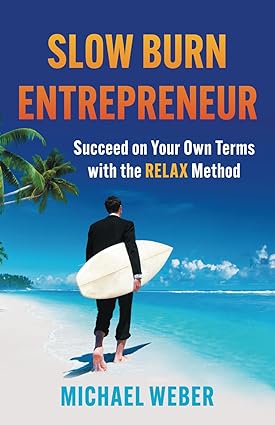
Michael Weber’s Slow Burn Entrepreneur offers a refreshing take on entrepreneurship, blending personal experiences with actionable insights. Unlike the fast-paced, burnout-inducing startup culture that dominates much of the entrepreneurial narrative, Weber introduces the concept of the “slow burn entrepreneur.” His approach emphasizes sustainable growth, balance, and long-term planning—principles that will resonate with both new entrepreneurs and seasoned business owners. He champions self-discipline, reflection, and maintaining a steady pace as realistic strategies for achieving success in today’s demanding business environment. Throughout the book, Weber communicates his ideas with clarity and precision, making complex concepts feel both approachable and relevant.
Weber’s writing is conversational and accessible, a style that keeps the reader engaged while delivering valuable lessons. He injects warmth and relatability into his business advice, weaving in vivid storytelling that brings the book to life. The imagery of deserted airports and tranquil beach sunsets adds a human touch, making the book more than just a guide; it’s a journey. His down-to-earth tone invites readers to connect with his experiences, from his early entrepreneurial struggles to the heights of his success. The result is a candid, reflective narrative that feels more like a seasoned mentor offering advice than a conventional business text. Anecdotes like his family’s time in Nicaragua during the pandemic add depth, showing the personal side of entrepreneurship. This balance between emotional resonance and practical advice makes the book accessible to a broad audience, free from jargon and over-complicated language. One of the book’s standout qualities is how Weber presents his ideas. He contrasts two distinct entrepreneurial archetypes: the fast-living, risk-taking entrepreneur prone to burnout and the patient, relationship-oriented business leader. This powerful comparison underscores the core philosophy of his “slow burn” approach. By sharing both his successes and failures, Weber invites readers to learn from his experiences in a way that feels authentic and relatable. His ability to simplify complex entrepreneurial concepts into digestible, practical steps sets this book apart. This book is not for those seeking quick wins or high-risk strategies. For readers looking for rapid scaling techniques, Weber’s measured, methodical approach may seem too cautious. Slow Burn Entrepreneur is a book that requires time to fully appreciate both the insights and the anecdotes.
Slow Burn Entrepreneur is a must-read for anyone interested in a thoughtful, realistic approach to building a business. Weber’s mix of personal storytelling, clear guidance, and practical advice offers a compelling and eye-opening perspective that challenges the traditional entrepreneurial mindset.
Pages: 178 | ASIN : B0DCY7BPB1
Impactful, Purpose-Driven Workplaces

Purposeful Performance is a guide for leaders and professionals seeking to infuse their work with greater meaning and value while advocating for a shift from profit-centric models to purpose-driven approaches that prioritize empathy, employee well-being, and community impact. Why was this an important book for you to write?
When the company I founded was acquired, I felt lonely and isolated. I went from being deeply connected to a purpose-driven organization to feeling isolated and disconnected in a new environment. My previous company had a clear mission of making a social impact and supporting our community, which gave me a profound sense of purpose.
The transition was tough, and I initially struggled with it. However, I recognized the need to adapt and embraced a new role at the acquiring company. I focused on transforming the organization’s approach from a profit-centric model to one that embraced a purpose-driven ethos. This shift not only re-engaged me but also reignited my passion for work.
Drawing from this experience, I wrote a book to address a critical issue: the broken state of the American workforce. Disengagement at work is at an all-time high, and people are searching for meaning. I aim to help leaders and professionals cultivate a work environment that fosters purpose and meaning. By sharing my journey and insights, I hope to inspire others to create impactful, purpose-driven workplaces that stand out and drive lasting change.
What is a common misconception you feel people have about gaging what is successful in business and life?
A common misconception about success in business and life is the overemphasis on money. While financial gain is often seen as the ultimate measure of success, true success is more about our impact on others.
Many of the most successful individuals I know lead with a mindset of support and service. They prioritize the well-being and success of those around them rather than focusing solely on their achievements. These leaders help others, offer support, and create connections that facilitate growth and progress for everyone involved.
Success, in my view, is about empowering others to reach their full potential and celebrating their achievements alongside them, not simply ahead of them. When you put the interests of others before your own, whether in your professional or personal life, you cultivate meaningful emotional connections.
For example, you demonstrate care and support when you come home and engage with your spouse by asking about their day and genuinely listening. This shift in focus from self to others enhances relationships and contributes to a broader sense of self-fulfillment and success.
What were some ideas that were important for you to share in this book?
In my book, I emphasize that leaders can make a meaningful difference in the lives of the people they serve. One key idea is that selling products and services should not be about merely being the best but about positively impacting people’s feelings.
In many boardrooms, discussions rarely touch on a product’s or service’s emotional impact, yet understanding this is one of the best-kept secrets of fast-growing companies. Rather than focusing solely on metrics like increasing sales, businesses should ask themselves how they can change people’s perceptions of their offerings.
For instance, consider what emotions you want to evoke when customers interact with your brand. Identifying and targeting these emotions creates a deeper connection and enhances the customer experience. This emotional engagement can drive loyalty and satisfaction, setting your business apart.
Here’s a quick story that illustrates the power of emotion. I often visit a local convenience store where the staff has consistently made me feel valued and appreciated. However, a new employee has been operating the counter on my recent visits. This individual frequently leans against the counter, engrossed in his phone, and during my last visit, I waited for five minutes before he even acknowledged my presence at the register.
The shift was palpable: I went from feeling valued and respected to completely overlooked and unimportant. The loyalty and sense of belonging I once felt turned into frustration and alienation in a short period.
This experience highlights the crucial role of emotional engagement. How we interact with others can significantly impact their feelings and perceptions, underscoring the importance of maintaining a genuine connection in every interaction.
What is the one thing that people point out after reading your book that surprises you?
As a first-time author, I was initially apprehensive about sharing my work with the world. The overwhelming support and positive feedback deeply humbled me. One of the most surprising and gratifying aspects has been how readers resonate with the book’s core message about leading with intention.
For instance, one reader shared that the book inspired him to leave his job and pursue his dream of starting a purpose-driven business. While I don’t advocate making such significant changes without careful planning, it was fulfilling to see that my book provided the encouragement he needed to step out of his comfort zone.
Additionally, I’ve been pleasantly surprised to hear that many readers buy multiple copies—one for themselves and one for a leader they work with. This reflects a genuine desire for authenticity and meaning in the workplace, which the book seems to address effectively.
I’m incredibly grateful for the support from leaders and professionals who embrace the book’s message and find value in it.
Author Links: Goodreads | Linkedin | Website | Amazon
From profit to purpose: transform your business for meaningful impact.
The business landscape is shifting. At one time, the profit-first model drove strategic decision-making. Now business leaders are struggling with disengaged employees, unclear plans, and lack of purpose. It’s time to take a step back, get down to the heart of your organization’s mission, and lead with purpose.
In Purposeful Performance, business-strategy consultant and coach Jonathan Stanley gives business owners the key to developing a sense of purpose and meaning within and beyond their organization. Jonathan distills decades of experience as a business owner and CEO into a powerful framework that simplifies strategic planning into just eight slides. The Infinite Loop of Connection is a proven strategic plan that helps leaders define and create meaningful experiences for their employees, customers, and community. By aligning their teams around an authentic purpose and expressing their values, readers will learn how to unleash the full potential of their organizations.
In this book, you’ll discover:
Why the most successful businesses are those that operate with a clear, purpose-driven strategy.The 8-slide strategic plan that simplifies execution and alignment and deeply reflects your mission to drive societal impact.How to create a workplace where every team member is motivated by a shared sense of purpose, vastly improving productivity and satisfaction.Strategies for attracting customers who align with your values and purpose, including how to avoid the mistake of focusing on features over feeling. Tools for measuring and communicating the positive impact your business is making.
If you want to stand out, focus on showing care with an understanding of the advantages of being more human. Combining powerful insights on engagement, customer experience, and social impact into a cohesive approach that is accessible to leaders of small to medium-sized companies, Purposeful Performance is the guide to transforming your business and maybe the world around you. Ensure your next business move is fueled by meaning, and create a legacy that goes beyond the bottom line.



 LITERARY TITAN