Blog Archives
A Highlight Reel

Sugar Sand Land is a romance novel in which a famous influencer and a scandal-shadowed country star fall in love and must choose between the stories the world tells about them and their private truths. What drew you to writing a romance about people whose lives are shaped by public image?
I’m both a sociologist and a romance novelist, and I think that dual perspective shapes the stories I tell. In the age of social media, just about everyone has a public image, whether you’re famous or not—a curated image—and I’m fascinated with how that impacts our lives. I’ve always been interested in the gap between appearance and reality. That gap is heightened in a world ruled by Instagram images, TikTok reels, mass media stories, and the whims of “influencers.” But how do you get at the gap between appearance and reality, and identity more broadly? I’m obsessed with romance, and so a love story was my way into the topic. By creating a love story between celebrities, I was able to show the reality of their lives and include media stories and public commentary in the form of social media posts. That allowed me to explore the gap between what people think is true and what actually is true. At the end of the day, relationships are always central to my novels, so I very much see this as a romance first and foremost. But it’s also about identity in today’s society.
How did you balance the glamorous, high-profile elements of celebrity culture with the deeper themes of grief, loneliness, and emotional healing?
I’ve always thought about writing a romance novel like baking a soufflé. You want the light, airy bits, but when you dig your spoon in further, it’s rich and decadent. So in this novel I really tried to create balance between the fun celebrity elements and the deeper themes. I was able to do this by keeping the love story at the center. The romance between Emerson and Renn is genuine and deep. They spark. It’s sexy, but it’s also tender. By staying focused on their relationship, I was able to balance the different elements and emotions in the book.
Emerson and Renn feel like opposites in their relationship to fame. Was that contrast the starting point for the novel, or did it emerge as you wrote?
It was the starting point. I always begin with characters. I created Emerson Blue first—reality star, influencer, and basically the most famous person on the planet who has used social media masterfully to create her persona. The world thinks she’s an open book, but Emerson has secrets. As a counterpoint, I created Renn Walker, a fallen star who lives in seclusion and is so uninterested in social media he doesn’t even own a computer. The whole world has made assumptions about him despite his silence, but assumptions aren’t always right. To me, the contrast felt integral to both their love story and how they change each other, but also to exploring the larger topic of identity and what’s public and what’s private in contemporary culture.
What did you hope readers would take away from this story about love surviving both public myth and private pain?
We all need to think about what to make public and what to keep private in our lives. We should never compare ourselves to people on social media. It’s a highlight reel. It’s like comparing your insides to someone’s airbrushed outsides. People don’t always share their pain publicly. Many people carry invisible scars. There’s no number of “likes” on social media that serves as a substitute for real love. Above all, it’s a story about authenticity and love. Love helps us become more of ourselves, not less. Our real selves.
Author Links: GoodReads | Instagram | X (Twitter) | Facebook | Simon & Schuster | Website | Amazon
Twenty-eight-year-old beauty Emerson Blue is the second most followed celebrity on social media. A self-proclaimed “living piece of art” who rose to fame as a reality star and then parlayed her celebrity into a megabucks career as an influencer, she seems to have everything.
Forty-eight-year-old Grammy winner Renn Walker is a fallen country music star. Years ago, he was canceled following allegations of sexual misconduct, and he has lived in seclusion ever since. Once a beloved figure, he seems to have lost it all.
When Emerson and Renn meet, sparks fly. Against all odds, a star obsessed with popularity and a recluse shunned by the world fall in love. Everyone in the public and media has an opinion and thinks they know Emerson and Renn. But in a world dominated by social media—a world that blurs the lines between what’s public and private, what’s real and what’s illusion—do we ever really know anyone?
Impactful Small Decisions

What We Found Last Summer follows a group of friends whose summer turns into one filled with danger when they discover a bag of money tied to the mob. What was the inspiration for the setup of your story?
Childhood experiences and shared cultural memory: shooting off fireworks, building tree forts in the woods, and riding bikes with my friends. Everything we were doing while unsupervised in the 1980s, when the adults weren’t paying attention, which was most of the time. But it’s also influenced by movies like Stand by Me and, for the suburban crime element, TV shows like The Sopranos.
Derek’s bravado and Calvin’s caution create a strong tension. What interested you about writing that kind of friendship dynamic?
I just love that dynamic—the one friend who pushes the other toward the thing he really wants to do but is afraid to—or knows he shouldn’t. Derek is the catalyst, and Calvin is the conscience. Sometimes we need that friend because they push us to experience life. And sometimes that friend gets us into trouble.
The tone shifts between humor and real danger very quickly. How did you manage that balance without losing momentum?
There’s a lot of character work early in the book, and that’s where most of the humor lives. A fair amount of commentary from the characters about each other and their relationships. But when you’re running for your life, you only have time to react, not reflect. I tried to capture that shift as the stakes rise in the book.
If the characters could look back on this summer as adults, what do you think would stay with them the most?
How impactful small decisions are. How final some consequences can be. And how much simpler life felt when you were just playing with your friends.
Author Links: GoodReads | X (Twitter) | Facebook | Website | Amazon
But you just don’t know it yet.
When twelve-year-olds Calvin and Derek venture out to an abandoned treehouse at the edge of the woods, they stumble across something they were never meant to see.
What begins as another carefree day—when friendship still feels permanent and summer was meant for fun—quickly turns into something far more serious as the boys realize they’ve brushed up against a world of crime, danger, and secrets that don’t belong to kids.
Some summers you never forget.
Others change you forever.
Roscoe


Andrew J. Gregor’s Roscoe is a work of contemporary literary fiction that follows one day in the life of Roscoe Follman, a sixty-two-year-old unhoused man living on the streets of San Francisco with his small dog, Geppetto. The story moves through roughly twelve hours as Roscoe wakes in a doorway, wanders the city, reflects on the life he once had, helps a man after a serious accident, and suddenly finds himself noticed by the very society that usually looks through him. It’s a compact story in terms of time, but emotionally it feels much larger.
What struck me first was the voice. Roscoe is sharp, profane, funny, wounded, and often exhausting in a human way. He can move from a joke about a dog or a bad pair of shoes into a cutting thought about capitalism, colonialism, death, class, or dignity before you have time to settle in. That could have become too much, but Gregor gives the narration enough texture to keep it alive. Roscoe doesn’t sound like a symbol. He sounds like a man thinking out loud because silence has become too heavy. I liked that. I also liked that the book doesn’t sand him down to make him easy to admire. He’s tender, vain, angry, lonely, observant, and sometimes unfair. In other words, he feels real.
Gregor’s main choice, keeping the story so tightly focused on one man’s day, gives the novel its power. There’s not a lot of plot in the traditional sense, but there is constant movement inside Roscoe’s mind. The city becomes more than a setting. San Francisco feels damp, expensive, crowded, beautiful, cruel, and weirdly generous in flashes. The book asks readers to look at homelessness without turning Roscoe into either a lesson or a charity case, and I appreciated that restraint. Roscoe’s digressions can feel long, and some readers may find the political and philosophical asides blunt. Still, those asides are part of the point. This is a man trying to keep hold of his dignity by thinking, naming, remembering, and arguing with the world.
I would recommend Roscoe to readers who appreciate literary fiction with a strong social conscience, especially stories centered on voice, interior life, and moral discomfort rather than fast plotting. It’ll appeal to people who like character-driven novels that make them pause and reconsider the lives they pass by every day. It’s candid, rough-edged, and sad, but also unexpectedly funny. Most of all, it’s a reminder that being seen can be both a gift and a burden.
Pages: 191 | ASIN : B0GX3771MT

Nothing Left to Lose

Nothing Left to Lose, by Len Joy, is a literary family drama about Tawni Carter, a prominent anti-abortion activist whose public convictions collide painfully with her private life. After she tries to take legal control of her pregnant daughter, Charlotte, Tawni loses more than a court case. She loses trust, family, and the story she has told herself about who she is. The novel moves between 2018, the 1960s, and the early days of COVID, building a layered portrait of mothers, daughters, regret, survival, and the hard work of letting go.
I liked how willing Joy is to sit with complicated people. Tawni could have been written as a symbol, but she isn’t. She’s proud, sharp, manipulative, wounded, funny, selfish, and capable of real tenderness. That makes her frustrating in the way real people can be frustrating. I didn’t always like her. I was not always meant to. But I kept wanting to understand her, and that is where the book earns its emotional weight. The shifts into Clover’s past also give the novel a wider shape, moving it beyond one family crisis into a story about inheritance, not just money or blood, but belief, grief, stubbornness, and love passed from one generation to the next.
Joy’s writing is clean and direct, with dialogue that often carries the charge of a courtroom argument or a family fight at the worst possible moment. The book takes on big issues, abortion, faith, political identity, addiction, aging, illness, and the pandemic, but it works best when those ideas are pressed through intimate scenes. A hospital room. A phone call. A daughter at the door. Those moments feel authentic. I did sometimes feel the novel was juggling a lot, especially as it stretches across decades and social conflicts, but the emotional line stays clear. This is a book about a woman who has built a life around certainty and then has to survive the collapse of that certainty.
I would recommend Nothing Left to Lose to readers who enjoy character-driven literary fiction with the sweep of a family saga and the tension of contemporary social drama. It will especially appeal to readers who like morally messy protagonists, intergenerational stories, and novels that ask hard questions without pretending the answers are easy. It is not a light read, but it is a thoughtful one, and by the end, I felt the title land with force.
Pages: 217 | ASIN : B0GXLJRYWF
What We Found Last Summer

What We Found Last Summer is a compact, propulsive coming-of-age thriller built around a very 1980s kid-adventure setup: bikes, woods, fireworks, treehouses, comics, neighborhood rivalries, and parents who are just far enough away for trouble to bloom. The hook is simple and effective: Calvin and Derek find a bag of mob money in an abandoned treehouse, and their summer suddenly becomes much bigger than scraped knees and boyhood dares. The book knows exactly what it’s playing with when it invokes “Kids on bikes,” but it gives that familiar shape a sharper adult edge.
What makes the story work is that it isn’t just nostalgia dressed up as danger. Author Javier De Lucia fills the neighborhood with specific, lived-in relationships: Calvin and his brother Ryan, Calvin and Ravi’s strained friendship, Derek’s restless bravado, Rochelle’s divided loyalty, Lolo’s quiet vigilance, and the uneasy presence of adults whose choices are spilling into the kids’ world. The mob plot gives the novel momentum, but the real texture comes from the way every kid is trying to understand power, loyalty, fear, and belonging with only a twelve-year-old’s emotional toolkit.
The tone is probably the book’s strongest asset. It’s funny in a blunt, profane, very character-driven way, and then it can turn tense fast without feeling like it has changed books. Agent Baker’s line, “We follow the money,” could’ve been pulled from a straight crime novel, but here it sits beside comic-book arguments, treehouse engineering, and kids making decisions they’re nowhere near ready to make. That mix gives the novel its personality: half suburban adventure, half crime story, with the two halves rubbing against each other in interesting ways.
I also liked how the book lets the kids be messy without sanding them down into symbols. Calvin is cautious but tempted, Derek is bold but scared, Ravi is annoying because he’s often right, and Rochelle sees more than the adults realize. Lolo, meanwhile, becomes one of the book’s most memorable presences because he understands the danger before the kids fully do. The story has a real affection for childhood imagination, but it’s also honest about how quickly imagination can collapse when actual violence enters the frame.
By the end, What We Found Last Summer feels like a memory that’s been sharpened into a pulp adventure, then complicated by an adult narrator who knows memory and fiction don’t always sit in separate rooms. The afterword’s idea that “Everything counts” fits the book nicely, because this is a story about the way childhood incidents can become myths, wounds, jokes, and origin stories all at once. It’s a fast read, but it has more going on than its premise suggests, and its best moments come from how confidently it treats a neighborhood summer as something big enough to change everyone who lived through it.
Pages: 105 | ASIN : B0GT26H2ZM
Immortal Beings

A Tale for the Shadows follows a murdered woman who is reborn as a ghost and finds unexpected love and purpose alongside a hunted vampire in a world where death is only the beginning. What drew you to combining ghost lore with vampire mythology in the same narrative?
The simplest answer is that I love stories about ghosts, and I love stories about vampires, so I combined them for my own entertainment. I knew that I wanted to write a novel that I would love to read.
A longer answer would include a recognition that the lore around ghosts and vampires is deep, centuries of material. Those stories are also ingrained in our societal consciousness. We tend to view ghosts as fearful entities in most European traditions, but in so many cultures, they’re welcomed, revered. Vampires are feared because they are alpha predators of human beings. In the Victorian novels (Bram Stoker’s Dracula, for example), vampires are symbolic of a frightening force of sexuality. I think the fear of ghosts and vampires also rises from a fear of death, our own and that of those we love. My idea was to turn this fear on its head, at least to some degree. No group of humanity is monolithic. That includes the dead and undead. Could there not be kind ghosts, wise vampires? We know that, for those who live on, love lingers after death. What would happen if love were a force for those who have died?
And, finally, I was intrigued by how a friendship might develop between a ghost and a vampire, two supernatural beings. And from there, how love might develop. From that rose the promise of an eternity together, as two immortal beings. How cool would that be?
Senka’s story begins in trauma but grows into something more complex. How did you shape her emotional evolution?
A lot of my shaping of Senka’s character was instinctual, based on my own experiences. Life, not just mine but everyone’s, is a process of accumulating anniversaries—of births, marriages, deaths, significant events. When I was in high school, my father died suddenly. My grandmother, mother, and life partner all died in the space of a year. My son’s fianceé died about a year after he was in a devastating car accident that left him paralyzed from the collarbones down. I watched him recover and learned a lot about forgiveness from him. Senka’s losses and her eventual choices about how to heal come from my own beliefs about the value of life and the extraordinary healing power of forgiveness and compassion.
The novel explores love after betrayal. Do you see the story as more about love, survival, or transformation?
Hmmm. I see those three as inextricably intertwined. Each supports the others; each makes the others possible. In Shadows, there are obviously several different kinds of love: Finn’s for his mom, hers for him; Senka and Silas for Luna, his for them; Mrs. Wang for her husband; Jeremy for his parents; Sarah/Senka’s for Stanley; and, of course, Senka and Silas for each other. There are also several kinds of transformation: from living to dead, from apparently good husband to … not so good husband, from smoke to monster, from revenge-focused to justice-focused. There’s even a shape-shifter. If Senka hadn’t transformed from the self-absorbed, willfully blind actress she was into the compassionate, caring, introspective ghost she became, she wouldn’t have been capable of finding the love with Silas that she finds. At the same time, if Silas hadn’t found the love he has with Senka, he wouldn’t have been interested in continued survival.
What is the next book that you are working on, and when will it be available?
It’s 1972. When Poppy is forced to move to Monterey, California, just before her senior year in high school, she’s furious and powerless to stop it. Then she discovers a mysterious journal that answers her anger with something irresistible: every wish she writes becomes real. At first, it feels like freedom, like finally taking control. But the magic has a cost, and someone else always pays. As the consequences grow darker, Poppy realizes she must give up the magic and develop the strength to shape her life without it. It’s a coming-of-age story with a dollop of Twilight Zone. I’m hoping it will be in bookstores by October 2026.
Author Links: GoodReads | Facebook | Website | Amazon
She was murdered by the man she loved. Now she’s a ghost bound to the cabin where she died—until a wounded vampire, an ancient enemy, and a mysterious cat change everything.
Senka was once a rising television star. Now, she’s a restless spirit, trapped in the site of her betrayal. But everything shifts the night Silas appears—an ageless Native American vampire fleeing a ruthless Maker determined to erase him from existence. When a violent confrontation leaves the cabin in flames, Senka is finally freed, and an unlikely partnership is born.
As Senka and Silas forge a path through shadows and centuries-old grudges, they begin to pursue justice—not just for Senka’s murder but for the other lives shattered along the way. Guided by ghosts who’ve chosen to remain in the world of the living and aided by Luna the twenty-third, a clever feline with a talent for love and loyalty, they face vengeful vampires, unravel hidden truths, and awaken powers Senka never imagined.
But love in the afterlife is complicated. Haunted by the past and hesitant to trust again, Senka must confront the choices that led her here—and decide if an eternity with Silas is worth risking her heart one more time.
Lush, lyrical, and darkly romantic, A Tale for the Shadows is a supernatural fantasy that blends ghost stories and vampire lore with emotional depth, wit, and resilience. Perfect for fans of The Invisible Life of Addie LaRue, The Dead Romantics, and Buffy the Vampire Slayer, this is a tale of second chances, found family, and the quiet power of choosing love—even after death.
A Tale for the Shadows
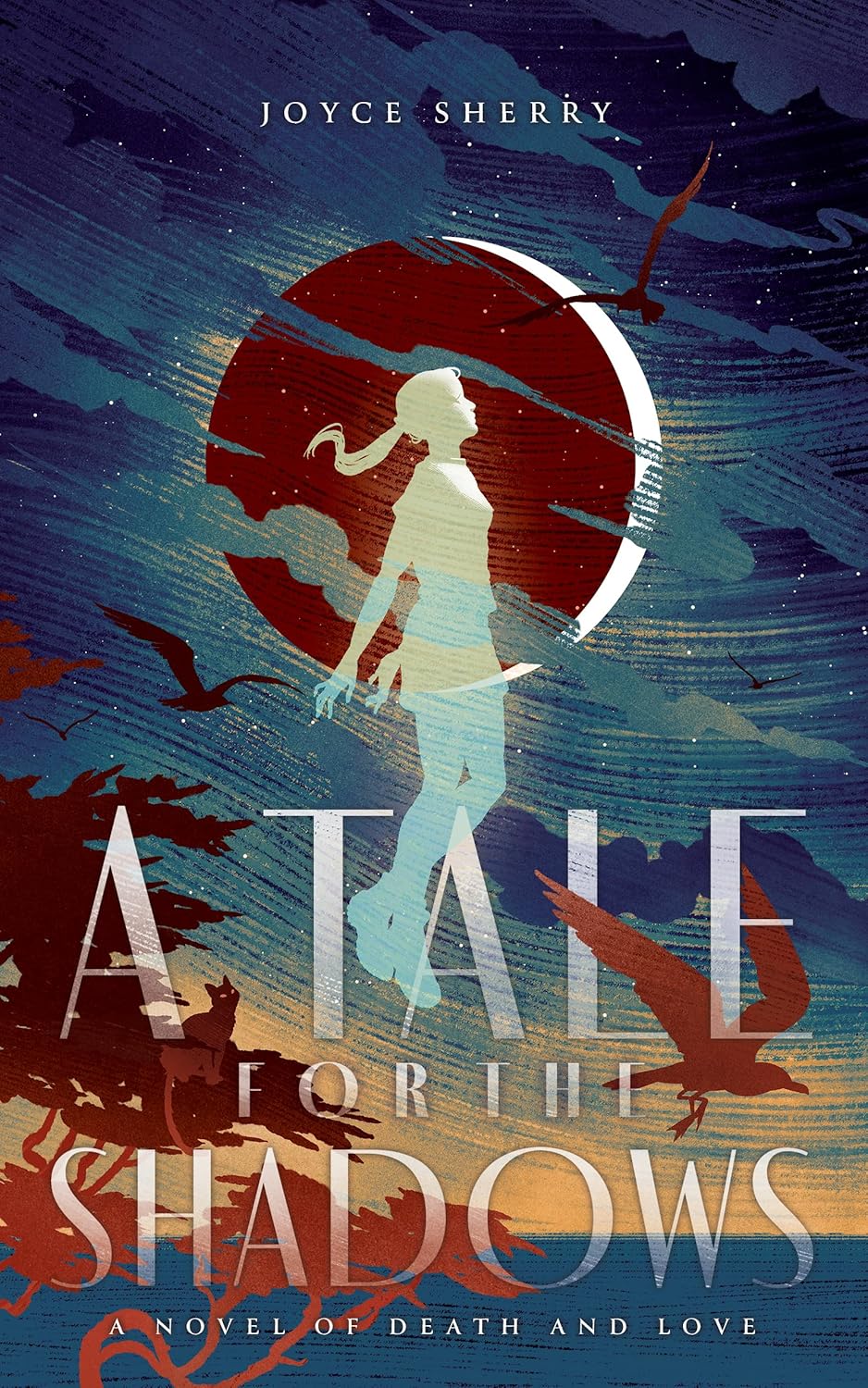

A Tale for the Shadows is a paranormal fantasy novel with a strong gothic streak and a surprisingly tender emotional core. It begins with murder, which sounds blunt because the book is blunt about it: Sarah Sommers is killed by her husband, becomes a ghost, and from there the story opens outward into something larger about grief, loneliness, survival, and connection. As her ghostly life unfolds, she becomes Senka and crosses paths with Silas, a hunted vampire, while another thread follows Finn, a sick teenage boy in a hospital, listening night by night to a story that may be doing more than simply entertaining him. It is a book about death and love, just as the subtitle promises, but it is also about what keeps a person, or spirit, moving when they have every reason to stop.
Author Joyce Sherry writes in a way that feels intimate without getting precious, and that is not easy to pull off in fantasy. The book has ghosts, vampires, ancient rules, and real danger, but the language keeps bringing everything back to feeling. A cabin smells wrong. A hospital room feels long after visiting hours. Loneliness sits in the air. That grounded quality made the supernatural parts easier to trust. I also liked the author’s choice to frame the novel through storytelling itself. The repeated sense that stories “want” to be told gives the book a self-aware quality, but it never turns smug. It feels more like someone sitting across from you and saying, let me tell you what happened, and meaning it.
I found myself especially drawn to the way Sherry handles character. Senka could have been written as pure vengeance, Silas as pure brooding, and Finn as the sentimental heart of the book. None of them stay that flat. Senka grows into someone more thoughtful and more brave. Silas has the old-world vampire sadness you expect from the genre, but he is not just a dark silhouette in a doorway. He is wounded, weary, funny in flashes, and very human in the ways that matter. Finn, meanwhile, gives the novel an anchor. His scenes keep the book honest. They stop it from drifting too far into mood for mood’s sake. I also appreciated that the novel takes its big ideas seriously without dressing them up in heavy language. It asks what love looks like after betrayal, whether pain has to define a life, and what it means to keep choosing existence. Big questions. Quietly asked.
I would recommend A Tale for the Shadows most strongly to readers who like paranormal fantasy, gothic romance, and character-driven supernatural fiction that cares as much about emotional healing as it does about eerie atmosphere or mythic stakes. It will appeal to people who enjoy vampire and ghost stories but want something softer around the edges and more reflective at heart. I came away thinking this book understands that darkness is only interesting if there is some light pressing against it. That balance is what gives it its pull. It is thoughtful, strange, and sincere, and for the right reader, that combination will feel like being led into the dark by someone who knows exactly where they are going.
Pages: 292 | ASIN : B0FBYTKMSB
Change Is Inevitable

A Real Collusion follows a mid-level ad guy who looks back on his best friend’s wild rise and fall as a grassroots political candidate that took on America’s two-party system. What was the inspiration for the setup of your story?
I’ve been frustrated and angry about the US government’s dysfunction and the broken two-party system for a long time. Leading into the 2000 election, I consulted with the Committee For A Unified Independent Party on their fundraising and also wrote a song called “Bush And Gore Suck.” My band, Channeling Owen, played at a rally in NY for John Haglin, a third-party Presidential candidate. Somewhere along the way, I guess I started wondering what it might take for a third-party candidate to really get traction, and it occurred to me that it might need to be a mistake or an accident…..
The novel suggests that systemic change is incredibly difficult. How did you balance storytelling with the book’s more exposé-like elements?
That’s kind of my thing. I get excited about fighting injustice, and if there’s any truth to the pen being mightier than the sword, perhaps it can make a difference. In my previous book, The Organ Broker, I painstakingly explained how the organ donation system in the US is broken, what I believe caused it, and what I think the remedies could be. Rather than provide an academic paper on that (although I did write a magazine article for Everyday Health), I explained it through the eyes and experiences of a character named New York Jack. In A Real Collusion, I have tried to explain and dissect the dysfunction in our government through the eyes and experiences of two regular guys who almost take down the system.
How did your background influence the authenticity of the media and political scenes?
In 2005, I launched a natural soda brand, which I ran as CEO for six years. I also briefly ran a social-mobile technology company, and learned a bit about marketing and, in particular, digital marketing. I suppose that informed the scenes at the marketing agency but frankly, in my mind I think I imagined the look of it to be akin to the boardrooms I worked in when I first started my career on Wall St. The political scenes—as well as the discussion, policy statements, etc.—were born out of my genuine and passionate interest in political reform and the things I learned when doing some work for an independent political organization twenty-five years ago. Shit, I’m glad you asked. I thought I had just made it all up!
Do you see A Real Collusion as a warning, a mirror, or a conversation starter?
I think it is all of those things. I actually love what your Editor and Reviewer said about the book, making him feel, “Sad, angry, but also weirdly hopeful.” That is exactly how I feel. Like so many Americans, I feel angry about the broken system, the way politicians are self-serving and also choose party over country. I feel sad, and even exhausted, when it seems to never change. Yet, I do think that not only can things change, but that change is inevitable. The problem with change, or long-term evolution, is that it sometimes moves too slowly to be seen easily, or to benefit an individual within his or her own lifetime. I try to think about the timeline being humanity’s, and not my personal one of 80 or 90 years, and I continue to hope that things will get better and we will end up with a system of true and free democracy, with a government whose genuine goal is to serve the interests of the collective citizenry.
Author Links: GoodReads | Website | TikTok | Instagram | Amazon
From the author of the bestselling novel, The Organ Broker, (hailed by Lee Child, New York Times # 1 bestselling author of the Jack Reacher series as, “Exciting and thought-provoking–the perfect package”) comes, A Real Collusion, a stunning political thriller and expose.
A Real Collusion is a David Vs. Goliath(s) story about a man who accidentally becomes the leader of an independent political movement that nearly takes down the two-party system in America, while exposing a conspiracy that affects the results of the 2016 election. It explores universal and deeply human themes of loss, and the tension between justice and power. In the opening sentence the narrator points out that, “Ordinary people often do extraordinary things.” The characters in the book do, and the action is driven by the fantastic events of a unique political satire. It is also the heartfelt story of regular people struggling with lost love, alienation and nearly universal disaffection who find strength in enduring loyalty and friendship
This is the story of John Campbell (a regular guy from the lower east side of Manhattan) as recounted by his friend Skip Winters. Skip becomes John’s campaign manager and later, a congressman in his own right. He narrates the stunning-but-plausible story of how John Campbell and The American Coalition race to popularity, raising over a hundred million dollars from grassroots contributors—and become a threat to the political duopoly of the Democratic and Republican parties. The book sprinkles in references to real events from recent history, and real political leaders including Trump, John McCain, and more. This imbues the novel with a sense of realism, albeit one of an alternate reality. Skip discovers a deep-seated conspiracy within our political system whose leaders orchestrate a murder, destroy his friend and tip the scales of the election. The novel turns out to be Skip’s exposé of the secret collaboration between the two major political parties in our country—a cooperation to protect the duopoly that is, in part, real.


