Blog Archives
Impactful Small Decisions

What We Found Last Summer follows a group of friends whose summer turns into one filled with danger when they discover a bag of money tied to the mob. What was the inspiration for the setup of your story?
Childhood experiences and shared cultural memory: shooting off fireworks, building tree forts in the woods, and riding bikes with my friends. Everything we were doing while unsupervised in the 1980s, when the adults weren’t paying attention, which was most of the time. But it’s also influenced by movies like Stand by Me and, for the suburban crime element, TV shows like The Sopranos.
Derek’s bravado and Calvin’s caution create a strong tension. What interested you about writing that kind of friendship dynamic?
I just love that dynamic—the one friend who pushes the other toward the thing he really wants to do but is afraid to—or knows he shouldn’t. Derek is the catalyst, and Calvin is the conscience. Sometimes we need that friend because they push us to experience life. And sometimes that friend gets us into trouble.
The tone shifts between humor and real danger very quickly. How did you manage that balance without losing momentum?
There’s a lot of character work early in the book, and that’s where most of the humor lives. A fair amount of commentary from the characters about each other and their relationships. But when you’re running for your life, you only have time to react, not reflect. I tried to capture that shift as the stakes rise in the book.
If the characters could look back on this summer as adults, what do you think would stay with them the most?
How impactful small decisions are. How final some consequences can be. And how much simpler life felt when you were just playing with your friends.
Author Links: GoodReads | X (Twitter) | Facebook | Website | Amazon
But you just don’t know it yet.
When twelve-year-olds Calvin and Derek venture out to an abandoned treehouse at the edge of the woods, they stumble across something they were never meant to see.
What begins as another carefree day—when friendship still feels permanent and summer was meant for fun—quickly turns into something far more serious as the boys realize they’ve brushed up against a world of crime, danger, and secrets that don’t belong to kids.
Some summers you never forget.
Others change you forever.
Societal Rules and Rituals

Nebraska Avenue follows a lonely Brooklyn boy in 1976 Long Island as he joins a crew of paperboys whose neighborhood adventures, comic rituals, and risky scheme to clear their boss’s name teach him about courage, loyalty, friendship, and home. What was the inspiration for the setup of your story?
The inspiration for the story was my own experience moving from Brooklyn to Long Island in the 1970s, leaving behind my school, friends, and “block”, and needing to start over. My twin sisters, two years older than me, had a much easier time adjusting to our new environment. I was indeed a paperboy for Newsday, and most of the “shenanigans” depicted in the book actually happened.
Vinny’s world feels rich with period details, from paper routes to banana-seat bikes. Were these drawn from personal memory, research, or a mix of both?
I have vivid memories of that time period, which I supported with research to make sure my memory knew what it was talking about! I only wish I had kept my Royce Union bicycle all these years – although I’m pretty sure I still have the milk crate I used to deliver newspapers,
The novel treats childhood like its own small society with rules, rituals, and economies. Was that perspective central to the story from the beginning?
An examination of childhood societal rules and rituals was not at all planned. My intention was just to tell a story about paperboys (and one girl paperboy). But by Chapter 2 – beginning with Wally’s sister becoming annoyed at Artie’s immaturity – it became apparent that some of the most interesting things about growing up happen “between the lines.” Recounting the manner in which interactions between the characters were conducted became fun for me. For example, the frequent punches in the arm were essentially the way the paperboys kept order, with each of them having the authority to render judgment when someone stepped out of line. I recall receiving my fair share of (well-deserved) punches, all in good fun and with no lasting damage.
How did you balance nostalgia with the more tender emotional undercurrent of Vinny’s homesickness and need to belong?
I think most everyone is nostalgic for their formative years and could write a story about it if they put their mind to it. My eyes would sometimes tear up when I was writing about Mr. R’s struggles or the loneliness I felt after moving to Long Island. It would have been a very sad story if I remained in that space, so I tried to concentrate on the lighter moments. Fortunately, my summers as a paperboy were filled with those lighter moments – and way too many fireworks.
Being a paperboy gave me friends and confidence, not to mention the best financial lessons an early teen could hope to learn. Best of all, I remain good friends with some of the “characters” depicted in the book. I only wish today’s children could experience what my friends and I did fifty years ago.
Author Links: GoodReads | Amazon
But the easy rhythm of morning routes and Fourth of July mischief doesn’t last. When a string of burglaries hits homes along Vinny’s route, suspicion lands on the boys—and a local cop with a long memory is more than willing to make it stick.
With no one else on their side, the crew sets out to prove the truth themselves—following the only lead they have and risking more than they bargained for in the process.
The news is only for a day. The legend of Nebraska Avenue is for a lifetime
What We Found Last Summer


What We Found Last Summer is a compact, propulsive coming-of-age thriller built around a very 1980s kid-adventure setup: bikes, woods, fireworks, treehouses, comics, neighborhood rivalries, and parents who are just far enough away for trouble to bloom. The hook is simple and effective: Calvin and Derek find a bag of mob money in an abandoned treehouse, and their summer suddenly becomes much bigger than scraped knees and boyhood dares. The book knows exactly what it’s playing with when it invokes “Kids on bikes,” but it gives that familiar shape a sharper adult edge.
What makes the story work is that it isn’t just nostalgia dressed up as danger. Author Javier De Lucia fills the neighborhood with specific, lived-in relationships: Calvin and his brother Ryan, Calvin and Ravi’s strained friendship, Derek’s restless bravado, Rochelle’s divided loyalty, Lolo’s quiet vigilance, and the uneasy presence of adults whose choices are spilling into the kids’ world. The mob plot gives the novel momentum, but the real texture comes from the way every kid is trying to understand power, loyalty, fear, and belonging with only a twelve-year-old’s emotional toolkit.
The tone is probably the book’s strongest asset. It’s funny in a blunt, profane, very character-driven way, and then it can turn tense fast without feeling like it has changed books. Agent Baker’s line, “We follow the money,” could’ve been pulled from a straight crime novel, but here it sits beside comic-book arguments, treehouse engineering, and kids making decisions they’re nowhere near ready to make. That mix gives the novel its personality: half suburban adventure, half crime story, with the two halves rubbing against each other in interesting ways.
I also liked how the book lets the kids be messy without sanding them down into symbols. Calvin is cautious but tempted, Derek is bold but scared, Ravi is annoying because he’s often right, and Rochelle sees more than the adults realize. Lolo, meanwhile, becomes one of the book’s most memorable presences because he understands the danger before the kids fully do. The story has a real affection for childhood imagination, but it’s also honest about how quickly imagination can collapse when actual violence enters the frame.
By the end, What We Found Last Summer feels like a memory that’s been sharpened into a pulp adventure, then complicated by an adult narrator who knows memory and fiction don’t always sit in separate rooms. The afterword’s idea that “Everything counts” fits the book nicely, because this is a story about the way childhood incidents can become myths, wounds, jokes, and origin stories all at once. It’s a fast read, but it has more going on than its premise suggests, and its best moments come from how confidently it treats a neighborhood summer as something big enough to change everyone who lived through it.
Pages: 105 | ASIN : B0GT26H2ZM

Bad Americans: Part II

Bad Americans: Part II by Tejas Desai is a sprawling novel-in-stories set during the summer of 2020, after New York’s Covid lockdown, when billionaire dating-app magnate Olive Mixer gathers twelve Americans at his Hamptons estate for an experiment in romance, confession, competition, and moral exposure. Each night, a guest tells a story; in this second half, the book moves through Lisa’s #MeToo-inflected art-world account, Khassan’s provocation, Hayley’s modeling-world tale, Pritesh’s immigrant-professional odyssey, Sylvania’s fashion-and-identity chronicle, and Angela’s bruising finale, all while the frame narrative tightens around accusation, loyalty, illness, desire, and the question of who gets believed.
I admired the book most when it refused to let any character become a clean emblem. Desai is writing about America as a loud room where everyone has a grievance, a wound, a blind spot, and a microphone. The result can be abrasive, but productively so. The frame narrative has the nervous electricity of a reality show filmed inside a moral philosophy seminar: people flirt, sulk, posture, accuse, console, and revise themselves in public. I found that messy social weather more compelling than any single plot turn. The book understands that “discourse” isn’t abstract; it happens over food, sex, money, race, fear, vanity, and the old human need to be the injured party.
The novel’s appetite is almost gargantuan: it wants to absorb pandemic politics, gender conflict, race, class, immigration, celebrity, sexual harm, art, fashion, social media, tech money, and literary history all at once. Still, I would rather read a book that risks excess than one polished into anesthesia. Desai’s best scenes have a jagged vitality; they make the reader sit in contradiction instead of offering the soft chair of easy judgment.
I would recommend this to readers of literary fiction, social satire, contemporary American fiction, and frame narrative experiments, especially book clubs willing to argue rather than merely agree. Readers who enjoy the social sweep of Tom Wolfe or the polyphonic setup of The Decameron will recognize the pleasure of watching a whole culture refracted through competing stories, though Desai’s sensibility is rawer, more contemporary, and more quarrelsome.
Pages: 454 | ASIN : B0GGV7Q3TH

The Cultural Threat
Dollartorium follows a struggling corndog shop owner who chases a too-good-to-be-true business scheme, only for the fallout to expose the hollow promises of hustle culture. Did this novel begin as satire, social commentary, or character study?
The Dollartorium began as a play, inspired by Aristophanes’ Clouds, but instead of satirizing philosophers (not much a target these days), I thought better to take on that new class of hustlers and the culture they have created. Like most satire, it became social commentary and, sadly, even more relevant now than when I began.
The Dollartorium scheme feels disturbingly familiar. How closely did you model it on real-world programs? Were you more interested in exposing the scam itself or the conditions that make people vulnerable to it?
Ha! It is disturbingly familiar to me as well. The Dollartorium is a critique of the many ways our culture, especially business culture, creates a numbness in ourselves and in our relationships with others. The Dollartorium is more about the cultural threat, the scam itself, but of course, the scam would hardly be a threat if we, like Ralph, weren’t vulnerable to it. Fortunately, Ralph and Phyllis recover with the help of a more reality-grounded Stella.
The novel is funny, but there’s an undercurrent of anger beneath the jokes. How do you balance humor with critique?
Without humor, I’d go mad. The heart of the book is in the lectures at the Dollartorium. I use each lecture to ridicule one thing. If the book revealed the totality of living under the culture of uncontrolled capitalism, it would be humorless and unbearable. These little things, from sex in advertising to dilution of food, are pieces we all experience, and up close they are both funny and disconcerting. To see their absurdities enables us to distance ourselves from them a bit. But to be so used, so often, makes me angry.
The book closes on a realistic, not idyllic, note. Why was that the right ending?
I would be gratified if the ending were realistic, that we simply open our eyes and live and work doing what we can as best we can, bearing in mind the needs of others. After a brutal journey for Ralph and his daughter, I hope the ending shows that things do not have to be the way they have become, and that the journey to a saner world is a personal, as well as social, responsibility. Even Phyllis finds pleasure in honest work. Still, the Money Master endures, intent on his own selfish worldview, doesn’t he?
Author Links: GoodReads | X (Twitter) | Facebook | Website | Amazon
Girl Bonding

Hearts on Paper follows a teenager on summer break learning to navigate life with a new stepmother and a picture-perfect stepbrother. What was the inspiration for the setup of your story?
One drop of truth spiraled into a writer’s hurricane. The first draft of Hearts on Paper poured out of me in just eleven days. When I was in seventh or eighth grade, my father remarried and didn’t tell me. I found out when I went to visit for two weeks over summer break. I let myself in with the spare key, hidden in a mustard jar, because my dad was at work. My new stepbrother, a total stranger, greeted me in the dining room. He showed me pictures of their wedding hanging on the newly painted pink walls.
Looking back as an adult, I thought two things: What a shifty thing to do, and what a great way to start a story.
What draws you to write YA fiction?
I’m drawn to the story; this one just so happened to be YA.
Do you have a favorite scene in this novel? One that was especially enjoyable to craft?
Chapter: “Clever Girls.” I loved writing the self-defense scene—girl bonding at its most savage.
What is the next book that you are working on, and when will it be available?
Pretzel Fangs is a cozy horror short novel. Kat ages out of the foster system and becomes a human blood bag for vampires. It’s salty, twisted, and delicious. Available on Wattpad while I fine-tune a few scenes. It might be available in print as soon as this fall, just in time for spooky season.
Author Links: GoodReads | TikTok | Facebook | Amazon
Emery Carter’s two-week visit takes an unexpected turn when she learns her diplomat dad secretly remarried and forgot to tell her. His new wife? Whatever. Her new stepbrother? Way too handsome, way too distracting, and way too easy to fall in love with.
No strings? Yeah right. No drama? Think again.
She never planned on staying. He never wanted her to leave.
A young adult sweet romance.
Hearts on Paper
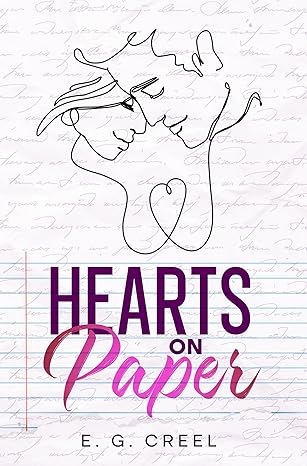

Hearts on Paper, by E. G. Creel, is a charming story that follows Emery, a witty and thoughtful teenager whose summer break turns upside down when she discovers her father has remarried and forgotten to mention it. Thrust into a shiny new life with a picture-perfect stepbrother named Dean, Emery stumbles through awkward poolside encounters, a stifling country club culture, and a whirlwind of emotional and romantic confusion. The book is packed with sharp dialogue, heartfelt introspection, and plenty of high school drama, but beneath all the sass and swoons, there’s a deeper story about identity, grief, and navigating the awkward gray areas between childhood and growing up.
Emery’s tone makes this book. She is funny in that quietly savage way that makes you want to follow her around just to hear what she’ll say next. Her thoughts feel real–the kind of thoughts you only admit to yourself. E. G. Creel has this knack for nailing teenage awkwardness without making it cringeworthy. The banter between Emery and Dean hits the perfect balance of playful and emotionally loaded. I caught myself smiling during the quieter scenes, especially when Emery is trying to figure out whether Dean is trouble or just a misunderstood golden boy. It never felt overdone or syrupy. The pacing, especially in the early chapters, was smooth and tight. I was pulled in fast and stayed locked in.
There were moments where the story leaned into tropes. Still, I couldn’t put it down. There’s something magnetic about watching these characters slowly orbit each other, even when the plot takes some predictable turns. The writing keeps things light enough to stay fun but serious enough to give the characters some weight. Creel’s prose never talks down to the reader, and that’s a big part of why the story works.
Hearts on Paper is the kind of book I’d recommend to readers who loved To All the Boys I’ve Loved Before or Everything, Everything. If you’re into slow-burn romance with strong emotional undercurrents, rich teenage voice, and a little chaos in your love life, this one will hit the spot. It’s messy and sweet and complicated, just like being seventeen.
Pages: 226 | ASIN : B0F8WB2PPW


