Blog Archives
Stairwell To Silence
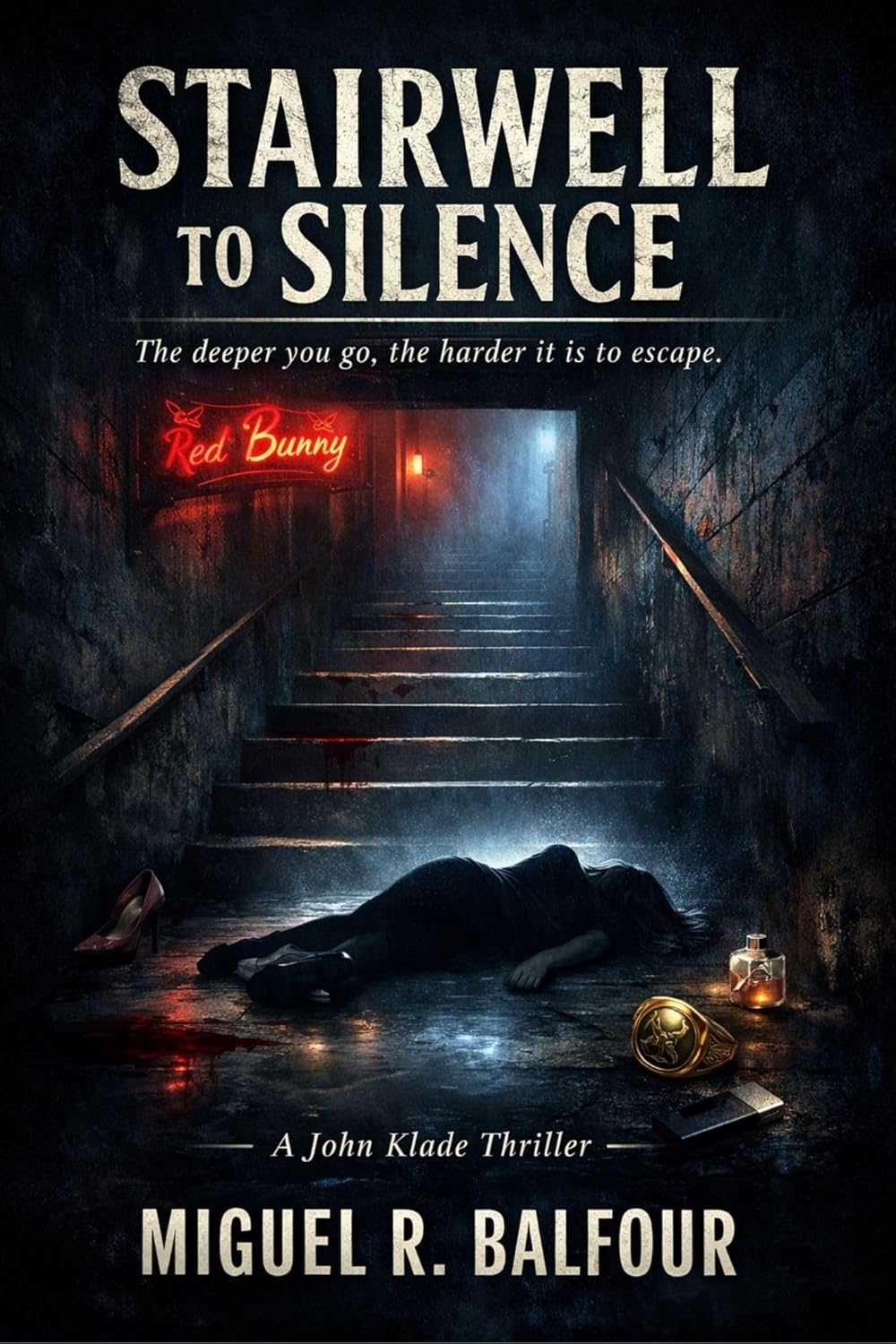

Stairwell to Silence opens with private investigator John Klade being warned away from a case he is destined to take anyway: the suspicious stairwell death of Bella Gaines, a brilliant law student whose “accident” quickly widens into a web of compromised police work, elite vice, military-adjacent secrecy, and family deception. What begins as a murder inquiry hardens into a conspiracy thriller, with Klade following bruises, burner phones, club back rooms, and buried wartime history toward a truth that keeps changing shape even after it seems cornered.
I liked this book most when it trusted its atmosphere, because atmosphere is one of its genuine strengths. Klade’s world is all controlled light, hard angles, quiet threat, expensive perfume, cheap coffee, and the procedural tenderness of someone who notices everything because he has learned what happens when he does not. The prose often leans deliberately hard-boiled, but it is not merely imitating noir; it has a chilly, polished texture of its own. I kept reading not just to know who killed Bella, but to remain inside that vigilant, airless mood the novel builds so well around surveillance, class, and private grief.
What I really reveled in, though, was the book’s interest in masks. Bella is not just a victim but a pressure point between institutions and identities; Marjorie arrives as bereaved mother and slowly reveals a more complicated moral silhouette; Ortiz never settles into a single readable role; and Klade himself is compelling because competence is both his armor and his damage. I did think the novel prefers momentum to stillness, so some emotional turns land more as sharpened revelations than as deep excavations. Even so, the book has real propulsion, and its later reversals give the story an undertow of melancholy instead of mere cleverness. By the end, the investigation has expanded far beyond one death, yet the narrative keeps returning to the intimate cost of using people as instruments.
I’d recommend this to readers of crime thrillers, conspiracy thrillers, detective fiction, noir suspense, and procedural mysteries, especially people who like capable, solitary investigators moving through corrupt systems with equal parts caution and stubbornness. It reminded me a little of Michael Connelly’s cleaner investigative drive crossed with the colder, more shadow-lacquered sensibility of David Baldacci at his most conspiratorial. This is a sleek, bitter-edged thriller that knows how to turn a staircase into a whole architecture of menace.
Pages: 391 | ASIN : B0GFCXT3WF

Heroes Are Lonely Hunters

Heroes Are Lonely Hunters, by Lloyd R. Free, is a historical mystery that follows an audacious setup: the Marquis de Sade, imprisoned and compromised, is pulled into a covert investigation after a series of brutal murders of young women rocks Paris. The police want his knowledge of the city’s hidden rooms, secret appetites, and dangerous social circles, so the book turns him into a deeply uneasy detective moving through salons, prisons, brothels, theaters, and court intrigue in late eighteenth-century France. It is part murder mystery, part historical fantasia, and part character study of a man the novel never lets us see as simple.
I was pulled in by the writing’s appetite for atmosphere. Free clearly loves this world, and that love shows up in the detail. The streets feel crowded, damp, and watchful. The interiors glitter, then sour. Paris often comes across like a stage set built of velvet, mud, perfume, and rot. I liked that the book does not give us a clean hero. Making Sade the center of a mystery is risky, and that risk is the point. Sometimes I admired the boldness of that choice, and sometimes I felt the discomfort of it pressing back on me. That tension is where the novel has its pulse. It asks me to follow a man who is clever, damaged, self-justifying, observant, and morally unstable, and that makes the reading experience more jagged than cozy, which feels right for this kind of story.
I also found myself drawn to the book’s ideas, even when I was not fully persuaded by them. The novel keeps circling the gap between enlightenment and appetite, public virtue and private vice, reason and superstition. You can feel that in the way Sade moves through philosophical talk, occult rumor, erotic spectacle, and state power, all while the mystery keeps widening instead of neatly shrinking. That gave the book a restless energy I appreciated. I do believe that, at times, the dialogue and exposition can feel a little overflowing, as if the novel wants to pour every fascinating name, scandal, and theory from the era onto the page at once. But even then, I never felt the book was empty. It is too curious for that. Too committed to the mess. And I think the ending leans into that same refusal to tidy everything up, which felt truer to the world the book had built than a slick, over-polished finish would have.
I’d recommend Heroes Are Lonely Hunters most strongly to readers who enjoy historical fiction with a dark edge, especially people who like their mystery novels tangled up with politics, sexuality, philosophy, and real historical figures. For readers who are open to a historical mystery that is intellectually curious, morally thorny, and willing to get its shoes dirty in the back alleys of history, I think there is a lot here to appreciate.
Pages: 247 | ISBN : 978-1948664059
The Last Profile: A Samantha Wright Crime Series #2


Theresa Janson’s The Last Profile is a police procedural with a strong romantic-suspense spine that keeps tugging the “case” and the “love story” closer together until they are basically knotted. Samantha Wright Little Bear has finally stepped out of the FBI profiler life and into a quieter, hard-won peace on the Cheyenne reservation, pregnant and trying to sleep through the memories that still show up at night. Then the Bureau yanks her back in anyway: her resignation is denied, and the “one last profile” she is promised drags in the FBI Director, Senator Stockman, her longtime partner Charlie Falken, and a Chicago history full of deceit and cover-ups. What starts as a professional obligation becomes personal fast, spiraling into a wider net of power games and human trafficking, and forcing Sam and Will to fight for their safety and their future together.
I liked the intimacy of the voice. Janson opens with Sam literally leaning on the lodge pole in the middle of their home, trying to borrow strength from something solid when her mind won’t settle. That choice tells you what kind of ride you are on: not cool, detached procedural distance, but a case told from inside the body and the marriage. The book spends real time in the everyday texture of Sam and Will’s life, and it is not shy about affection, humor, and heat. Sometimes it works like a palate cleanser between tense scenes. Sometimes it feels like the point. Will’s devotion is written big, almost mythic, and it gives the story a protective shell even when the plot keeps trying to crack it.
The author’s big swing, though, is how she ties the crime to old grief and old choices instead of treating it like a neat puzzle. Charlie’s rage begins with the story he has told himself for decades about who is to blame for his family’s death, and the book keeps pulling that thread until the real ugliness underneath is exposed. When Sam starts mapping the cover-up, you can feel the dread settle in because the “bad guy” is not one monster in an alley. It is a network, polished on the outside, rotten underneath. And then Janson makes a choice I respected: she lets consequences land. Charlie’s final letter is messy and human, full of regret and longing and an honesty that comes too late. It’s sad. It also reframes a lot of what came before.
By the end, the story turns its face back toward home, toward repair. The final stretch leans into family, community, and what it means to finally step out of the Bureau’s shadow, with Sam and Will grounded in the life they’ve chosen and the child they are bringing into it. If you like romantic suspense and police procedurals that are emotionally front-and-center, with a marriage you can actually root for and a plot that goes after corruption with both hands, you’ll probably tear through this. For readers who want crime, heart, and a setting that matters, The Last Profile is a riveting read.
Pages: 240 | ASIN : B0G87MLZXD
The Collapse of Political Power

The Quarry follows two powerful men building empires in a Soviet quarry town, exploring the intertwined lives of thieves, villagers, and families caught between criminal codes and collapsing political power. What was the inspiration for the setup of your story?
A novel is a bridge born in the writer’s imagination, thrown from the past into the future. It is the expression of the time lived. What happens in Azerbaijan is a reflection of what happens on the Absheron Peninsula and in Baku. When you look at the country’s hundred-year history, you witness this clearly. This is not a crime novel. Through the confrontation of two families and their ruthless struggle, the book portrays the collapse of political power, the fall of the Russian-Soviet Empire, and the decline of a colony.
Sani Absheronski and Malikajdar represent two kinds of power. How did you build their contrast?
I wrote about real events. The characters in the novel are not fictional out of nowhere; each has a prototype. To express their contrasts, I turned to Zoroastrianism. Let me tell you that in the lands where we once lived, Zoroastrian thought once prevailed. The god of evil was Ahriman, and the god of good was Hormuzd. There was an eternal struggle between these two deities. In my novel, Sani represents evil, while Malikajdar represents good. They gathered around themselves individuals aligned with their own nature. This creates diversity, dynamism, and strong contrasts within the events.
The novel explores loyalty in complex ways. What does loyalty mean in this world?
The foundation of humanity rests on loyalty. In society, in families, among people, between states, in religion, in science—even in the animal world—loyalty holds great importance. When wolves or dolphins lose their mate, they do not approach another. When a marriage contract is made, a vow of loyalty is given before God. When friends make a pact, loyalty is spoken of. Agreements between states are a demand for loyalty. If there is loyalty, there is humanity. If there is none, there is no humanity.
What is the next book that you’re working on, and when can your fans expect it out?
The novel I recently completed is titled “At the Fortieth Latitude.” It discusses the collapse of the Soviet Empire, economic hardships, the freedom movement, chaos, youth unemployment in the country, emigration abroad, love and regret, and loyalty. It also speaks about the abilities of our young people who realize themselves abroad.
I am thinking about two more novels. But since their outlines are not yet drawn and they are still in an amorphous state, I cannot speak about them yet. God willing, we will complete them.
The Book of Unforgivable Sins

If you like stories that ask what “unforgivable” really means while still delivering car wrecks, library heists, and small-town apocalypses, you’ll enjoy this book. The Book of Unforgivable Sins throws an immortal woman who has spent five thousand years sealed in a tomb together with a stressed-out archaeology student, then sends them racing from Egypt to Dublin to Chicago and small-town Iowa to find a legendary volume and stop an ancient sorcerer’s followers from using a death ritual to wipe out entire populations. Ricky Crowe, still cursed with immortality after an earlier showdown over the Scroll of Life and Death, is freed from Shendjw’s hidden mastaba by Jabari, a young Egyptian American on his first big dig, and the two of them chase clues to Marsh’s Library in Dublin, where The Book of Unforgivable Sins holds a handwritten version of the ritual that can strip Shendjw of his power and potentially save the world.
This one is fast and loud and sometimes a little wild, and I enjoyed that vibe a lot. The opening in Tarkhan grabbed me straight away, with Jabari’s mixture of awe and petty academic misery, and the whole sequence of him sneaking back into the tomb, cracking the ghost door, and finding “the mummy” in the sarcophagus had that great horror-movie energy that made me grin and wince at the same time. Once Ricky enters the story, the tone shifts into this snarky, bruised, found-family thriller that really worked for me. Her voice is sharp and funny, and the banter with Jabari, Adams, Green, and the others kept scenes from getting too grim even as bodies turned to ash in places like Marksville. The book leans on exposition about the earlier adventure with Cessair and the Scroll, though. There are chunks where characters sit and explain the previous novel and the metaphysics of the ritual, and every so often, that slowed the pace for me, even if the information was needed.
What I enjoyed was the mix of big ideas under all the chases and shootouts. The story keeps coming back to what immortality really costs and what people will do when they believe their cause is holy enough to excuse anything. Ricky’s five thousand years in the dark is not treated like a cool superpower; it feels like trauma and boredom and madness and survivor’s guilt, and the book is pretty blunt about how that messes with her. In the end, there is justice, a kind that left me uncomfortable in a good way, and I liked that the novel lets that sit instead of pretending it is simple.
By the time I turned the last page, I felt like I had gone through a whole season of a dark, pulpy TV show with these characters. The prose is straightforward and punchy, the jokes land more often than not, and the set pieces feel cinematic, even when the plot occasionally sprawls, and the mythology gets dense. I would happily recommend The Book of Unforgivable Sins to readers who enjoy contemporary fantasy thrillers with ancient magic, cults, and a bit of gallows humor.
Pages: 321 | ASIN : B0GQ6R7BD4
The Man in the Dam

Andrea Barton’s The Man in the Dam is a contemporary cozy-style mystery set around Mansfield and Lake Eildon in Victoria’s High Country, where journalist Jade Riley is meant to be writing a feel good arts piece about a local production of The Importance of Being Earnest. Instead, she wakes after a tense night with her partner Brett, spots a body in the property’s paddock dam, and the week turns into a knot of interviews, small-town suspicion, and a mystery that widens beyond that first death into family history and hidden motives.
What I liked most is how Barton anchors the book in everyday texture before letting the plot accelerate. The opening has that sharp, slightly painful intimacy of real life: Jade replaying a relationship argument, noticing mess on the counter, trying to steady herself, and then the sudden wrongness of seeing “something” in the water that becomes a person. The writing is clean and easy to move through, with lots of forward motion. And I enjoyed the author’s playful structural choice to use song titles for chapters, plus the nod to a playlist, which fits the creative-arts thread without turning the novel into a gimmick.
Barton’s bigger swing, though, is the way she braids “performance” into everything: the literal theatre production, the public masks people wear in a small town, and the private selves they protect when grief and money and reputation start pressing in. That theme lands because it shows up in character choices, not speeches. Jade is a journalist, so she has a believable reason to ask questions, notice tells, and keep pushing even when it gets uncomfortable. I also appreciated that the story doesn’t stay simple. It adds layers of family backstory and a second mystery that turns the book into something closer to a puzzle box, where one answer opens the next door and you start wondering how far back the damage really goes.
I’d recommend The Man in the Dam to readers who like character-driven mysteries with a strong sense of place, a community cast, and an investigation that feels like it’s happening over cups of coffee and awkward conversations rather than car chases. If you enjoy amateur-sleuth stories, theatre and arts settings, and mysteries that mix present-day danger with long shadows from the past, you’ll have a very good time with The Man in the Dam.
Pages: 310 | ASIN : B0GGWHFPY9
Libraries Preserve Stories

Dead Drop in Lily Rock follows a newly unhoused hiker as a Fourth of July stopover turns into an investigation of a murder at a library where classic-book devotion and small-town secrets lead to an interesting culprit. What sparked the idea to make a library the crime scene, and to make books function as evidence?
A Little Free Library is one of the last places we’d expect violence. Quiet, ordered, built on the assumption that knowledge is shared freely and stories are preserved with care. That sense of safety is exactly what made it the right crime scene.
Mysteries disrupt what feels stable in a community. A murder in a back alley is tragic. A murder at a Little Free Library is personal. It unsettles a town’s sense of who it is. It forces people to ask not just who did this, but why would anyone violate a community service devoted to ideas?
In Dead Drop in Lily Rock, books aren’t props. They’re catalysts. They carry history, ideology, memory, and sometimes controversy. A bookmark can signal allegiance. A marginal note can reveal motive. A banned title tucked into a Little Free Library can expose fault lines in a community that otherwise prides itself on harmony.
I was also drawn to the metaphor: Libraries preserve stories. A murder investigation uncovers one.
In Lily Rock, stories matter. So when something violent interrupts that space, the truth has to be found between the lines.
Officer Janis “Jets” Jets’s sarcasm is practically a climate. How did her voice develop, and what role does she play in shaping the tone of the series?
Janis’s voice developed before Avery arrived in Lily Rock. She first appeared in the original Welcome to Lily Rock Mystery series, sent as an undercover cop during the holiday season. Once Olivia arrives, in Getaway Death, Janis becomes the counterweight to Olivia’s empathy. When Olivia leans into intuition and connection, Janis leans into process and proof.
Her sarcasm grew organically out of that tension.
Small-town policing is intimate. You’re not just enforcing laws, you’re dealing with neighbors, gossip, fragile reputations, and people you’ve known since high school. Sarcasm became Janis’s armor. It’s how she maintains authority without becoming brittle. It’s how she keeps her footing when emotion threatens to swamp the facts.
In the Avery Denning books, Janis serves as tonal ballast. Avery feels the world deeply—animals, shifts in energy, subtle emotional undercurrents. Janis cuts through that with sharp clarity. Her voice sharpens scenes, prevents sentimentality, and keeps the series from floating away into pure intuition.
If Avery listens to crows, Janis reads warrants and sometimes invents her own to make a point.
Lily Rock feels authentic down to Mayor Maguire’s bookmark celebrity. What’s your process for inventing those hyper-specific town details without overloading the story?
I treat Lily Rock like a real town with zoning restrictions and a Chamber of Commerce. Before I write, I quietly ask the following:
What would this town brag about?
What would they put on a postcard?
What would they argue about at the hardware store?
Mayor Maguire, the labradoodle with local celebrity status, began as a small detail. But once he existed, the town responded to him. Someone would absolutely put him on bookmarks. Someone else would roll their eyes about it. Others called him psychic without knowing why. That’s how details become an ecosystem rather than decoration.
The key to avoiding overload is restraint. I think of world-building like seasoning. The reader doesn’t need the entire spice rack. They need the right pinch at the right moment.
A Little Free Library doesn’t need a full architectural history. It needs one crooked hinge, a banned book tucked inside, and a note written in a hurried hand.
Specificity creates authenticity. Selectivity creates readability.
How do you design clue trails so they feel fair and still deliver a snap of surprise?
For me, fairness is sacred to a mystery.
I design clues in three layers:
- Visible clues – The reader sees exactly what the sleuth sees. No hidden evidence withheld unfairly.
- Misinterpreted clues – These are the magic ones. The clue is accurate, but its meaning is slightly bent by context emotion, or assumption.
- Quiet clues – Small, almost throwaway details that only gain weight later.
The “snap” of surprise happens when a reader realizes: Oh. That was there the whole time.
I avoid surprise for shock’s sake. Instead, I aim for inevitability disguised as misdirection. The ending should feel both startling and earned.
And perhaps most important: I design suspect motivations before I design mechanics. If the emotional truth tracks, the clue trail will feel organic.
Mystery, at its heart, isn’t about trickery.
It’s about perception.
Author Links: GoodReads | Website | Audible | Amazon
Instead, she finds a murdered woman at the foot of a Little Free Library.
Arriving in the mountain town of Lily Rock for the Fourth of July weekend, Avery plans to rent a room from Stella Rawlins—a friendly local known for her love of books and quiet acts of defiance. When Stella is killed by a sabotaged firecracker hidden inside her library, Avery becomes the discovery witness… and an immediate suspect.
With parades planned and tensions rising over which books belong on public shelves, Lily Rock’s only police officer, Janis Jets, has her hands full. Olivia Greer, a constabulary consultant with a gift for listening, offers Avery a place to stay—and a chance to explain how she ended up at the scene of the crime.
As Avery begins asking questions, she uncovers a secret network of Little Free Libraries, anonymous religious threats tucked inside children’s books, and a second shocking death that turns the case deeply personal. Along the way, she reconnects with Brad May—older, steadier, and quietly trying to make a better life—awakening feelings Avery thought she’d left behind.
Soon it’s clear this isn’t just about books.
It’s about control, belonging, and who gets to decide which stories are worth protecting.
Armed with sharp instincts, a knack for noticing what others miss, and the growing realization that her outsider status may be her greatest strength, Avery steps into a role she never expected: amateur sleuth.
But in Lily Rock, asking the wrong questions can be deadly…
and staying might mean risking her heart as well as her life.
Dead Drop in Lily Rock launches a new mystery series set in the beloved Lily Rock universe—perfect for readers who love small-town whodunits, strong women sleuths, and cozy mysteries with heart.
The Quarry


The Quarry is a literary historical crime novel set around an Absheron stone quarry and the shifting criminal and political world of late Soviet Azerbaijan. It follows the rise and decline of Sani Absheronski, a legendary “thief in law,” and his uneasy rivalry with Malikajdar, the village “Aga” who builds an empire on fish, flowers, and quiet deals with generals. Around them orbit people like disabled ex dancer Maria, her sharp granddaughter Samaya, and Malikajdar’s son Hatam, whose secret love affair ties the families together. The story moves from the 1950s settlement days, through prison intrigues and black market schemes, to a violent tangle of betrayals that ends in Sani’s murder and the silence of Black January settling over Baku.
I felt like I was being let into a long, layered village conversation, where one story leads into another, and nobody ever starts at the real beginning. The writing has that oral, “come closer, let me tell you” feeling, especially in Maria’s long confession about the war, exile, and how she ended up in the quarry and in Sani’s bed. I sometimes got a bit lost in the flood of names and nicknames, and the translation keeps some awkward turns of phrase, but it also preserves the local flavor, the mix of Azerbaijani, Russian, and Tatar criminal slang. The novel is most alive when people are talking around a table, passing tea and money and half truths. As a literary historical crime novel, it moves more by memory and gossip than by big set-piece scenes, which makes the world feel lived in, even when the timeline slips, and I had to mentally backtrack.
I liked how the book keeps rubbing together the sacred and the dirty. Malikajdar runs a sanctuary and hires boats, bribes a general and still worries about who gets his blessing. Maria loses her legs to the saws of the quarry and then drags herself from shrine to shrine, trying to bargain with God for a different ending to her life. Samaya holds up the whole fragile family and still gets pulled into an affair that can only hurt her. The author keeps asking small, human questions inside big historical ones. What does loyalty look like when your “brothers” are criminals. How far can kindness go in a corrupt system before it breaks. By the time Sani is shot by a man calling him “brother,” and the crash and the roar of military planes fade into the bloody quiet of Black January, the metaphor is not subtle, but it is effective. Personal feuds feel tiny against the weight of tanks, yet the book insists they matter.
The Quarry is not a sleek thriller, and if you want a fast, twisty crime plot, this will probably feel slow and heavy. But if you are up for a grounded, talkative, sometimes messy literary historical crime novel that opens a window on late Soviet Azerbaijani life, with all its compromises and quiet courage, The Quarry is worth the time. I would especially recommend it to readers who enjoy character-focused sagas, who do not mind following a big cast across decades, and to anyone curious about how crime, family, and politics get tangled together on the margins of empire.
Pages: 229 | ASIN : B0882YSFVB



