Blog Archives
Pedaling East


Pedaling East by E. A. Coe is an FBI thriller that begins with agents Marina Butnari and Doug Hill suspended after a clash involving ICE-linked local enforcers, the Iron Shields, and a human-trafficking operation. What starts as an enforced break becomes a cross-country bicycle-and-RV journey with their partners and friends, but the road trip soon gathers danger behind it: corrupt militia networks, cartel interests, old enemies, and unfinished justice all keep pace with the cyclists.
I enjoyed how the book refuses to be only one thing. It’s part procedural thriller, part travel adventure, part found-family story, and part love letter to the oddly practical logistics of survival, bicycles, motel stops, RV repairs, route planning, hospital visits, and all. Coe gives the trip an authentic feel. I could feel the miles accumulating, not as empty scenery but as pressure, respite, and companionship. The best scenes are not always the most explosive ones. Sometimes the book is strongest when six people are sharing food, teasing each other, worrying in private, or choosing, again and again, to keep moving.
The novel’s earnestness is also its signature. Its villains can be stark, and some exposition arrives with a firm hand, but the book’s emotional architecture is sturdy enough to carry that weight. I liked that the thriller machinery never entirely swallows the tenderness between Marina, Tati, Doug, Henri, Carrie, and Russ. The violence has consequences, but so does loyalty. By the end, the story has the unusual warmth of a suspense novel that wants to raise your pulse without curdling your faith in people.
The target audience is readers who enjoy thrillers, human-trafficking suspense, adventure fiction, found-family, and crime thrillers with heart. I would compare it to a softer, more road-worn David Baldacci novel, less sleek and cynical, more companionable, with room for coffee, bruises, jokes, and grace between the peril.
ASIN : B0GZ7CB48C

The Winter Verdict

The Winter Verdict is a fast-moving legal thriller that knows exactly how to use its setting. It opens with Tom Berte, a small-town lawyer and dedicated skier, taking an early morning run at Castle Ridge before getting brutally attacked on the mountain. From there, author Dan Buzzetta builds the book around a mix of local politics, legal maneuvering, family anxiety, and a widening conspiracy that turns a quiet resort town into the center of something much bigger. What I liked most is that the novel never forgets its core identity. Even when the stakes keep expanding, it still feels rooted in one man trying to protect his family, his town, and the life he rebuilt for himself.
Castle Ridge isn’t just a backdrop with pretty snow. It gives the book its texture, its rhythm, and a lot of its personality. Buzzetta clearly enjoys writing winter landscapes and ski culture, and that comes through right away in lines like “miles of groomed corduroy awaited Tom on his favorite morning commute.” That sentence captures something the book does well all the way through. It makes the mountain feel vivid and authentic. The routines of the resort, the local businesses, the town leadership, and the weather itself all shape the story in ways that feel tangible.
Tom is the reason the whole thing holds together. He’s not written as a superhero in a suit. He’s capable, stubborn, smart, bruised, and a little weary, which makes him good company for a long novel. His marriage to Brooke and his love for their daughter give the story emotional weight without turning it sentimental. I also liked how the supporting cast helps define the book’s world. Faith McReynolds, Constable Ozzie, Brooke, and the people around the resort make Castle Ridge feel like a real community under pressure. The legal side of the story works for the same reason. It’s not there just to decorate the plot. It’s part of how Tom thinks, how he solves problems, and how the book keeps its feet on the ground even when the danger escalates.
What kind of thriller is this, then? It’s a snowy, high-stakes, very earnest page-turner that blends courtroom instincts with conspiracy plotting and action set pieces. It likes momentum, cliffhangers, secret agendas, and big reveals. But it also likes competence. A lot of the pleasure comes from watching Tom read people, follow paper trails, test theories, and keep going when things get personal. Once the attack happens, everything tightens, and the novel keeps pressing forward with real urgency.
The Winter Verdict is an entertaining and confident thriller with a strong sense of place and a lead character who’s easy to stick with. It delivers danger, mystery, legal tension, and family stakes in a way that feels genuinely readable rather than mechanical. I came away thinking this book understands its lane and drives it hard: it wants to give you a smart, dramatic, winter-set suspense story with heart, and it does. If you like thrillers that pair local texture with larger intrigue, this one has plenty to offer.
Pages: 288 | ASIN : B0DXQQP5L6

Mob Justice
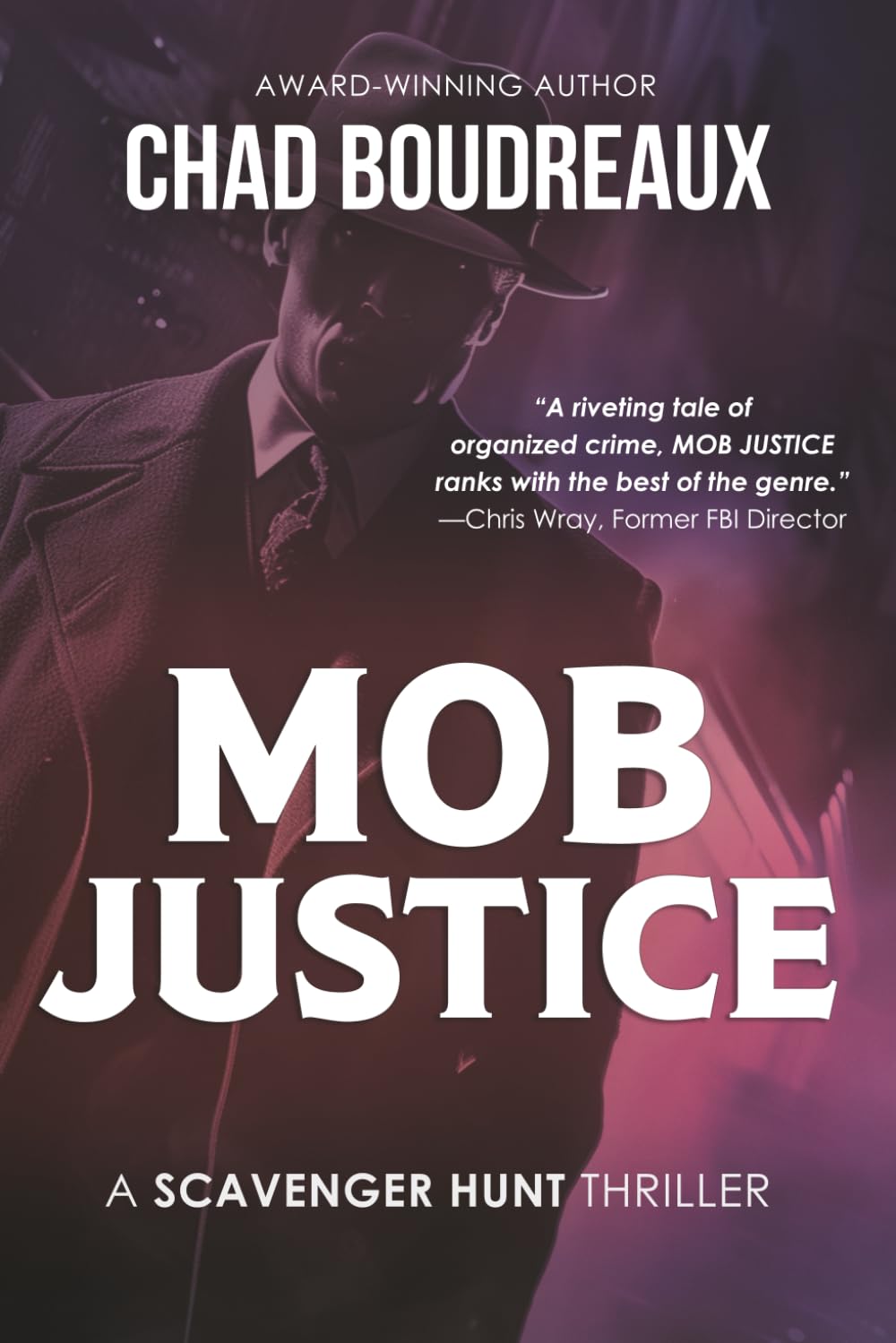
Mob Justice is a crime thriller with a strong legal thriller streak, and it pulls those two lanes together better than I expected. The story follows federal prosecutor Blake Hudson as he gets shoved from the fallout of a past covert operation into a fresh fight against organized crime in Chicago, while Enzo Renzi, a mob insider with a complicated past, tries to survive an assassination attempt that opens the door to betrayals, shifting loyalties, and a deeper look at how power actually works. What I came away with most was the book’s interest in the blurry space between justice, loyalty, and survival, especially as it moves between DOJ rooms in Washington and the mob world in Chicago.
This book moves. The opening hospital escape is sharp and tense, and the author has a real feel for dropping a reader into chaos without making the scene feel muddy. I also liked how much personality comes through in the dialogue. People don’t all sound the same here, which matters in a thriller like this. Blake has a dry, controlled edge. Enzo feels more layered than I expected, almost split between polish and danger. And Alyssa Russo has the kind of presence that can tilt a scene the second she walks into it. There’s also a confidence in the writing that comes from knowing the terrain. The DOJ material and the organized crime material both feel authentic.
What I really enjoyed, though, was the author’s choice to keep pressing on the idea that the line between the good guys and the bad guys isn’t clean. That could have turned into something heavy-handed, but here it mostly lands because the book lets institutions and individuals both look compromised in believable ways. Blake isn’t presented as some spotless hero, and Enzo isn’t reduced to a simple villain. That tension gave the book more bite for me. Sometimes the novel leans into its own intricacy, and there were stretches where I had to slow down and reorient myself among the alliances, histories, and reveals. Still, I would rather a thriller aim high than play everything flat and safe. This one has ambition and you can feel it.
Mob Justice delivered what I want from this genre: pressure, intrigue, character friction, and enough moral unease to keep the whole thing from becoming just another shootout-and-conspiracy story. I would recommend it most to readers who like crime thrillers, legal thrillers, and political thrillers that care as much about systems and loyalties as they do about action. It will especially appeal to people who enjoy fast pacing but also want a book with some backbone behind the suspense.
Pages: 431 | ASIN : B0GHZBPT66
The Collapse of Political Power

The Quarry follows two powerful men building empires in a Soviet quarry town, exploring the intertwined lives of thieves, villagers, and families caught between criminal codes and collapsing political power. What was the inspiration for the setup of your story?
A novel is a bridge born in the writer’s imagination, thrown from the past into the future. It is the expression of the time lived. What happens in Azerbaijan is a reflection of what happens on the Absheron Peninsula and in Baku. When you look at the country’s hundred-year history, you witness this clearly. This is not a crime novel. Through the confrontation of two families and their ruthless struggle, the book portrays the collapse of political power, the fall of the Russian-Soviet Empire, and the decline of a colony.
Sani Absheronski and Malikajdar represent two kinds of power. How did you build their contrast?
I wrote about real events. The characters in the novel are not fictional out of nowhere; each has a prototype. To express their contrasts, I turned to Zoroastrianism. Let me tell you that in the lands where we once lived, Zoroastrian thought once prevailed. The god of evil was Ahriman, and the god of good was Hormuzd. There was an eternal struggle between these two deities. In my novel, Sani represents evil, while Malikajdar represents good. They gathered around themselves individuals aligned with their own nature. This creates diversity, dynamism, and strong contrasts within the events.
The novel explores loyalty in complex ways. What does loyalty mean in this world?
The foundation of humanity rests on loyalty. In society, in families, among people, between states, in religion, in science—even in the animal world—loyalty holds great importance. When wolves or dolphins lose their mate, they do not approach another. When a marriage contract is made, a vow of loyalty is given before God. When friends make a pact, loyalty is spoken of. Agreements between states are a demand for loyalty. If there is loyalty, there is humanity. If there is none, there is no humanity.
What is the next book that you’re working on, and when can your fans expect it out?
The novel I recently completed is titled “At the Fortieth Latitude.” It discusses the collapse of the Soviet Empire, economic hardships, the freedom movement, chaos, youth unemployment in the country, emigration abroad, love and regret, and loyalty. It also speaks about the abilities of our young people who realize themselves abroad.
I am thinking about two more novels. But since their outlines are not yet drawn and they are still in an amorphous state, I cannot speak about them yet. God willing, we will complete them.
The Quarry


The Quarry is a literary historical crime novel set around an Absheron stone quarry and the shifting criminal and political world of late Soviet Azerbaijan. It follows the rise and decline of Sani Absheronski, a legendary “thief in law,” and his uneasy rivalry with Malikajdar, the village “Aga” who builds an empire on fish, flowers, and quiet deals with generals. Around them orbit people like disabled ex dancer Maria, her sharp granddaughter Samaya, and Malikajdar’s son Hatam, whose secret love affair ties the families together. The story moves from the 1950s settlement days, through prison intrigues and black market schemes, to a violent tangle of betrayals that ends in Sani’s murder and the silence of Black January settling over Baku.
I felt like I was being let into a long, layered village conversation, where one story leads into another, and nobody ever starts at the real beginning. The writing has that oral, “come closer, let me tell you” feeling, especially in Maria’s long confession about the war, exile, and how she ended up in the quarry and in Sani’s bed. I sometimes got a bit lost in the flood of names and nicknames, and the translation keeps some awkward turns of phrase, but it also preserves the local flavor, the mix of Azerbaijani, Russian, and Tatar criminal slang. The novel is most alive when people are talking around a table, passing tea and money and half truths. As a literary historical crime novel, it moves more by memory and gossip than by big set-piece scenes, which makes the world feel lived in, even when the timeline slips, and I had to mentally backtrack.
I liked how the book keeps rubbing together the sacred and the dirty. Malikajdar runs a sanctuary and hires boats, bribes a general and still worries about who gets his blessing. Maria loses her legs to the saws of the quarry and then drags herself from shrine to shrine, trying to bargain with God for a different ending to her life. Samaya holds up the whole fragile family and still gets pulled into an affair that can only hurt her. The author keeps asking small, human questions inside big historical ones. What does loyalty look like when your “brothers” are criminals. How far can kindness go in a corrupt system before it breaks. By the time Sani is shot by a man calling him “brother,” and the crash and the roar of military planes fade into the bloody quiet of Black January, the metaphor is not subtle, but it is effective. Personal feuds feel tiny against the weight of tanks, yet the book insists they matter.
The Quarry is not a sleek thriller, and if you want a fast, twisty crime plot, this will probably feel slow and heavy. But if you are up for a grounded, talkative, sometimes messy literary historical crime novel that opens a window on late Soviet Azerbaijani life, with all its compromises and quiet courage, The Quarry is worth the time. I would especially recommend it to readers who enjoy character-focused sagas, who do not mind following a big cast across decades, and to anyone curious about how crime, family, and politics get tangled together on the margins of empire.
Pages: 229 | ASIN : B0882YSFVB

Organized Crime Stories

Lords of Sixty-Third Street follows a Chicago reporter who is investigating his friend’s brutal murder, leading him deep into mob deals, street gangs, and political corruption. What was the inspiration for the setup of your story?
I wanted to write a story that corresponded with all of the gang violence headlines in the Chicagoland area. It seems that every time we watch the news, there is gang-style violence, and innocent people are always getting killed. Also, I liked the ‘Bugsy Siegel’ story and wanted to mix that in with this storyline.
The story jumps between the investigation, mob crews, and gang life without feeling scattered. How did you manage that balance?
I wrote the storyline as though I were watching the movie…different scenes, different characters, different plot structures.
An intriguing aspect of your story is the contrast between the Outfit’s old rules and the chaos of younger street gangs. What interested you about that generational divide?
Like the current organized crime stories, there seems to always be conflict between the ‘old guard wise guys’ and the young, violent gang members who run the Chicago streets without any rules, morality, or scruples.
What is the next book that you are working on, and when can your fans expect it to be out?
Russo’s Revenge, coming out in March, is about a Chicago Cop who is wrongly accused of selling drugs and weapons on the Chicago streets, and looks to pursue redemption and clear his name. The next book, hopefully this summer, is When A Thief Comes To Rome, about a Chicago ex-convict who is hired by the Sicilian Mafia to steal a rare, valuable artifact from a Roman Catholic church in Trastevere, Rome.
Author Links: GoodReads | Facebook | Website | Amazon
McKay becomes entangled with both the Outfit and the street gangs, even taking in a young member of the O-Block gang, DeMarco Stevens. McKay attempts to save this young teenager from the city’s cycle of violence. But there is betrayal and violence at every level. The Sixty-Third Street crew is already skimming cash from its investors before the casino opens its doors.
With mob boss Little Tony DiMatteo’s blessing, everyone is getting a piece of the action, even though some are not willing to pay for it, including Chicago’s corrupt mayor, Bradley Jefferson. Giannini is under pressure to ensure all the investors are playing by the rules while trying to cover up the embezzlement by his Sixty-Third Street crew.
As Giannini’s Windy City Casino is about to have its grand opening, the Outfit’s Bugsy Siegel is going to realize his magnificent dream. But with all of the city’s bloody violence and corruption, is everyone willing to pay the ultimate price?
Lords of Sixty Third Street

Lords of Sixty-Third Street is a gritty crime thriller set on Chicago’s South Side, opening with the shocking murder of Tribune reporter Michael Anderson. From there, the story widens into an underworld web: a mob crew scrambling to protect its interests, a ruthless street gang fighting for power, and a fellow reporter determined to uncover the truth. The book has the bones of a classic crime novel but wraps it in local detail, political corruption, and the messy humanity of people who live and die on those blocks.
I was pulled in right away. The opening chapter is brutal. It sets a tone that never really lets up, and I caught myself tensing as the scene unfolded. Author Edward Izzi writes in a straightforward, almost journalistic style that fits the subject matter, especially when he switches into Larry McKay’s first-person point of view. Larry’s voice feels worn down in the way longtime reporters often are. His sarcasm, his grief, and even his guilt feel believable. And the pacing surprised me. The chapters bounce between the investigation, the mob’s internal politics, and the O-Block gang’s chaos, but it never feels scattered. Instead, it feels like standing in the middle of a neighborhood where everything is happening at once.
What I liked most, though, was how the author handles violence and power. He doesn’t shy away from either. Some scenes made me uncomfortable, not because they were poorly written but because they felt too close to stories that make the news in real life. The book keeps circling back to what desperation and loyalty can make people do. There’s also this tension between the old guard, the Outfit, with its rules and rituals, and the young gang members who don’t care about structure and burn everything they touch.
By the time I reached the end, I felt like I had watched a full neighborhood ecosystem twist around one terrible act of violence. It’s the kind of story where nobody gets out clean, and honestly, that feels right for this genre. If you enjoy crime fiction that leans into atmosphere and moral gray areas, especially stories rooted in Chicago’s history of corruption and street politics, this one will hit the spot. Fans of gritty crime thrillers will appreciate how fully it commits to its world and its characters.
Pages: 378 | ASIN : B0FXVVHLD5
Perceived Predictability

Inheriting Karma follows a man hiding in plain sight whose cover is blown, sending his life into chaos and forcing him to scramble to hold it all together with the least amount of casualties. What was the inspiration for the setup of your story?
The question itself holds the key to my answer. I’m the type of guy who needs a challenge. Predictable outcomes send me packing from the story. I write how I feel, so having a man hiding in plain sight with a perceived predictability lets me shock the reader.
I thank you for your review; it truly nails my intention when writing stories. It’s no secret that my series is not for everyone. Characters who die in the first book are still big participants in follow-ups. For the reader, they are tasked with trying to follow the depth of karma each actor’s actions create.
What inspired your characters’ interactions and backstories?
Growing up, I didn’t have to go far for what I now call Safari Hunts. Challenging Karma was meant as a one-off, keep a last promise to my mom. So many family traits make up the characters. Mam’s boob magnet eyes, Francois’ inventing new dishes and making everyone try it, Ray’s never buying new clothes, and love of pickles.
Backstories are a blend of daydreaming, people-watching, and engagement. When my tenth draft of Challenging Karma shocked my mom into trying to talk me out of using its ending, I knew I had a formula that I couldn’t change.
By nature, I’m a puzzle solver; even playing cards, it has to be a strategic game or I get bored (any bridge players who can help educate)? Even now, I have to slow down because I write an interaction that leads to a fifth, sixth, or even seventh book storyline. For example, lawyer Charlene Reece was supposed to die in Surviving Karma then a daydream brought her story to a new level. Her Karma story really expands in Reciprocating Karma, coming out later this month.
How do you balance story development with shocking plot twists? Or can they be the same thing?
For me, the story takes the reader so many miles down a path only to reach a time when the puzzle hits a three-pronged crossroads. Again, your reviewer nailed it when he said he had to go back to adjust his thoughts. So far, the twists exist on these three paths: believe what you think you read, go back to change your thinking, or go forward with expected outcomes.
The twist, although meant to shock, is a kind of progression of events that fills a lot of our current news cycles. Serial Killers in #1. A wrongfully convicted prisoner seeks payback in #2. Criminal organizations use public events to further their goals in #3. And #4, where a vigilante will seek retribution for the deaths of loved ones.
The premise, “Walk in another’s shoes,” is how I try to develop the story. Hence, the need for a comedic slowdown, weird encounter, or stubborn quirk. I want unique characters that readers can relate to. Reciprocating Karma introduces Carlee. Her sports story is one such lighter moment. But even while writing it, I could picture my wife actually living that experience (before she married a sports nut, of course).
I hope the series continues in other books. If so, where will the story take readers?
Beta readers for #4, Reciprocating Karma compare it to a movie that has caused many a conversation about whether it’s a Christmas movie or a thriller during the holiday season. It comes out in the next few weeks, so readers will have to pick a side. Yes, there’s a shock, but its subtitle causes a self-review of one’s own life.
The future in my Karma world has at least two more shocks to provide. In fact, both #5 and #6 are ripping through pages (I handwrite every first draft). But with Karma being such a wide open source of inspiration, seven will start filling dreams soon.
Author Links: Goodreads | X (Twitter) | Website | Amazon
Runs parallel to the soon to be released crossover book #4 ‘Reciprocating Karma!’
One oversight is all it took to turn hunters against him. Legal documents record his real name as Wilson O’Reilly instead of Forrest Clay, but his involvement with Ricky Topin going rogue brightens the already dual personality spotlight. Two criminal accomplices vie for attention over the one true love Wilson has ever experienced, a cop.
Once word spread of his link to Topin’s murderous rage, hiding in plain sight no longer became a possibility. Or just maybe? A boss to one, partner to another, and enemy to the third person, O’Reilly weaves his circumstances toward a solution. Although for him to walk the streets again, past friends may die, organizations receive new leadership, and cops become targets.
Although fluid, the first seed planted is to use his onetime lovers, position against her. A simple warning of an assassination attempt piques interest until the offspring of a former gangster ‘Inherits Karma’ from his father. One kill shot setting the stage for O’Reilly to regain the blessings of freedom.
Stuck in quicksand, law enforcement takes the case, international. Thrilling mind games culminate in a three-minute window, where survival becomes a scene of chaos.


