Blog Archives
DON’T MESS WITH ANNA: A RECKONING IN BLOOD AND INK


Celeste Prater’s Don’t Mess With Anna is a wild, genre-melting ride that throws a petty online feud into a fantastical medieval meat grinder. When relentless troll Milton Smith takes one jab too many at author Anna DeMarco, karma doesn’t just knock—it drags him kicking and screaming into a brutal otherworld where knights don’t wear shining armor and dungeons are disturbingly real. Packed with vengeful magic, dark humor, and a strange sense of justice, the book follows Milton as he pays, painfully and hilariously, for every snarky comment he’s ever typed from the comfort of his mom’s basement.
Okay, first off—this book is bonkers in the best way. Prater doesn’t tiptoe around the setup. She throws us straight into Anna’s emotional breakdown over a brutal one-star review and it just spirals gloriously from there. But it’s when Milton starts feeling “icy tendrils” in his gut and faceplants into a keyboard that I knew I was in for something completely different. Prater doesn’t hold back. Her writing swings between hilarious and visceral, and the pacing is relentless. You’re either on this ride or you’re roadkill.
The fantasy world Milton lands in is where the story really flexes its muscles. It’s rich, weirdly believable, and mean as hell. These knights are not your noble, gallant types. More like angry executioners with perfect hair and better comebacks. Godric, Damon, and Jasper have big “don’t test me” energy, and watching Milton—a troll through and through—get absolutely wrecked by their world was satisfying in a primal, slightly guilty way. Milton’s journey through humiliation, fear, and growth, is uncomfortable but compelling. He’s kind of awful, but he’s also kind of us at our worst. That’s smart writing.
Now, don’t expect a subtle tale of redemption. This is more medieval-flavored revenge fantasy with a keyboard warrior at the center, and I loved that about it. But it’s not all snark and swords. Prater weaves in some really clever commentary on internet toxicity, cancel culture, and the emotional labor of creators. The queen and king’s fury over Anna’s mistreatment feels both over-the-top and totally justified. It’s like watching an entire fantasy kingdom rage-quit the internet on her behalf.
Don’t Mess With Anna is for anyone who’s ever read a one-star review and thought, “Wow, who hurt you?” It’s for writers, for readers, for anyone who’s been on either side of online drama and lived to tell the tale. It’s messy, chaotic, wildly entertaining, and unexpectedly sharp. If you’ve got a thing for dark fantasy, poetic justice, or just want to see a professional troll get medievaled, this book is for you.
Pages: 322 | ASIN : B0F22X4FVD

Making Vespuccia Great Again
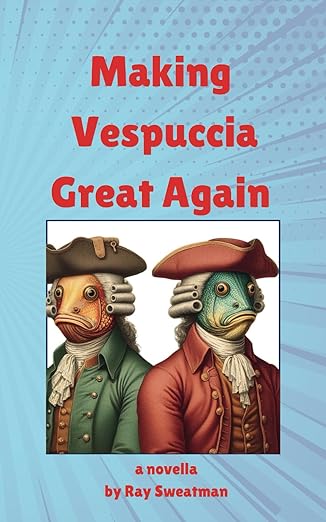
Ray Sweatman’s Making Vespuccia Great Again is a sharp, fearless, and at times laugh-out-loud political satire that imagines a dystopian America rebranded as “Vespuccia.” Set in a twisted mirror of our current socio-political climate, the novella follows the rise (again) of President O.J.C. McDonald, a grotesque caricature of a certain orange-hued reality TV personality. Through absurd characters, biting dialogue, and a surreal plot that includes everything from sentient fish Founding Fathers to LGBTQ revolutionaries called “The Pronouns,” Sweatman delivers a fiery send-up of authoritarianism, fake news, and cultural division in America.
From the very first chapter, Sweatman goes full throttle, skewering the January 6th insurrection with the same kind of commentary you’d expect from The Onion if it took acid and watched Idiocracy on repeat. The fake news anchors Donna Dumay and Don Drapery narrating the Capitol attack like a sports event? Genius. “Oh my, this is better than Getflix!” Donna chirps as democracy crumbles. I was equal parts horrified and laughing out loud. Sweatman walks that tightrope masterfully, never letting the humor soften the blow of the real critique.
One of my favorite arcs was Reverend Swindlemore and his daughter-turned-nonbinary-hacktivist Bucky (aka They/Them). The Reverend is a grotesque blend of fire-and-brimstone televangelists with just the right dose of unhinged righteousness. His hell-obsessed sermons feel ripped from real-life absurdities, and when Bucky forms a rebel group of queer hackers, I was all in. It’s outrageous, it’s camp, but there’s heart. You get the sense that Sweatman deeply respects those fighting for justice, even while cranking the satire up to eleven.
And then there’s the Founding Fathers. Literal fish-people who rise from the sea, transform into Jefferson and Hamilton, and get swept into a costume shop where they breakdance to Rick James’ “Super Freak.” It sounds insane because it is, but somehow it works. These absurd moments don’t just entertain, they hammer home Sweatman’s larger point: when truth dies, history becomes theater, and we’re all stuck on stage, flailing. Watching Jefferson defend his slave-owning past while Hamilton snarks and George Washington threatens to shoot him with a shotgun? That’s satire doing its job, shining light through the madness.
Making Vespuccia Great Again isn’t for everyone. It’s blunt, crude at times, politically fiery, and proudly liberal. But if you’re the kind of reader who enjoys Dr. Strangelove, South Park, or Vonnegut on a rampage, you’ll eat this up. Making Vespuccia Great Again is for the disillusioned, the politically exhausted, the angry, and the hopeful. It’s for anyone who still believes words have power, humor can cut deep, and that fighting back might look a little ridiculous but is still necessary. I laughed, I cringed, I shook my head. And I’d read it again in a heartbeat.
Pages: 252 | ASIN : B0DY4T96PV
Fulfilment City

Fulfillment City is about collapse—the slow, sticky unraveling of a woman, a city, an industry, and, in a broader sense, American identity. The story kicks off with Lydia Calligan, once a powerhouse in San Francisco’s boutique advertising world, and follows her as her crown jewel campaign. A wholesome berry ad featuring a lisping Black child implodes spectacularly in a culture-shifting scandal. What follows is a ghost story, but not the kind with cobwebs and creaky doors. Lydia becomes a living specter, wandering the city in a trench coat, haunted by both personal and public failure, as her former colleague Paul, sharp-tongued, prickly, and strangely endearing, tries to drag her back from oblivion. From its hip urban core to a strangely eerie prefab town in rural Colorado, the novel explores guilt, reinvention, and the absurdities of a country selling itself one delivery box at a time.
What I really loved was how quietly funny the book is, even when it’s steeped in grief and disappointment. The writing is whip-smart but never showy. The scene where Lydia, now adrift, sits in silence at a café while Paul performs his one-man comedy routine, trying to draw a single flicker of recognition from her, is painfully hilarious. I could practically hear the espresso machine hissing in the background as he babbled nonsense, and she stared through him like he was just another ghost. The comedy sneaks up on you, poking at the tragic bits without letting you sink. And Lydia’s fall from grace was Brutal, but also believable. The way the berry campaign spirals into controversy, starting with a lisp and ending in a death, is satire so sharp it practically bleeds.
Paul, for me, stole the show. He’s this oddball mix of charming, petty, broken, and brilliant. I didn’t expect to feel for him so much, but watching him scramble for relevance while his world shrinks to the size of a secondhand teacup was quietly devastating. His dry midwestern sass and resentment give the novel its bite and his weird antique obsession is oddly grounding.
The section set in the artificial town of Saltair Springs was deliciously eerie. The contrast between Lydia’s haunted sophistication and the soulless sheen of a fulfillment-center utopia gave me chills. You can feel Lydia’s unease seep through the page and yet, the town isn’t just a prop. There’s real life and love there, like with Cherise and Darnell, a couple that somehow blooms in the middle of all this engineered happiness. That sweetness tucked between cynicism and corporate doom felt like a little glimmer of hope.
Fulfillment City doesn’t wrap itself up in neat bows. But its honest about loss, about compromise, about how easily people and institutions get swallowed whole. I’d recommend this book to anyone who likes their fiction with bite and wit, who’s curious about what happens when the culture machine eats itself alive. If you liked Mad Men, White Noise, or just want to read something that feels both current and weirdly timeless, this one’s for you.
Pages: 245 | ASIN : B0DZ3RWF83
Compassion

Spin Cycle: Notes from a Reluctant Caregiver follows an exhausted and frustrated man navigating the complexities of caregiving for his aging mother with dementia. The book is beautifully written and addresses a subject that is rarely discussed in this way. Why did you want to write about caring for an aging parent?
This is the book I wish I had five years ago. It was around then that my mom was first diagnosed with “likely onset Alzheimer’s.” Those years, during which I became a parent to my parent, were some of the most challenging and exhausting of my life. I was frustrated, confused, angry, and felt guilty about feeling frustrated, confused, and angry. I felt alone. That’s the spin cycle. And going with fiction rather than, say, a memoir, gave me the freedom to explore and imagine more facets of that experience. If one person reads this book and thinks, “I’m not alone. These characters think and feel what I think and feel,” then I’ve done my job. I want this book to resonate with readers, and, hopefully, comfort them.
I find that authors sometimes ask themselves questions and let their characters answer them. Do you think this is true for your characters?
I think it was Truman Capote who said, “You can’t blame a writer for what the characters say.” I love this because I think it’s true. As you get to know a character more deeply through the writing process, you begin to hear their voice, their opinions, their view on life. For me I can be much more honest and raw – and therefore, hopefully, relatable – when I inhabit the minds of other people, people who might say or do things I wouldn’t. I think of myself as being reserved and polite, perhaps excessively so, and my characters give me the chance to break from myself.
What were some themes that were important for you to explore in this book?
Compassion is the overriding theme in Spin Cycle. When we meet the protagonist, Ezra, he is so consumed by resentment, frustration, guilt, and self-loathing that he no longer has the capacity to be compassionate, to others as well as himself. The book is about his journey to rediscover his capacity to empathize and love. I also try to explore the corrosive effect of family secrets, as well as the fulfilling sense of human connection we have when we choose to be vulnerable with others.
What is the next book that you are working on, and when will it be available?
It is called Convergence. I’ve just begun it. The theme for this novel will be “escape.” I think there are times in all our lives when we wish we could just snap our fingers and “escape” – perhaps literally: to a different place, a thousand miles from home; perhaps with extreme diversion: sex, drugs, booze; or maybe the escape is an internal one we make by shifting – not our circumstances – but the lens through which we view them. Put characters with these varying approaches to “escape” in a pressure cooker and that’s the book. Knowing my work pace, it will probably be out in a year, perhaps a year and a half.
Author Links: GoodReads | X (Twitter) | Website | Instagram | Amazon
Overwhelmed by it all, Ezra opens a strip-mall school to help others-and himself-become better caregivers. As he learns to handle the personalities of his nine misfit students, Ezra must also navigate the complex feelings he has toward his mother. It doesn’t help that she adores his do-nothing slacker brother.
But Ezra hasn’t told his students that he also has an agenda beyond becoming a more compassionate caregiver. And, it turns out, so does one of his students. Ezra confides the entire tale to his childhood friend Danny as he attempts to sort it all out and find room in his heart again for compassion and love.
A Storyteller at Heart

An Eye for an Eye: The Mallet Murders follows a police force in Nova Scotia who would rather do anything other than solve the mystery surrounding a serial killer terrorizing the town. What was the inspiration for the setup of your story?
I lived in Nova Scotia for seven years and was a police officer/investigator. The small town I lived in had many quirky and inspirational characters that I could use in the story. Moreover, a few of my police officer colleagues were so terrible at their jobs that they became rousing characters in the book. I like to use absurdist humour, and the serial killer Saul, a cat-loving psychopath, became a perfect antagonist for me.
How did you come up with the idea for the antagonist in this story, and how did it change as you wrote?
I knew a guy who had (what seemed like) a million cats in his home, whom he called “cat.” My daughters encouraged me to write about a cat-loving killer, as they were convinced that the guy was a tad “odd.” He was a nice guy in real life; however, writing a character into the story was easy based on his idiosyncrasies.
I found this novel to be a cutting piece of satire. What is one thing that you hope readers take away from your novel?
I am a storyteller at heart. Give me a topic, and I’ll make up a silly or slapstick story in the blink of an eye. I have held a few very serious jobs in my life, like policing and child protection—dark humour has helped me to maintain my sanity. Joseph Heller inspired me (Catch-22 and Something Happened!). I loved how he drew me into his narratives and colourful characters, making me laugh out loud. Few authors have been able to do this. Carl Hiaasen is one, and David Sedaris is another. The Monty Python team and their work NEVER get old for me, and laughter has been a considerable medicine in my life. In fact, satirical books saved my life in my teens. I wrote about this in my memoir, The Hate Game: Screaming in the Silence (by Gary Trew). Literary Titan also reviewed the memoir. I hope readers enjoy the story’s absurdity, knowing that the location, scenarios, and some of the characters were a very real part of my life experience.
Is this the first book in the series? If so, when is the next book coming out, and what can your fans expect in the next story?
I wear two hats (or sombreros). I write humorous crime fiction and nonfiction (memoirs and other challenging topics like generational trauma). I want to write a sequel to The Man with the Pink Sombrero AND An Eye for an Eye. Two very different books—both absurdist fiction, yet with a commonality of humour. In An Eye for an Eye (the mallet murders), I have a sequel as the end of the story leaves the reader with many questions about the antagonist. Saul and his paramour escape the prison, obviously) and relocate. This time, his “partner” finds herself in a situation where she and the antagonist find joy and justification in their new “venture,” leading to more killings. The sequel may be called “Hello, Mr Pillow.” Enough said.
Author Links: GoodReads | X | Facebook | Website
Chaos unfolds in Yeovilton County as a doctor is found dead, one eye chillingly missing. While the authorities turn a blind eye to the mayhem, former detective Daryl Smith is determined to uncover the truth behind the gruesome killings. He joins forces with Yvonne Sparks, a brilliant profiler sidelined by her colleagues, and the pair begin the strangest homicide investigation of their lives. As events unfold, a twisted cat-loving serial killer emerges, brandishing a mallet and leaving a trail of chilling clues: a missing eyeball, dismembered fingers, half-eaten cans of tuna, messages written in blood and vanishing purebred felines.
In this thrilling story, a quirky cast of characters takes center stage: a one-eyed Chartreux cat, a scandalous mayor, a book club-obsessed police chief, a seductive cult leader, and a detective who prioritizes bias over his badge. At the core of it all is a cold-hearted killer who puts the well-being of his cats above everything else.
An Eye for an Eye is more than just a murder mystery; it’s a wild and darkly comedic journey that will keep you on the edge of your seat. The outrageous characters will shock you and have you laughing out loud.
70 Things You Can Do While Being Hospitalized

This book by Lasse Toft is a quirky, humorous take on coping with long-term hospitalization. Through a mix of satire, personal anecdotes, and dark humor, Toft transforms what could have been a grim manual into a creative guide for enduring hospital stays. The book is structured around absurd yet oddly endearing suggestions, ranging from “Medicine Roulette” to “Fake Your Own Death,” all aimed at lightening the emotional load of being stuck in a medical setting. Beneath the wit lies a touching testament to resilience, humor, and human connection.
What struck me first was how unapologetically funny this book is. Take “Dress as the Grim Reaper,” for example. Toft gleefully outlines how donning a black robe and scaring staff and patients could liven up a dull day. It’s an audacious idea, but it captures the defiance of boredom that defines the book. His story about mistakenly taking another patient’s laxative pills and spending the weekend in the bathroom is another standout his ability to laugh at himself made me laugh along too. The writing is conversational and loaded with Toft’s personality, which I loved. He doesn’t shy away from being irreverent. These antics are ridiculous, but they cleverly highlight the small joys and distractions that can make a hospital stay bearable. Toft’s voice is warm, yet his humor has an edge that keeps the book from becoming too sentimental. The book also has moments of unexpected depth. The preface, where Toft reflects on fear, hope, and humor as his tools for survival, sets a poignant tone. Even his sillier ideas, like starting a betting company for who might “go next,” reflect a dark but relatable sense of grappling with mortality. This balance between humor and vulnerability is one of the book’s biggest strengths.
70 Things You Can Do While Being Hospitalized is for anyone who appreciates humor with a hint of darkness, especially those navigating difficult times. It’s perfect for patients, caregivers, or anyone who’s spent too long in an unfamiliar place and needed a laugh. I’d recommend it to those looking for a lighthearted way to find meaning and a bit of fun in challenging circumstances.
Pages: 182 | ASIN : B0CYTKTCFP
An Eye for an Eye: The Mallet Murders

An Eye for an Eye: The Mallet Murders masterfully exposes the dysfunction, mediocrity, and deep-seated corruption within law enforcement. Set against the grim backdrop of Nova Scotia, a serial killer lurks while the police department, rife with apathy, treats the escalating murders as mere inconveniences. Chief Kennedy, preoccupied with his book club and personal escapades, displays a staggering lack of leadership, swiftly declaring homicides as suicides and shelving cases as cold. Yet, amidst this chaos, the narrative reassures readers that not all officers have succumbed to this moral decay; a few still hold onto their integrity.
One of the novel’s standout qualities is its suspense. While employing dramatic irony, the author skillfully builds tension by weaving a web of mystery around the characters’ connections. For instance, Chapter 19 introduces Bobby Bobbit, and Chapter 21 shifts focus to the Poskett family. These characters vanish from prominence for much of the story, reappearing only briefly. This subtle threading leaves the reader pondering their significance and questioning how they tie into Saul or the broader case. The author expertly sustains this intrigue until the final pages, making the resolution deeply satisfying.
The portrayal of the police department’s shortcomings is scathing and incisive. More effort is spent scrutinizing Daryl’s clerical error during his application than on investigating the string of murders gripping Nova Scotia. Chief Kennedy’s incompetence reaches absurd levels, as he prioritizes recruiting book enthusiasts over capable officers to bolster his book club. Investigations are laughably perfunctory; if no leads emerge within a mere 22 minutes, cases are abandoned and marked cold. This gross negligence breeds public mistrust, illustrating the chasm between law enforcement and the community they are supposed to protect.
The story evokes a visceral emotional response, ranging from anger and disgust to morbid curiosity. Chief Kennedy’s flippant remarks at Dr. Hussain’s crime scene—where he muses about re-election and lobster sales—cement him as a detestable figure. Scenes such as the brainstorming session about the killer, treated as a light-hearted joke, are equally infuriating. Despite this, the author elicits unexpected empathy for characters like Saul. A poignant example occurs when Saul, seeking justice, approaches the Skank family only to face harsh insults. Moments like these reveal the depth of the narrative, allowing readers to connect with Saul’s plight while simultaneously lamenting the environment he must navigate.
This novel is an excellent recommendation for fans of crime fiction, particularly those who enjoy titles like In a Place of Darkness by Stuart MacBride or The Wrong Hands by Mark Billingham. Readers who appreciate dramatic irony and are captivated by protagonists unraveling mysteries will find much to love here. Prepare for a rollercoaster of emotions—anger, pity, and disgust—but be assured the gripping storytelling will keep you hooked until the very end.
Pages: 312 | ASIN : B0DPZT3KMB
Spin Cycle: Notes from a Reluctant Caregiver

Spin Cycle offers a raw and intimate look into the life of Ezra Pavic, a man navigating the complexities of caregiving for his aging mother with dementia. Through Ezra’s reflections, Alfredo Botello unpacks themes of guilt, frustration, and love, crafting a poignant and often darkly humorous tale about familial responsibility and the messy emotions it stirs. The story unfolds with sharp prose and deep introspection, pulling readers into the exhausting and often heartbreaking reality of caregiving.
One of the most striking aspects of the book is Botello’s unflinching honesty. Ezra’s recounting of his struggles is refreshingly candid, whether he’s snapping at his mother in frustration or battling feelings of inadequacy after a failed attempt at patience. The opening chapter lays bare his emotional rawness: “Maybe I’m not struggling with who I became. Maybe I’m struggling with who I always was.” That vulnerability hit me hard. I think it will resonate with anyone who has ever felt the weight of self-doubt or resentment. Botello doesn’t shy away from showing Ezra’s flaws, making him deeply relatable.
The narrative is also peppered with moments of dark humor, which add levity to an otherwise heavy subject. Ezra’s wry observations, like his envy of serene caregivers in online videos or his internal monologues about self-care platitudes, feel genuine and earned. One particularly memorable scene involves a nail salon visit with his mother. Despite his irritation, Ezra finds himself moved by the small joy it brings her, a rare glimmer of light in the otherwise bleak caregiving cycle. These moments of connection, fleeting as they are, illustrate the resilience of love in the face of overwhelming hardship.
Botello’s writing shines when he delves into the nuanced dynamics of Ezra’s relationships, not just with his mother but with his ex-wife, son, and support group. Ezra’s attempts to reconcile his anger with his lingering affection for Irene are some of the book’s most profound passages. His inner conflict, oscillating between resentment and duty, rings true for anyone caught in the so-called “sandwich generation.” These emotional layers are what elevate Spin Cycle from being just another fictional memoir to a profound exploration of humanity.
Spin Cycle captures the exhausting, thankless, and often isolating world of caregiving with heart and precision. This book is a must-read for those navigating similar challenges or anyone seeking an honest and moving story about the imperfect art of loving and caring for others. I think it’s ideal for readers who appreciate introspective, character-driven narratives that aren’t afraid to dive into life’s messiness.
Pages: 316 | ASIN : B0DQXDSTYN


