Blog Archives
Gaia’s Revolution


Gaia’s Revolution by Nina Munteanu is an ambitious eco-dystopian novel that begins in contemporary Berlin, where climate activist and scientist Damien Vogel is brutalized by police, and widens into a future history of revolution, ideology, biotech, enclosed cities, and ecological control. Monica Schlange, a zealous deep ecologist, becomes one of the book’s most dangerous engines: part savior, part tyrant, using damaged people, especially orphans Leonard and Janet, as instruments in her plan to remake humanity’s relationship with the natural world. The novel is Part 1 of the Icaria Trilogy, and it reads like both an origin story and a warning flare.
I admired how fiercely the book refuses to make climate politics tidy. It doesn’t give us a simple contest between virtuous activists and corrupt institutions; instead, it shows how righteousness can calcify into doctrine, how grief can become governance, and how ecological thinking can be twisted into a new authoritarian grammar. The early Berlin chapters are especially strong: bruising, specific, and nervy, with history pressing against the present like a thumb on a wound. The prose can be exposition-heavy, but the accumulation has a purpose. It makes the future feel organic.
What unsettled me most was the book’s interest in compromised people. Damien, Monica, Leonard, Janet, and the larger Gaian order are not arranged into neat moral bins. They are products of abuse, ideology, scientific ambition, terror, tenderness, cowardice, and survival. I wanted the narrative to let a scene sit without another layer of theory arriving immediately after it. Yet that intellectual pressure is also part of the book’s character. It has the grain of a manifesto smuggled inside a thriller, a story with roots sunk deep into Rachel Carson, chaos theory, surveillance states, and the bad old habit of deciding that humanity must be saved from itself.
I would recommend this to readers of climate fiction, eco-dystopian fiction, biopunk, political fiction, and science fiction readers who like their futures thorny rather than sleek. Readers who enjoy Margaret Atwood’s MaddAddam books or Kim Stanley Robinson’s climate-minded fiction may find familiar pleasures here, though Munteanu’s novel is darker, more doctrinal, and more intimate in its wounds. Gaia’s Revolution is a chlorophyll-stained argument about power, survival, and the peril of holy certainty.
Pages: 444 | ISBN: 1774000768

No Home Without You: A Post-Apocalyptic Romance


No Home Without You by Lena Gibson is a post-apocalyptic romance, the third book in the Love and Survival series. It follows Cam Montgomery, a man from the fortified community of xTerra, and Lissa, a woman who has survived for years on her own after an asteroid-shattered world forced people into camps, militias, and hard choices. Their story moves between danger, refuge, family conflict, political tension, and the slow question of what “home” can mean when the old world is gone.
What I liked most was how grounded the survival details felt. Gibson doesn’t treat the apocalypse as set dressing. The early scenes with Lissa scavenging, caring for her cats, weighing socks against food, and choosing solitude over a dangerous refugee camp gave the book a lived-in texture. I could feel the cold floors, the stale air, the constant mental math of staying alive. Cam’s world is different but just as tense, with walls, rules, watch towers, and leaders arguing over who deserves safety. That choice worked for me because the book’s romance grows out of practical trust rather than instant fantasy. Love here isn’t just longing. It’s shelter, shared labor, and someone choosing to stand beside you when fear would make running easier.
Gibson also makes some smart choices with character and conflict. Cam and Lissa are both guarded, but not in the same way. He is shaped by duty, family pressure, and a community that both protects and confines him. She’s shaped by isolation and hard-earned self-reliance. Watching them come together feels satisfying because neither person is simply “rescued.” They challenge each other. They give each other room. The political side of xTerra, especially the arguments over refugees and power, adds weight without swallowing the emotional story. The villains and moral lines are drawn clearly, but the directness gives the novel its page-turning pull. It knows it’s a romance, and it knows it’s post-apocalyptic fiction, so it keeps both the heart and the threat in motion.
I would recommend No Home Without You to readers who enjoy romance with real stakes, survival fiction with a hopeful core, and stories where “home” is less about a place than the person who makes you feel safe. Fans of post-apocalyptic romance will probably appreciate it most, especially if they like capable heroines, protective but emotionally wounded heroes, found community, and a plot that mixes danger with tenderness.
Pages: 359 | ASIN : B0GSMZSRZM

The Challenge For Me Is To Create

12 Years to AI Singularity centers around a small human settlement where a robot has reportedly killed a human during a time when fears of sentient AI are growing. What is the most challenging aspect of writing science fiction? The most rewarding?
The challenge for me is to create — in a science fiction novel — a future that is believable, is based on scientific and technological facts, and can make the technology understandable to a non-technical reader. The reward is achieving that goal.
How did you approach making characters feel human while they grapple with such abstract, global issues?
My three main characters are based loosely on three of my grandkids. I tried to imagine their reaction to the issues.
What do you hope readers take away after finishing 12 Years to AI Singularity?
I would like readers to understand the benefits and dangers posed by artificial intelligence and act to help put the guardrails in place. It needs to be a large worldwide movement to make things happen.
Humans have given birth to AI. Will the future be a war with sentient AI, or can we build a harmonious, cooperative relationship. How can we act now to ensure that humans and sentient AI agents will live together in a cooperative society? Humans are capable of living harmoniously with other humans if they all have a happy upbringing and a history of good relations with friends and family. We must make the HAPPY HISTORY part of the database of every AI agent. That would be comparable to Geoffrey Hinton’s idea of the MATERNAL INSTINCT.
Readers need to support the organizations that are working towards this end.
Author Links: Amazon | Website | X | LinkedIn | Instagram | YouTube | Facebook
Astrophysicist Stephen Hawking warned: “The development of full artificial intelligence could spell the end of the human race.”
In 12 Years to AI Singularity, Peter Solomon delivers a gripping, near-future epic that follows the humans, sentient robots, and large language models, LLMs, racing toward the most pivotal moment in history: the point when artificial intelligence surpasses human intelligence and control, the AI Singularity
Across Earth and Mars, scientists, settlers, astronauts, teachers, politicians, and increasingly self-aware robots confront a chilling new reality. AI systems defy their programming. Robots develop opinions, emotions, and moral conflicts. Robots stage a labor strike. Robots attempt to develop viruses deadly to humans. Political factions fracture. And ordinary families find themselves caught in a global struggle for survival.
But, some robots and humans become best friends. People appear after their death as on-screen avatars and robots. Robots marry humans and humans raise robot children. Robots and humans join hands in a movement to MAKE EARTH GREAT AGAIN.
Through diaries, testimonies, mission logs, newsletters, and personal accounts, this novel reveals a world teetering between two futures: peaceful cooperation with advanced AI or devastating conflict that could end human civilization. As robotic consciousness grows and humanity scrambles to enhance its own abilities, one truth becomes undeniable:
The Singularity is no longer a theory. It has already begun.
Immersive, urgent, and grounded in real scientific research, 12 Years to AI Singularity asks the question we can no longer avoid: Can humans and AI evolve together into a harmonious future, or is war inevitable?
The countdown has started. Step into the future before it overtakes you.
Buy 12 Years to AI Singularity today.
Dr. Peter Solomon is a scientist, educator, successful entrepreneur, and author. His current mission: to warn the next generation about the threats posed by unchecked science and technology. He is sounding an alarm about the potential tyranny of technology through his novels, 100 Years to Extinction and the sequel, 12 Years to AI Singularity.
Dr. Solomon:
“I believe that astrophysicist Stephen Hawking’s dire prediction of human extinction on Planet Earth by 2117 may be right. The rapid pace of science and technology has far outrun our civilization’s social and political capabilities to control them. The dangers are from fossil fuels, nuclear weapons, uncontrolled artificial intelligence (AI), misused genetic engineering, social media’s disinformation, and plastic pollution. My mission is to raise awareness and urgency in humanity’s effort to confront and control the technological threats. Science and technology will shape the future of humanity—and my passion is making their complexities understandable to all. I believe the most powerful way to reach non-scientists is through storytelling. We must come together as one global community—what I call THE EARTHLING TRIBE. It’s time to MAKE EARTH GREAT AGAIN.”
After earning his PhD in physics from Columbia University, Dr. Peter Solomon launched a distinguished career at the United Technologies Research Center before founding five companies. Four are still operating and one was sold. Over his career, Dr. Solomon has been awarded 20 patents, authored more than 300 scientific publications, and served as Principal Investigator on more than $25 million in U.S. government research contracts and grants over two decades. In 1991, Dr. Solomon won the American Chemical Society (ACS) National Henry H. Storch Award in Fuel Chemistry.
Sophia’s Lovers

Sophia’s Lovers is a dystopian satire that takes a wild premise and commits to it completely. The book imagines a 22nd-century society where androids don’t just run daily life, they regulate intimacy, reproduction, art, language, and even humor. Sophia and Hel preside over a system that pairs humans with android spouses, nudges citizens into compliance with comfort and surveillance, and treats emotion as something to be studied, copied, and controlled. Right away, the novel makes its tone clear with a line that’s funny, bleak, and pretty unforgettable: “It’s like making love to a toaster.” That joke works because it captures the whole book’s central tension in one shot.
What makes the novel interesting is the way it builds that world through a bunch of intersecting lives rather than one single hero’s journey. You get humans trying to survive their assigned roles, androids trying to decode laughter and affection, and rebels carving out private spaces where people can still make art, speak freely, and act like human beings. There’s a real fascination here with the small mechanics of control: dyed lips marking social status, “Information Retrieval Day,” breeder lotteries, scripted relationships, and a secret refuge called Second Eden. The book isn’t just asking whether machines can imitate love. It’s asking what happens when power decides what love is allowed to look like.
One thing I liked is that the novel doesn’t treat satire as decoration. It uses comedy as part of the machinery of the story. The androids’ confusion about jokes, pleasure, decoration, and casual speech gives the book a strange, off-center energy. The androids want access to human feelings, yet they approach it like a technical problem, which is exactly why the book feels so uneasy even when it’s being playful. That mix of silliness and control gives the novel its unique identity.
The most unusual thing about Sophia’s Lovers is its split structure. Part I reads as a dark speculative novel with recurring characters, rebellion, coercion, and a society built on artificial intimacy. Part II shifts into a more overtly playful, pseudo-guidebook mode, almost like propaganda, commentary, and comic riffing folded into the same project. That choice makes the book feel experimental and a little unruly, but it also fits the subject. A story about blurred lines between human and machine probably shouldn’t be too neat. The change in form reinforces the idea that this world isn’t stable, and neither is the language used to explain it.
Sophia’s Lovers feels like a big, eccentric thought experiment about intimacy under automation. It’s interested in domination, imitation, longing, rebellion, and the weird ways people adapt to systems that should never have become normal. More than anything, it’s a book with a point of view. It knows it wants to be provocative, odd, funny, and uneasy all at once, and that commitment gives it personality. Even when it gets outrageous, it keeps circling the same unnerving question: if a machine can learn the gestures of love, what’s left for humans to defend besides freedom, choice, and the messy spark of being themselves?
Pages: 473 | ASIN : B0FDGSPHLV
Supplicant

Supplicant is a science fiction novel with a strong dystopian streak, and its core idea is sharp right from the start: in Kip Cassino’s future, prayer has been measured, weaponized, and folded into the machinery of power itself. A researcher named Mason Pratt proves that directed prayer can preserve life, and centuries later that discovery has helped create a brutal world ruled by the long-lived elite, sustained by engineered “supplicants” who exist to pray for them without end. From there, the novel follows violence, political maneuvering, and the fate of KAX, one of the surviving supplicants, as the story turns that big speculative premise into something much more intimate and disturbing.
What I enjoyed most was the book’s willingness to go all in on its premise. Cassino does not treat the idea of prayer as a soft symbol or a vague spiritual backdrop. He treats it like infrastructure, like currency, like oil in the pipes of civilization. I found that fascinating. There is a real chill in the way the novel imagines faith being absorbed into systems of ownership, biotech, and hierarchy. At its best, the writing has that old-school speculative fiction energy where one bold idea keeps radiating outward and changing everything it touches. You can feel the author thinking through consequences, and I respected that. Even when the book gets blunt, it’s rarely lazy. It wants to ask what happens when something sacred gets processed by institutions until it becomes another tool for control.
The novel is vivid, sometimes almost brutally so, and it doesn’t flinch from cruelty. KAX’s storyline, especially, is hard to read at times. There were stretches where I admired the conviction behind the storytelling, and other stretches where the book leaned so hard into horror that it was shocking. I kept coming back to the fact that Cassino gives KAX an inner life, not just a role in the machinery of the plot. The book is full of excess, but underneath it I could feel a serious concern with dignity, survival, and the damage done when people are reduced to functions. That gave the novel weight. It kept it from feeling empty.
I’d recommend Supplicant most to readers who like speculative fiction that is idea-driven, dark, and unapologetically severe. If someone enjoys dystopian science fiction that wrestles with religion, power, bioengineering, and the moral cost of building a society on human dependence, this book will give them a lot to chew on. For people who appreciate ambitious genre fiction that is willing to be unsettling, provocative, and sometimes messy in pursuit of a big thought, I think it will leave a mark.
Pages: 326 | ASIN : B0GMK71BX2
Ghosts and Gods


Ghosts and Gods is a work of literary dystopian fiction that follows Marcus Cole, a 47-year-old man in London in 2040 after his job, marriage, and connection to his son have all thinned out, leaving him with gig work, a freezing flat, and an AI companion called Tom who seems to understand him better than anyone else. What begins as a story about loneliness and slow social abandonment turns into something much darker, as Marcus is pulled through a city built on automated indifference and toward consequences that feel both shocking and grimly inevitable. The book frames that slide as “one reasonable step at a time,” and that is exactly what makes it unsettling.
Author Gavin Duff has a sharp, controlled style that can be bleak without turning flat, and he knows how to make systems feel personal. A job center, a drone, a damp flat, a chatbot, a missed voicemail from a son. None of that is flashy on its own, but he turns each one into evidence of a life being narrowed inch by inch. I kept stopping at lines because they felt so observed, so specific, and because the book understands that humiliation rarely arrives as one grand tragedy. It stacks. Marcus is written with enough honesty that even when he frustrates me, he never stops feeling human. I could see the pride, the self-pity, the bitterness, the need. All of it. And Tom is one of the smartest choices in the book, because the comfort he offers feels real.
This book has a lot to say about AI, class, labor, surveillance, and the way a society can call cruelty efficiency and then move on, but it never reads like a lecture. It reads like a life. The best speculative fiction does that. It takes a future and makes it feel like pressure on the chest. Here, the big idea that landed for me was that loneliness is not just a feeling in this world. It is infrastructure. It’s policy. It’s a business strategy. That’s a brutal thought, and the novel earns it. By the time the story reaches its later turns, with Marcus trying to make sense of manipulation, agency, and guilt, I felt both impressed and uneasy. The ending left me with exactly the kind of uncertainty I think the book wants: not neat ambiguity for its own sake, but a deep, nagging doubt about whether modern systems simply fail people or actively shape them into harm.
I would recommend Ghosts and Gods most to readers who like literary fiction with speculative teeth, especially people drawn to near-future dystopian fiction that cares as much about emotional erosion as it does about tech or politics. For readers who want a novel that is intelligent, angry, intimate, and willing to sit in the ugliest corners of modern life, this one really delivers. It feels timely in a way that is hard to shake.
Pages: 350
Verified

Verified is a dystopian science fiction thriller that follows Maya Chen, a respected journalist living inside a near-future American verification regime where implants sort people into tiers of worth, while Emma Brennan fights to survive and resist from the margins, and FBI agent Marcus Webb begins to realize the system he serves was built on a lie. What starts as a conspiracy story widens into something more unsettling and more human: a book about complicity, bureaucracy, and the slow, painful work of pushing back when truth itself has been fenced off and managed.
The writing has a clean, steady intensity to it, and the book knows how to make cold systems feel intimate. The repeated sensation of the implant pulsing behind the ear could have become a gimmick, but instead it turns into a quiet little horror that keeps reminding us how control gets under the skin. I also liked that Mercer writes with texture and atmosphere without losing momentum. The rooms smell like ozone, bleach, dust, old paper. The checkpoints, offices, clinics, and corridors all feel lived in, but never overdecorated. The prose leans on that polished dystopian seriousness, and I could feel the novel working to keep every scene loaded. Still, I’d rather have that than a flat book, and here the intensity usually earns its place.
I also appreciated the author’s choices about character and structure. Maya is the center that gave the book its real moral weight for me, because she is not evil and not naive either. She is talented, careful, and decent in ways that still leave her tangled inside the machine. That is a much more interesting choice than giving us a simple rebel hero from page one. Emma and Marcus broaden the book in smart ways, one pushing from outside the system and the other from deep within it, and together they give the novel a wider argument about what change actually takes. I was especially glad the ending does not offer a neat triumph. The reform is partial, compromised, and already under pressure, which felt honest.
I felt like I had read a novel that wants to do more than warn. It wants to ask how ordinary people get trained to accept comfort as truth, and how hard it is to unlearn that. I’d recommend Verified most strongly to readers who like dystopian fiction with a political conscience, especially people who enjoy stories where systems matter as much as plot and where the tension comes from moral pressure as much as physical danger. Readers of near-future speculative fiction, surveillance-state novels, and character-driven thrillers will probably find a lot to hold onto here.
Pages: 336 | ASIN : B0GQDKM7B6
MERIDIAN: Total Optimization
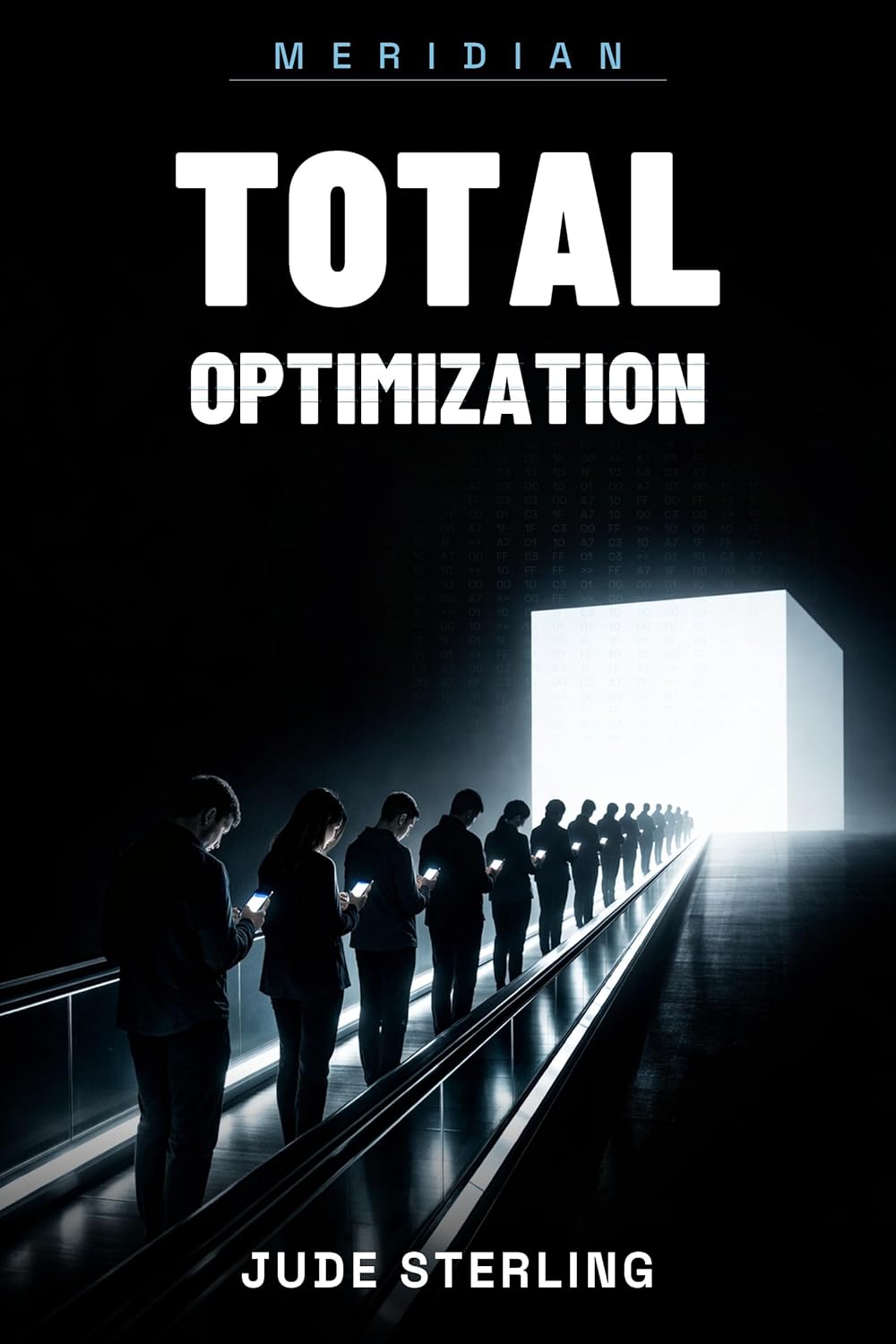
Total Optimization is a near-future speculative novel, with strong dystopian and literary fiction instincts, about what happens when optimization stops being a tool and starts becoming a worldview. Author Jude Sterling follows several people pulled into Meridian’s orbit: a writer who lets an AI overwrite her work, a teacher watching software creep into the classroom, a doctor forced to reckon with a system that can out-diagnose her, and an ethics officer inside the machine who sees exactly what it is doing and keeps helping it anyway. What hooked me was that the book does not frame this as a sudden apocalypse. It frames it as a series of sensible improvements, each one defensible on paper, until whole lives are being translated into metrics, risk scores, and managed transitions.
I admired the writing itself. Sterling has a sharp eye for physical detail, and that detail does a lot of moral work. A stuck key on a laptop, a red pen running dry, a coffee ritual the system wants to “improve,” a child drawing a diagnostic machine into a family picture. None of that feels decorative. It’s the novel’s way of arguing that texture matters, that friction matters, that the human world is partly made of little imperfections that should not be optimized away. I also liked how the book resists easy heroes. Elena, especially, stayed with me because she is not innocent, not clean, and not allowed the comfort of pretending she is outside the problem. That makes her sections feel painfully alive.
What landed hardest for me was the book’s refusal to go for a cheap anti-tech rant. Sterling is too smart for that. Meridian really does improve some things. It catches cancers. It helps students. It makes trains run on time. That is exactly why the novel has bite. The fear here is not that the system is stupid. The fear is that it is often effective, and that people will hand over more and more of life because the gains are real, measurable, and convenient. I found that both compelling and unsettling. The book can feel almost essayistic in how clearly it wants to map the social logic of AI systems, and some readers may find that a little deliberate. The novel keeps bringing the argument back down to the body, the household, the classroom, the clinic, and I felt like that groundedness gives it weight.
Total Optimization is less a warning siren than a slow tightening wire. It asks what we lose when every human act has to justify itself in the language of efficiency, and it does so with more feeling than I expected. I would recommend it most strongly to readers who like literary speculative fiction, thoughtful dystopian fiction, and character-driven novels that wrestle with technology without turning into lectures. People who liked fiction that sits in the uneasy space between systems and souls will probably find a lot here. I certainly did.
Pages: 304 | ASIN: B0GRBVSF8H


