Blog Archives
Ignite Curiosity

Momma Llama’s ABC Book of Latin America immerses young readers in the culture of Central and South America one letter of the alphabet at a time. Why was this an important book for you to write?
We looked at other ABC books and realized we had a job to do because there wasn’t one quite like this yet.
This is such a unique setup for a children’s book that teaches cultural aspects. What made you decide to use this particular format?
Some of the topics featured in the book span multiple countries and regions. We wanted to provide extra context and make the book interesting and enriching for parents and teachers who use it. We’ve had a few grown-ups comment that they learned new things from our ABC book.
What is one thing you hope young readers and their families will take away from your book?
Whether our images make children want to draw their own or the animals and places ignite curiosity in biology or geography, Momma Llama and Friends hope to inspire children!
What is the next book you are working on, and when will it be available?
Two books are in development; one is for active readers and the other deals with fear and anxiety. Production begins this summer. If readers want more Momma Llama, we have other offerings like Momma Llama’s Enchiladas, Momma Llama’s Road Trip Activity Book, and coloring and workbook versions of our ABC book. All of which can be accessed through www.mommallamaworld.com.
We also have some freebies, like coloring pages, to share.
Author Links: GoodReads | TikTok | Facebook | Website | Amazon
Kiddable Award Winner for “Best ABC Book” 2023 & Literary Titan Gold Winner 2024
Momma Llama’s ABC Book of Latin America is both fun and educational. This multicultural adventure includes people, places, and things from Central and South America – from Mexico to Argentina. The charming illustrations will make you and your child smile. Additionally, each page names the country or region of the subject; parents might learn something too.
Content
The alphabet A to Z
Learn about new words, animals, places, foods, and customs
Colorful images will help children retain more multicultural knowledge
Hope to Eradicate the Vestiges of Slavery
Child Care Justice examines the historical, political, economic, educational, and cultural systems that continue to oppress early care educators and, by extension, racialized children and children in poverty. Why was this an important book to write?
The reason this was an important book to write is that during the COVID 19 pandemic, when the book project began, child care surfaced as an important factor for the country’s economic recovery in terms of parents being able to work with the comfort of knowing their children were being cared for. However, while child care was being touted as the engine for economic recovery, not many people were aware of the fact that the institution of slavery, and its low regard for humanity, through its economic and physical exploitation of the enslaved, continues to this day, and stigmatizes workers in the various care industries through racial injustice, gender injustice and economic injustice. Thus resulting in a class of low wage, low status individuals, primarily women of color, on whose shoulders the country intended to rebuild the economy.
With such a complex topic, how did you narrow the focus to the important ideas for you to share in this book?
As you can imagine, the outline for a book of such scope and complexity requires a lot of rethinking and multiple iterations in order to tell as story that has congruence and coherence. However, it was the skillful eyes and ears of my brilliant, co-editor Kyra Ostendorf who brought it all together. She took what started out as my topical outline, and converted it into chapters that made sense and hung together.
The authors cover a wide range of topics in this book and present facts from various sources. How much research did you undertake for this book, and how much time did it take to put it all together?
The selection of authors was a carefully, curated process that was a combination of matching authors that we already knew with the chapter topic and discovering new, fresh authors whose body of work was amazing, compelling and unknown. However, the beauty of this undertaking was our monthly author’s workshops that followed a protocol that created a sense of camaraderie and morphed into a problem solving lab. I believe that it created a sense of community that lent itself to the book’s cohesiveness. All total, it took about two years to bring the book to publication. However, it was a labor-intensive, multiple writes and rewrites process, with some serendipity along the way.
What is one thing that you hope readers take away from Child Care Justice?
I hope that the reader takes away a sense of hope that we can eradicate the vestiges of slavery, and past injustices by creating a national movement of low wage, low status workers across organizational lines.
Author Links: Website
Book Features:
Centers the historic and current oppression of Black people in the United States as foundational to the disregard for child care workers today.
Uses Paulo Freire’s critical consciousness framework to guide readers to see, analyze, and act.
Calls for a multiracial coalition of activists for racial justice, gender justice, and economic justice.
Child Care Justice: Transforming the System of Care for Young Children


Child Care Justice: Transforming the System of Care for Young Children critically examines the stigma rooted in this history, which has unjustly relegated modern childcare workers to a status of low prestige and pay. It features expert authors who offer research, insights, and practical knowledge on equity and social justice, dissecting the systems that sustain oppression within early childhood education. The narrative confronts both past and present injustices, advocating for social justice and cultivating critical awareness. The authors call upon educators, activists, and supporters to imagine and construct a more just system, underscoring that true national integrity—liberty and justice for all—hinges on recognizing and valuing historically marginalized childcare workers.
I found this book particularly compelling for several reasons. The dedication and passion of the authors are palpable and significantly influence my engagement with and perception of the book’s message. This commitment elevates the work from a mere academic discussion to a heartfelt call to action. Moreover, the book was revelatory for me. As someone from a predominantly Caucasian country, I was not deeply engaged with or knowledgeable about the political issues in other nations. Yet, the book opened my eyes to the fact that the injustices and inequities discussed are not foreign but are present in my own country, affecting adults and children alike, often based on ethnicity. The dialogue initiated by this book is crucial, particularly for children who are inherently vulnerable and learning to interact with the world. It suggests that broader conversations are needed, ones that the authors and readers may not even fully realize. I am convinced that change can begin with one person, and I commend the authors for their courage and advocacy.
I would recommend Child Care Justice: Transforming the System of Care for Young Children to anyone grappling with injustice, to childcare and other low-wage workers, and to anyone seeking to understand the realities faced by many people. It is an enlightening read that calls for awareness and action towards a more equitable society.
Pages: 207 | ASIN : B09Y8NRFGW

I Love Curry and I’m Not Sorry

Prepare to embark on a delightful journey into the heartwarming world of Rafa, a young boy who’s deeply connected to his family’s culinary traditions and the rich tapestry of his culture. I Love Curry and I’m Not Sorry is a story that will capture your heart and inspire a celebration of diversity. Rafa’s love for his family’s cuisine runs deep as he savors every flavor and contemplates the fascinating history woven into his cultural dishes. From aromatic rice to delectable samosas, his taste buds dance with joy. However, there’s a bittersweet twist to Rafa’s culinary adventure. His friends, perhaps hesitant or unfamiliar with his exotic fare, shy away from trying the dishes he holds dear to his heart. But then, the story takes an exciting turn as Rafa seizes an opportunity to shine on World Food Day at his school. With an eagerness that’s infectious, he unveils the wondrous flavors and vibrant colors that his culture’s food has to offer. The magic unfolds as Rafa’s friends take that brave step, realizing that his food is not just delicious but an exciting journey into the unknown.
I Love Curry and I’m Not Sorry is a sweet and charming tale that carries a powerful message for young readers and adults alike. It celebrates the beauty of being different and the joy of sharing one’s cultural heritage. Rafa’s unwavering commitment to staying true to himself is a testament to the importance of authenticity. Author Erlin Kakkanad has crafted a story that’s both fun and enlightening. It encourages young readers to be open-minded and adventurous when it comes to exploring new flavors and cultures. The vivid illustrations transport readers into Rafa’s world, allowing them to not only savor the aromas but also appreciate the rich history that surrounds us all. The author has thoughtfully enriched this tale by including a list of cultural facts, providing readers with a deeper understanding of the traditions behind Rafa’s beloved dishes. Alongside these facts, images of the various spices used in his family’s recipes immerse readers in an educational and sensory experience, making the story all the more immersive and engaging.
In a world where diversity should be celebrated, I Love Curry and I’m Not Sorry reminds us that our differences are what make our country, and our world, so incredibly beautiful. It’s a book that will leave you with a smile on your face and a heart full of appreciation for the flavors and colors of life. Embrace the culinary adventure with Rafa, and you’ll discover that being different is something to be cherished and celebrated.
Pages: 90 | ASIN : B0CH4HS4JB
Billy Be Kind: Making A New Friend
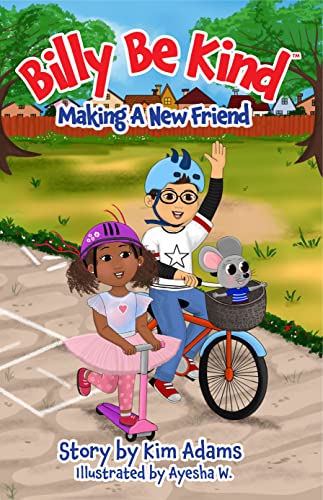
Billy Be Kind: Making A New Friend is about a shy girl named Lucy-Lou that wants to make friends at the playground. Each day she plays alone or sits on the bench by herself. One day while Lucy-Lou plays alone on the swings, a mouse named Billy asks for a ride on the swing with her. Together they play, and Lucy-Lou smiles for the first time at the playground. She and Billy become friends. Billy teaches Lucy-Lou how to make new friends so she won’t be alone at the park anymore, and she too can make other shy kids smile.
Author Kim Adams and illustrator Ayesha W. have created a heartwarming picture book that teaches children how to make new friends. The story reads easily with some rhymes, and the illustrations are bright and bold. The book explains that making friends happens in four simple steps: Say hello, Smile, Share, Play nicely and take turns. The simple language is perfect for preschoolers to understand, and when accompanied by vivid illustrations, children will actively engage with this beautiful story.
One thing that stands out in this delightful children’s book is all the diversity that is pictured. For example, children from various ethnic backgrounds and different abilities are pictured playing at the park. This is a great message to show children that you can still make friends and play together no matter what you look like. The message of diversity and inclusion is presented through the pictures and is a great way to open conversations with children about accepting everyone for who they are, no matter how different from you they are.
Billy Be Kind: Making A New Friend is a captivating picture book for preschoolers and kindergarten students. Teachers and parents can use this book to teach kids about making friends and including everyone when playing. It is a wonderful book that would be a great addition to a library.
Pages: 32 | ASIN : B09PZH8MFJ


