Blog Archives
The World of Extremism

So You Want to Be an Extremist is a satirical guide that traces the origins and evolution of conspiracy theories from ancient Rome to modern-day social media. Why was this an important book for you to write?
I think people know bits and pieces, but there wasn’t a full picture of extremism in one place. I wanted to create a single piece of content that anyone could pick up and easily learn about the world of extremism, from its humble origins to a major part of society today. And also laugh a bit at the horrors they learn along the way because it is a dark, scary place. Whether we like it or not, these people, these products, these movements are affecting all of us in some fashion.
Did you learn anything during your research that surprised you?
How truly ubiquitous this level of extremism and conspiracy thinking has become, particularly among the younger generation. Twenty years ago it was your crazy uncle sending emails. A decade ago it was older people falling for Facebook memes, believing anything that was written online. Now, it is a younger, seemingly displaced generation, who are very tech-savvy, failing at even baseline critical thinking on many topics.
Why was it important for you to take the satirical approach with this book?
For me, satire has always been a way to convey certain ideas and vices as laughable, but also reprehensible. I have a penchant for poking fun at the horrible people that take advantage of others: dictators, oligarchs, and now, extremists. I like to strike a balance between comedy and learning, and I do think they can complement each other. So, I wanted to give the audience that same balance. Plus, they don’t have to read a 400-page academic paper to learn about this stuff. I suffer for them.
What is one thing you hope readers take away from So You Want to Be an Extremist?
Extremism isn’t fringe anymore! It has been normalized to the point that it is a part of everyday media, politics, religion, business, and society. This isn’t going away anytime soon. These ideas and movements are only becoming more prevalent and worse, more accepted.
Author Links: GoodReads | Facebook | Website | Amazon
With Extremism, explanations can be simple – and exciting. You’re not a “loser.” Nope, It’s just an international cabal of lizard people holding you back from greatness.
In this satirical leadership guide for oven-ready radicals and greedy grifters, uncover a mind-blowing myriad of crazy conspiracies, insane ideologies, and meet the fabulous fanatics who promote them.
Join former government lackey turned humorist, C.T. Jackson as he takes you from the quiet corners of sanity to the far fringes of social implosion, as you learn to reach your full radical potential.
So You Want To Be An Extremist? Well, This Book Is For You! (And The Voices In Your Head.)
So You Want to Be an Extremist: A Motley Manifesto for the Motivated Maniac
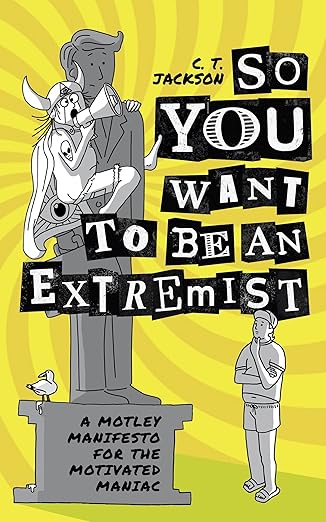

After reading So You Want To Be an Extremist: A Motley Manifesto for the Motivated Maniac by C.T. Jackson, I can say it’s a hilariously scathing, over-the-top satirical guide that lampoons modern conspiracy culture, online extremism, and the absurdities of “truth-seeking” subcultures. Structured like a how-to guide for the aspiring extremist, the book blends biting wit with dark humor as it traces the evolution of conspiracy theories and their players, from ancient Rome to the far-right fringes of social media. It walks readers through stages of “extremist enlightenment,” skewering everything from sovereign citizens and crystal-chugging wellness influencers to red-pilled incels and flat-earthers.
Reading this was like sitting through a savage stand-up special filtered through a graduate seminar in sociology. Jackson doesn’t just go for laughs—though there are plenty—he goes for the throat. The humor is raw, unrelenting, and often walks a tightrope between outrageous and uncomfortable. Personally, I found the style refreshing. It’s not sanitized or delicate. It’s brash and fearless. The jabs at figures like Joe Rogan and Marjorie Taylor Greene, or at cultural absurdities like chemtrails, 5G vampires, and moon-landing denialism, had me laughing and cringing at the same time. Jackson has a knack for mimicking the language and tone of the people he’s satirizing, which makes the parody hit even harder.
At the same time, there’s a deep undercurrent of anger here. Anger at how misinformation, grift, and willful ignorance have festered into real-world harm. That comes through in the relentless mocking of right-wing populism, internet cults, and self-declared gurus. It’s not subtle, and it’s definitely not neutral. That’s part of what I liked about it: it’s not trying to both-sides its way into approval. The parody is clever, but sometimes a little exhausting, like a meme thread that’s gone on too long. Still, when it lands, it’s fantastic.
If you have a dark sense of humor, a healthy skepticism of internet personalities, and a strong stomach for satire that cuts deep and doesn’t pull punches, this book is a fun ride. I’d recommend it to readers who enjoyed books like Thank You for Smoking or The Onion’s political commentary. It’s perfect for anyone who has ever doomscrolled Reddit or Twitter and thought, “How did we get here?”
Pages: 239 | ASIN : B0DF62LYTR

Satire of the Human Condition

Pairs: This Dating Site Will Be the Death of You follows a detective in Tampa Fl who is investigating the bizarre death of a woman who invited seven peculiar men from a friendship-dating app called Pairs to the local aquarium, only to end up murdered. What was the inspiration for the setup of your story?
Interestingly, my inspiration came from the nights my friend, who had put herself – and me – on Match so we could both find partners, texted me countless weird profile pictures of people on the site. She was infuriated, but I found it really funny. I was at a riverside Tiki bar one day trying to write an outline for my second novel when I decided to write something funny about all the pictures she sent me. That turned into Pairs (none based on actual people, but not so far off the mark either).
Each character in this story is unique and leaves readers with more questions than answers. What was your inspiration for the characters’ interactions and backstories?
Pairs is set up so that I can inspire reader involvement. The characters are purposefully vague in order to stimulate reader imagination. At the end of the book, people are encouraged to write their own ending (I have done 3), and send it to me. I may put theirs on my website (pending approval signature etc from the contributor). Pairs is also set up formulaically. Its theme is online dating. All future books have a different theme. Detective Ned is the recurring character, and he develops a backstory throughout the series, and has his own diary on CracktheCaseBooks.com.
How do you balance story development with shocking plot twists? Or can they be the same thing?
I hate to say this, but I just write and edit. The ideas are almost too easy since it’s farce, folly, satire of the human condition… But I would also say they are about the same thing.
What is the next book that you are working on, and when will it be available?
- Mishaps is out already on Amazon. It is book #2.
- Books 3 (Wrecks) and 4 (Critters) should be out by the end of 2025, and 2 more are in the works for 2026.
- A longer, more serious mystery novel should also be out by the end of 2025. All info will be announced on social media and CracktheCaseBooks.com.
Author Links: GoodReads | X (Twitter) | Facebook | Website | Amazon
A woman searching for love. A string of online suitors. A deadly end. When a young woman’s body is discovered, Detective Ned is drawn into the murky world of online dating. The suspects? Every man in her dating history on the app Pairs. Each profile photo hides a secret: the suave charmer with a shady past, the awkward loner with an unhealthy obsession, or the too-perfect match with everything to lose..
In this sharp and satirical mystery, you hold the power to uncover the truth. Will the killer be caught in the web of lies? Choose from three gripping endings and then perhaps create your own. Submit your take to tremorinthehills@gmail.com for a chance to be featured on crackthecasebooks.com. Love might be a game, but in Pairs, the stakes are deadly.
Making Vespuccia Great Again
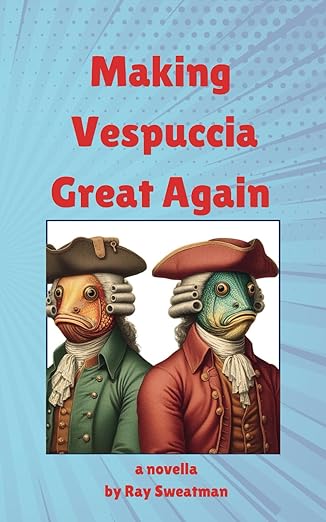
Ray Sweatman’s Making Vespuccia Great Again is a sharp, fearless, and at times laugh-out-loud political satire that imagines a dystopian America rebranded as “Vespuccia.” Set in a twisted mirror of our current socio-political climate, the novella follows the rise (again) of President O.J.C. McDonald, a grotesque caricature of a certain orange-hued reality TV personality. Through absurd characters, biting dialogue, and a surreal plot that includes everything from sentient fish Founding Fathers to LGBTQ revolutionaries called “The Pronouns,” Sweatman delivers a fiery send-up of authoritarianism, fake news, and cultural division in America.
From the very first chapter, Sweatman goes full throttle, skewering the January 6th insurrection with the same kind of commentary you’d expect from The Onion if it took acid and watched Idiocracy on repeat. The fake news anchors Donna Dumay and Don Drapery narrating the Capitol attack like a sports event? Genius. “Oh my, this is better than Getflix!” Donna chirps as democracy crumbles. I was equal parts horrified and laughing out loud. Sweatman walks that tightrope masterfully, never letting the humor soften the blow of the real critique.
One of my favorite arcs was Reverend Swindlemore and his daughter-turned-nonbinary-hacktivist Bucky (aka They/Them). The Reverend is a grotesque blend of fire-and-brimstone televangelists with just the right dose of unhinged righteousness. His hell-obsessed sermons feel ripped from real-life absurdities, and when Bucky forms a rebel group of queer hackers, I was all in. It’s outrageous, it’s camp, but there’s heart. You get the sense that Sweatman deeply respects those fighting for justice, even while cranking the satire up to eleven.
And then there’s the Founding Fathers. Literal fish-people who rise from the sea, transform into Jefferson and Hamilton, and get swept into a costume shop where they breakdance to Rick James’ “Super Freak.” It sounds insane because it is, but somehow it works. These absurd moments don’t just entertain, they hammer home Sweatman’s larger point: when truth dies, history becomes theater, and we’re all stuck on stage, flailing. Watching Jefferson defend his slave-owning past while Hamilton snarks and George Washington threatens to shoot him with a shotgun? That’s satire doing its job, shining light through the madness.
Making Vespuccia Great Again isn’t for everyone. It’s blunt, crude at times, politically fiery, and proudly liberal. But if you’re the kind of reader who enjoys Dr. Strangelove, South Park, or Vonnegut on a rampage, you’ll eat this up. Making Vespuccia Great Again is for the disillusioned, the politically exhausted, the angry, and the hopeful. It’s for anyone who still believes words have power, humor can cut deep, and that fighting back might look a little ridiculous but is still necessary. I laughed, I cringed, I shook my head. And I’d read it again in a heartbeat.
Pages: 252 | ASIN : B0DY4T96PV
Right Can Be Wrong

Right Can Be Wrong is an unconventional collection of musings, observations, and aphorisms that span a wide range of topics, parenting, race, religion, relationships, politics, and human nature. Rather than following a traditional narrative structure, the book offers a series of thought-provoking statements, often contradictory, that encourage readers to question the status quo. It reads like a stream of consciousness manifesto, challenging societal norms while pointing out the paradoxes of everyday life.
One of the book’s greatest strengths is its raw honesty. The author does not shy away from controversial topics, tackling issues of race and inequality with a bluntness that is both refreshing and, at times, unsettling. Statements like “America’s FOUNDING FATHERS fled OPPRESSION in EUROPE, to come to THE NEW WORLD, to OPPRESS BLACK AFRICANS” hit hard, exposing the contradictions in American history. The book does not offer easy answers but instead forces readers to sit with uncomfortable truths. It’s the kind of book that makes you nod in agreement one minute and shake your head the next, which speaks to its power to provoke deep thought.
That said, the writing style can be somewhat polarizing. The heavy use of capitalization, fragmented thoughts, and lack of a traditional coherent narrative might frustrate some readers. While the format creates a sense of urgency, it can also feel disjointed, making it difficult to engage with the text in a sustained way. At times, I found myself wishing the author had expanded on certain ideas instead of simply presenting them as standalone statements. For example, “We cannot see THE DARKNESS of POP CULTURE, because it is COVERED WITH GLITTER” is a brilliant insight, but I wanted more exploration into why pop culture operates this way.
Another striking feature is the book’s balance of cynicism and wisdom. There’s a sense of world-weariness in statements like “Some people who ARE THE PROBLEM believe they are THE SOLUTION.” Yet, amidst the critique, there is also hope, an encouragement for self-awareness and change. Lines like “The BETTER WAY to EDUCATE our CHILDREN is to BETTER EDUCATE OURSELVES” highlight the book’s core message: personal responsibility and growth are the first steps toward a better world.
Right Can Be Wrong is best suited for readers who enjoy philosophical musings and social commentary without the constraints of traditional storytelling. It’s a book that sparks conversation, challenges assumptions, and refuses to be neatly categorized. If you appreciate authors like James Baldwin and George Carlin, or even the fragmented wisdom of Twitter threads, you’ll find value in this book. But if you prefer a structured argument or a clear narrative arc, this might not be the right fit. I highly recommend Hendrix’s unique collection of one-liners to any reader seeking a work of satirical fiction designed to challenge their thinking on everyday topics.
Pages: 204 | ASIN : B0CV48MSZB
Compassion

Spin Cycle: Notes from a Reluctant Caregiver follows an exhausted and frustrated man navigating the complexities of caregiving for his aging mother with dementia. The book is beautifully written and addresses a subject that is rarely discussed in this way. Why did you want to write about caring for an aging parent?
This is the book I wish I had five years ago. It was around then that my mom was first diagnosed with “likely onset Alzheimer’s.” Those years, during which I became a parent to my parent, were some of the most challenging and exhausting of my life. I was frustrated, confused, angry, and felt guilty about feeling frustrated, confused, and angry. I felt alone. That’s the spin cycle. And going with fiction rather than, say, a memoir, gave me the freedom to explore and imagine more facets of that experience. If one person reads this book and thinks, “I’m not alone. These characters think and feel what I think and feel,” then I’ve done my job. I want this book to resonate with readers, and, hopefully, comfort them.
I find that authors sometimes ask themselves questions and let their characters answer them. Do you think this is true for your characters?
I think it was Truman Capote who said, “You can’t blame a writer for what the characters say.” I love this because I think it’s true. As you get to know a character more deeply through the writing process, you begin to hear their voice, their opinions, their view on life. For me I can be much more honest and raw – and therefore, hopefully, relatable – when I inhabit the minds of other people, people who might say or do things I wouldn’t. I think of myself as being reserved and polite, perhaps excessively so, and my characters give me the chance to break from myself.
What were some themes that were important for you to explore in this book?
Compassion is the overriding theme in Spin Cycle. When we meet the protagonist, Ezra, he is so consumed by resentment, frustration, guilt, and self-loathing that he no longer has the capacity to be compassionate, to others as well as himself. The book is about his journey to rediscover his capacity to empathize and love. I also try to explore the corrosive effect of family secrets, as well as the fulfilling sense of human connection we have when we choose to be vulnerable with others.
What is the next book that you are working on, and when will it be available?
It is called Convergence. I’ve just begun it. The theme for this novel will be “escape.” I think there are times in all our lives when we wish we could just snap our fingers and “escape” – perhaps literally: to a different place, a thousand miles from home; perhaps with extreme diversion: sex, drugs, booze; or maybe the escape is an internal one we make by shifting – not our circumstances – but the lens through which we view them. Put characters with these varying approaches to “escape” in a pressure cooker and that’s the book. Knowing my work pace, it will probably be out in a year, perhaps a year and a half.
Author Links: GoodReads | X (Twitter) | Website | Instagram | Amazon
Overwhelmed by it all, Ezra opens a strip-mall school to help others-and himself-become better caregivers. As he learns to handle the personalities of his nine misfit students, Ezra must also navigate the complex feelings he has toward his mother. It doesn’t help that she adores his do-nothing slacker brother.
But Ezra hasn’t told his students that he also has an agenda beyond becoming a more compassionate caregiver. And, it turns out, so does one of his students. Ezra confides the entire tale to his childhood friend Danny as he attempts to sort it all out and find room in his heart again for compassion and love.
Laughing In the Face of COVID

Laughing in the Face of Covid by Glen Stone offers a refreshing and humorous take on the chaos of the 2020 pandemic, turning the bleakness of quarantine into an opportunity for sharp-witted commentary. While many of us struggled through lockdowns and hospital stays, Stone found a way to lighten the mood by documenting his experiences through a Facebook diary. This collection, born out of those feverish, Covid-induced posts, brings readers a mix of stories, commentary, and humorous observations that are bound to resonate, no matter how varied our pandemic experiences were.
Stone’s whimsical sarcasm leaps off the page, making even the darkest moments of the pandemic feel laughable. His strong opinions and biting humor make the book wildly entertaining, though some readers with differing views might find themselves a little ruffled. But as the saying goes, you can’t make an omelet without breaking a few eggs, and Stone doesn’t shy away from cracking them. The stories span everything from Covid-themed pop-culture references to political jabs, lyrical poems, and even short fiction, ensuring there’s something for everyone to enjoy. What makes Laughing in the Face of Covid stand out is its relatability. Instead of dwelling on the hardships, Stone masterfully flips the narrative, finding humor in the bizarre norms we adopted during the pandemic. His commentary allows readers to laugh at things that, at the time, felt overwhelming. Serious issues are transformed into moments of levity, and it’s all done with a light-hearted touch that makes the collection deeply enjoyable. Most of Stone’s stories are hilarious, with 90% of them delivering laugh-out-loud moments. However, some stories toward the end veer into unexpected territory—such as his Harry Potter Covid fan-fiction. This particular tale is a wild ride, blending disorganized chaos with a quirky “what if” scenario about Harry transferring to Oxford after a brawl. While it might not stay true to the original characters, it’s a curious and humorous alternate take that some readers may find entertaining, even if a bit off-the-rails.
No matter which story strikes your fancy, Stone’s collection has a way of changing your perspective on the pandemic. By focusing on the absurdities, his tales bring out the lighter side of those difficult months, reminding us that even in the darkest times, laughter is essential. Laughing in the Face of Covid is one of the best pandemic-inspired books I’ve come across—equal parts entertaining and cathartic.
Pages: 60 | ASIN : B0DCF3ZHDZ
Grimmer Revisionist Fairy Tales, Fables, and Nursery Rhymes

Remember those cherished childhood moments, listening to bedtime stories filled with classic fairy tales, fables, and nursery rhymes? Perhaps you’ve even read these timeless tales to your own kids. Now imagine taking those beloved stories, throwing out the rulebook, and infusing them with modern twists, witty humor, and a dash of cheeky irreverence.
Grimmer Revisionist Fairy Tales, Fables, and Nursery Rhymes by Marissa Carter is a delightful blend of styles, presenting fairy tales and fables with a twist. The nursery rhymes might start off sweet but could suddenly veer into snarky commentary or transform into entirely different stories. Along the way, you’ll encounter clever nods to pop culture, movies, books, politics, and even a bit of quantum physics (because, why not?). It’s as if someone turned your grandma’s storybook inside out and sprinkled it with a generous dose of mischief. Get ready to laugh because this isn’t your childhood fairy tale collection—and that’s exactly what makes it so much fun. Marissa Carter has crafted a hilarious adult take on well-known nursery rhymes. This book is definitely not for children, but it’s perfect for parents looking for a good laugh. Each story is funnier than the last, and the new spin on the fable/fairy tale genre is incredibly entertaining. Carter provides unique commentary with each story, offering readers insights into how we as a society view and absorb the themes of these iconic tales. The fast-paced nature of each fable, combined with modern-day story elements like the internet and television, makes it easy to devour these stories. The imaginative use of imagery brings these tales to life on the page. From parenting techniques and anger management to higher education, the wealth of modern themes breathes fresh air into these traditional stories.
Grimmer Revisionist Fairy Tales, Fables, and Nursery Rhymes takes familiar fairy tales, fables, and nursery rhymes and puts a comedic, new-age spin on them. While it’s definitely not for children, it’s a must-read for adults who appreciate humor and wit. This brilliant collection turns well-known stories on their heads, offering twists to the morals or even the absence of them altogether. The relatability of these stories as an adult and their inappropriately funny nature make for a truly enjoyable read.
Pages: 92 | ASIN : B08KPN2SJB


