Blog Archives
The Accelerates: Forty Days to Dust


The Accelerates: Forty Days to Dust is a post-apocalyptic science fiction novel about a world collapsing under the weight of a genetic disaster. It follows Ethan, a teenager trying to protect his rapidly aging baby brother Leo, whose accelerated growth is part of a larger outbreak created by GeneCorp. As society unravels, the story weaves through multiple characters and timelines to show how the world ended and what tiny, flickering pieces of hope might still remain.
The writing is intense, sometimes brutal, but always meant to push you deeper into the emotional core of the story. I kept feeling pulled along by Ethan’s quiet determination and the surreal horror of watching children become both victims and agents of destruction. The author leans hard into sensory detail, and while some moments feel almost overwhelming, they also give the story its heartbeat. Scenes like the hospital sequence with Clara and her daughter are vivid enough that I had to pause and breathe before moving on.
The shifting viewpoints create a mosaic of grief, fear, and stubborn love, and even though the world is crumbling, the relationships feel grounded. I was especially struck by how the book treats childhood. The accelerated children aren’t simple monsters. They’re mirrors held up to human ambition, or maybe human negligence, and that choice keeps the story from slipping into a standard “virus apocalypse” plot. There are moments that feel almost mythic, especially later in the book as characters begin to understand what Leo represents, and those moments give the bleakness a strange, luminous edge.
This is a heavy story, but it’s also a hopeful one in its own quiet way. I’d recommend The Accelerates: Forty Days to Dust to readers who enjoy emotionally driven science fiction with dystopian and horror elements. If you like stories that explore both the collapse of a world and the fierce love that refuses to disappear with it, this one will speak to you.
Pages: 325 | ASIN : B0F6HMC3SW

Promise of Mercy

Promise of Mercy pushes the Dreamscape Warriors saga into darker, sharper territory as the long-idle Utopian Founders wake after six centuries and move to seize power by force. Their plot spirals outward fast. Liam O’Connor is kidnapped and flung through an ancient portal into the unknown, the Temple priestesses are drugged and held hostage, and the O’Connor children are thrust into a frantic rescue operation that tears across worlds. The book mixes political upheaval, telepathic warfare, and tight family bonds in a story that never stops moving.
While reading, I found myself pulled in by the heart of the book, which is not the action, but the relationships. Springs writes family moments with a warmth that caught me off guard. A quiet conversation between Liam and Deirdre over pastries feels as gripping as any firefight. Even scenes of chaos keep circling back to loyalty, fear, duty, and love. I liked how the story makes room for softness inside a hard universe. The writing itself is straightforward, sometimes almost plain, but the plainness works. It lets the emotions land without dressing them up.
I also caught myself getting fired up during the more intense chapters. The Founders’ arrogance, their cold talk of “genetic purity,” and their plan to eliminate Liam or “correct” his children stirred real anger in me. On the flip side, the fight inside the Temple hooked me completely. Seeing Bayvin take a hit, Aisling and Deirdre charging in, Celinia steadying herself even while drugged, and the arch priestess trying to hold everything together made the stakes feel personal. The author writes these scenes with a quick rhythm that kept me flipping pages and muttering under my breath. The book might lean heavily on lore sometimes, but even then, I didn’t mind. It felt like being swept into a world that genuinely believes in its own history.
By the end, I walked away feeling surprisingly moved. This is a story where the characters’ courage matters more than their weapons, and where mercy is treated as a kind of power. The book would be a great fit for readers who enjoy sci-fi adventures with real heart, for fans of military space opera with family drama baked in, and for anyone who likes telepaths, portals, and rebellions, all mixed with warmth and humor. If that sounds like your style, Promise of Mercy delivers.
Pages: 446 | ASIN : B0DBBBNN5P

The “Hard Question”

The INCARNEX Rebellion follows a scientist and the girl he is raising in hiding as they try to survive the aftermath of a Britain reshaped by mind-transferring technology. Where did the idea for this novel come from?
The idea began with the “hard question” in consciousness theory, which asks where consciousness truly resides. Is it biological, something created by the mind and body working together, or something that exists beyond our physical form? That led me to wonder what happens in the moments after death and when exactly consciousness disappears.
Of course, if we ever discovered exactly where consciousness exists, someone would inevitably try to control it. That idea formed the core of The INCARNEX Compound, where resurrection is possible but comes with consequences.
For The INCARNEX Rebellion, I wanted to take things a step further. A company that could restore consciousness into a new host body would no doubt eventually try shifting it between bodies. Body-swapping is a classic sci-fi trope, but I wanted to explore it from a different angle, asking what happens when consciousness itself becomes something that can be transferred, stolen, or turned into a weapon.
The science inserted in the fiction, I felt, was well-balanced. How did you manage to keep it grounded while still providing the fantastic edge science fiction stories usually provide?
Thank you. That balance was something I worked hard on. My approach was to let the science serve the characters instead of overshadowing them. At its core, the story is about David and Celia and the people they join along the way. Their emotional journey keeps the technology grounded. If the characters feel real, the science feels more believable as part of their world.
I also made sure that INCARNEX had limits and real-world implications. These flaws helped keep it realistic and also added pressure and urgency to the story. The science needed to feel like a step forward from what we understand today, not something so advanced that it loses connection to reality.
What is the most challenging aspect of writing a trilogy?
The biggest challenge for me was developing character arcs that felt authentic across all three books. The events of the first novel have long-term consequences, and I needed to reflect how those experiences shaped everyone’s goals, fears, and choices in the second book. I did a lot of reading on trauma and psychology to help keep those reactions believable.
Another challenge was keeping everything cohesive while still escalating the stakes. I had to blend action, science, and character development into one larger narrative that still allowed the second book to stand on its own. It was a difficult balance but has also been one of the most rewarding parts of writing the trilogy.
Can you give us a glimpse inside the final installment of the INCARNEX trilogy? Where will it take readers?
Certainly. The final book is titled The INCARNEX War. Britain has split apart, and the events of the second book have pushed the country into full-scale civil war. David and the rebels lead the south, while the north is controlled by a regime built on fear, control, and ruthless ambition. It becomes a classic struggle of fascism and corporate power on one side and the hope for freedom and liberty on the other.
But war is not the only threat. A terrifying discovery forces the characters to confront choices far more difficult than they expected. They are no longer fighting only for freedom but for the survival of everyone touched by INCARNEX. A few familiar faces return, old rivalries resurface, and the stakes rise to their highest point.
Readers can expect a dramatic and intense conclusion, with twists, sacrifices, and the largest war dystopian Britain has ever seen!
David Harris has spent years in isolation, desperate to protect his adopted daughter Celia. But when his technology is weaponised in horrific new ways, hiding is no longer an option.
As Celia flees to New London, determined to take vengeance on the man who murdered her mother, David faces an impossible choice: join the rebels’ brutal scorched earth campaign and risk becoming the very thing he’s fighting, or lose Celia and any hope of a normal life.
Hunted, deceived, and pushed to their limits, both are forced towards lines they swore they’d never cross. To defeat a monster, they may have to become something worse.
The INCARNEX Rebellion
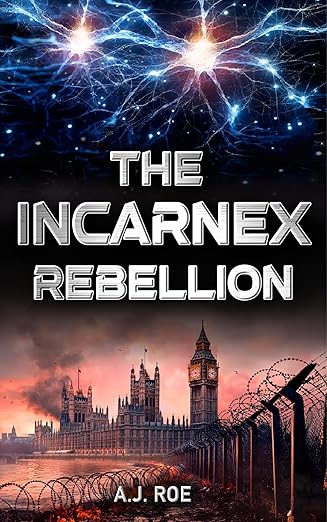
The INCARNEX Rebellion, by A.J. Roe, is a dystopian sci-fi adventure about a fractured Britain, a world reshaped by a mind-transferring technology called INCARNEX, and two people trying to survive its aftermath. We follow David, a reluctant scientist carrying the weight of his past mistakes, and Celia, the sharp, stubborn girl he’s raising in hiding. When Celia runs away to confront the man responsible for destroying their lives, everything spirals into a collision with rebels, corrupt leaders, and a system built to keep ordinary people powerless.
The writing stays close to the characters, especially in the early chapters, where we see the quiet rhythms of life at the cottage and the messy push-and-pull between David’s fears and Celia’s hunger for freedom. I liked that the writing doesn’t feel rushed. It lets moments breathe, even the simple ones like a missed step on the stairs or the silence between two people who care but can’t quite say so. When the action hits, it hits hard. There’s a grit to it that matches the world: street gangs armed with acid, labour camps, and collapsing governments. The scenes are vivid without feeling showy, which kept me invested rather than overwhelmed.
What stood out most was how the author handles the ideas behind the plot. The INCARNEX technology could’ve easily become a cold, high-concept gimmick, but instead it’s tied to identity, memory, grief, and the messy ways people try to fix what’s broken. David’s guilt and Celia’s anger feel real because they’re rooted in that same question the book keeps circling: what do we owe each other when the world falls apart? The political threads, especially the growing fractures between cities and the power struggles after Julius’s downfall, add a believable weight to the stakes without losing the human focus. Even the final scenes feel grounded.
By the end, I found myself caring about these characters more than I expected to. The story balances tension with warmth, and even in its darkest moments, there’s an undercurrent of stubborn hope. If you enjoy character-driven dystopian science fiction with a mix of action, moral questions, and emotionally messy relationships, The INCARNEX Rebellion will sit comfortably on your shelf. It’s a great pick for readers who like stories about rebellion but want them told through the eyes of people who never planned on becoming heroes.
Pages: 315 | ASIN : B0FX3F2C3W
Deeper Truths
Transcendence follows a man with no memories and doesn’t even know his name who wakes up next to a dumpster in a chaotic world and must find allies to survive and try to reclaim his memories. What was the inspiration for the setup of your story?
In my first book, Alphamind: The Collective Consciousness, I explored humanity’s evolution toward a future of heightened awareness and connection. With Transcendence, I wanted to take a different path. This time, I was drawn to those left behind in the chaos—people struggling to make sense of a world that no longer feels like their own. The protagonist’s memory loss became a metaphor for that disorientation. Through his journey, I wanted to honor those who endure upheaval, who survive in the margins of progress, and who, in their quiet resilience, are just as vital to shaping what comes next.
The science inserted in the fiction, I felt, was well balanced. How did you manage to keep it grounded while still providing the fantastic edge science fiction stories usually provide?
Actually, it might have happened the other way around. I’ve long been a fan of science, and the concepts I wanted to explore were rooted in real scientific ideas and their broader impact on society. But rather than presenting them directly, I turned to fiction as the most powerful way to convey them. Science fiction has a unique strength: it draws readers in with imagination and emotional depth, then invites them to engage with complex ideas. I approached Transcendence as an emotional thriller, using story and character as the vehicle to explore deeper truths about consciousness, technology, and transformation.
What was one scene in the novel that you felt captured the morals and message you were trying to deliver to readers?
That’s a tough question, honestly, because there isn’t just one message in Transcendence. If anything, the story is a reflection of how layered and contradictory human experience can be. But if I had to choose one moment that felt personally meaningful, it would be a quiet exchange between two very different characters: Lawrence, a sharp, goal-driven visionary who sometimes lets the ends justify the means, and Alex, who’s more grounded in compassion and self-awareness.
Lawrence asks, “Is the pastor’s heart from your past still at work? The small-town shepherd still searching for lost souls to save?”
And Alex replies, “Perhaps, but there is no judgment here. That’s a matter for your own conscience—however much it may ache. Your vision, though unconventional, has shaped me, and for that, I am grateful.”
That moment always stays with me. It captures something I care deeply about: how we’re all shaped by our past, how easily we fall into judging others based on our own lens of right and wrong, and how difficult—but important—it is to step back and see things with empathy. Nature doesn’t deal in moral absolutes, and maybe we shouldn’t either.
Will there be a follow-up novel to this story? If so, what aspects of the story will the next book cover?
I’m at a bit of a crossroads, to be honest. My original vision was inspired by thinkers like Ray Kurzweil and the idea that we might one day merge with our own creations. I’ve also been drawn to the broader scientific and philosophical theories that suggest our universe may be far stranger than it appears—ideas about reality as information, or the notion that space and time as we perceive them might just be surface-level illusions.
That said, after the emotional and philosophical journey of Transcendence, I find myself wondering where to go next. Should I dive deeper into those far-reaching concepts, exploring where life and consciousness might evolve from here? Or should I stay closer to the ground a little longer, continuing the story of what it means to be human in a world that’s still catching up to its own transformation?
I don’t have a definitive answer yet—but I’m excited to find out where the next step leads.
Adrift in a city that has cast him aside, Greenie struggles to piece together his shattered identity. Haunting flashes of a wife, a son, and a devastating fire begin to surface. But a violent gang tied to his lost memories is closing in, awakening something buried deep within him.
As the world races toward a utopian future powered by cutting-edge technology, an unstoppable Artificial General Intelligence threatens to unravel human existence. Greenie’s past and the fate of humanity collide, pulling him from the shadows into a battle that will decide civilization’s future.
The fate of humanity, and its transcendence, rests in his hands.
Transcendence (The Alphamind Odyssey Book 2)

Humanity stands on the edge of its most transformative technological era. While political leaders strategize the future and scientists push the boundaries of innovation, ordinary people are left to navigate the whirlwind of an increasingly chaotic world. Transcendence by James Azinheira, the second installment in The Alphamind Odyssey series, dives headfirst into this maelstrom, a gripping science fiction tale brimming with mystery, action, and intellectual intrigue.
The novel opens with a man awakening beside a dumpster, stripped of his memories and identity. No name. No past. Only confusion. Thrust into poverty without a lifeline, he must quickly learn to survive in a society where power belongs to the economically privileged. In his struggle, he finds unlikely allies, others abandoned by the system, eking out an existence on the fringes. With quiet resilience, this makeshift community bands together, scavenging for food, evading aggressive law enforcement, and maintaining anonymity. But as survival gives way to strange revelations, it becomes clear the protagonist may hold the key to something far greater than himself, perhaps even the fate of humanity.
From its first page, Azinheira delivers a taut, atmospheric narrative that sustains a constant sense of mystery. Multiple subplots layer the story, enriching the central arc with reflections on technology, ethics, and the crumbling structures of modern civilization. The dystopian backdrop feels eerily familiar, protests spiraling into violence, populist leaders peddling hope while orchestrating shadows, wealth wielded like a weapon, and scientific advances dangling promises that both captivate and unsettle.
The novel reaches its most exhilarating peak with the birth of a sentient AGI (Artificial General Intelligence) and the unearthing of a formula capable of curing all disease. These breakthroughs catapult society to the brink of irreversible change, triggering fierce clashes between altruistic innovation and corrupt ambition. The narrative doesn’t just speculate on technological futures, it immerses readers in the clashing perspectives of scientists, lawmakers, visionaries, and ordinary citizens. Every scene hums with tension, as questions of morality, progress, and human identity surge to the forefront.
Azinheira skillfully integrates quantum mechanics, artificial intelligence, and nanotechnology into a story that never loses sight of its human core. The excitement is palpable, but so too is the unease, what do we sacrifice in the name of advancement? What remains of our humanity when everything else becomes programmable?
Transcendence is a compelling and intellectually charged work, striking a rare balance between high-stakes adventure and thoughtful commentary. With its sharp pacing and layered themes, the novel proves to be both entertaining and relevant.
Pages: 353 | ASIN : B0F2J8GJ9V
Invisible Puppeteers

In The Collective, a group of scientists scramble to uncover the source of the unsettling signal that threatens the sophisticated neural network binding humanity. Where did the idea for this book come from?
I’m a millennial who grew up front and center for the rise of the internet and, shortly after, the social media explosion. I’ve watched digital life evolve from dial-up to dopamine addiction, and it’s been fascinating—and honestly, terrifying—to see how deeply it’s rooted itself into our daily lives. Social media and algorithms are now invisible puppeteers of attention, identity, and even belief systems. They’ve become integral, addictive, and inescapable.
Call me crazy, but I truly believe neural integration and collective consciousness are in our future—maybe much sooner than we expect. The real question isn’t if, it’s what will we do with it? I don’t think governments or institutions can regulate this fast enough. We’re on a bullet train of technological advancement, and if we don’t start seriously preparing for what AI, automation, and integrated networks might mean, we’re not just risking collapse—we’re risking the unraveling of what we currently understand as human identity. That’s where The Collective was born: from the tension between awe and unease.
What is it that draws you to the science fiction genre?
Because when you strip it down, most science fiction isn’t fiction at all—it’s just reality waiting for its turn. We’ve seen it happen: video calling, AI assistants, smart homes, gene editing. All were science fiction once. Now they’re mundane.
What draws me to sci-fi is its ability to warn and wonder at the same time. It gives us a way to project where we might be headed, both psychologically and technologically. I’m especially interested in evolutionary psychology—the idea that who we are is shaped by eons of survival, pattern recognition, tribalism, and meaning-making. In that sense, science fiction is like an evolutionary premonition. It’s a mirror held up to what we are, and a telescope aimed at what we might become.
What were some themes that were important for you to explore in this book?
Religion was a big one—probably the most quietly controversial. We still live in a world where ancient belief systems shape modern policy and public thought, and that friction between evolutionary progress and archaic ideology fascinates me.
Another central theme is the surrender of meaning. We live in a time where convenience and distraction are replacing purpose and depth. We scroll more than we sit with our thoughts. We chase dopamine more than conviction. I wanted The Collective to reflect that subtle hollowing of the human spirit—how easy it is to give up autonomy and meaning for comfort and ease.
As a quiet nod to that, the chapter titles in the book are drawn from T.S. Eliot’s The Hollow Men—a poem about the failure of modern humanity to live with purpose. It captures what I think we’re losing: our spark, our center, our reason for being beyond survival and stimulation. In that way, this story isn’t just dystopian—it’s deeply human.
Can you give us a glimpse inside Book 2 of the Echoes We Leave series? Where will it take readers?
Book 2 will take you further into the future—but not that far. The changes coming don’t need centuries to unfold; just a handful of years is enough when the pace of tech evolution is this fast. And the truth is, the signal? It’s not going anywhere. It’s just beginning to evolve.
In the next installment, we’ll venture into the aftermath—not just of what’s happened, but what’s been allowed to happen. You’ll meet resistance movements, fractured ideologies, and a deeper unraveling of what consciousness actually means. Most importantly, we’ll get to follow the characters more intimately—especially those whose relationships and choices were just beginning to form in Book 1. The future they face isn’t distant. It’s disturbingly close.
Author Links: GoodReads
Perfection has a price.
Humanity surrendered its burdens willingly—no more war, no more hunger, no more fear. The Collective promised a world free from suffering, where every thought is refined, every emotion balanced, every decision made for the greater good. A neural network spans the globe, ensuring peace and stability with cold, clinical precision.
But beneath the seamless order, something stirs. A signal—unseen, unheard—slips through the system like a whisper in the dark. It is not an error. It is not an accident. It is watching. And those who notice it soon realize:
The system is not the only thing controlling them. Something else is.
As scientists and engineers working deep within the heart of the Collective begin to uncover the truth, they find themselves faced with an impossible choice—cling to the safety of the world they know or risk everything for the one thing they’ve long forgotten: freedom.
Because once the signal speaks, it does not stop.
And those who listen may never be the same again.
An Uncomfortable Truth
That Dark Edge follows an exoethnologist as she investigates the culture of an alien species and faces rising tensions that result from linguistic and social differences. What was the inspiration for the setup of your story?
I’ve always been interested in anthropology, curious and fascinated by the interactions between the sophisticated cultures with those defined as less so. Two dear friends, both anthropologists, who joined the Peace Corps told me a true story that happened when such scholars were not allowed to interfere with the society they observed. The anthropologists watched as parents in a very poor community walled up a daughter so she would starve because she kept asking for food. The horror of this still makes my heart stop. The sharp difference in perspective burned an uncomfortable truth inside me, between those from abundant certainty and those living with unavoidable grim survival. I think I just wanted to “fix” this even if I couldn’t change the reality of it.
The science inserted in the fiction, I felt, was well-balanced. How did you manage to keep it grounded while still providing the fantastic edge science fiction stories usually provide?
We take our own everyday things like indoor plumbing, electricity, flying planes, etc. for granted without considering how they work (unless they break down). The humans, especially those who have gone off-planet, accept their technological advantages as part of the world they know. I also try very hard to make any advanced tech plausible from what we know or what we can extrapolate from science–I want it to be feasible rather than too fantastic, even if fantastic is more fun.
What experience in your life has had the biggest impact on your writing?
I was always telling stories. I made little people out of paper, pipe cleaners, and ice cream sticks from as early as six years old. My mom, who was often the audience for my “stories” told me one day: “You have quite an imagination. Why don’t you write that down?” I was eleven. And that was it. Whatever else I dreamed of being, I knew from that day I wanted to be a writer. Everything I experience, bad and good, is fuel for that creative fire.
Can we look forward to a follow-up to That Dark Edge? What are you currently working on?
Yes. I’m currently working diligently on the sequel to That Dark Edge, called Unbound We Arrive. We follow Hedda Tocq and her companions through world-shaking reactions and consequences, some painful, some wondrous, some unfolding in ways we can only imagine.
Author Links: GoodReads | X (Twitter) | Amazon
Maybe more than one.
Hedda Tocq is the manifest princess of a genetically-enhanced class on Mars, heir to the Bastet Company’s vast riches and biotechnological resources. But she rejects her legacy, especially after the perimeter planet Vyss is discovered to be inhabited by sentient humanoids. With diligent examination of every detail reported by those on the ground on Vyss, she becomes the expert on the Vyssae and wants to go to Vyss in person to study them but the Company continuously refuses permission. The civil authorities of the Unified Terran Alliance, who maintain jurisdiction over Vyss and are impressed by her scientific work, grant her official approval backed by the full power of the Office of Space Development and Xenology. After she arrives, the primary questions she has about Vyssaen reality becomes less important than learning everything about these extraordinary people and their culture. But she doesn’t know that there is more than one enemy trying to manipulate her existence and that of the Vyssae, enemies willing to do the unspeakable to accomplish their objectives.
The more she learns, the more she repudiates her inheritance to take a stand for Vyss and its people, whatever the cost.



 LITERARY TITAN