Blog Archives
The Last Ghost
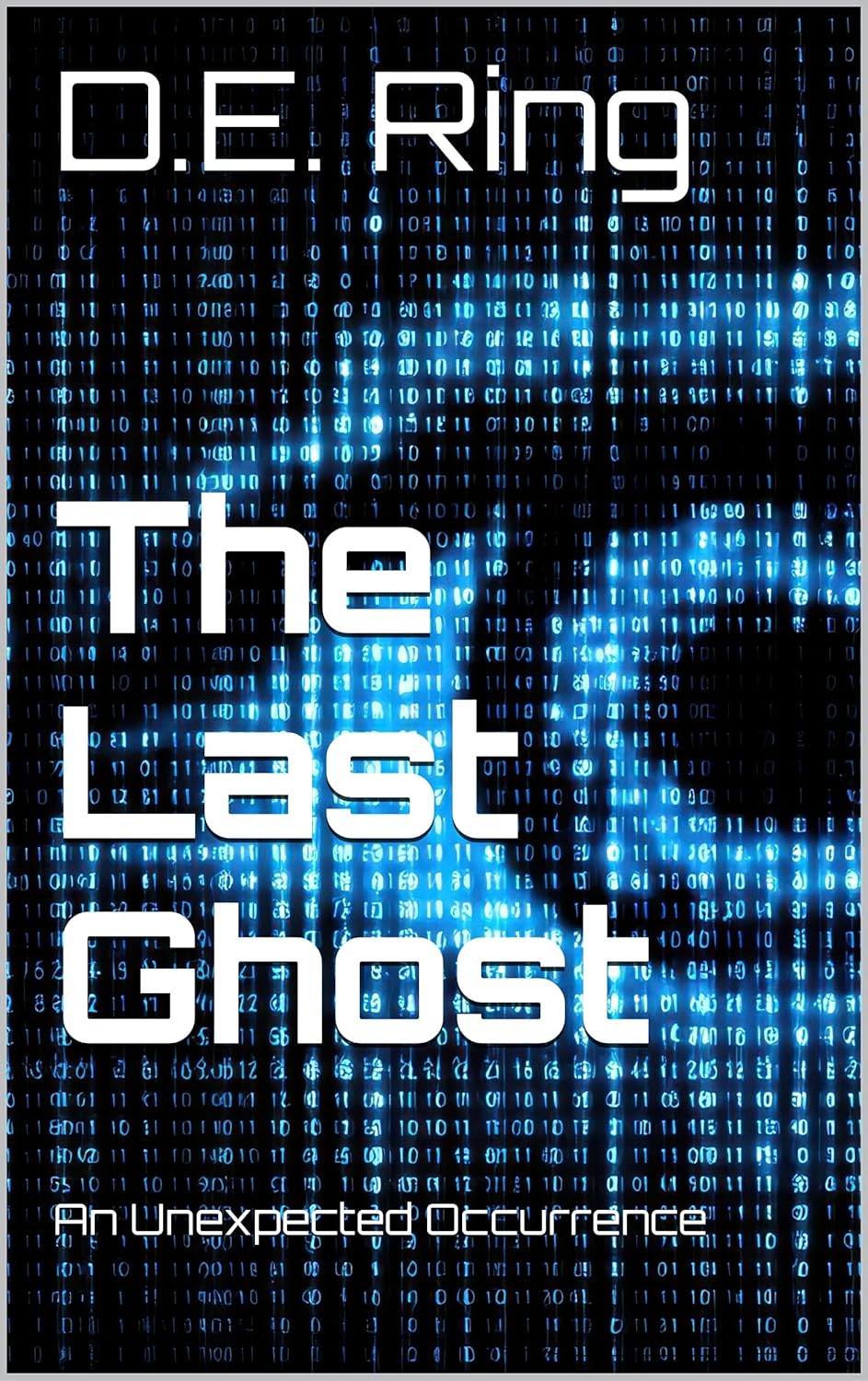

The Last Ghost tells the story of Joshua Stewart, a boy who loses his parents in a tragic fire in Thailand and is raised by his aging grandparents in Toronto. What begins as a quiet, tender domestic story about loss and love evolves into a moving reflection on family, morality, and the strange intersection between faith and logic. It’s a coming-of-age story shaped by grief, education, and a world that seems to change faster than anyone can understand. The book carries Joshua from childhood through adolescence, from the safety of his grandfather’s theological certainty to the uncertainty of global chaos and financial collapse. In the background are ghosts, literal and figurative, the memories and moral lessons that cling to life long after the living are gone.
The prose is elegant but warm, never showy. Author D.E. Ring writes dialogue that feels alive, filled with pauses and silences that say more than the words themselves. The pacing is slow in the best way. I found myself caring deeply for Caleb and Marianne, those kind, weary grandparents trying to raise a boy while the modern world races past them. Joshua’s curiosity, his moral sense, and his grief are rendered so gently that when emotion hits, it hits hard. I caught myself tearing up more than once. The way Ring balances tragedy with moments of simple beauty, a walk by the lake, a child’s question about God, is fantastic. It’s literary without being pretentious, and it touches something primal about family and forgiveness.
That said, this isn’t a light read. The novel asks you to think. Some chapters stretch with patient detail about conversation or setting. The story builds a world that feels lived in. So much so that when the supernatural edges in, it feels believable. Ring doesn’t write jump-scares or gothic gloom. His ghosts come through in memory, regret, and the quiet ways people haunt one another. I loved that restraint. It’s the kind of ghost story that leaves you thinking rather than trembling. Still, I found myself haunted anyway, not by spirits, but by love, loss, and how time slips away no matter how much we hold on.
I’d recommend The Last Ghost to readers who love literary fiction with heart, people who appreciate family sagas, subtle hauntings, and moral reflection. It’s for those who like their ghost stories human, not horrific. I’d hand it to anyone who believes that real hauntings come from memory, conscience, and the ache of unfinished love.
Pages: 291 | ASIN : B0FS1W4T5Q

Woman in the Abbey
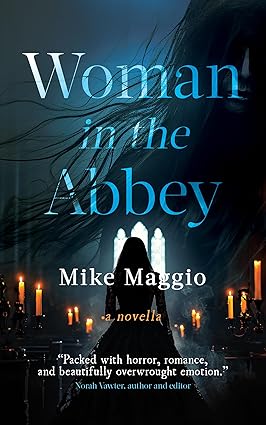
Woman in the Abbey is a rich and relentless gothic tale, told in a voice that’s both seductive and sinister. The novel spins a dark fable about temptation, regret, faith, and the blurred line between good and evil. The story is narrated by a voice we eventually come to recognize as infernal—Lucifer himself—who recounts a centuries-old cycle of suffering, fear, and tragic desire, all centered around a decaying abbey haunted by the sins of its cloistered inhabitants. Two women—Perdita and later Graziella—are pulled into the abbey’s clutches, and their stories unfold with dread, horror, and strange tenderness. The narrative is drenched in fire and shadow, full of rich, lyrical descriptions and emotional torment, while Lucifer himself wrestles with an aching, impossible longing for love and redemption.
The writing is intense—florid, poetic, deliberately archaic at times—and it works, because the story needs to feel like a fever dream. Maggio clearly delights in language, and he lets the sentences unfurl like dark ribbons, twisting into corners you didn’t see coming. I found myself rereading lines out loud just to let the rhythm hit. That said, the style won’t be for everyone. It’s indulgent, dense, and sometimes over-the-top, but honestly, that’s part of the fun. The narrator is a fallen angel who wallows in tragedy, so of course, he’s going to be melodramatic. But the emotional core, his longing, his regret, his unholy desire to be seen, is real and even moving. There were moments when I pitied him, hated him, and rooted for him, all at once.
What really got me was how Maggio managed to make this ancient villain feel heartbreakingly human. I didn’t expect to feel so much for a character that’s supposed to be the embodiment of evil. And Graziella—sweet, terrified, resilient Graziella—she felt like a candle flickering in the dark. Her struggle to escape, her confusion, her faith, all hit harder because we see it through the eyes of someone who both adores and threatens her. The abbey itself feels alive, crumbling and grotesque, a character in its own right. Sometimes the horror is physical, other times it’s spiritual or emotional, but it’s always there, pressing in. The book doesn’t give easy answers or tidy arcs. It leaves you rattled, unsettled, but also weirdly satisfied.
I’d recommend Woman in the Abbey to anyone who loves gothic fiction, horror with a heart, or stories that sit in your gut long after you’ve closed the book. It’s for readers who like to get lost in dark places—not just spooky ones, but the kinds lit by flickering candles and lined with grief. If you want atmosphere, emotion, and a narrator who’ll charm and repulse you in equal measure, this book will stick to your bones.
Pages: 134 | ASIN : B0DMNG21RT
Red Shadows at Saugatuck

Red Shadows at Saugatuck is the fourth entry in Randy Overbeck’s Haunted Shores Mysteries series, and it wastes no time plunging us back into the life of Darrell Henshaw, the history teacher with a ghost-sensing “gift” he never asked for. This time, Darrell, his wife Erin, and their son Leo are headed to Michigan for a family celebration, but like clockwork, something much darker is waiting for them. Ghosts, secrets, and the unsolved disappearances of Native girls from the local Gun Lake Tribe start to bubble up as Darrell is once again pulled into a mystery he didn’t go looking for.
What struck me right away was how real the characters felt, especially Darrell and his family. I loved the opening chapter where they’re fresh from a trip to Sesame Place, still sticky with cotton candy and joy, and Darrell’s dad instincts are on full display. That whole bit where their son Leo gets “lost” in the restroom for three minutes had my chest tightening. It’s those quiet, relatable parenting moments that Overbeck nails, grounding the supernatural in the mundane. Erin, especially, feels like a full character and not just a supportive spouse but a smart, capable woman with her own voice and presence.
The pacing builds in a way that’s more eerie than action-packed. One of my favorite scenes happens early on when Darrell visits the recreated Indian village at Meadowcroft and has that surreal, low-key haunting interaction with the Native elder. That moment felt… still. Intimate. And a little unnerving. Then, when the elder vanishes, and the park ranger tells him that no one was scheduled in that wigwam, it’ll give the reader chills. Overbeck clearly did his research, and it shows, especially in how delicately and respectfully he handles the very real issue of missing and murdered Indigenous women. It never felt exploitative, just tragic and timely.
Where the book really grabbed me emotionally was in the smaller, more personal scares. Darrell’s growing fear that his young son might share his ghost-seeing ability is honestly heartbreaking. When Leo cheerfully talks about his invisible playground friend Monica, and Darrell realizes she’s a ghost of a dead girl, the moment hits hard. I found myself whispering “Oh no” under my breath more than once. That slow, gnawing dread works better than any jump scare. It’s the kind of haunting that lingers, especially when you’re a parent.
I really enjoyed Red Shadows at Saugatuck. It’s thoughtful, deeply human, and low-key terrifying in a quiet way. If you like your mysteries with a bit of the supernatural but grounded in family, history, and emotional truth, this book is for you. Fans of Louise Penny or Tana French will appreciate the character depth, while ghost story lovers will get their fix, too. It’s not a thriller that rushes. It’s a slow burn and one that stays with you. I’d recommend it to readers who like their mysteries to make them feel something, not just guess whodunnit.
Dark Dreamcatchers: And Other Stories

Michael Stone’s Dark Dreamcatchers: And Other Short Stories delivers a chilling quartet of tales, each unraveling its own brand of paranormal unease. Across these pages, Stone invites readers into unsettling worlds where the line between reality and the extraordinary blurs, leaving behind an atmosphere thick with tension. The collection opens with Dark Dreamcatchers, where a family vacation descends into terror. Jonah’s family stumbles upon a quaint town seemingly frozen in the 1950s—a picturesque facade concealing something far more sinister. The story unfolds with mounting dread, setting a haunting tone for the rest of the book.
In Rattlesnake Dick and His Proposition, the Sierra Nevada mountains become the stage for a surreal encounter. Ethan’s hike takes a dark turn when he meets gold panners from a bygone era. Held at gunpoint and brought to their leader, he faces a grim choice that could determine his survival. Then, in The Rift, the discovery of a mysterious portal upends the lives of Nala and her owner. The portal offers the allure of time travel but exacts a perilous cost. Finally, Pear, Anyone? plunges into the disorienting depths of the human mind, exploring how extreme circumstances twist perception and fracture reality.
What makes this collection compelling is its refusal to lean solely on conventional horror tropes. Stone deftly blends psychological terror with supernatural intrigue, crafting tales that provoke both fear and fascination. Each story is distinct yet tied together by recurring themes of the uncanny and the unknown. The result is an emotional rollercoaster—relief, unease, and shock linger long after the final page. Stone’s gift for vivid detail enhances every story. His evocative descriptions bring eerie towns, time-bending portals, and unnerving encounters to life. The accompanying illustrations amplify this immersion, making each setting and character feel strikingly real.
Dark Dreamcatchers: And Other Short Stories is a fresh take on horror and the supernatural. With its creative storytelling and psychological depth, the collection will captivate fans of both genres. Whether you crave mind-bending twists or spine-tingling suspense, this book promises an unforgettable journey into the extraordinary.
Pages: 125 | ASIN : B0DLT8L4D8

Who’s There?: A Collection of Short Horror, Supernatural, and Ghost Stories
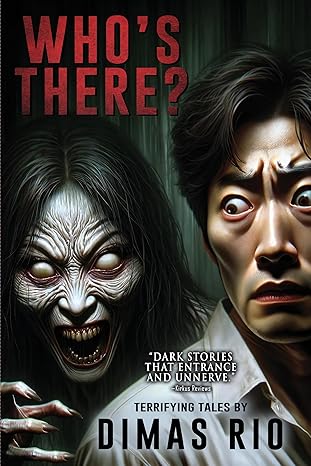

Who’s There?: A Collection of Short Horror, Supernatural, and Ghost Stories by Dimas Rio is a dark and immersive anthology of supernatural horror stories, each laced with elements of suspense and psychological tension. The collection delves into the realms of fear, exploring themes of guilt, unresolved trauma, and the macabre unknown. From tales of haunted islands to cursed beings hiding in the shadows, the stories are designed to unnerve and provoke reflection on the horrors that lurk not only in the supernatural but also within the human psyche. Rio uses atmospheric settings and introspective character-driven narratives to create unsettling experiences for the reader.
One thing that stood out to me is Rio’s use of atmosphere and psychological depth in the stories. He doesn’t rely on jump scares or typical horror clichés. Instead, the horror often comes from the characters’ internal struggles and guilt. Take, for example, the story of Adam, whose anxiety and fear of commitment bleed into his nightmarish encounters. The tension between reality and supernatural dread blurs in such a way that you’re never quite sure where one begins and the other ends. The vivid description of the cursed island and Adam’s mental spiral left me both unnerved and intrigued. While the ambiance and psychological themes were compelling, the pacing of some stories felt uneven. The buildup often took a while, and by the time the supernatural element kicked in, I sometimes felt like it arrived too abruptly. This left me wanting just a bit more payoff from the slow-burn atmosphere Rio is so good at building. One notable aspect of the book is how Dimas Rio weaves cultural references into his horror, especially drawing from Indonesian folklore. In “At Dusk,” when the old man mentions Kelinting, the blood-sucking spirit, there’s a distinct sense of place and history. It’s refreshing to see horror that taps into cultural myths that aren’t as widely explored in mainstream horror. This adds a layer of authenticity and makes the horror feel more personal, as if these are tales that could truly haunt someone’s village or neighborhood, rather than just abstract concepts of fear.
Who’s There? is a haunting and thoughtful collection that’s perfect for readers who enjoy slow-burn psychological horror with a mix of cultural folklore. It’s not a book for someone looking for quick thrills or gore; instead, it’s for those who appreciate moody, atmospheric horror that leaves you unsettled long after you’ve turned the last page. If you’re into horror that’s more about what’s lurking in the shadows of the mind, this collection is well worth the read.
Pages: 193 | ASIN : B0B29PSLSC
Kintsugi

Asayi: An Autistic Teen’s Journey to Topple a Shogun in Medieval Japan follows an autistic teen on a journey to challenge the oppressive regime and find her tribe and love. What are some things that you find interesting about the human condition that you think make for great fiction?
In Asayi – An Autistic Teen’s Journey to Topple a Shogun in Medieval Japan, the main character, Asayi, presents as mute. She understands what is spoken to her and can copy text, i.e., ink Japanese characters, but in book one, she is illiterate.
So Asayi has a rare skill, but is hampered by her lack of literacy. Not being able to speak is a severe disability in a culture that is with obsessed with perfection. That is why Nabui constantly repeats that the Shogun “had given him a defective gift” when Yoshinori Ashikaga arranged for Nabui to marry Asayi after her father’s death. The Shogun felt that the daughter of the late Chief Scribe needed to be placed in Nabui’s household since he was the next Chief Scribe. Asayi’s “defectiveness” led to beatings, rape and other cruelities in Nabui’s household. It was not until Yoshinori’s successor, Yoshimasa, came to power that the obsession with perfection came to be a bit dispelled. Yoshimasa introduced the art of “kintsugi” in the 15th century wherein broken porcelain was repaired with gold welding to restore its wholeness and utility.
While life has many struggles, the disabled in Medieval Japan suffered through more struggles than the average person. Had Asayi not been connected through her Chief Scribe father to the power circles, she would have no doubt been killed as a child or used as a household slave. As it was her father kept her condition a secret from the court during his lifetime. Asayi’s humanity is affirmed as she learns to communicate with others by drawing. Thus Asayi adapts to her limitation and uses her prowess with the brush to have a voice.
What were some themes that were important for you to explore in this book?
Certainly, I wanted to touch upon the norm of perfection held by the aristocratic class and present its impact on an autistic young girl. I also wanted to touch upon the severe restrictions on the lives of women in this period as they were ruthlessly governed by fathers, brothers, and husbands. When I asked a friend of mine who I worked with to teach me Japanese, he told me that I needed to learn the language from a woman. I then discovered the Japanese language spoken by women was like a different language, filled with many honorific words for males that the women were to use in conversation with men!
What is the next book that you are working on, and when will it be available?
In my next book I will be covering the theft of the Imperial Regalia from the Northern Court. Controlled by the Ashikaga family for generations by the Southern Court, which was the province of the emperor. The regalia consisted of a sovereign sword, a many-sided mirror, and some gems. Whoever possessed these objects had the mandate to reign, and they were coveted by each Court. Asayi goes underground to recover these objects, so another adventure lies ahead.
Author Links: Website | YouTube | GoodReads | Librarything
Layers of nuance unfold: the vulnerability of an autistic young woman in a merciless time period; political unrest, physical survival, secret identities, and finding one’s tribe and love while facing injustices and revolts that are just as real as today’s inequities and discontents.
The underdogs prevail in this remarkable medieval Japanese saga replete with true to life characters, political and personal sagas, and the enduring Asian cultural icon: the ghost.
Asayi: An Autistic Teen’s Journey to Topple a Shogun in Medieval Japan
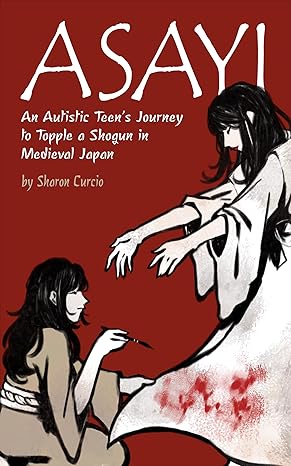
Asayi: An Autistic Teen’s Journey to Topple a Shogun in Medieval Japan, by Sharon Curcio, is a compelling narrative that immerses readers into the tumultuous life of Asayi, an autistic young woman navigating the perilous landscape of medieval Japan. From the very beginning, the story is laden with tension as Asayi confronts political intrigue and social turmoil, resolutely determined to challenge an oppressive regime. The story unfolds through a rich tapestry of court drama and shadowy characters spanning all social strata. Deception is rife, yet amid the swirling machinations, the truth gradually emerges. The portrayal of Asayi’s vulnerability, coupled with her formidable resolve, offers a deeply nuanced perspective on the challenges faced by individuals with autism in a ruthless era.
Asayi’s journey transcends mere survival; it is about discovering her tribe and finding love amidst chaos. The relationships she forms, particularly with her father, the housekeeper Hatsu, and the ever-present spirit of her late mother, Omari, are both touching and profound. These connections ground her as she confronts numerous challenges, including the daunting prospect of an arranged marriage and the scrutiny of the Shogun’s court. Curcio’s masterful storytelling brings to life the visceral reality of political unrest and the constant fight for survival.
Asayi’s journey, marked by secret identities and the relentless pursuit of justice, echoes enduring struggles against inequities and societal discontent, resonating with contemporary issues. The narrative not only highlights Asayi’s personal battles but also her quest for belonging and love, weaving a powerful tale of finding one’s tribe amidst chaos. The novel’s strength lies in its authentic depiction of true-to-life characters and the enduring cultural motif of the ghost, enriching the story’s historical and emotional depth. Asayi is a remarkable saga of resilience and empowerment, where the underdogs ultimately prevail.
For those who appreciate historical fiction with profound emotional and cultural dimensions, Asayi is an unforgettable read. The book captures the essence of medieval Japan while addressing universal themes of identity, resilience, and justice.
Pages: 160 | ASIN : B0D3FRCC19
The Ghost of Highgate

Nestled within the haunting confines of London’s Highgate Cemetery, Nob, an IT engineer, finds himself meandering and deep in thought. In an unexpected twist, he suddenly starts receiving telepathic messages from a rather illustrious cemetery resident, the famed philosopher Karl Marx. In an attempt to rectify misunderstandings about his ideologies, Marx seeks Nob’s assistance. This peculiar pairing sets forth on a whirlwind journey, tackling a series of outlandish challenges as they strive to address the misconceptions held by Marx’s critics.
The Ghost of Highgate by Bob Mazzei can be best described as a fusion of supernatural intrigue with a comedic flair. While some might anticipate the atmospheric tension found in the works of British author Brian Lumley’s Necroscope series, this narrative is reminiscent of the lighthearted fantasy of Terry Pratchett’s Discworld series.
The originality of the plot—Nob joining forces with the spirit of Karl Marx—is undeniably one of Mazzei’s strengths, offering a refreshing narrative arc. While I enjoyed the story, maintaining the voice and intellect of Marx proves challenging. I feel that there are instances where the representation of Marx’s spirit seems less genuine. I felt that this occasionally affects the immersive quality of the story, causing readers to grapple with fully embracing the central premise.
Nevertheless, the ingenuity of the plot’s foundation certainly warrants exploration by readers. It’s evident that Mazzei ventured outside his comfort zone in crafting this novel—a commendable endeavor for any writer. It will be intriguing to see where his literary journey takes him next, possibly steering towards a narrative that resonates more seamlessly.
Pages: 226 | ASIN : B0CJRV854G



 LITERARY TITAN