Blog Archives
A Lack of Closure

Born of Bombs and Bullets follows a prison psychologist who relocates to Belfast following a brutal murder only to find himself deep within unrest tied to the IRA. What was the inspiration for the setup of your story?
While visiting Belfast, Northern Ireland, a few years ago, I took a political history tour to learn about The Troubles. Although that 30-year conflict supposedly ended with the Good Friday peace agreement in 1998, signs of lingering tension between the Catholic and Protestant communities were everywhere, especially in West Belfast.
Massive peace walls separated the two communities. I saw dozens of murals commemorating attacks and the people who died on both sides—ever-present reminders of the horror and grief and trauma that lasted an entire generation. There were even IRA stickers on street signs warning people not to cooperate with the police. I wondered what it’s like to live with that sort of constant strain. Afterward, when I started reading daily news reports from Belfast, I sensed a lack of closure on both sides of the conflict that haunts people today.
Imaginary characters began to form in my mind, and soon I gave them life through words—with a bit of history mixed in for context. To maintain objectivity, though, I decided to write the story through the eyes of an American psychologist. But first I needed to get him to Belfast, so that murder in the first chapter served as a catalyst.
What kind of research went into putting this book together?
A lot! But first, let me say the characters and the story are entirely fictional. Still, I knew from the beginning I wanted readers—especially here in the States, where The Troubles are less understood—to walk away with an accurate understanding of historical events. So I read countless histories and old press accounts, studied period photographs, and watched a lot of documentaries about The Troubles.
They have different car models and candy brands, for example, in the UK, so I had to research those details, too, to make the descriptions as authentic as possible. I also subscribed to Belfast news media and read the current daily headlines for a couple of years—that really helped me grasp the lingering effects of The Troubles.
At the same time, I wanted to acknowledge the psychological impact of such a prolonged and pervasive conflict. So I researched Northern Ireland’s modern behavioral health trends and reflected those themes in the characters. The descriptions of combat equipment and tactics—then and now—are as accurate as I could make them, as well. I really wanted the story to feel genuine, even though it’s entirely made up.
The hardest part, though, as an American, was trying to master the Northern Irish idioms and accents in the dialogue! I watched a lot of Northern Irish movies and television to get a handle on that—and I apologize now for any times I got it wrong! I’m sure a few “Americanisms” slipped past me.
What elements do you feel are essential for creating a successful thriller?
For me, it boils down to tension, plot twists, and pacing. Conflict between the characters—and of course, setbacks—generates the tension. An ever-present sense of danger fuels it, too.
And plot twists keep the reader guessing and therefore engaged. But above all, in my opinion, the pacing has to be right. The action needs to move forward consistently at a good clip to keep the reader’s attention. Personally, I’m a big fan of short chapters with fewer words per page to promote a feeling of urgency.
Can we look forward to seeing a follow-up to Born of Bombs and Bullets soon? Where will it take readers?
Absolutely! There will be several more books in the series, but I don’t anticipate the next one until late 2026. My niche is travel-inspired thrillers, so the setting will be another country with a fascinating history. I’m presently choosing among Spain, Argentina, and Chile. Maybe your readers can help me decide?!
Author Links: GoodReads | Facebook | Website | Amazon
Psychologist Aaron Thornton is riddled with self-doubt after failing to stop a tragic incident at the American prison where he works. So when his wife, Claire, receives a job offer in her native Belfast, Northern Ireland, he sees a chance to start over by treating hardened criminals in Northern Ireland’s judicial system.
But Thornton’s work soon entangles him in the aftermath of ‘The Troubles,’ a brutal conflict that rocked Belfast for over thirty years. Charged with overseeing the release of the Irish Republican Army’s deadliest bomb maker, Thornton reignites smoldering feuds that threaten to consume him and his family in the flames of political violence.
Alongside a broad cast of characters who reflect the many facets and shifting allegiances of The Troubles, Thornton fights to heal long-standing hatred and prevent another tragedy. But can he save himself?
In the spirit of John le Carré and Graham Greene, writer David A. Dummer has created an everyman hero for our time, and with Born of Bombs and Bullets, a political thriller for the ages.
Born of Bombs and Bullets: An Aaron Thornton Thriller


David A. Dummer’s Born of Bombs and Bullets is a sharply written, emotionally charged political thriller that pulls no punches. It follows Dr. Aaron Thornton, a prison psychologist whose life is upended after a brutal murder at the penitentiary where he works. Seeking a reset, he relocates with his wife Claire to Belfast—only to be thrust into a volatile world of old grudges, hidden identities, and a brewing storm of violence tied to the legacy of the IRA. Through layered narratives, the book digs into the personal and political costs of trauma, loyalty, and vengeance, all against the backdrop of Northern Ireland’s troubled history.
What grabbed me first was the way Dummer weaves high-stakes action with genuinely human moments. The opening scene inside USP Hazelton is pure tension. One second, you’re in a therapy session; the next, you’re watching the chaos unfold, ending in a devastating double murder. I felt the chill in the room, the tension in Thornton’s indecision, the horrifying weight of inaction. That moment—when Thornton can’t bring himself to strike with the baton—lingers through the rest of the book. It’s a quiet, haunting flaw that makes him real. Dummer doesn’t just serve up trauma; he lets it stew, then uses it to shape the characters.
The Belfast chapters dig deeper into identity and trauma, especially through Liam O’Malley and Tommy Magee. Liam’s backstory—particularly the vivid, heart-shattering scene where his sister Deidre is killed by a British armored vehicle—is one of the most powerful in the book. It felt cinematic and visceral. That single event justifies Liam’s rage and radicalization. At the same time, Dummer avoids painting him as a monster. Liam’s weariness, his doubts about renewed violence, his reflections on a life lived in shadows—they’re painfully honest.
On the flip side, we’ve got Tommy. He’s the emotional powder keg—an orphan, a trauma case, caught in a cycle of poverty and rage. His journey from suicidal despair on Ballycastle Beach to reluctant accomplice in a murder is wild. His flashbacks, especially the aftermath of the Sheehan’s furniture store bombing, are raw and haunting. What impressed me was how Dummer shows Tommy slipping into violence. He’s not evil. He’s broken. And in that brokenness, he becomes someone else’s weapon.
The pacing is tight, the writing is sharp, and the dialogue has just the right edge of grit and realism. It does get pretty heavy, especially with all the political history and acronyms. But Dummer does a solid job of keeping it digestible. He throws you into a world of factions and vendettas, sure—but never without anchoring it in people who bleed, mourn, and remember. The balance between plot and pathos is what makes this more than just a thriller. It’s a character study in the ruins of ideology.
I really liked this book. It’s not a breezy read—it’s emotionally heavy, politically messy, and morally gray. But it’s also compelling as hell. If you’re into thrillers with a conscience, stories that tackle trauma, redemption, and the gritty realism of sectarian violence, you’ll want to check this out. Fans of The Troubles-era fiction, political thrillers like The Ghost or The Constant Gardener will find plenty to chew on here.
Pages: 458 | ASIN : B0DY6MS7F8

Characters Breathe Life

In Provenance of Ashes, a group of students in East Berlin finds themselves deep within an international espionage plot that spans decades. Where did the idea for this novel come from?
The idea sprung from two different threads. I was fascinated when reading about the case of Cornelius Gurlitt (the son of a famous Nazi art dealer), who had a hoard of paintings stashed in his apartment and was caught in modern times on a Swiss train after selling one of the paintings. I was intrigued that paintings with such a sordid past could be hidden for decades and surreptitiously sold in the new millennium. I’ve also done lots of global travel, in the course of which I met people who worked for (or used to, I think!) Israeli intelligence and the Stasi.
Which comes more naturally to you? The plot or your characters?
The plot/broader concept, and then my characters breathe life into the story.
What part of this book was the most fun to write?
Too tough to answer! Perhaps the reminiscing of Werner, the evil former Stasi agent and bastard son of the Nazi who stole and hid art at the end of WWII.
Can we look forward to a follow-up to this novel? What are you currently working on?
Absolutely–I am working on a new novel featuring Marco and Beryl, which will fit into the theme of a Married into the Mossad Thriller but not willing to reveal more just yet!
Author Links: GoodReads | Facebook | Website | Amazon
Realizing jet-set passions are no match for Beryl’s nobler pursuits in hunting Werner, Marco slowly yields to his wife’s batting eyes and steely determination. Love, loyalty, and a quest for restitution drag him into the Mossad’s embrace. When the couple near the truth about Werner’s real identity, they must confront a dark secret of their own buried deep in East Berlin. Will either side risk exposing past crimes to win today’s cat-and-mouse battle? Beryl and Marco plot traps spanning the Mid-East, Silicon Valley, and Holland as modern-day spies counter legendary espionage guile.
Jeff Ulin’s thriller Provenance of Ashes thrusts the weight of haunting history into a marriage grappling with higher priorities. Read it now and travel into a world of shadows where the mantra never forget motivates patriots of good and evil.
Provenance of Ashes
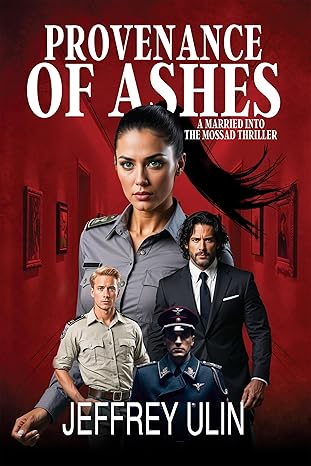

Jeffrey Ulin’s Provenance of Ashes is a riveting espionage thriller that grips you from the first page and doesn’t let go. Set against a backdrop of historical intrigue, the novel weaves a complex tale of Nazi-looted art, the Mossad, and a tangled web of past and present secrets. The story moves between different time periods and locations, from 1944 Munich, where stolen masterpieces are hidden, to 1988 East Berlin, where a group of students gets caught up in international espionage, and beyond. At its core, the book explores the weight of history, the moral compromises people make, and how the past refuses to stay buried.
Ulin’s writing is immersive, pulling you into his world with vivid descriptions and sharp, believable dialogue. The opening scene in wartime Munich sets the tone beautifully, artwork being smuggled under the cover of chaos, a Nazi officer sealing away treasures not for admiration but as leverage for the Reich’s uncertain future. The historical depth of the novel is one of its strongest points. It’s clear Ulin did his research, crafting a narrative that feels both authentic and compelling. The Nazi antagonist, Dieter Mullenhauer, is terrifyingly pragmatic, making his actions all the more chilling. His cold efficiency in hiding stolen art and eliminating witnesses without hesitation is disturbingly real.
The modern storyline, particularly the sections set in 1988 East Berlin, was my favorite part of the book. The tension is thick from the moment the protagonist, Marco Bellagio, and his friends cross into East Germany under the pretense of attending a Bruce Springsteen concert. Their naive excitement quickly turns to paranoia when they realize they’re being watched. The dialogue in these scenes crackles with nervous energy, especially when they unknowingly befriend two East German men who might not be as harmless as they seem. The casual way these characters discuss escaping to the West, offering information in exchange, is haunting. You can feel the walls closing in around Marco, even if he doesn’t fully realize it yet.
The book sometimes juggles so many storylines that it risks losing momentum. The alternating perspectives between past and present add depth but occasionally slow things down. That said, the chapters written from the perspective of Werner Boesseneker, a second-generation Nazi loyalist embedded in the Stasi, were eerily fascinating. His unwavering belief in his father’s ideology makes him a compelling but disturbing character. The best thrillers make you uneasy, and Ulin certainly accomplishes that.
I’d recommend Provenance of Ashes to fans of historical thrillers, espionage fiction, and anyone who enjoys a well-researched, intricate plot. If you liked The Night Manager by John le Carré or The Art Forger by B.A. Shapiro, this book is right up your alley. Ulin balances action with historical weight, creating a novel that lingers long after the last page. It’s a high-stakes journey through history, deception, and the power of secrets, and it’s definitely worth taking.
Pages: 396 | ASIN : B0DSCKL6DK
Ebbing and Flowing in Emotions

The Lady of the Lighthouse follows a woman balancing a lonely existence, a failing marriage, and her own unwitting involvement in espionage. Where did the idea for this novel come from?
I’m drawn to reading novels that explore themes revolving around suspense and difficult choices. I wanted to write a novel in a similar vein. Loralei is a strong, flawed, yet relatable character, I think, who struggles to live her life her way with her convictions despite the difficult time and situation she lives in.
Did you plan the tone and direction of the novel before writing, or did it come out organically as you were writing?
I had an idea of the general direction of this novel because I sketched out the ending and a few basic ideas before I started writing. The overall tone of the novel seemed to develop on its own, ebbing and flowing in emotions and actions based on what the characters ended up doing.
What was your approach to writing the interactions between Loralei and Devon?
I tried to have Loralei and Devon react to each other’s words and actions in scenes including dialogue to give a sense of their relationship. But I also tried to include an unspoken tension between them, which probably came from all the outside pressures they were dealing with in their lives, that drove their individual actions and affected how they related to each other and other people.
Can we look forward to more work from you soon? What are you currently working on?
I am working on another suspense novel.
Author Links: GoodReads | Website | Amazon
A pirate, a Great Lakes shipping captain, a dashing Italian spy, and the lonely, pregnant young mother who loved them all.
Loralei Lancaster, a lonely, pregnant young mother and lighthouse keeper on the Great Lakes is caught up in a WWII espionage plot while waiting for her shipping-captain husband, Devon, to return from a Great Lakes voyage. When a dashing, Italian spy posing as a down-and-out art dealer and handyman enters her life and seduces her, she must ultimately choose between her passionate love for him and her love for Devon, her family and her country.
The Lady of the Lighthouse
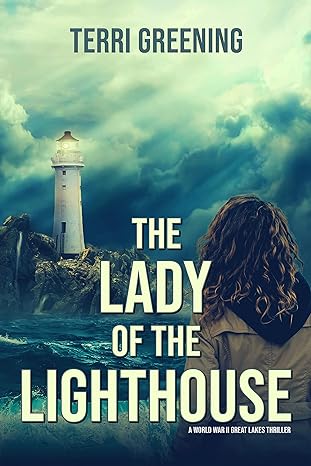
Terri Greening’s The Lady of the Lighthouse is a historical novel set during WWII, blending the isolation of lighthouse life with suspense, wartime intrigue, and forbidden love. The story follows Loralei Lancaster, the devoted keeper of a lighthouse on Lake Superior, as she navigates loneliness, her troubled marriage to freighter Captain Devon, and the threat of sabotage by a shadowy enemy. Meanwhile, subplots of espionage and sabotage unfold in Europe, connecting art theft, Nazi spies, and clandestine missions to the broader war effort. The novel weaves history with fiction, painting vivid portraits of both the wilderness and the darker edges of human relationships.
In the opening scene, Loralei is gazing over a kaleidoscope sunset while tending to the beacon, which immediately sets a vivid tone. You can feel her yearning, both for her distant husband and the life they once had. The lighthouse feels alive, a character in its own right, and a symbolic role as a beacon of hope amidst the war’s chaos. But just when you think the story is about quiet introspection, the plot thickens. Loralei’s encounters with Jake Calico, a supposed smuggler who may be sabotaging ships, add a layer of danger and temptation that feels like catnip for fans of morally complex thrillers. Her midnight trysts on the beach with this mysterious man create a palpable tension between duty and desire, and I found myself flipping pages, torn between rooting for her and questioning her judgment.
Loralei is complex and relatable, haunted by grief and longing for connection. But Devon’s coldness made me want to yell at him to shape up! His aloofness is explained by his love for the lake and his father’s death, but there’s a bitterness in his treatment of Loralei that makes their scenes uncomfortable at times. The subplot involving Loralei’s fears that her unborn child might not be Devon’s raised the stakes emotionally. Jake is enigmatic, brooding, and too charming for his own good. The plot twist was thrilling but also heartbreaking.
Andre Sorrento, an Italian spy masquerading as an art curator, brings a high-stakes international angle to the story. Andre’s ability to hide in plain sight while committing cold-blooded murders added a sinister flair. The art theft subplot, involving priceless works hidden from the Nazis, gave me Monuments Men vibes. I couldn’t help but appreciate how the novel tied together seemingly disparate elements art, espionage, and domestic drama into a cohesive narrative.
The Lady of the Lighthouse is a fascinating read. It’s part historical drama, part romance, and part wartime thriller, offering a little something for everyone. Fans of espionage will enjoy Andre’s cold calculations and the Nazi sabotage plot, while those drawn to romance will savor Loralei’s complicated love life. The writing is atmospheric, the themes of loss and resilience are poignant, and the historical details make the story immersive. I’d recommend it to anyone who loves historical fiction with an edge of danger or to those who’ve ever dreamed of lighthouses and longed to uncover their secrets.
Pages: 271 | ASIN : B0BXHT12ZK
Stop at Nothing

Stinger follows a former DEA informant thrust into a deadly CIA mission to secure a Stinger missile, risking everything to save his kidnapped family in a world of espionage, betrayal, and impossible choices. What was the inspiration for the setup of your story?
I was thinking, what if I was a CIA officer tasked with developing a plan to prevent the US from having to invade Iraq to search for weapons of mass destruction. This would be my plan.
How much of the detail in Stinger comes from your own law enforcement background?
The investigative procedures performed by the law enforcement characters are exactly as it would have been done in 2003 if this was a real investigation.
Amir Rahimi is a compelling villain. What was your approach to making him so layered and menacing?
He’s desperate to avenge his son’s death. I wanted him to stop at nothing in getting that revenge.
What is the next book that you are working on, and when will it be available?
I’m contracted with my same publisher, Black Rose Writing, to write a memoir about my four years in Pakistan as a DEA Agent. The working title is: DEA Assignment: Pakistan. It is scheduled to be released April, 2026.
Author Links: Goodreads | X (Twitter) | Facebook | Website | Amazon
She coerces Robaire Assaly, a Los Angeles based DEA Confidential Informant, to take part in her elaborate scheme. Robaire agrees, however, in doing so, he must betray his long-time DEA Agent handler, Gary Lowery, to get what she needs. Robaire soon realizes June has tricked him into taking the blame for stealing a Stinger missile, which she pulled off right under the nose of the hapless FBI.
The duped FBI and Gary desperately want Robaire. He’s now frantically on the run as an international fugitive with the FBI and Gary relentlessly pursuing him and the stolen Stinger before it is used against an unknown target. However, June finds Robaire first before he can reveal the CIA’s involvement to the Feds.
Treasure-Laden Expedition

The Lost Expedition follows a former Indian paratrooper who, while trying to enjoy a vacation in Dubrovnik, gets sucked into a web of danger involving war photographers, mystical relics, and Croatian warlords. What was the inspiration for the setup of your story?
Being an Indian thriller novelist, I felt obliged to have an Indian protagonist in one of my thriller series. I wanted history and global locations. The series had to be educative, too, and preferably, have a link to India. And of course, the protagonist had to handle dangerous situations. Thus was born “Izak Kaurben.” Izak is a play on Isaac, and Kaurben is arguably an Indian-sounding name. Izak Kaurben is an elite paratrooper who, after a bitter experience in a mission (described in the series’ first book, RELIC) wanders the world. Croatia caught my eye as a good kick-off point for the series. So, Kaurben arrives in Croatia, hoping for a peaceful Eastern Europe backpacking experience, and instead, gets embroiled in trouble. THE LOST EXPEDITION follows closely after the events of RELIC. It is nearly a Part II because it closes plot lines opened in RELIC. However, readers have sufficient background to get into the story without reading RELIC. That being said, it’s a more enjoyable read in order.
The Malian Empire and Mansa Musa (the richest man ever) have been on my mind for years. The idea of a fabulous treasure-laden expedition across the Atlantic and the hunt for that treasure is a hook that never gets old. Linking it to Croatia and other key elements — like the ship graveyard in Nouadhibou and slave trade — was the hard part. But, if your review is any sign, I believe I’ve created a plausible and exciting scenario. 🙂
What character did you enjoy writing for? Was there one that was more challenging to write for?
If you notice, each “part” of the story begins with a Cast of Characters. I felt it a good way to ease them into the picture without overwhelming the reader. I enjoyed writing Chief Inspector Goran. In RELIC, he is a no-nonsense ‘top cop.’ Here, I had fun ripping away his ‘work ethic’ yet keeping him honorable. Writing the Senegalese characters was challenging, because of the non-linear plot structure — it switches between present-day and flashbacks often — and determining the optimal way to plug them into the events of RELIC.
I felt that the action scenes were expertly crafted. I find that this is an area that can be overdone in novels. How did you approach this subject to make sure it flowed evenly?
I avoid unnecessary action. If my characters can flee instead of engaging, they will do that. Even in an action sequence, I do not labour with distance measurements, specifications of guns and bullets, and physics and chemistry. It has to be quick, like you — the reader — is watching it. This, keeps it light and fluffy, like a good pancake. 🙂
What will the next book in that series be about and when will it be published?
I’m on a book-a-year process. The next book comes out in 2025. Without revealing too much, Izak Kaurben will come face to face with a ghost from his past. And there’s a dollop of history, too.
Author Links: GoodReads | Website | The Lost Expedition-Behind the Scenes | Amazon
“I need your help,” Goran says, as he unpacks a stash of weapons… “To commit a crime.”
Before Kaurben can stop him, Goran puts his plan into action: ambush a prisoner transport van and free a Senegalese gangster.
The Senegalese can help locate an old Russian fishing vessel. Aboard this ship is evidence that Goran seeks — at any cost — to solve a case that is deeply personal to him.
From Croatia to the world’s largest ship graveyard in Mauritania, to the Archivo General de Indias — the greatest repository of the Spanish Empire’s history in the New World, to the Caribbean Islands, Izak Kaurben is in a race against time and unknown adversaries…
Because the ship has another secret — one that will rewrite history and point the way to a fabled treasure horde.



 LITERARY TITAN