Blog Archives
Two Destinations

13: Stone Corners and Other Stories is a collection of ghost stories rooted in memory, family, guilt, faith, and the strange comfort of being scared on purpose. What was the inspiration for the setup of your story?
I used to split my time between writing lyrics, and songs, and stories. My songs were well-received (the other bandmates liked them, and a few got on the St. Louis radio). So, I wondered what the difference was between my songwriting and my failed fiction writing. There were a few reasons: the lyrics were concise, had a good rhythm, and hit with emotion, whereas my fiction meandered and often didn’t connect. The goal was to make my fiction more like my songwriting: to the point, playful with the rhythm, and to pack an emotional punch.
Adding to that goal would be what to write or which genre to explore. As a teen and a young adult, I had tried fantasy (which was derivative and boring) and science fiction (which wasn’t very plausible). In college, I tried creative writing and realized I had a lot of maturing to do in order to write convincing fiction, so I gravitated to alternative rock and roll music, which gave me immediate satisfaction and feedback. However, that lifestyle wasn’t too healthy to maintain without serious deliberating habits.
In my first try at sobriety at age thirty-five, I decided to write a ghost story and use the lessons learned in my songwriting. I made a Ghost Emotion list, which would be the kind of things that might linger after death and feed a ghost: lust, murder, betrayal, despair, coveting, guarding someone or guarding against something, etc.
“Night At the Black Orpheum” was my first ghost story and the first story I wrote that I thought was publishable. From there, it was finding the seeds for a ghost story and mixing the reality with something weird.
At some point, I decided to name the collection under the umbrella title of 13 and all the connotations that number brings, though, for me, the number thirteen has some personal connections.
Are any of the locations featured in your book inspired by places you’ve known in real life?
Several, as it turns out. Some are first-hand experiences, such as ghost tours in the Crescent Hotel in Eureka Springs, Arkansas. That is the weirdest and most haunted place that I have been to. At the Meridian Coffee House in Alton, Illinois, I experienced orbs (quite a lot of that activity) and saw second-hand evidence of other manifestations. A nightmare about my grandparents’ huge basement inspired “A Sort of Homecoming.” In this dream, there were secret doors in closets that led to secret rooms that I had never explored. Taking the house as a metaphor for the mind, I used it to make a story of hidden secrets. “Blue Harvest” was a second-hand story told to me by my band-mates who all went to a haunted barn where there had been a mass killing by a deranged father (I had to leave early that night and was not present). Two of my bandmates gave me some details, but the third refused to talk and quit the band soon afterwards. A little later, I went to his house, and he told me his version of the events, which provided the climax for the story. He had been so upset by what he had seen that he eventually became a Christian preacher.
Faith is woven naturally into many of these stories. How important was it to treat spiritual belief as an active part of the supernatural rather than simply a background detail?
My upbringing in a Christian home instilled a belief in an afterlife with two destinations. As a history student, I read a lot about the Egyptian and Greek beliefs and depictions of the afterlife. As a reader, I discovered that the best ghost literature hinged on one important fact: the people in the stories believed in the phenomena happening to them in order to understand it, combat it, or resolve it. At some point, after watching ghost documentaries, reading nonfiction accounts of hauntings, and watching debunkers, I came to the conclusions that there could be four assumptions: one, it’s just in our imaginations (but if I can project ghosts, I wish I could learn how to project so many other things like money and gold); two, it’s all real like people say they’ve experienced (which tends to make people very uncomfortable); three, it’s not real, but seems real due to magnetic fields or some kind of local force in the environment that acts upon our brain and causes the projection to manifest; or four, this phenomena is real and can only interact in our section of reality by using certain electrical wavelengths or light spectrums and has other attributes beyond our knowing.
I am open-minded to the phenomenon. I can’t explain away everything I’ve seen, or heard, or felt other than it’s beyond me. Even as a believing Christian, can a spirit be seen, or is it actually the spirit of the deceased or something nastier? There are such stories in the Bible. Jesus was a demon hunter. They sure didn’t like it when He came to town.
Are there other haunted places or family stories waiting to be explored?
Yes, I am working on a companion collection of tales for a future 13 collection. One other tale that I posted on Substack involves a visit to the St. Augustine Lighthouse. My wife wanted to visit; I’ve never been to a lighthouse, and I love historical places. But I had no idea of the ghost activity there and only learned about it when two workers told me about it. A third worker knew their stories but was a skeptic. He said, “I’m only a skeptic because I have never seen a ghost. I would love to see a ghost and be proven wrong.” Well, there you are: that became the seed for a story.
Author Links: GoodReads | Facebook | Website | Amazon
The Genre Holder
Ex-Mas Song follows a man who survives a suicide attempt and wakes to face his failures, toxic attachment, fractured family life, and desperate need for recovery. At what point did you know this would become a Christmas story?
This project began as a dare from my then second wife to write a meta-fiction story like the film Adaptation, directed by Spike Jonze and written by Charlie Kaufman (portrayed by Nicolas Cage in the movie), who writes about his problems scripting a non-fiction book into a metaphysical meta-mess of a comedy. My first thought was, “Well, what would I write about?” The answer became what was going on around me during Christmas. That became the starting point, but I spun my wheels on it until I came up with an idea for a structure: mimic A Christmas Carol. Since mental health, suicide ideation, addiction, and recovery play such a prominent role in my life’s history and experience, that became the idea, and A Christmas Carol became the genre holder, so to speak. “Cont;nue” became a subtheme for the book.
Faith is central to the novel, but the journey feels more like wrestling than preaching. Was that balance important to you?
My faith became the cornerstone that made my redemption possible. However, after it happens, it’s no longer about me, but about helping others. After I began to let God reshape my life, I began to serve others more. In order to serve, you have to talk to people and listen to their stories. The opportunity came to help lead a faith-based twelve-step program, which is about “walking the talk”, yielding oneself for service, or living out the Serenity Prayer. The Lord’s Prayer and the Serenity Prayer are my cornerstones to sobriety and sanity. There is no use in preaching those prayers. One must live them out for them to be of any use. Words are meaningless without being connected to action and the motives of the heart. When the right words match the right motives, miracles can happen!
The psychiatric ward is portrayed with both pain and humanity. How important was it to avoid stereotypes?
There were no stereotypes since most of it was based on first-hand experience; Grandpa’s Ghost, Boz, and the Merry Prankster were meta-add-ins from A Christmas Carol (Boz) structure. The closest literary experience that I have come across regarding a psychiatric ward would be One Flew Over the Cuckoo’s Nest, by Ken Kesey (the Merry Prankster), which I read after my own experience. I would like to add that some reviewers and readers have mixed reactions to Blair (which can translate to “battlefield”). Your review was very sympathetic. Hint: she represents the PAST, and as we all know, the Past Doesn’t Change: it’s a Dead End. The Serenity Prayer helps me to deal with the past and to focus on the here and now as I head toward the future.
What is the next book you are working on, and when will it be available?
I have two ongoing concerns. The older and longer project is a Mark Twain meets Jules Verne steam balloon adventure. A grandfather tinkerer makes a balloon for one last adventure, only to discover his granddaughter has stowed away, and shenanigans ensue. I am about three-fourths done with a draft, but since I revise as I go along, I doubt this will be finished and published in 2027.
The other ongoing project is my latest serial on Substack. Breaking Grin’s Law is a Gothic mystery, an alchemical comedy with an ensemble cast. Set in 1803 Heidelberg, Germany, two orphaned brothers, Sebastian and Karl Grin, work at a rare book store and attend University during the night, and solve bizarre occult mysteries at night. The serial comes out at the end of every month, covering the brothers’ adventure in the form of a principle that is experienced or discovered. I am halfway done with this project. The latest installment is June’s “Send in the Golem,” which is available here.
Once the serial is complete, it will form the next installment of the 13 short story collection, which I hope to publish sometime in 2027, so to speak. “Cont;nue” became a subtheme for the book.
Author Links: GoodReads | Facebook | Website | Amazon
13: Stone Corners and Other Stories


13: Stone Corners and Other Stories is a ghost story collection built around houses, basements, churches, bars, old stages, graveyards, orchards, and the emotional leftovers people carry into those places. Jeffrey Cummins frames the number thirteen as personal, spiritual, and spooky, writing in the foreword, “It haunts me pleasantly enough. It is nothing to fear.” That line fits the whole book: these stories are frightening, but they’re also deeply interested in memory, family, guilt, faith, and the strange comfort of being scared on purpose.
The collection has a strong sense of place. “A Sort of Homecoming” turns a grandparent’s house into a map of the mind, with rooms, closets, and basements holding old dread. “Lethe Home” returns to that basement in a tighter, sharper childhood nightmare. “Stone Corners” expands the book’s world through Kelley and Mercury Branscombe, whose supernatural sensitivity turns an old home into a spiritual battleground. The stories often feel like someone telling you what happened late at night, after everyone else has gone quiet.
Cummins’ horror is very physical. Floorboards wobble, doors slam, beetles crawl, shadows gather in corners, and the dead don’t stay politely symbolic. At the same time, the supernatural usually points back to something human: a mother’s fear in “Tearing at Holes,” a town’s buried violence in “Haunting My Hometown,” temptation and bravado in “Blue Harvest,” or grief and music in “Night at the Black Orpheum.” Even when the book goes big, as in “The Day the Ghost Walks,” with Shakespearean theater and old debts among actors, it still comes back to the same question: what do the living owe the dead?
Faith runs through the collection in a direct and sincere way. Scripture, prayer, forgiveness, and spiritual warfare aren’t decorative here. They’re part of how characters understand fear and how they push back against it. That gives stories like “Ghostproof” and “Church of the Holy Spook” a distinctive personality, where the haunted house story and the testimony sit side by side. Cummins also has a fondness for rough-edged, conversational narration, mixing dread with jokes, domestic detail, and working-class memory.
What makes the book engaging is the way it treats ghost stories as something close to home. These aren’t just tales about apparitions. They’re about places that remember, people who can’t quite shake the past, and fear that keeps looking for a door back in. Near the end of the foreword, Cummins writes, “All I really have to do to find one is fall asleep.” That’s the book in one sentence: intimate, haunted, personal, and always listening for something moving in the dark.
Pages: 467 | ASIN : B0FLB6NHNP

Creative Non-Fiction

Leftwich Blues/Elfwitch Rules follows twin twelve-year-olds from a broken home who are abducted by the Elfwitch and taken to another world, where they must now find a way to get back home and heal their broken home. What was the inspiration for the setup of your story?
The idea started with the title. I like to make lists of titles from time to time. The title made me think who is Leftwich? Why does he have the blues? Who is the Elfwitch and why is she trying to rule? This image came to mind: a witch travelling through the air with twins she had kidnapped. One twin gets away, but the Elfwitch tricks the other twin into serving her. The escaped twin finds an oppressed people who need encouragement in fighting against the Elfwitch. So, the twin has to lead an uprising against the Elfwitch and try to free the other twin who turned against their original selves.
The idea reminds me of the many Saturday morning TV shows by Sid and Marty Krofft: H.R. PufnStuff or Lidsville plus other portal fantasies or science fiction movies like Alice in Wonderland or Planet of the Apes (the original from 1968, not the watered down remakes/reboots) where a stranger ends up in a strange land and has to keep their identity intact while turning from fugitive to hero/heroine to survive in a harsh new reality.
Your characters are wonderfully emotive and relatable. Were you able to use anything from your own life to inform their character development?
The twins’ first names I borrowed from my cousins. Their last name also belongs to distant cousins. I find that the more real or personal I can make the character or backstory, the more I can dig into it to adapt and change it according to how the story dictates. I was a mental health paraprofessional for a few years (so I have been to family court a few times) and worked at a charitable thrift store as well as conducting a twelve-step program and now I am a public educator. I have had ex-clients as my students and have come to know the families. I understand better the dynamic in households and the problems children bring to the classroom.
My writing has been called “creative non-fiction.” I never thought of it like that, but it’s true as I need a heavy dose of realism in my fiction before I introduce the weird and fantastical.
What themes were particularly important for you to explore in this book?
The idea of twins separated and working against each other and having to reconcile was the starting point. Then it became a study of duality: two sides or polar opposites that feed or synergize entities or issues: tyranny and freedom, good and evil, lies and truth, night and day, family/friends and foes, forgiveness and unforgiving.
Is this the first book in the series? If so, when is the next book coming out, and what can your fans expect in the next story?
This was written as a stand-alone. However, I am brewing ideas for a sequel (which I would make into a cliffhanger for a duology). That project will have to wait as I have two other current projects I am working on plus I am currently promoting my first collection of short stories: ghostly shudder tales.
Author Links: GoodReads | Website | Substack
Leftwich Blues/Elfwitch Rules
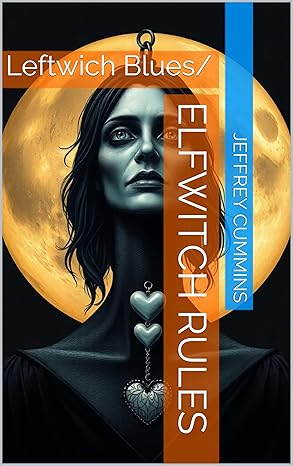
Leftwich Blues/Elfwitch Rules is a sweeping fantasy tale woven into the struggles of a fractured family. It starts in myth, with vows made under the moon and curses that shake kingdoms. Then it jolts into the present, landing in the Ozarks with two twins caught in the fallout of their parents’ broken marriage. From there, the story keeps folding back and forth between a mystical Realm of hunters, owls, and ancient metals, and the harsher modern reality of courtrooms, social workers, and family strife. The twin narratives eventually bleed together, blurring what is real, what is allegory, and what is memory.
The writing bounces between old-world fantasy language and down-to-earth small-town chatter. That clash can be jarring, but it also gives the book a unique energy. One minute I was caught up in quicksilver necklaces glowing under a full moon, the next I was listening to kids argue about video games and crackheads. Sometimes I found myself laughing at the dialogue, other times I felt weighed down by how bleak it could get. The swings were sharp, but they kept me reading.
What hit me hardest wasn’t the magic or the battles. It was the raw mess of family life. The fights between Mom and Dad felt too familiar, too close to real arguments I’ve overheard in my own life. The kids’ tug-of-war over which parent to trust felt honest, painful, and sad. The fantasy parts worked like a mirror, twisting those personal struggles into epic stakes. When the twins lost their footing in the “real” world, it was like the Realm itself was cracking apart. That connection between worlds gave the story its punch.
The sudden shifts might throw some readers. But for people who like fantasy mixed with real grit, who don’t mind faith and scripture tucked into the corners, and who can handle a story that cuts close to the bone about family, it’s worth the ride. I’d recommend it to readers who like their myths messy, their heroes flawed, and their stories willing to sit in both wonder and heartbreak.
Pages: 435 | ASIN : B09CD1D958


