Blog Archives
Deception, Love, and Revelation

The Seeker centers around a young silk weaver in 1203 Constantinople whose gift for revealing hidden truths places her in grave danger. What was the inspiration for the setup of your story?
In England, there is a television documentary series in which celebrities from different faiths and backgrounds undertake pilgrimages across the world. One episode followed their journey to Istanbul, and during it, they passed a wishing tree where a young girl sat beneath its branches selling strips of brightly coloured cloth. Visitors would buy a ribbon, tie it to the tree, and whisper a wish as they did so. The branches shimmered in the sunlight, heavy with hundreds of vibrant strips fluttering in the breeze.
The image stayed with me long after the programme had ended. Curious, I began researching wishing trees and discovered that similar traditions exist across many cultures and countries, often linked to spirituality, hope, and human longing. What fascinated me even more was the setting itself. Istanbul — once Constantinople — stood for centuries as the great bridge between East and West, a city where cultures, religions, and empires collided. It was also a major crossroads along the Crusading routes, making it impossible for me not to weave the city into my story.
As the idea developed, I transformed the concept of the wishing tree into something darker and more unsettling: a truth-revealing tree. Instead of granting desires, it would expose hidden truths, forcing characters to confront secrets they would rather keep buried. It became the perfect symbol for the tension at the heart of the novel — a meeting point of faith, deception, love, and revelation.
Deanda is often trusting to the point of vulnerability. Was that innocence intentional, and what does it represent in her character arc?
At the beginning of the story, it was very intentional that Deanda appeared innocent, vulnerable, and, at times, almost painfully naïve. I wanted her to embody the uncertainty and trust of someone who has not yet been exposed to the darker realities of power, ambition, and manipulation. Her gullibility is not a weakness without purpose; rather, it lays the foundation for her transformation across the series.
As the books progress, Deanda is gradually shaped by the dangerous world around her. She becomes more self-assured, more independent in her thinking, and far less willing to take people at face value. This evolution becomes especially significant once she is drawn into the volatile world of King John’s court — a place rife with political manoeuvring, shifting loyalties, betrayal, and hidden agendas. It was the perfect historical setting in which to test her character.
I wanted the court itself to feel almost predatory: a place where trust could be weaponised and where a single mistake might prove disastrous. Deanda’s innocence therefore, becomes both her vulnerability and the catalyst for her growth, allowing her to fall into carefully placed traps before learning, often painfully, how to navigate and ultimately escape them.
Did you ever struggle with how much historical fact versus fictional interpretation to include?
One of the greatest challenges I faced while writing the series was finding the balance between historical fact and historical fiction. I wanted readers to feel fully immersed in the medieval world — to be able to picture the castles, markets, courts, clothing, customs, and the people who inhabited them. The atmosphere and detail were incredibly important to me because I wanted the setting to feel authentic rather than simply decorative.
At the same time, I was determined to remain as faithful as possible to the real history of the era. All of my novels are rooted in actual historical events and broadly follow genuine timelines, although there are moments where chronology has been adjusted slightly in order to maintain narrative pace and dramatic momentum. That balance between accuracy and storytelling was something I constantly wrestled with throughout the writing process.
I also felt strongly about incorporating real historical figures — people readers would instantly recognise from history — because their presence gives the story greater weight and realism. However, while the foundations of these characters are historically grounded, I have occasionally adapted aspects of their personalities or interactions to heighten literary tension and improve readability. The only entirely fictional creations are Deanda, her family, and Asim.
Because of this, the research process became immense. I spent years studying the period to ensure that the appearances, reputations, achievements, and general characteristics of the historical figures aligned as closely as possible with how they are understood historically. I knew from the beginning that I would not be satisfied creating a purely fictional medieval backdrop; I wanted the novels to feel anchored in genuine history, with real events and real people shaping the emotional and political landscape of the story.
Where will the next book in The Hidden Truths Saga take readers?
The next instalments in the series will take Deanda’s relationship with her father to more complicated places, testing their loyalty and trust. As the political tensions surrounding the court intensify, Deanda finds herself increasingly drawn into the dangerous orbit of the king himself — at first manipulated by his authority and ambitions, but gradually learning how to manipulate him in return in order to honour the promise she made to Sir Richard.
This shift marks a significant turning point in her character. No longer the sheltered and trusting young woman of the earlier books, Deanda begins to understand that survival within King John’s court depends not only upon courage, but upon deception, strategy, and the careful use of influence.
At the same time, her relationship with Sir John deepens, evolving from fragile affection into a far more powerful and dangerous bond. Their eventual union, however, is anything but secure. What should represent safety and fulfilment instead places Deanda in even greater peril, as she slowly realises that the mysterious gift which once protected her can no longer shield her from the paranoid king.
As alliances fracture and ambitions spiral out of control, Deanda is forced to confront the terrifying possibility that she may simply become another sacrifice to King John’s increasingly delusional sense of power and destiny. The question that lingers over the series is not merely whether she can protect those she loves, but whether she herself will survive the ruthless world she has become entangled within.
Author Links: GoodReads | Facebook | Instagram | Website | Amazon
In a world teetering on the edge of faith and power, one woman’s gift could change the course of kingdoms.
Deanda, born with the power to see hidden truths, becomes a pawn in Emperor Alexius III’s ruthless quest for control. Her visions, coveted and feared, could topple empires—or destroy her. Across the sea, King John of England faces political ruin and prays for a sign from God. Fate answers in ways neither ruler could have foreseen, as prophecy binds their destinies together in a perilous dance of deception, ambition, and divine will.
From the glittering chaos of Constantinople to the intrigue of England’s royal court, The Seeker, Book One of the Hidden Truths Sagaweaves a breathtaking tale of love, betrayal, and revelation.
One woman holds the key to salvation—or ruin—for a kingdom.
Perfect for fans of Philippa Gregory and Emma Donoghue, this epic historical drama plunges you into a world of prophecy, passion, and power where every truth comes at a price.
The Seeker


The Seeker, by SJ Snel, is a medieval historical fantasy and the first book in The Hidden Truths Saga. It follows Deanda, a young silk weaver in 1203 Constantinople whose gift for revealing hidden truths places her in danger when politics, prophecy, faith, and war collide. After a vision tied to the Fourth Crusade, she is pulled from the fragile safety of her life and sent on a journey toward England, where her gift becomes entangled with King John, Sir Richard, and the brutal power games of the age.
I liked how the book treats truth as both sacred and dangerous. Deanda’s gift sounds simple at first, almost fairy-tale-like, but Snel makes it feel heavy. Every answer she gives has a cost. I liked that tension. The story is not just about seeing the truth, but about deciding when truth helps, when it harms, and who gets to use it. Deanda can be trusting to the point of frustration, yet that innocence also makes sense. She has been raised to believe in duty, faith, and obedience, and watching those beliefs get tested gives the novel much of its emotional weight.
Snel’s writing is rich and visual, especially in the Constantinople scenes. You can feel the heat, smell the incense, see the silk strips moving in the branches of the Judas tree. The prose leans into description, and some moments might feel slower for readers who prefer a leaner pace. Still, I found the detail useful because this is a historical fantasy that wants the past to feel lived in. The author also makes a bold choice by mixing real medieval figures and political events with Deanda’s supernatural ability. That blend gives the book its spark. It’s grounded in history, but there is always this shimmer of the uncanny just beneath the surface.
I recommend The Seeker to readers who enjoy historical fiction with a mystical edge, especially stories set in the medieval world where faith, power, and personal conscience are all fighting for space. It will appeal to fans who like a patient, character-driven journey. If you enjoy books about women with unusual gifts trying to survive in dangerous times, this one has a clear pull. It’s thoughtful, dramatic, and sincere, with enough unanswered tension to make the next book feel worth seeking out.
Pages: 449 | ASIN : B0DY61GYZ3

“What if ….”


The Secret Hamlet follows a brave and intuitive young woman gifted with a mysterious spiritual connection who gives birth to her daughter under extraordinary circumstances, causing her and her found family to seek a life away from the threats. What was the inspiration for the setup of your story?
It started with a “What if ….”. The ongoing barrage of news and media was woven with overwhelming stories around war. Brian starting thinking … Are women starting these wars? Are they involved in the planning? What if they did … and they were. Would the world be a different place today? Women aren’t the power brokers at the war tables. They, and children, are always the victims. What if women could have a deep and ongoing voice and strength?
Originally, more books were planned, but as we dove into it, multiple changes happened. More characters evolved. They spoke to us—even challenging some of the situations we wrote and the dialogue used. Skills started to surface in book 1, The Secret Journey that weren’t originally thought of, they just bubbled up as we wrote together—never in our minds in the beginning.
Brian had a first draft and joined forces with Judith, someone who had written several books and had an expertise in writing about women. Wanting to help Brian get the book done, the characters took her over, waking her at night. She was committed to completing the book, not realizing that they had a solid series in their hands.
We write differently from other partners. One of us will start a chapter in a Word document, then it’s Zoom time where Judith becomes the wordsmith and types away as they both talk, view, and verbally write together for a two or three hour stretch nonstop in a full collaboration.
Typically, we complete a chapter within one to two sessions. During those sessions, we banter back and forth as Judith writes and talk forward as to what we see is coming or needs to be created to fill a void that has bubbled up as we work together. What works here is we are both in the same place, with the same mind/talk think., bouncing live ideas off of each other … and then a “Yeah, that works…”
I found the characters in your story to be relatable and engaging. What character did you enjoy writing for?
Always Nichol and what we could do with her. The “what if she …” was a common phrase between the two of us. Nichol became part of us, almost like family—the one who bypassed fear did what needed to be done. Judith loves to describe her as a “badass young woman who can take down four men in one minute with a bow and arrow—something that was never imagined in the beginning. As Brian says, “Why not have a young woman do great things, unexpected things … why is it always the men in stories?” We let Nichol’s vision become the roadmap for us … often not knowing what she would reveal as the writing evolved.
The monk Timo was just this kind man who was open for Nichol to be what she was and would become. His nonjudgment has become a huge strength in her … and himself. Timo was always going to be a good guy and friend. We didn’t see him as a major character and he let us know he was and will be forward in the series.
Shadow, the wolf pup introduced in the first book, The Secret Journey, was a “bubbled up” storyline that became a major in all the books. As a protector of Nichol, she’s one smart wolf, reading sign language and anticipating Nichol’s and her children’s needs.
Was there one that was more challenging to write for?
Book 1, The Secret Journey introduced three cruel characters—Astrid the cruel mother, Fredric the vicious half-brother, and Priest Loupe who dripped with everything bad about the church. Astrid withers away in The Secret Hamlet, but we allowed Fredric and Priest Loupe to gather in building turbulence throughout and we planned deliciously for their downfall. What awful things could we do? You will see in Book 3 The Secret Rise!
What were some themes that were important for you to explore in this book?
Women are hot! Women can be smart … Women can get it done. Women can meet and handle challenges. And that working together works. The theme of family and caring for others, even when they are family, is important—for them and for self. The power of building a community and creating a gathering place where the glue can be spread and trust developed.
In the beginning of The Secret Hamlet, with Nichol and her family on the run from the greedy and evil Priest Loupe, she comes across a young woman in a daze who recently gave birth from a rape and not wanting anything to do with the baby. She and the infant were thrown away by the young woman’s family. Instantly grasping the situation, Nichol, on the run herself, promises her sanctuary and saying, “Your child will become my son. All I ask is that provide him milk until he no longer needs it. I will care for him with my infant daughter.”
Where does the story go in the next book, and where do you see it going in the future?
Empowerment runs through Book 3 The Secret Rise and the mystical Lady remains with her, her three children, and those she is in close contact with. Also scandal, tragedy, and triumph. Her strengths continue to grow and she now sees variations of them within her children. Nichol becomes a trusted advisor to Duke Richard—saving his life—and Shadow has pups, introducing them to become heroes and setting the stage for Book 4, The Secret Awakening.
Author Links: X | Facebook | Website
WINNER! American Fiction Awards … Fantasy Historial Fiction
Can the Hamlet of Harmonie Remain Hidden?
It’s the 11th century and Nichol with an infant daughter must escape Paris with her extended family. In Book 2 of the Harmonie series, The Secret Hamlet, the power of Nichol is turned loose. At her side is Shadow, her wolf-dog. In the bitter winter, she has become the target of the ruthless priest Loupe and her evil brother Fredric, both in pursuit of her and her daughter, Lucette.
With her expanding vision and skills coupled with the guidance of the Lady, Nichol leads her family, and those in need, to the creation and development of Harmonie. Hidden within the Kingdom of Normandy, Harmonie abuts No Name, another hidden hamlet.
Will the jeweled dagger stay in the hands of the rightful owner?
Will Nichol’s friendship with the new Queen of England benefit both?
Will the alliance with the Duke of Normandy protect the Harmonites?
Will more secrets be revealed by Nichol, Robert, Ezra, Helene, and Timo?
And … will the alliances last? Will the Lady stay by Nichol’s side?
The Secret Hamlet is Book 2 in the Harmonie series.
Authors Brian Barnes and Judith Briles weave a book series for the reader to open and fall into. It’s historical fiction that unravels the 11th century. Out of the darkness comes the empowerment of Nichol … a sanctuary, and the revelation of what women with vision can achieve.
The Secret Hamlet

The Secret Hamlet, the second installment in The Harmonie Books Series by Brian Barnes and Judith Briles, is a sprawling historical fiction novel that blends medieval intrigue, mystical elements, and family drama in a 1000 AD setting. The story follows Nichol, a brave and intuitive young woman gifted with a mysterious spiritual connection, as she gives birth to her daughter Lucette under extraordinary circumstances. As whispers of witchcraft and danger spread, Nichol, her husband Robert, and a group of devoted allies, including a loyal dog, a monk turned farmer, and a wise matriarch, are forced to flee, seeking safety in a secret land revealed to Nichol through visions. This is a tale of survival, belief, and the forging of a new community amidst threats from both church and state.
Reading this book pulled me into a richly painted world, and I often found myself surprised by how real the characters felt. The writing flows like a familiar story told around a fire. There were moments when the dialogue felt a bit modern for the time period, but honestly, that made it more personal. What stood out most was how the authors balanced the mystical with the grounded. I didn’t expect to care so deeply about a donkey named Moki or find a newborn’s connection to light so emotionally moving, but those scenes resonated with me. The pacing slows down at times with a lot of description, but the story always picks up again with a new challenge or twist that pulled me back in.
What I really appreciated was the heart behind the ideas. This isn’t just a book about a woman escaping danger. It’s about trust, rebuilding from nothing, and holding on to light when others call it darkness. The theme of found family shines bright throughout, and that really resonated with me. I also liked that the mystical “Lady” guiding Nichol isn’t explained too much. She’s a force, not a plot device. That restraint actually made her presence more powerful. The final chapters, where they start building their new haven, gave me chills. There’s real hope in those pages.
If you love historical fiction that leans into emotion and magic without turning into a fantasy epic, this book is worth your time. It’s perfect for readers who want strong women leads, tight-knit communities, and a little mystery wrapped in old-world charm. I’d especially recommend it to book clubs. There’s so much here to talk about, from gender roles to spiritual belief to survival under persecution. This is a warm, soulful book that doesn’t shy away from darkness but still manages to feel like a candle flickering in it. I closed it feeling deeply moved.
Pages: 428 | ASIN : B0CRXRD3JH
Whose Hearts Align


Whose Hearts Align, by Mara Purl, takes us to Milford-Haven, a quaint, yet complex small town on California’s Central Coast during the late 1990s. The story focuses on Miranda Jones, an artist navigating the joys and complexities of her recent engagement to Cornelius, an astronomer. Their union, though seemingly perfect, creates ripples through Miranda’s family and friendships, especially with her sister, Meredith. Layered with secrets, unresolved tensions, and shifting relationships, the book weaves personal stories with the socio-environmental backdrop of a rapidly changing community.
One of the novel’s standout features is its vivid setting. Purl’s descriptions such as “breathtaking vistas” and “quaint shops” drew me in. I especially loved the scenes set at Ragged Point for the wedding planning. The details painted a postcard-worthy picture but also hinted at the tension between progress and preservation.
The heart of the novel is its characters. Miranda is relatable in her insecurities and her desire to please everyone, but her interactions with Meredith often feel strained. Their dynamic is compelling, though; Meredith’s blunt, sometimes abrasive personality contrasts with Miranda’s more idealistic demeanor. Their conversation about Zack, the man they both had connections with, was raw and revealing, though I believe it felt a bit heavy-handed in resolving past misunderstandings. The story’s structure, interwoven with mystery and romance, kept me invested, but at times, the pacing seemed a bit slow. The journal entries and slow reveal of clues intrigued me, but I wished they had tied more seamlessly into the main narrative.
Whose Hearts Align is a heartfelt exploration of relationships, family dynamics, and personal growth. It’s perfect for readers who enjoy small-town tales with complex characters and a touch of mystery. Fans of character-driven stories like Gilmore Girls or Chesapeake Shores will find themselves right at home in Milford-Haven. While it’s the fourth book in the series, it can stand alone, though you may find yourself curious enough to explore the rest. The writing’s warmth and charm make it an enjoyable read.
Pages: 386 | ASIN : B0CZ7NP2FF
Life and Love and Joy

The Phantom of Forest Lawn unravels a tale of love, legacy, and intrigue as a determined woman and a haunted man confront the dark secrets buried within a bustling cemetery. What was the inspiration for the setup of your story?
Years ago, I devised a kind of ‘mental yoga exercise’, which I believe keeps the mind flexible and able to see things from multiple points of view—and which sometimes results in a flash of inspiration. Here it is: Whenever I observe something, I try also to look at the very same thing from the diametrically opposed perspective and then come up with reasons why each can have substantially equal validity.
In the case of The Phantom of Forest Lawn, about a year ago I was walking through Forest Lawn Cemetery, and I began thinking about how cemeteries are places of grief and loss. Certainly, that’s a common and valid point of view—but then my little mental gymnastic routine began, and I stood it on its head: Could cemeteries also be considered places of joy and love?
Around that nucleus, ideas began to form. I began to imagine that grief and loss themselves are perhaps the opposite faces of joy and love. How, for example, can one know sadness without having once experienced joy? How possibly can one feel loss without ever having loved? That made sense to me, so I went deeper into each of those themes.
As to joy, I dreamed up a few scenes in which two lovelorn people at last find not only each other but also their own truest natures, in a cemetery setting. And as to love . . . well, at the most basic level, I believe every person interred in any cemetery was once, or still is, loved by someone. Now I had my story, or at least its underpinnings.
In writing the book, I came to believe that if anything can overpower and outlast death, it is love—and so I nowadays I see cemeteries not as places steeped in sadness and death, but as a kind fossil record of life and love and joy.
What drew you to make Forest Lawn Cemetery such a central and dynamic element of the novel?
As a fundamental matter, I believe that ‘setting’ (as in ‘setting, plot, and character’ being the basic elements of a novel) can be—and ought to be—a character unto itself. Otherwise ‘setting’ is merely a backdrop, and stage dressing which leaves the plot and characters to do all the work. Why not make every setting a character? That’s what I try to do in all my books.
As to Forest Lawn specifically, I suppose at first it was the incongruity of the whole thing that made me write it as a dynamic force. Cemeteries are normally considered the ultimate in ‘static’—hardly dynamic . . . why, they’re full of dead people! But before they became cemeteries, they were something else entirely—fields or forests or farms—and thus their metamorphosis into burying grounds is clearly one element of a larger dynamic process of life, death, and change itself.
Georgia Moffatt is a compelling character. Was she based on anyone from history or your imagination, and what was your process for developing her strong-willed nature?
Thank you for saying so! Georgia Moffatt is not based on anyone past or present . . . like most of my characters, she knocked on the door of my subconscious as the book was beginning to take shape, and asked to have a chat with me. She challenged me to put myself in her shoes, and to try to understand the grief, frustration, and powerlessness she feels after her father sells off the beloved family orchard lands (and her presumed inheritance) to become a cemetery, of all things. She asked me to look out over what had been lush acres of trees that are now only stark rows of headstones . . .
So at the start, Georgia Moffatt is a very frustrated heiress—angry and sad about what she saw as her father’s act of destruction. As the story goes by, though, Georgia begins to notice the aching beauty of this eternal place of peace and rest as the result of an act of creation. As her eyes open, she begins to notice someone very close that she has overlooked for a very long time. And, most important of all, for the first time she begins to understand herself.
What allows Georgia to grow in all of these dimensions is her indomitable will to challenge and reconsider her own prior perceptions, assumptions, and beliefs. That kind of humble curiosity is, to my mind, one of humanity’s best and rarest qualities. That Georgia possesses it, and in quantity, will tell you a little about how much I admire her.
The novel balances lyrical descriptions with moments of humor and grit. How did you strike that balance, and were there any particular challenges in achieving it?
I try to write stories that touch on all dimensions of the human experience, and I think we can all agree that life itself is a mix of beauty, humor, and horror.
To achieve this comprehensiveness in prose, I approach writing books the way I would imagine that composers approach writing a symphony. Symphonies have slow movements and fast ones, and the music coaxes out different emotions at different times in the piece. So it is with a novel, or at least a good one . . . which to my mind is one that stirs a variety of passions, entices the reader to reflect, and offers up some good fun along the way.
Gritty scenes stir up passionate emotions—or release them cathartically. Lyrical passages, I think, create a mood conducive to contemplation, both about the deeper themes of both the story and of one’s own experience of life. And humorous bits provide the fun . . . and in books as in life, fun is very important!
As long as I can write ‘symphonic’ books that feature a number of different musicians (the characters) playing together in a particular place (the setting), I have infinite possibilities for thematic and melodic variation (the plot) along the way. And so long as life itself remains a mix of grit, beauty, and laughter which it always will—all I have to to is hold up a mirror to it.
Author Links: GoodReads | Amazon
From acclaimed author Robert Brighton comes a sweeping saga of mystery, love, and intrigue in “an epic in miniature.” This “achingly beautiful story” with compelling clues and buried secrets will prove irresistible to uncover.
Smuggler King George Eberly faces a dilemma—his shipments of whiskey, opium, and French photographs are being intercepted somewhere near the sprawling Forest Lawn Cemetery. And neither he nor his most trusted henchmen can devise a solution.
Until, that is, young Mary Carkriff arrives from Canada, eager to seek her fortune in the big city. George is immediately drawn to Mary—and to her expertise with codes and ciphers—and the new arrival soon becomes his indispensable First Mate.
Meanwhile, heiress Georgia Moffatt and her devoted right-hand man Christian Schamber watch powerlessly as the land that was once the Moffatt Orchards is slowly eaten up, an acre at a time, by progress—and profit.
Before long, a much bigger problem confronts both couples, when a band of resurrectionists—men who disinter freshly buried corpses to sell to medical schools—sets up operations in Forest Lawn. And they will stop at nothing, including murder, to achieve their unholy aim.
Soon nothing is safe in Forest Lawn—not even its dead—and these four unlikely friends are set on a collision course with ghouls for whom nothing is sacred.
The Phantom of Forest Lawn will keep you guessing until its unforgettable ending in this eternal story with mystery, romance, and a bit of humor that is “in a league of its own.”
Get your copy today! Perfect for book clubs and gifts, too.
The Secret Hamlet
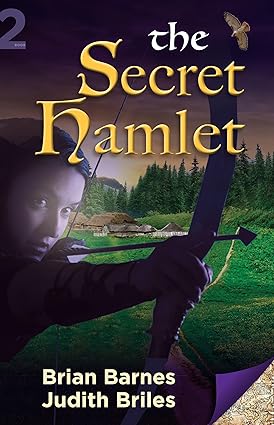
In The Secret Hamlet, authors Judith Briles and Brian Barnes continue the narrative of Nichol, their resilient protagonist from The Secret Journey. This second installment of the Harmonie Series transports readers back to medieval France, where Nichol, having fled from peril, seeks to establish a sanctuary for herself and others in danger. Surrounded by a blend of old friends and new, including her supportive husband Robert and parental figures Helene and Ezra, Nichol faces the lingering threat posed by her revenge-seeking mother and brother, allied with the corrupt priest, Loupe.
The novel shines with its richly depicted medieval setting and seamless integration of new characters who enhance the stakes of Nichol’s plight. The Secret Hamlet adopts a more reflective narrative pace compared to its predecessor, focusing on character development through dialogue and discussion. This approach allows for a deeper exploration of character motivations and relationships. The sequel also employs frequent shifts in point of view, offering a variety of perspectives that add layers to the unfolding events. These narrative techniques invite readers to engage more thoughtfully with the story, providing a rich tapestry of interactions that highlight the complexities of its characters and their medieval setting. Nichol remains a compelling central figure, particularly in her role as a mother. Yet, the enigmatic figure of The Lady who guides her remains underexplored. Clarifying whether The Lady is a religious icon or a mystical entity and detailing her motivations could lend greater depth to Nichol’s reliance on her visions, which are critical given her role as the linchpin in her community’s safety.
Crafted with evident care, The Secret Hamlet builds upon the strengths of The Secret Journey, deepening its exploration of resilience and community within a vividly rendered historical setting. While it adopts a different tone, focusing more on introspection and the strategic elements of building a safe haven, the narrative offers a compelling look at Nichol’s journey. The enriched insights into the characters’ personal motivations and their intricate relationships add depth to the unfolding story, reinforcing the series’ thematic focus on perseverance and unity.
Pages: 414 | ASIN : B0CRXRD3JH

Intuition Offers Key Guidance

What the Heart Knows follows an artist from a privileged background who moves to a small town on a journey of self-discovery and to find purpose in her life. What was the inspiration for the setup of your story?
The basic journey of self-discovery is based on my own experience, but I also have observed this same arc for others. Our culture tends to emphasize logic, AKA “head” information, as being more legitimate than intuition, or “heart” information. Yet intuition offers key guidance if we can learn to listen for it. My protagonist’s specific journey, but also the theme of my book series, is “The Journey from Head to Heart.”
Are there any emotions or memories from your own life that you put into your character’s life?
Yes, and some are very specific. For example, I served as a crew member on a Greenpeace voyage to save whales, and so does my protagonist Miranda. I also grew up with privilege, and my parents were high achievers who expected the same of their two daughters. This is mirrored in my novels. It’s very powerful to “write what you know.”
What were some themes that were important for you to explore in this book?
The first is the “Heart” theme: in your heart of hearts, what did you always want to do? Are you doing it? If not, why not? If not now, when? This is echoed throughout all the storylines in the book. Some characters embrace their intuition and progress; others resist it.
What is the next book you are working on, and when will it be available?
What the Heart Knows is novel #1 in my series. Novel #2, Where the Heart Lives, and Novel #3, Why Hearts Keep Secrets, are already available. I’m working on Novel #4, Whose Hearts Align, which will be published in May 2024.
Author Links: GoodReads | Twitter | Facebook | Website | Amazon


