Blog Archives
Man of Determination

Season of Life follows a free Black farmer in the aftermath of the Civil War who returns home only to be drawn into military intelligence alongside a Union spy. What was the inspiration for the setup of your story?
I’ve always been fascinated by the American Civil War. It was such a convulsive rupture of the American Republic. At first that fascination was with the military aspects, but gradually expanded to other facets of the war such as military intelligence and espionage, which grew to almost an art on the Union side. The effects of the war on the civilian population were both terrible and fascinating — it was fought in towns and rural areas across the country, affecting hundreds of thousands of people. Many people lost everything: homes, farms, property. War is a callous and uncaring consumer of people’s lives. The military aftereffects of battle at this time astonished me. This was an age when the medical arts were still in their infancy. Germ theory was only just beginning (Louis Pasteur only published his work on microorganisms in 1861, and Joseph Lister’s experiments with carbolic acid as a disinfectant in surgery only began in 1865, after the war had ended). Also shocking was the lack of forethought given to the treatment of the inevitable wounded organizationally, in a time when weapons like the rifled musket increased casualties exponentially. Civilian volunteers became common and vital after battles. Season of Life was my attempt to try to bring all these things together…with a surreal twist.
How much of Basil Biggs’s story is based on the historical figure, and where did your imagination take over?
Historical Fiction is usually, if not always, about filling in the gaps when primary evidence is spotty, incomplete, or sometimes almost non-existent. Basil Biggs was indeed a tenant farmer on the actual battlefield, whose home and farm were devastated by the battle. He lost almost everything, including stock, trampled and burned crops, and a pillaged home. He then went on to become instrumental in the reinterment of Union dead from hastily made graves across the battlefield to the new National Cemetery, a task he did with great respect for the dead. He also inherited the land where the final terrible fight on the third day of the battle occurred, Pickett’s Charge. All of this was recorded. In that slender folio of facts, I saw a man who would not be beaten down, a man of determination and courage and resolve who would do his best for his family, and for others. It is unlikely that he met John Babcock of the Bureau of Military Intelligence and was conscripted into espionage work. But not impossible. A man of his character and resolve could have risen to dangerous work like that. It is unlikely he would have met Cornelia Hancock at the field hospital at Camp Letterman, but also not impossible, given the nature of his task at re-burying men, and his obvious quality and care for others. And of course the entity of Wesley Culp was my creation, but a useful one to bring my main characters together.
Basil is constantly aware of the realities of race while navigating Union military circles. How important was it to portray those complexities honestly?
This was an age of great racism in the United States, and not only in the South. It permeated every aspect of the country (and one could say it still does today). Books like Leon F. Litwack’s North of Slavery were instrumental in giving me the tools to deal with this respectfully and honestly. It was clear that in the Federal Army there were many men who did not fight so much for the end of slavery as for the preservation of the Union. A Black man in the North could be free, but he was not equal. The caution, resolve, and courage it took to navigate that state is testimony to their quality. Racism is a persistent sin of humanity and one that needs to be addressed.
The ending leaves readers wondering whether Wesley Culp’s story extends far beyond this novel. Is there more you hope to explore in this world?
The Wesley Culp/Entity character was my observer. His interest in the three main characters is how I drew them together, and how I wanted to highlight the quality of the historical people they are based upon, to show my eternal respect for who they were. As such, I find him very useful and intriguing, and he will appear again, but in a different context and time.
Author Links: Website

Season of Life

Season of Life, by Jeff Janoda, is an absorbing work of Civil War historical fiction that begins in the raw aftermath of Gettysburg. Basil Biggs, a free Black farmer, returns home to find his land torn apart by battle and soon gets drawn into military intelligence work alongside Union spy John Babcock. What starts as a grounded story of survival develops into a historical adventure novel filled with espionage, dangerous travel, battlefield medicine, and a strange encounter with the dead Confederate soldier Wesley Culp. The book has a big canvas, but Basil’s practical concerns about his family, animals, livelihood, and freedom keep it personal.
Janoda gives the historical fiction a lived-in quality through physical details that make the war feel immediate. Roads are clogged with wounded men, homes become improvised hospitals, armies depend on rumors, and civilians are forced to make choices with little reliable information. The story also makes room for Cornelia Hancock, whose nursing work provides a compassionate view of the suffering left behind by military glory. Basil remains the strongest presence, though. He’s observant, stubborn, funny, and deeply conscious of how racism shapes every conversation, job, and moment of danger. His growing friendship with Babcock works because respect builds through shared experience rather than easy declarations.
The novel’s supernatural fiction elements add an eerie current without pulling the story away from its historical setting. Rosalie’s voice, the recurring crows, Wesley Culp’s impossible appearances, and the ancient being behind them turn the book into a blend of historical fantasy and supernatural thriller. That presence plays with fear, belief, memory, and human violence, which fits a landscape already haunted by thousands of deaths. The supernatural mystery becomes more prominent as the characters move behind Confederate lines, giving the middle and later sections the momentum of an espionage thriller while raising questions about whether help offered by a powerful being can ever be trusted.
What stayed with me most was the book’s interest in the lives growing around famous history. Generals and battles matter, but Season of Life focuses on farmers, nurses, scouts, teamsters, servants, wounded soldiers, and Black communities whose experiences are often pushed to the edges of Civil War stories. Its combination of Civil War fiction, historical adventure, supernatural fiction, and military espionage creates a distinctive reading experience with plenty of action and an emotional core. The epilogue gives Basil, Babcock, and Cornelia’s journeys satisfying historical weight, while the final note about Wesley Culp leaves the door open to a much older and stranger story.
Available Now
The “Right” Call

Rogue Vengeance is the third installment in the Colt Hawkins Series and follows a network of CIA and special forces operations figures as their personal lives collide with international violence. What draws you to the espionage thriller genre?
There’s a particular tension in espionage that you don’t find anywhere else in fiction- the collision between the personal and the geopolitical. A spy can’t have a normal conversation, can’t fully trust the person across the dinner table, can’t ever truly come home. That fascinates me. The genre lets me explore loyalty, deception, and sacrifice at their absolute extremes, where a single decision ripples across borders and lives.
With the Colt Hawkins Series, I wanted to write thrillers that move at full throttle but never lose the human heartbeat underneath. The CIA briefings and the firefights are the engine, but the fuel is always the story and the characters. Rogue Vengeance is where that combustion really ignites- the stakes feel global, but every chapter comes back to people you’ve grown to care about over three books.
Colt is repeatedly forced to choose between duty and personal happiness. Why was that conflict important to the story?
That conflict is Colt Hawkins. A man who’s exceptional at his job precisely because he’s willing to give up everything- and a man who’s slowly realizing that “everything” includes the people he loves most.
I built that tension into the story because I think it’s the truest thing about anyone who serves. The mission demands total commitment, but commitment has a cost, and someone always pays it. By the third book, Colt can no longer compartmentalize. The two halves of his life crash into each other, and watching him try to be both the operative the world needs and the man his loved ones deserve- and learning he may not get both- is the emotional core of Rogue Vengeance. Readers who’ve followed Colt from the beginning will feel that weight in a way that hits hard.
What does the novel say about the limits of patriotism?
This is the question that kept me up at night while writing. Patriotism is often portrayed as uncomplicated–love your country, serve without question. But real loyalty gets tested in the gray spaces, where the “right” call and the “being ordered” aren’t the same thing.
Rogue Vengeance asks what happens when serving your country means betraying your conscience, or when the institutions you’ve bled for stop deserving that blood. Colt and the network around him are forced to define where their loyalty actually lives- in a flag, in their orders, in each other, or in their own sense of right and wrong. I don’t hand the reader an easy answer, because there isn’t one. What I do offer is a story that makes you feel the cost of every choice and respect the people willing to make them.
What is the next book you are working on, and when will it be available?
We are going to release an Audio version of Rogue Vengeance that will be out around August. The sequel to Rogue Vengeance, Book 4, The Price of Freedom, picks up moments after Rogue finishes. And it is the centerpiece of the Colt Hawkins Series. It is completed and sitting on the shelf. We are going to wait a bit before its release. I have maybe a standalone WWII Historical Epic Fiction Novel, Ties That Bind (179K words), that just went through final edit. That I will seek representation for. And we have done the rough outline for Book 5 of the Colt Hawkins Series, Arch Angel.
Author Links: GoodReads | X (Twitter) | Facebook | Website | Amazon
Their own government outcasts Colt and his team, Task Force 24, as ruthless Chinese assassins brutally attack the woman he loves on their wedding day, leaving her severely wounded.
But Colt isn’t dead- Now, it’s personal, he won’t rest until he’s hunted down every last person responsible.
With a mole at the highest levels of power and a ruthless enemy leader pulling the strings, Colt finds himself a target of both the intelligence community that abandoned him and a vengeful Chinese death squad. Aided by his former teammates, Colt uncovers a conspiracy that goes deeper than he ever imagined. Now, his quest for revenge becomes a race against time to save his country from a devastating espionage plot.
The lines between loyalty and betrayal blur as Colt must decide if he can trust the very agency that cast him out. With a new CIA director at the helm and an elite operative watching over the woman he loves, Colt must navigate a deadly game of international espionage where the only rule is survival.
Rogue Vengeance
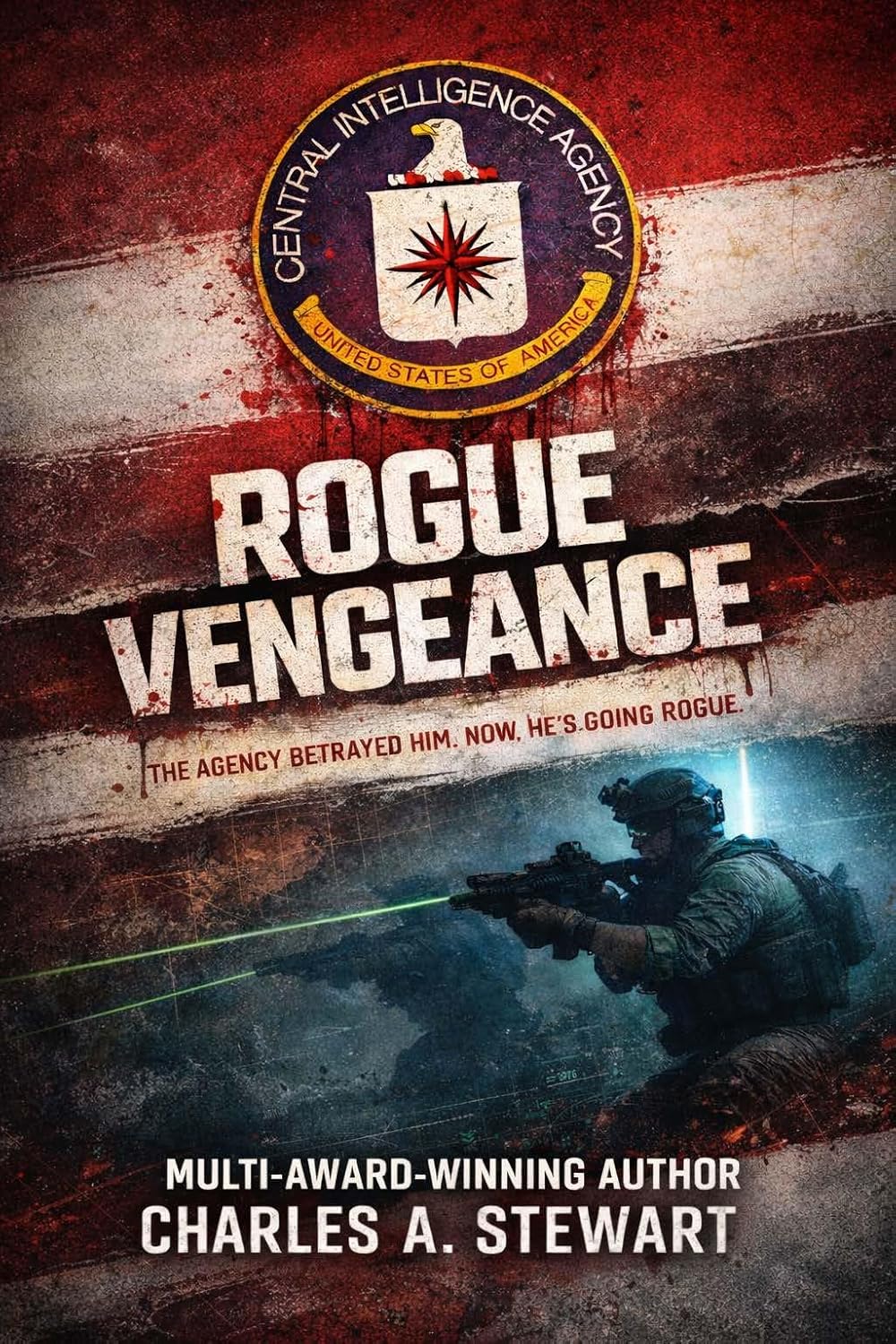

Rogue Vengeance, by Charles A. Stewart, is a military espionage thriller about betrayal, loyalty, and the heavy cost of service. The story follows Colt Hawkins, Liberty Starr, Jesse, and a network of CIA and special operations figures as personal lives collide with international violence. What begins around a wedding and a fragile hope for peace quickly turns into a larger conflict involving China, covert missions, political pressure, revenge, and survival. It’s an action-heavy thriller, but underneath the gunfire and strategy, it’s also about people trying to hold onto love, purpose, and identity after trauma.
The pacing in this story is fantastic. Stewart writes in short, sharp bursts that often feel like quick camera cuts. One scene is intimate and warm, with family gathered around a ranch house or Colt trying to imagine a quieter future, and then the next scene drops into surveillance, ambush planning, or prison brutality. That contrast works well for the genre. It keeps the pressure high. The book feels almost built for the screen, with clean scene breaks, direct action, and a strong sense of movement. I did sometimes want a little more breathing room, especially when the cast widened and the operational details stacked up. But I also understood the choice. This is a thriller that wants the reader alert, not settled.
I was most drawn to the emotional spine of the book. Colt isn’t just another tough operator who can take a bullet and keep moving. He is a man being asked, again and again, how much of himself he can give before there’s nothing left. The scenes with Liberty give the story its heart, and they make the violence matter more because there is something real at stake beyond mission success. Jesse’s captivity adds another layer, showing endurance in a quieter but no less brutal form. Stewart’s ideas are clear: duty can save people, but it can also consume them; loyalty is noble, but it can become a chain; and governments often treat sacrifice like a renewable resource. That’s where the book feels most grounded to me.
I would recommend Rogue Vengeance to readers who enjoy military thrillers, CIA action stories, and revenge-driven espionage novels with a large cast and a strong patriotic edge. Fans of high-stakes operations, tactical detail, and stories about brotherhood under pressure will probably appreciate it most. Readers looking for a fast, emotional, mission-focused thriller with both firepower and heart should find plenty to enjoy here.
Pages: 429 | ASIN : B0GFXJYSQ2



