Blog Archives
PEOPLE PERSONnel


PEOPLE PERSONnel follows Janice Mead, a seasoned HR manager trudging through her final year at a shrinking charity while juggling caregiving for her declining mother and quietly plotting a radical act of mercy. Set against the backdrop of a dreary office and the grey sprawl of southeast England, the story slips between sardonic workplace comedy and unsettling introspection before veering into a shocking yet oddly tender act of revenge and redemption. Holup delivers a narrative that simmers slowly, then boils over in a morally complex and relatable way.
Holup’s writing is dry, sharp, and deeply British. The voice of Janice (or Myra, depending on which identity you trust) is both painfully funny and heart-achingly bitter. Her observations cut deep, especially on ageism, bureaucracy, and the way society quietly dismisses older women. I found myself wincing at how real it all felt. There’s no sugar-coating here. It’s the raw, unfiltered truth of late-career burnout and quiet domestic despair, until, suddenly, it’s a murder mystery disguised as an act of grace.
What really surprised me is how effortlessly Holup builds a character who is both forgettable and unforgettable. Janice is invisible in the way that older women often are, and yet she becomes the exact opposite by the end: powerful, decisive, terrifying in her stillness. I couldn’t stop thinking about her. The bees, the gloves, the crispy pancakes, all these odd details add up to something chillingly intimate. The ending, though extreme, felt almost inevitable. It left me with that odd emotional mix of satisfaction and sadness, like watching a long-overdue storm finally break over a parched field.
If you like character-driven fiction with bite, with humour that borders on cruelty but never loses its humanity, then you’ll get a lot out of it. It’s perfect for readers who enjoy Eleanor Oliphant Is Completely Fine, but wish Eleanor had a darker side and a plot to poison someone. PEOPLE PERSONnel is bleak, funny, and full of feeling.
Pages: 307 | ASIN : B0FC462XY8

Until I Come Back for You
P.A. White’s Until I Come Back for You is a gritty and heartfelt coming-of-age novel wrapped in the warmth of humor, nostalgia, and quiet devastation. Set in 1970s rural Michigan, the story follows Trisha, the youngest of five siblings, as her family escapes the dangers of Detroit and tries to build a new life in the countryside. At first, their farm life seems charming, if a little chaotic, but the idyllic picture quickly unravels when their new neighbor, Ronnie Clark, emerges as a menacing, violent figure. The story balances childhood mischief and tender family dynamics with the dark undercurrents of trauma, violence, and survival.
What struck me most was the writing. White’s voice is funny, raw, and full of personality. The tone swings wildly. One minute you’re laughing at a family spat or a calf in the backseat, and the next you’re reeling from a jarring act of cruelty. I loved that unpredictability. Her sentences are tight, punchy, sometimes jarring, and always vivid. She captures the voice of a precocious kid better than most authors I’ve read. There’s no gloss, no pretension, just a sharp memory and a fearless pen. Her storytelling is laced with trauma, but it never begs for pity. It invites you to look, to sit with it, and to feel every uncomfortable inch of what she lived through.
But it’s the ideas underneath that left the biggest mark on me. This book isn’t just about growing up. It’s about what’s stolen from you when adults fail to protect you. The tension between innocence and danger is relentless. I found myself deeply moved by how the story exposes cycles of abuse, the silences of good people, and the resilience of children who learn to carry too much. The Clark family, and Ronnie in particular, are portrayed with brutal honesty, and I often had to put the book down just to breathe.
I’d recommend it to anyone who appreciates sharp memoirs, especially those by women who aren’t afraid to tell the ugly parts of their story. If you loved Educated by Tara Westover or The Glass Castle by Jeannette Walls, this belongs on your shelf. It’s also a must-read for anyone who grew up in the Midwest, anyone who knows what it means to live in a town where “nothing bad happens,” until it does.
Pages: 382 | ASIN : B0F224D1BJ
The Phantom Affliction
The Phantom Affliction is a gripping noir-style mystery set in post-WWII Chicago. The story follows Jack Kelly, a wounded veteran and son of a slain cop, who returns home only to stumble into a dangerous web of lies, disappearances, and old ghosts. When a former flame’s mother asks for help finding her missing daughter, Jack gets swept up in a messy case involving crooked families, lost identities, a fake milkman with a knife, and secrets tied to his own father’s death. What starts as a favor spirals into something bigger, more sinister, and deeply personal.
Reading this book felt like watching a smoky detective movie. Parker’s writing has bite. The voice is raw and full of personality. It’s sarcastic, wounded, cynical, but strangely warm. Jack Kelly is no hero with a shiny badge. He’s bruised, bitter, and limping, literally and emotionally. What I loved most was how real he felt. He’s the kind of guy who’ll joke about his fake leg even while bleeding from the head. The dialogue crackles with grit and wit, and the prose never overreaches. It’s straight talk from a street-smart vet who’s seen too much. I found myself grinning one second and wincing the next. The pacing slows in a few spots, sure, but never enough to kill the mood. You just want to follow Jack, even when he’s clearly in over his head.
The ideas Parker digs into hit hard. The novel looks at loyalty, corruption, trauma, and the loneliness of coming home to a world that moved on without you. There’s something tragic in how Jack wants to do the right thing but keeps getting burned. The people he trusts most, his uncle, his ex, even his late father, carry secrets that gnaw at the edges of the truth. The story swerves from mystery to thriller to something almost tender, and I didn’t expect that. It’s violent in places, but it never feels flashy. Every punch, every lie, every bloodstain means something. That’s what kept me hooked.
If you like a dark mystery that feels like it crawled out of a forgotten alley in a black-and-white film, this one’s for you. The Phantom Affliction is perfect for fans of Raymond Chandler or James Ellroy, but with a softer gut and sharper grief. It’s messy, bruised, and crawling with heart. I’d recommend it to anyone who enjoys a hard-boiled story with a twist of real emotion and a lead character you can’t help but root for.
Pages: 364 | ASIN : B0CTCQ4YPQ
Paying Homage To My Childhood Hero

Paradox Forged in Blood follows a woman from her early years through post-WWII America who is found to be the last remaining witness to the death of a socialite four decades ago. What was the inspiration for the setup of your story?
Growing up, reading Nancy Drew novels captivated my sense of adventure and their underlying support of female empowerment—including the ability to solve life’s mysteries—regardless of age. If I completed all chores and homework assignments, I was rewarded with a new book for the exorbitant price of $1.95! We weren’t rich but our lives were fulfilling as love, happiness, and family unity became mainstays in tackling problems that arose. Each Nancy Drew book transported me into a world of exciting escapades and achievement. Before tackling my first novel, Paradox Forged in Blood, I relied on those feelings through the use of carefully chosen words and scenarios to develop strong characters. My goal was twofold: drawing readers into the story by identifying with characters and historical events; and, paying homage to my childhood hero.
Do you think there’s a single moment in everyone’s life, maybe not as traumatic as Ellen’s, that is life-changing?
Absolutely! An example in my life occurred at the age of 27 when I met Jack and fell madly in love. But my Guardian Angel (she’s always present and forever doing her best to keep me honest) kept screaming he was married. Unfortunately, I chose to believe Jack’s claim that he wasn’t. Within three months, I discovered I was pregnant and, miracle of miracles, Jack suddenly remembered he was married. It’s an old story, but when it happens to you, acknowledging the daunting concept that life as you knew it was forever changed. I was so traumatized that I didn’t date for 15 years—except once, but it turned out he was also married “but don’t worry, it’s an open marriage.” Needless to say, that date was a one-off. However, my story has a wonderful ending—my son and very best friend is always there with an encouraging word and laughter to offset life’s hardships. Facing a challenge with determination and faith can be a path toward realizing happiness of unprecedented proportions.
Did you find anything in your research of this story that surprised you?
The Top Secret Rainbow Plan to address potential attacks by foreign nations (Black Rainbow Plan for an attack by Germany; Orange Plan involving a strike by Japan) were developed in the 1920s, outdated and lacking in technological advances. This resulted in the astounding lack of America’s preparedness to enter World War II. The America First plan, promoted by Charles Lindbergh with overwhelming support to keep America out of foreign wars, resulted in a nation completely ill-equipped to enter the worldwide conflict. Combined with the decision to keep all planes on the tarmac at Hickam and other Pearl Harbor airfields, ostensibly to prevent saboteurs, ironically provided a concise target for the Japanese invasion. Japan’s critical supply of sufficient oil to continue further attacks, the result of America’s oil embargo, was the impetus for the Pearl Harbor attack. Simply put, the American islands were blocking Japan’s ability to access oil-rich areas to replenish their dwindling supply. They also relied on Japanese spies in Hawaii who believed America would not retaliate an attack based on the popularity of America First.
What is the next book that you are working on, and when will it be available?
I’m actually working on two books: When I Grow Up: A Collection of Short Stories and Never Truly Alone, a psychological thriller. My goal is a release of short story compilations in 2026 and, hopefully, my thriller in 2026 as well.
Author Links: Website | Amazon | Facebook | Instagram | GoodReads | X | LinkedIn
A murder on Millionaire’s Row.
A killer’s chilling words, “Shh. I know where you live.”
A woman tormented by her guilt-ridden past.
A historical murder mystery, PARADOX FORGED IN BLOOD is set in Cleveland, Ohio, during the late 1930s. Four decades after the murder of socialite Louis Sheridan, the cold case is resurrected with receipt of new evidence that transports detectives back to Nazi Germany. The only living witness, Ellen O’Malley, must confront a haunting secret and her complicit actions.
PARADOX FORGED IN BLOOD

Paradox Forged in Blood is a historical murder mystery rooted in the decades-long repercussions of a brutal crime. Told through multiple timelines and perspectives, it weaves the tragic tale of Ellen O’Malley Szabo, who harbors a chilling secret stemming from a 1939 murder of a Cleveland socialite. As the story unfolds from Ellen’s early years through post-WWII America, it uncovers the dark entanglements of love, loss, guilt, and justice. Based on true events and enriched with authentic period detail, Fisher’s novel explores themes of trauma, moral ambiguity, and the long shadows cast by war and prejudice.
From the get-go, I was pulled in by Fisher’s talent for bringing history to life. The early chapters read like sepia-toned memories, layered with texture and heart. Her characters, especially Ellen, feel heartbreakingly real, flawed, brave, and haunted. Fisher doesn’t just tell a story—she captures a world. The prose is straightforward and emotionally direct, often charged with a kind of raw nostalgia. That said, the pacing sometimes slows, especially in the middle, where the plot steps back from the murder mystery and focuses more on historical backstory. While that deepens the characters and themes, it slightly muddles the genre expectations for a mystery. Still, I didn’t mind too much, I was already invested in the people more than the puzzle.
What stuck with me most wasn’t the crime, but the emotional wreckage it left behind. Ellen’s guilt seeps into every corner of her life. I also appreciated the undercurrent of social commentary. The anti-Semitism, the lingering trauma of war, the costs of silence. Fisher doesn’t preach. She shows us what it feels like to live with choices you can’t undo. At times, the story gets heavy, but it earns that weight. There’s grief here, but also grit. And love, the kind that quietly saves you, even if it can’t fix everything.
Paradox Forged in Blood isn’t just a mystery. It’s a reckoning. A slow burn about how the past refuses to stay buried. I’d recommend this book to fans of historical fiction who appreciate a strong emotional arc and morally complex characters. It’s especially suited for readers who like their mysteries more character-driven than clue-packed. If you’ve ever wondered how one secret can echo through generations, this one’s for you.
Pages: 662 | ASIN : B09WYSRZ6Q
Going Postal
In Going Postal, Corky Giles crafts a quiet yet increasingly unsettling descent into the psyche of Fred Hart—a beloved small-town mailman whose patience, kindness, and dignity are slowly eroded by years of unspoken trauma and everyday indignities. Set in the idyllic but claustrophobic town of Cedar Creek, the story begins with Fred as a model citizen: generous, thoughtful, and tirelessly dependable. But as the narrative unfolds, and as one insult after another chips away at him, we watch Fred transform from a gentle soul into someone capable of violence and ultimately murder. The shift is slow, chilling, and heartbreakingly believable.
Reading this book made me uncomfortable, and that’s precisely what makes it so compelling. Giles’s writing has a quiet power, building tension with scenes that seem simple on the surface but simmer with suppressed emotion. The prose is honest and unflashy, letting the story’s emotional weight carry the reader. I felt an uneasy empathy for Fred, which left me questioning where the line between victim and villain really lies. The character work is so rich that when Fred finally snaps, it doesn’t feel sudden. It feels inevitable. That inevitability is what haunted me most.
Some chapters could have benefited from tightening, and occasionally, the dialogue meandered. But even when it wandered, it felt real. I also found myself frustrated, not with the book, but with the people in it—how they treated Fred, how they dismissed his quiet suffering. That frustration morphed into sadness, then dread. Giles doesn’t glorify Fred’s choices. He doesn’t excuse them. Instead, he shows us the raw, lonely road that led there. It’s not a whodunit or a thriller in the traditional sense. It’s more of a psychological slow burn, with a main character who gets under your skin and stays there.
Going Postal is a powerful, emotionally complex novel for readers who like character-driven stories with dark edges. It’s for those who wonder what happens when good people get pushed too far. If you’ve ever felt invisible, used up, or dismissed, this book might shake something loose in you.
Pages: 100 | ASIN : B0F3V4T8PG

Hummingbird Moonrise, Book 3 of Murder, Tea, and Crystals Trilogy
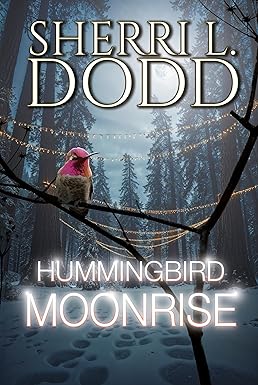
Hummingbird Moonrise opens with a historical bang with a hauntingly dark and emotional prologue set in 1940s California. It traces the grim consequences of a man’s violent choices, the echoes of which reverberate through five generations. We’re introduced to a family curse born from vengeance and sustained by ritual, tragedy, and an unshakeable belief in the power of dark magick. From there, the story weaves between timelines, following Arista Kelly, a modern-day woman grappling with supernatural inheritance, witchcraft, and an old stone tablet that may seal her family’s fate. Part cozy mystery, part witchy thriller, it blends murder, magic, family trauma, and healing in a way that’s both suspenseful and tender.
What struck me most about Dodd’s writing was the way she mingles the everyday with the mystical. One minute, characters are sipping tea or feeding stray cats; the next, they’re channeling spirits or breaking into homes to investigate arcane symbols. I appreciated the humor that peeked through, especially Auntie, whose wit and warmth anchor many of the darker moments. The voices feel distinct, the pacing surprisingly tight despite the multi-generational sprawl, and the dialogue sings with emotional truth. The way Dodd writes female relationships—particularly between Arista and her Aunt—is just beautiful. There’s a lived-in realness to their bond that made me care about what happened to them far more than I expected from a story with spells and curses.
The shifts in tone—moving between drama, horror, humor, and a touch of paranormal whimsy—were bold and creative. A few sections leaned more into exposition, which briefly slowed the momentum. The supernatural elements are intriguing and imaginative, and the atmosphere was rich, the stakes personal, and the themes like grief, redemption, and inherited pain rang true. Dodd clearly cares deeply about these characters, and that care spills onto the page.
I was moved. Not just by the tragic past that hangs over the Kelly family, but by the hope that emerges through Arista’s strength. This is a book for those who like their witch stories intimate, their mysteries character-driven, and their fiction laced with emotion and weirdness in equal measure. If you enjoy Alice Hoffman’s Practical Magic, but wish it had a bit more grit and ghost stories, Hummingbird Moonrise might just be your cup of tea. Or maybe your crystal-infused moon water. Either way, it’s worth the read.
Pages: 304 | ASIN : B0FB5QV948
Thrilling and Unpredictable

Native Arcana follows a Cherokee marshal who has survived multiple traumas throughout her life as she plunges headfirst into the mystery behind a series of occult murders. What was the inspiration for the setup of your story?
Anyone familiar with Eastern Oklahoma knows it has a deep undercurrent of mystery and strange folklore, which made it the perfect backdrop for Native Arcana. The initial idea came to me back in college while brainstorming with a writing partner, but it ended up sitting on the shelf for years. It wasn’t until I met my wife that the story truly came to life. She’s a proud Cherokee woman who grew up in and around Tahlequah, and when I shared the concept with her, she immediately connected with it. She began contributing her own insights, cultural knowledge, and ideas, which really shaped the story’s themes. Many of Nita’s mannerisms and experiences are drawn directly from her life.
As for the occult elements—Oklahoma has a strange history that includes everything from the OKC bombing to isolated incidents of cult-like behavior. With enough research, you start to notice peculiar threads connecting some of these events, often rooted in fear, hate, or darkness. I felt like the only kind of character who could face down that kind of evil was someone like Nita: someone who has endured trauma without losing herself to it, someone who turns pain into purpose and strength. She’s the kind of person who helps others not despite her suffering, but because of it.
What do you find is the most difficult thing about writing a thriller?
For me, the biggest challenge was keeping the story grounded in reality while also exploring some of the mystical elements that naturally arise in a story like Native Arcana. Balancing believable law enforcement procedures with moments of the supernatural was tricky. I wanted the narrative to remain thrilling and unpredictable without veering too far from authenticity. Hopefully, I found that balance—but ultimately, that’s for the readers to decide.
Which of your characters do you feel you relate to most and why?
All the characters carry pieces of me, especially Nita and Blake. But if I had to choose, Nita feels the most personal. She’s a reflection of the strong women who shaped my life—most importantly my wife, my mother, and my sister, but I’d be remiss not to mention my aunts and cousins as well. I often say I was raised by strong women, and that gave me a deep respect for their resilience, complexity, and quiet strength. Writing Nita was my way of honoring them—of capturing their spirit and putting that strength on the page.
Can fans look forward to a follow-up to Native Arcana? What are you currently working on?
While Native Arcana stands strong as a standalone novel with a complete arc for Nita and the supporting characters, I’m definitely exploring where her journey might lead next. As a Cherokee Marshal, there’s no shortage of strange, dark corners of the world she could uncover. I’m currently developing ideas that would push her into new mysteries and challenges—ones that test her resolve and reveal even more layers of who she is.
In addition to that, I’m working on a couple of other projects, most notably The Drums of Secession, Book II in the Cannon Fire Plot series. It’s the sequel to The Wages of Kin and continues the saga of the Battier family as they fight back against a tyrannical regime in a fantasy world inspired by colonial America. The series explores revolution, loyalty, and identity in a richly imagined world filled with complex characters and high-stakes conflict.
Author Links: GoodReads | X (Twitter) | Facebook | Website | Amazon
Before that, Nita was an everyday Cherokee Marshal, working Cherokee Nation and policing its laws. However, a desire to live a stable life was always out of reach. She is a survivor of many traumatic events: The Oklahoma City Bombing, a shootout, and most recently, the death of her husband. In the aftermath of the latter, she struggles to mother her autistic stepson as the violent incidents around her begin to mount.
A series of occult murders involving an Amish girl, a ranch hand to a multi-millionaire, and demonic iconography leads to a task force to hunt down the culprit of these heinous acts – including OSBI and Nita’s old friend and Thorpe Ranch owner, Blake Edwards. But, with her persistence and unique capabilities, Nita soon realizes she may be the only person equipped to uncover this mystery.


 LITERARY TITAN