Blog Archives
CLEAN HANDS: A GUS ROURKE NOVEL, Book One of the Calder County Novels


David H. Tolly’s Clean Hands is a conspiracy-tinged crime novel built around a sharp premise: philanthropist Eleanor Grant is murdered during a gala at her own estate, while two hundred influential guests are close enough to witness everything and somehow see nothing. Detective Gus Rourke quickly recognizes that the apparent burglary is a carefully staged story, and the investigation leads from a missing manuscript and a hidden memory card to a century-old network that turns dirty money, political influence, and violence into respectable philanthropy. The financial trail is unusually important here. Charities, trusts, consulting payments, leases, and donor-advised funds aren’t just background details. They’re the machinery of the mystery, and Tolly explains them clearly enough that the reader can follow the money without feeling trapped in an accounting seminar.
Rourke is the novel’s strongest anchor. He’s a colorblind detective who trusts shapes more than colors, paper more than screens, and patient observation more than an easy explanation. His numbered rules at the beginning of each chapter give the book a sturdy procedural rhythm while revealing the personal losses behind his methods. He’s joined by an appealing team, especially his tech-minded partner Olivia Hayes, financial investigator June “Sparrow” Okafor, medical examiner Eliza Martin, and his journalist daughter, Casey. Their different skills keep the investigation moving, but their personal connections to the case give it weight. The most affecting parts often involve parents and children, including Eleanor and her estranged daughter Lily, Rourke and Casey, and the frightened mother who becomes a weapon in someone else’s plan.
Readers of Michael Connelly’s Harry Bosch novels will recognize the appeal of a stubborn investigator following evidence into rooms where powerful people expect obedience. Like Bosch, Rourke is guided by a private moral code and has little patience for institutions that value calm appearances over inconvenient truth. Tolly’s novel, though, is more openly focused on financial systems and inherited influence. Its villain is larger than a single murderer. The real adversary is a culture in which respectable people pass responsibility downward until nobody at the top appears to have touched the crime. That gives Clean Hands some of the institutional sweep of a John Grisham thriller, while its crime-scene work and damaged detective place it firmly in the police procedural tradition.
The novel moves quickly through short chapters, shifting viewpoints and frequent discoveries, and Tolly has a knack for ending scenes on lines that pull the reader forward. The book delivers a satisfying resolution to Eleanor’s murder while leaving the wider conflict alive. Clean Hands works as a complete mystery, but its final pages also make Gus Rourke’s next investigation feel like a natural continuation of a fight he’s only begun to understand.
Pages: 210 | ASIN : B0H7FTJHS5

A Sense of Pride

Hard Times is centered around a young magazine writer who discovers a life marked by racist terror, mob pressure, and reinvention when he tracks down a vanished heavyweight champion. What was the inspiration for the setup of your story?
I wanted to write a culmination of all the things African American boxers and war veterans went through in the years leading up to our greatest war. I interviewed several relatives who were in the “Great War” for their perspective, and I created Nathan as an homage to their sacrifice. I added the turmoil and adventures he went through, like the fictional story of The Odyssey, and it fit.
You portray Nathan as deeply human—flawed, driven, tender, and wounded. How did you approach balancing his mythic “King Cobra” persona with his private self?
Nathan always wanted to be something more than just a sharecropper. He saw what Black people went through in the South. He was driven to do great things.
Boxing often symbolizes struggle and survival in literature. What did the sport allow you to explore about race, power, and identity in Nathan’s life?
Boxing is a way, especially in the past, to give Black people a sense of pride over their oppressors. Equal opportunities were nonexistent, so the brutal sport allowed them to fight back the only way they knew how.
What is the next book you are working on, and when will it be available?
I’m working on a sequel to my dark Mystery novel, A Tall Dark Sin, entitled The Devil Walks In/A Tall Dark Sin 2. I’m looking for a late fall release.
Author Links: GoodReads | X (Twitter) | Facebook | Website | Amazon
Wreaking Vengeance

I read Wreaking Vengeance as a hard-edged police procedural that begins with a savage decapitation on a Chicago bike path and then widens into a methodical investigation involving wealth, dog-show circles, failed romances, and, eventually, a revenge plot. Joe Erickson and his partner Sam Renaldo work the case in the classic detective mode, interviews, forensics, false leads, gut checks, while the city around them feels specific rather than decorative. The book’s engine is not mystery for mystery’s sake so much as the slow, stubborn assembly of motive from scattered human damage.
What held me was the novel’s refusal to prettify violence while also refusing to wallow in it. The opening is grisly, but the book’s real texture comes from the contrast between brutality and ordinary life: dinners at home, dog care, office banter, long drives, the weary choreography of homicide work. I liked that balance. It gives the investigation a lived-in grain. Joe, in particular, comes across as competent without becoming stainless; he is steady, observant, sometimes wry, and recognizably tired in the way good detectives often are. The procedural detail has an old-school sturdiness to it, and I found that solidity more persuasive than flash would have been.
I also appreciated the way the novel keeps re-tilting suspicion. It moves through wealthy ex-lovers, professional grudges, family tension, and forensic fragments without feeling mechanically twisty. The dog-breeding and Affenpinscher material could have become gimmickry, but instead it gives the book an odd little signature, a slightly off-center domain of expertise that makes the case feel particular. The prose sometimes favors directness over flourish; still, that plainspokenness suits the book’s temperament. This is not a baroque thriller. It is a workmanlike, sinewed mystery that knows the difference between momentum and noise.
I’d hand Wreaking Vengeance to readers who like crime fiction, police procedural, detective mystery, serial-killer suspense, and investigative thriller novels with a strong case file backbone and a likable central detective. It should especially suit readers who enjoy the procedural patience of Michael Connelly, though Johanson’s tone is less lacquered and more blunt-force Midwestern. I came away thinking this book understands that the most unsettling crimes are not the loudest ones, but the ones pursued with calm, human persistence.
Pages: 281 | ASIN : B0FQZSVFDK

The Pressure of Testing

Tokyo Juku follows an eighteen-year-old student in Japan who, while studying all night in her cram school, discovers one of her teachers has been murdered, leading to an investigation into the education system. What was the inspiration for the setup of your story?
The main inspiration comes from talking with my students. Their struggles inspired me to write about them. I teach at a university, so hearing from my seminar students about what they’ve been through really made me rethink the Japanese educational system from their perspective. One of the largest problems is the pressure of testing. Students hate tests. I mean, really hate them! My job entails evaluation, but more as individual feedback than standardized testing as social gatekeeping. Over the years, when I tell people that I teach at a university, they often cast their eyes down and mumble the name of their school, a little embarrassed at their past failings. Or, just the opposite, very proudly. That’s a sad reaction to what should be a life-transforming experience. In the novel, I wanted to take my students’ stories, my observations, and others’ experiences and condense them into the struggles of the main character, Mana. Like most Japanese, she has to learn how to navigate treacherous educational waters. As an educator and a writer, I’m on the side of improvement, but that’s easier said than done.
How has character development for Detective Hiroshi Shimizu changed for you through the series?
Hiroshi has evolved through the series. In the first novel, he had just returned from America and found the detective job through a connection. He works the job reluctantly but gradually finds he is pretty good at it, despite being resistant to crime scenes and the grittier aspects of the job. He reconnects with his college girlfriend, moves in with her, and they start a family in the latest novel. That idea of fatherhood causes him great anxiety because of what he’s seen behind the curtain. Does he want to bring a child into the world he’s glimpsed while working in homicide? But he has a knack for finding the pattern in the chaos of cases, and he’s needed.
Was it important for you to deliver a moral to readers, or was it circumstantial to deliver an effective novel?
An effective novel comes first. The moral is something that occurs in readers’ minds. I think if you push a moral or make themes too explicit, it takes away from the beautiful ambiguity of reading. As a writer, I can nudge readers in specific directions, but they will draw their own conclusions. So, if you push a moral without a compelling story, it comes across as preachy. Nobody likes that. Readers have their own reactions to the characters’ conflicts, which might yield a moral they take away, but it might also be something more complex—a conclusion or understanding that doesn’t fit into the frame of a moral. The conflicts and confusions of characters are at the heart of an effective story. I focus on that. My job as a writer is to keep them turning pages, thinking, and enjoying the ride.
Can you tell us more about what’s in store for Detective Hiroshi Shimizu and the direction of the next book?
The next book will focus on the tourist industry, which has really taken off in Japan. I have culture shock—or maybe reverse culture shock—in parts of the city swamped with visitors from abroad. That’s changing the city. I’m not against that, but the influx of tourists and tourist money has not been clearly planned for. And much of Japan is highly planned. Japan is internationalizing, in good and bad ways, so that Hiroshi will be needed even more with his English and accounting skills. He’s got plenty more cases to work on.
Author Links: GoodReads | X | Facebook | Website
Eighteen-year-old Mana pulls an all-nighter at her juku, a private Japanese cram school that specializes in helping students pass the once-a-year exams. She failed the year before but feels sure she’ll get it the second time—if she can stay awake. The Japanese saying, “Four pass, five fail,” presses her to sleep just four hours a day, and study the rest.
When she wakes up in the middle of the night, head pillowed on her notes, she takes a break down the silent hallway. A light comes from an empty classroom, and still sleepy, she pushes open the door to discover something not covered in her textbooks. Her juku teacher, the one who got her going again, lies stabbed to death below the whiteboard, with the knife still in his chest and the AV table soaked in blood.
Detective Hiroshi Shimizu is called in, and though he’s usually the forensic accountant, not the lead detective, he’s put in charge of the case. With the help of colleagues old and new, he’s determined to find the killer before the media convicts the girl in the press, the new head of homicide pins it on her, or big money interests make her the scapegoat.
Hiroshi follows up on uncooperative witnesses, financial deceptions, and the sordid details of some teachers’ private lives. Even as he gets closer, the accumulating evidence feels meager amid the vastness of the education industry, and the pressures and profits of Japan’s incessant exams.
At the outset of the investigation, Hiroshi listens as an education ministry official lectures him on how education holds the nation together, but he soon discovers how it also pulls it apart, and how deadly a little learning can be.
Tokyo Juku


Tokyo Juku begins with a bang, literally and emotionally. A young student named Mana discovers her teacher dead in a cram school classroom, his body crumpled under the sterile glow of fluorescent lights. Detective Hiroshi Shimizu and his team step into a Tokyo dense with pressure, ambition, and secrets. What follows is a layered mystery that weaves together the cutthroat world of education, the hidden costs of success, and the loneliness tucked behind the city’s polished exterior. Author Michael Pronko takes what might seem like a simple murder case and turns it into a study of human drive, shame, and survival.
The writing pulled me in right away. Pronko’s style is sharp and cinematic. The scenes snap from one point of view to another like the cuts in a film, yet nothing feels rushed. The descriptions of Tokyo at night, its cram schools glowing like lanterns, its streets humming with ambition, feel both beautiful and sad. There’s something almost tender about how he writes the city, even when it’s cruel. What I liked most was how the story balanced the crime with emotion. The mystery kept me guessing, but it was the characters’ quiet struggles, the overworked teachers, the anxious students, the tired detectives, that stuck with me. They all felt painfully real, like people you might pass on a crowded train and never think twice about.
Pronko dives deep into conversations and inner thoughts, and sometimes I wanted the story to move faster. But even then, I couldn’t stop reading. I liked how he made me feel the weight of every decision, every word unsaid. The book doesn’t just show a crime; it shows what happens to people who live inside constant expectation. It’s not only about murder, it’s about burnout, ambition, and how easily a person can crack under the strain. The writing feels clean but heavy with meaning, and that balance hit me hard.
Tokyo Juku isn’t just a detective story; it’s a mirror held up to modern Tokyo and anyone chasing success at any cost. I’d recommend it to readers who love smart mysteries with heart, and to anyone who enjoys books that make you sit back and think after you close them. It’s perfect for fans of slow-burn suspense, city stories, and those who don’t mind a little soul-searching between the clues.
Pages: 314 | ASIN : B0FLW78XTZ
The Phantom Affliction
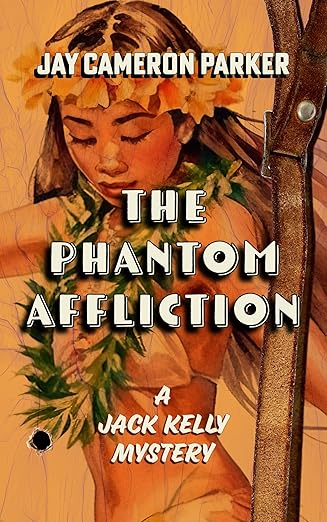
The Phantom Affliction is a gripping noir-style mystery set in post-WWII Chicago. The story follows Jack Kelly, a wounded veteran and son of a slain cop, who returns home only to stumble into a dangerous web of lies, disappearances, and old ghosts. When a former flame’s mother asks for help finding her missing daughter, Jack gets swept up in a messy case involving crooked families, lost identities, a fake milkman with a knife, and secrets tied to his own father’s death. What starts as a favor spirals into something bigger, more sinister, and deeply personal.
Reading this book felt like watching a smoky detective movie. Parker’s writing has bite. The voice is raw and full of personality. It’s sarcastic, wounded, cynical, but strangely warm. Jack Kelly is no hero with a shiny badge. He’s bruised, bitter, and limping, literally and emotionally. What I loved most was how real he felt. He’s the kind of guy who’ll joke about his fake leg even while bleeding from the head. The dialogue crackles with grit and wit, and the prose never overreaches. It’s straight talk from a street-smart vet who’s seen too much. I found myself grinning one second and wincing the next. The pacing slows in a few spots, sure, but never enough to kill the mood. You just want to follow Jack, even when he’s clearly in over his head.
The ideas Parker digs into hit hard. The novel looks at loyalty, corruption, trauma, and the loneliness of coming home to a world that moved on without you. There’s something tragic in how Jack wants to do the right thing but keeps getting burned. The people he trusts most, his uncle, his ex, even his late father, carry secrets that gnaw at the edges of the truth. The story swerves from mystery to thriller to something almost tender, and I didn’t expect that. It’s violent in places, but it never feels flashy. Every punch, every lie, every bloodstain means something. That’s what kept me hooked.
If you like a dark mystery that feels like it crawled out of a forgotten alley in a black-and-white film, this one’s for you. The Phantom Affliction is perfect for fans of Raymond Chandler or James Ellroy, but with a softer gut and sharper grief. It’s messy, bruised, and crawling with heart. I’d recommend it to anyone who enjoys a hard-boiled story with a twist of real emotion and a lead character you can’t help but root for.
Pages: 364 | ASIN : B0CTCQ4YPQ
Smitty’s Calling Card

In Smitty’s Calling Card: The Dark Retribution Series, B.R. Stateham crafts an intricate narrative threaded through the lives of several compelling characters. At the heart of the plot is Artie, a policeman who controversially enlists the aid of an outsider to solve a particularly perplexing case. This decision intertwines his fate with Smitty, a mysterious figure whose moral alignment is ambiguous, and Sarge, a former soldier entangled in a perilous romance that might endanger his beloved.
Stateham’s characters are exceptionally well-drawn, boasting a depth that sustains interest and engagement. Notable among them are the enigmatic Smitty, the intriguing criminal Philo Jenkins, and Artie’s affable partner, Joe Gallagher. Even peripheral characters like Doris add a rich layer to the narrative, enhancing the reader’s investment in the story. The novel excels in tone and pacing—balancing gritty elements with well-timed levity, ensuring that the narrative propulsion never wanes. Stateham’s world-building is equally praiseworthy, creating a setting that is as integral to the story as its characters. The plot is a whirlwind of action, marked by compelling confrontations and tender moments that build to a satisfying crescendo.
Smitty’s Calling Card is a tightly woven tale that grips the reader from start to finish, highlighted by its robust character development and dynamic storytelling. It’s a compelling addition to the crime thriller genre, and Stateham’s skill ensures that the anticipation for subsequent installments is well-founded. I thoroughly enjoyed the book and am eager to continue with the series.
Pages: 331 | ASIN : B0C4T45BGQ
A Long Night Cry

In the illustrious wake of two previous masterpieces, Terry Weaver once again proves his literary prowess with his third installment, A Long Night Cry, in the highly acclaimed Eli Ridge detective series. For aficionados of suspenseful police procedurals, intricately woven criminal mysteries, electrifying thrillers, and narratives that unmask the complexities of vigilante justice, getting acquainted with the character of Eli Ridge is an absolute must.
Weaver’s tale delves into a poignant exploration of contemporarily pressing issues, including murder, kidnapping, drug cartels, systemic corruption, and the debilitating impact of emotionally distant families. The plot thickens as three teenage girls — a Mexican immigrant, a senator’s daughter, and her intimate friend — mysteriously disappear. While societal and political pressures force Ridge to primarily focus on locating the senator’s daughter, he staunchly believes that every victim warrants an equal amount of concern and investigative rigor. This moral compass leads him down a treacherous path, as his pursuit of justice threatens his career and endangers those closest to him.
The author’s exemplary storytelling swiftly ensnares readers in a maelstrom of suspense, emotional turmoil, and an ever-growing anticipation of the narrative’s next development. Weaver’s adroit narrative techniques serve to augment the story’s suspense as each chapter delves deeper into the narrative, cleverly piecing together the mystery surrounding the missing girls and keeping readers on edge. In particular, Eli Ridge’s character will likely resonate with many as we share in his struggles and emotional descent triggered by the escalating events, creating a deep connection that echoes long after the final page.
A Long Night Cry is a thoroughly engaging read that stands as a testament to Weaver’s talent for suspense. For those unacquainted with the Eli Ridge series, fear not, as this book can certainly be enjoyed as a standalone novel. However, the reading experience will undoubtedly be enriched if you’ve had the pleasure of delving into the earlier works, namely A Dark Day in Texas and Whitewashed Tomb. A Long Night Cry is a truly captivating narrative that is entirely worth your time.
Pages: 354 | ASIN : B0C43LX91K


