Blog Archives
Personal Side of the Great War
 The Family that Went to War is both a family memoir and a history of the people of the state of New South Wales. Are you writing about your own family? What inspired you to write a story about your family’s life?
After starting to research my family tree I discovered for the first time that I had a great Uncle killed at the battle of Fromelles. Then to my amazement I gradually discovered the stories of the other 5 mentioned in the book. While I was discussing this with some of my cousins, I decided to see if I could write a book on their exploits.
This book is about World War 1. What research did you do to prepare to tell this story?
We had a guest speaker at a men’s dinner and he mentioned that he found a lot of information from public available war records. I applied for the service records of all six members and from there I researched the events shown in their records. Every time I came across a location that I was not familiar with I Googled the location to check on its spelling. Unfortunately army diaries were notorious for the inaccuracy of foreign names. The Google research also allowed me to see the relationship between the various locations. I also searched newspapers particularly after reading Georgina’s letters to the army. I realized that there was a lot more to learn. From the old newspapers I was able to put together the later histories of the Wright brothers (both of whom gained the rank of Inspector in the NSW police force).
This story gives a personal look into the lives of WWI veterans. Did you find anything in your research of this story that surprised you?
Everything surprised me as I (like so many of my generation) knew so little of the personal side of the Great War.
How do you think the return of these veterans from WWI helped to shape modern culture?
From those I have talked to, it seems that they were all effected long term. I got the feeling that the distance made it even harder on the families at home because it would be months after the event that their families would have any news. I think that many went to do their duty for the “Mother Country” only to be disappointed by the attitudes of the British Generals toward the Australians. From that time in history Australians ceased to feel they were British. They now were proud to be Australians.
Author Links: GoodReads | Website | Twitter
In1914 Australia joined England and declared war on Germany and it’s allies. In the small New South Wales town of Cootamundra 6 young Australians, all from the same family, individually joined the fight. This saga follows their journeys through Gallipoli and the Western Front. The saga also covers time in Egypt, England and France away from the fighting. This is a story of a family and how it was affected by a on the other side of the world. It tells of the battles, the wounding and sickness endured by these young men as well as the lighter moments. A readable history that shows some insights into what it was like during those dark times.
The Family That Went to War
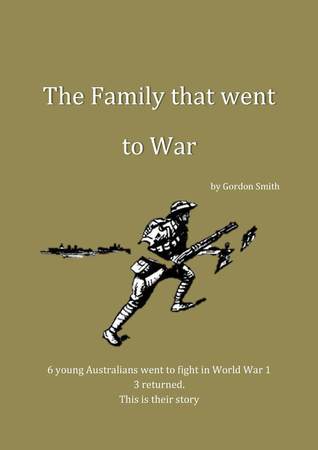
 The Family that Went to War is both a family memoir and a history of the people of the state of New South Wales, Australia. The author, Gordon Smith, gives a well-documented account of six members of a family from Cootamundra, NSW, who enlisted into the First Australian Imperial Force (1st AIF) at the onset of World War I. His research in historical archives, newspapers, and memorial societies is well done. The accounts of war and details of each man’s deployment presumes that he also had their war diaries and letters from home to draw on for detail.
The Commonwealth of Australia was still a young country, having formed a federation just over a decade previous. Australians still regarded Britain as their mother country, and when war broke out, Australia’s Prime Minister declared support for Great Britain and formally entered the Great War. Six members of the author’s family enlisted to fight the German army. He tells each man’s story with informative passages about the region they are in, the larger picture of the war that raged around them, and then brings it back down to the trenches where the soldiers fought. Smith’s details regarding ships, armaments, shortages and hardships, and other details of the soldiers’ experiences in Egypt and France will be of great interest to readers fascinated by World War I or the contribution of Australia to the Great War.
One such detail is in the account of Austin Schofield’s experience at Gallipoli. A water shortage, bad weather, and devastating losses motivated the British combined forces to evacuate. In order to safely evacuate, they used subterfuge to trick the Turkish forces into thinking they were still there.
Periscopes were to be propped up, and every effort was to be made to create the impression that the trenches were still fully occupied. … When it was time to finally abandon the trenches, Austin was to help set up some remote firing devices to fire some rifles to keep the illusion that the trenches were occupied. Some rifles had string tired to the trigger and a candle burning until it reached the string. The rifle would then fire.
Though the author writes with detachment, the stories of these soldiers in the midst of historic battles give a glimpse into the life, and death, of Australian soldiers. I was particularly interested in the account of William Power, fighting on the Western Front at Fromelles France. The losses to the Australian forces were described as, “the worst 24 hours in Australia’s entire history”. Though the account is given in a very matter-of-fact manner, it’s hard not to sympathize with the Australian soldiers.
The biggest drawback of this book was a simple case of bad editing. In one case, the name of an Egyptian city is spelled three different ways on the same page. Punctuation is inconsistent and made some passages difficult to understand and hard to follow.
Overall, I think the author has done a fine job documenting both his family history and military history. Despite the dry, academic tone of the account, there are moments of humor and humanity that shine through.
Pages: 92 | ISBN: 9781310378010

Joseph Khalid Massenburg
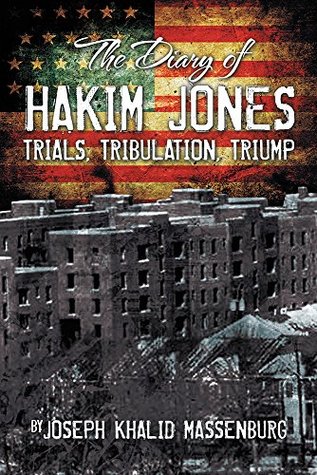 The Diary of Hakim Jones is a fascinating character story about the obstacles a person faces when growing up in the inner city. What was your inspiration for the character and stories in the novel?
The Diary of Hakim Jones is basically my life story with some fiction added. Most of these experiences I write about in this book are based upon similar experiences I have been through in my life. I hope to inspire the young men and women in our urban areas to never give up on their goals no matter how hard the road ahead may seem and I also hope to make those who are not familiar with the inner cities aware of the many hardships and struggles that go on in communities where the educational system has failed, along with a depleted economic system, and the loss of just basic family and community values.
This story is about a boy growing up in Newark, NJ. The background for the story I felt was well done. How are you familiar with Newark and New Jersey?
I grew up in Newark NJ and still live their today. I am also an employee for the city of Newark. I believe readers who have grown up in the inner cities around the country can relate to my book.
This story is told in a diary format. Why did you choose to tell the story in this format? How did that play into your development of the character?
The story is written in diary form because at first I was just writing down random events that had taken place in my life. But then I thought to myself, why not write the book in a diary (format) so that I could make it possible for readers (to feel like) they are watching a movie while reading my book.
What is the next book that your fans can expect to see from you and when is that coming out?
I want to try something a little different for my next novel. I was thinking about a possible inner city horror story. As a writer I want to be able to diversify my books so I can appeal to a wide range of readers. I have already started working on it so hopefully it will be done within the next year
Life in the hood is tough; violence and drugs are everyday realities, and motivation to change can be hard to come by. The Diary of Hakim
The Life and Crime of Ruby McCollum
 Dr. C. Arthur Ellis talks with The Monster about his new book Hall of Mirrors which comments on the various short films and documentaries developed to examine the life and crime of Ruby McCollum.
“Ruby McCollum (August 31, 1909 – May 23, 1992) was known for killing a prominent caucasian doctor in 1952 (whom she accused) that he had abused her and forced her to have sex and bear his child.” – Wikipedia.org
You’ve written many books about the case of Ruby McCollum and the true crime story that shook the south. How does Hall of Mirrors differ from your other works?
I first completed the annotated transcript of the trial of Ruby McCollum, which contained comments on each day of the trial, based upon my direct knowledge of the case. Commentary included various relationships among the key players, including attorneys and witnesses, who were known to me. I was motivated to create this work since various academic publications, including the first edition of Zora Neale Hurston: A Life in Letters by Karla Kaplan, maintained that Ruby McCollum was not allowed to testify at her trial when she actually did testify.
I then published a true crime novel of the story, written from the 1st person perspective of Zora Neale Hurston, the famous African-American anthropologist who reported on the trial for the Pittsburgh Courier, and then the omniscient narrator voice to tell the backstory leading to the murder.
Hall of Mirrors differs from these first two publications in that it comments on the various short films and documentaries developed after my work, as well as on the academic publication, The Silencing of Ruby McCollum, written by Dr. Tammy Evans. I considered all of these works to be without any foundation in fact, and developed with what appeared to be various biases that slanted the truth of the case in order to make political or personal statements. Further, all of these accounts were developed by people who never knew the key characters in the story. Hall of Mirrors presents primary research, not secondary opinion, to allow readers the freedom to develop their own take on the story.
What is your connection to the story of Ruby McCollum?
I was delivered into this world by Dr. C. Leroy Adams, Jr., the murder victim, in the front bedroom of our family home in Live Oak, Florida, just a block from the McCollum home. My father worked with Dr. Adams at the Suwannee County Hospital, and my mother was friends with Mrs. Adams. I knew every other character in the story, some of whom were my relatives.
Do you think Ruby McCollum’s case was instrumental in the struggle for civil rights and do you think her story is still relevant today?
I think that Ruby McCollum’s case was instrumental in the struggle for civil rights since it was the first documented case in which a woman of color was allowed to take the witness stand in her own defense in a trial charging her with killing a white man. In Hall of Mirrors, I place this trial in context, beginning with a similar trial prior to the Civil War, continuing to a case prior to McCollum’s in the Jim Crow South, and ending with the McCollum trial. This establishes a clear path of progress toward equal justice in America’s courtrooms.
I think that the public is witnessing many trials today that continue this march toward social equality, and the McCollum case is a clear benchmark on the timeline of that social progress.
The debate over the Ruby McCollum’s case has continued through the years in part because Judge Adams placed a gag order on Ruby. Why do you think the judge silenced Ruby?
Had Ruby McCollum been allowed to speak freely with the press, Live Oak, Florida would have been a feeding ground for IRS treasury agents, and the white community would have been equally convicted of tax evasion, illegal gambling, racketeering, illegal liquor sales and many related offenses. The judge himself stated that he issued the order to “protect the community,” and this is actually quite true. This being said, Ruby McCollum was visited by a reporter from the Jacksonville Times when she was in the Florida Prison at Raiford and refused to talk with him. This is in a letter written by McCollum and published in Hall of Mirrors. It is likely that McCollum had been advised to avoid the press, should they be able to reach her.
C. Arthur Ellis Amazon Author Page
Hall of Mirrors is the most thoroughly researched work on the Ruby McCollum story published since the work of William B. Huie. Written by the author who first published the annotated transcript of the murder trial, this work explores recent attempts to revise Ruby McCollum’s story to suit the motives of various authors, academics and film producers. Hall of Mirrors avoids confirmation and presentist biases and presents this captivating story in its proper historical context.
Hall of Mirrors
 Hall of Mirrors breaks down the presentist and confirmation biases of the life and trial of Ruby McCollum in 3 poignant chapters that are structured in an academic, journalistic fashion and are designed to elucidate the innocence of the protagonist — not from the crime itself, but from actual moral wrong-doing. Presenting the facts objectively, Arthur Ellis Jr., the most renowned Ruby researcher of his time, returns a decade after he compiled the definitive transcription of McCollum’s courtroom case to give his own interesting account of revisionism through a retrospective analysis that seeks to tell the truth, the whole truth and nothing but the truth about Ruby McCollum.
Unable to sum up the morally muddled events, the author evokes existentialism, saying, “ an inquisitive young mind will take up the challenge and write a dissertation on it,” as if he is too old to conclude a case that he grew up with; despite this implication of personal incompetence and conclusive shortcoming, the author shines through the shortsightedness of fellow commentators to demonstrate the fact that Ruby, by choosing her own destiny, regardless of what the legality of the setting might have been back then, had become the Rosa Parks of her time.
“McCollum also created her own values to bring meaning to her own life through a steadfast commitment to define herself according to her own terms, regardless of the race, class and gender issues that she faced in the Jim Crow South.”
These actions lead us to think she was actively trying to transcend her life and times by acting “authentically,” even if that entailed murder. The recollection that Ruby was “caught between two guns” describes danger for her as something inevitable. In confronting the discrepancies from documents and documentaries, Ellis Jr. describes Ruby as a woman that was not simply at the wrong place and time, but one that chose two of the wrong men. More importantly, however, she is characterized as a woman with pride that chose her predicament and would not back down or conform to solitude and silence like her contemporary women, or those that preceded her, had done.
An important theme in recounting evidence for Ellis Jr. is to not shortchange real judicial and social progress we’ve made since the times of Jim Crow, and to examine very closely the judicial trappings of the time to not sway opinions from the modern day legislation, lest risk an entanglement with fact and fiction; in staying true to reality, Ellis Jr. provides us with real liberty by setting Ruby free and telling her truth.
In telling that truth, Elis contends that Ruby’s decision to murder her paramour was, in fact, her own — one separate from the many pressures and competing urges she, and all of us, face on a daily basis — and that regardless of the will to choose it was a “reasoned choice,” a death sentence for her abusive lover rather than an act of pure self-preservation. Ruby McCollum took it upon herself to act as her own agent and to reclaim what was left of her tarnished self-image and physical life at the cost of another’s. Ellis Jr. makes it clear that he fully grasps the details of the case, but he implies that he does not fully understand if she if guilty outside of a textbook, and instead leaves the reader by the appendix to define Mrs. McCollum’s actions outside of the discrepancies that he works diligently to debunk.
Through testimonies from contemporary friends and foes of the trial that support Ruby’s case and her autonomy when committing a homicide, Elis does well to remain as loyal and objective to the image of Mrs. McCollum and her criminal circumstances as possible. Fittingly, Hall of Mirrors is an aptly named monograph of a woman’s civil rights struggle that is complete with flashbacks paralleling forward to the norms of modernity and current jurisdictional tendencies that, coupled with an excellent understanding of real morality that offers a third way of looking at right and wrong — beyond black and white law — by promoting the tenets of Existentialist burden and the reliance of identity to foster the correct choice of acting authentically in a bind, it shows us that actions do really speak louder than words.
Pages: 206 | ISBN: 0982094086
Review: 50 Shades of Truth

 Subtitled “a dark journey into the Light”, “50 Shades of Truth” is the story of one man’s journey through and out of the world of BDSM. Josef takes the reader through the incidents in his childhood that he feels precipitated his interest in the world of bondage and discipline and uses encounters from his 60 year journey to explain his path and the mental and emotional consequences that he is still working through.
Josef describes for the reader the life of lies and deceit that he was forced to live because of his participation in bondage. He details his encounters with transvestites, mistresses and gay men, and takes you through his thought processes during these encounters and afterward. The depth of his guilt and shame over these encounters is evident but also evident is the complete control that his urges for this type of behavior exhibited over him.
The writing in this book is top-notch. The writer’s style is clear and approachable and made the book easy to read. This book would, however, not be suitable for younger readers due to the language and the explicit descriptions of sexual scenes. Josef’s urges, as described here, feel like an addiction and as with most addictions he makes many attempts to change before finally being able to succeed with the help of a therapist. The struggle the author felt as he watched his urges destroy two marriages and several other relationships is palpable.
Josef also goes into great detail about how he views the role of the Catholic Church, where he was raised, in developing his feelings of guilt and shame about the activities which gave him such pleasure. He also goes into his views on how society’s attitudes toward sex make life more difficult for people like him. Josef points out to us the humanity of those people who are involved in the sex industry and presents them to us as people just wanting to have a life they can enjoy. Josef does not push the reader to want to participate in this world but he does push for it to be accepted by non-participants as a valid choice for an individual.
The obvious readers of this book are people who also engage in the world of bondage and enjoy reading about it. But I think this book could also be a good choice for people who would like a greater understanding of something they are not already familiar with and also for those who enjoy stories about people who struggle but find their victory in the end. Josef exposes some very ugly truths in his book and he bares his soul to his readers. I believe there are some who will take courage from this story and be able to apply that to their own lives. I tip my hat to Josef for being willing to share his story with the world and allowing his readers to make up their own minds about whether they are willing to change their viewpoints after reading it.
ASIN: B00Z7VR406
Pages: 174



 LITERARY TITAN