Blog Archives
Charli’s Pawsome Park: An Architectural Adventure


Charli’s Pawsome Park is about a curious girl who meets a landscape architect and instantly starts wondering what it would be like to design parks herself. The spark grows into a full-blown daydream where she imagines creating a dog park in her town. With her friends, some trial-and-error problem solving, and plenty of imagination, she sketches, models, and pitches her idea to the town council. In the end, her vision comes to life, and she learns that with creativity and teamwork, anything is possible.
I really enjoyed how this children’s book made a big idea like architecture feel fun and doable for kids. The writing has an easy rhythm, and the dialogue feels natural, like real kids talking to each other. I liked that Charli wasn’t perfect. She hit bumps, like realizing bushes blocked views or that a tunnel led dogs straight into a mess. Those little “oops” moments made the story feel alive. It didn’t read like a lecture on STEM. It felt like a playful adventure with just enough detail to spark interest without bogging kids down.
The theme of dreaming big hit me the most. I liked how Charli’s curiosity spun into action, and the story showed the whole process, from idea to fixing mistakes to presenting in front of grown-ups. It felt empowering, like a nudge saying kids’ ideas can matter too. The dog park concept itself was adorable, and the splash pad ending made me smile. The pictures also carried a lot of charm, like a Disney Channel cartoon. They pulled me into Charli’s world and made me want to cheer for her.
I think this picture book is a great pick for kids who love animals, enjoy drawing, or are just curious about how the world is built. It would be a fun read-aloud in classrooms, especially if teachers want to spark interest in STEM without making it feel heavy. Parents who want their kids to see that girls can design big, bold things will find it extra special.
Pages: 91 | ISBN: 978-1-964845-04-3
Charli’s Turtle Triumph: A Marine Biology Adventure

Charli’s adventure begins with a field trip to the aquarium, where she meets Dr. Grace, a marine biologist who rescues sea turtles. Inspired by the work, Charli imagines herself diving into the ocean, helping animals, and making a difference. That daydream becomes all too real when she stumbles upon a stranded turtle on the beach. With the help of her friends, she saves the turtle, names him Bristol, and soon launches a beach cleanup campaign to protect more turtles from the dangers of plastic. The story builds to a joyful release of Bristol back into the sea, ending with Charli realizing that her dreams of being a marine biologist might not be so far-fetched after all.
What really struck me about this children’s book was how it wrapped serious issues in such a hopeful package. The writing feels approachable and warm, never too heavy, even when it talks about endangered species or pollution. I found myself rooting for Charli not just as a character but as a voice for her community. The author managed to balance imagination and reality, and I loved that blend. The daydream sequences gave the story a magical pull, yet the lessons about conservation felt grounded and urgent.
The ideas in this picture book feel both practical and inspiring. I appreciated how it didn’t just point fingers at problems but showed kids and adults what small actions can do. Switching to less plastic, cleaning beaches, and working together. These are simple things, but they were presented with an energy that made me want to pitch in too. I also thought the friendship between Charli, Emma, and Molly added a nice touch. It reminded me that no big change ever happens alone.
I’d recommend Charli’s Turtle Triumph to kids around 7 to 9, especially those who love animals or dream about science. It’s also a great choice for parents and teachers who want to spark conversations about the environment in a way that’s uplifting. The story is heartfelt, the message is powerful, and the illustrations, which appear on every page, carry a lot of charm. It left me hopeful, and I think it would do the same for just about anyone who picks it up.
Pages: 96 | ASIN : B0FFWGD3HP

Ellie Ment and the Material Matter
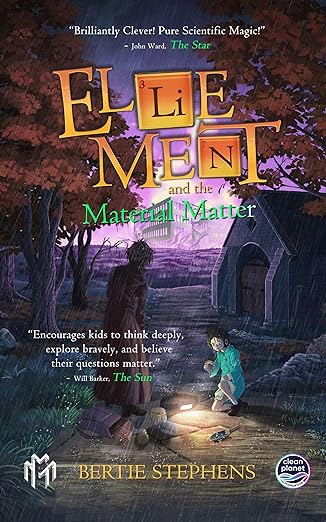

Ellie Ment and the Material Matter, by Bertie Stephens, is a quirky and fast-paced middle-grade adventure that blends science, humor, and environmental themes with a heavy dose of curiosity and chaos. It follows the story of Ellie, an 11-year-old self-proclaimed scientist living in the endlessly rainy town of Hapsie. After witnessing her brand-new school go up in strange purple flames, Ellie is drawn into a mystery that includes jam jar experiments, mysterious adults, glowing embers, suspicious teachers, a secret science club, and a new girl who seems just a little too perfect. Armed with a fierce love of science and a head full of questions, Ellie digs deeper into what’s really going on, and ends up discovering more about the world (and herself) than she bargained for.
The writing is seriously fun. Bertie Stephens has a wild energy in his prose that feels like Roald Dahl with a scientific twist. There’s a real rhythm to the way he plays with narration, slipping in clever asides and running gags that make you grin without feeling overdone. The world-building in Hapsie is rich in detail, from a pothole nicknamed “Stego-hole” to an art teacher who inexplicably wipes down students’ faces with talcum powder. It’s packed with oddball characters and moments that are both funny and surprisingly touching. I loved how the book never talks down to the reader; it trusts kids to understand big ideas, and that trust feels earned. The science woven into the story isn’t just accurate, it’s exciting. Ellie’s obsession with the periodic table, her experiments with rainwater, and her balloon hypothesis all made me want to pull out a notebook and start investigating things myself.
Ellie is a joy. She is relatable, sharp, stubborn, and delightfully flawed, but Kami, her main “rival,” didn’t feel quite as developed early on. I found myself wanting to understand her a bit more beneath the confident, polished surface. Some of that depth does come through later. I loved the fast pace and witty writing. While a few moments felt a little rushed or slightly tangled, there were still plot twists that surprised me in the best way. This is a story that’s bursting with creativity, warmth, and just the right amount of scientific mayhem.
Ellie Ment and the Material Matter is one of those rare stories that feels smart and silly in equal measure. It’s great for curious kids who love science, adventure, or just getting into a little trouble in the name of learning. Teachers and parents will appreciate its environmental message and the way it champions creative thinking without preaching. It reminded me how important it is to question the world around us and to never accept “that’s just the way it is” as an answer. If I had this book when I was eleven, I would’ve read it twice.
Pages: 284 | ASIN : B0F6T1ZMFX
“The Mother of Hubble”

Her Eyes Were On the Stars: Nancy Grace Roman, “Mother of Hubble” Space Telescope, tells the story of how one girl’s dream of becoming an astronomer turned into a reality. What inspired you to tell her story?
At the time, I was looking for subjects to write about. I was hearing a lot about STEM and biographies for women in science, so maybe it was prophetic when I was watching an episode of NOVA on PBS about the Hubble Telescope and “the Mother of Hubble” when the name of Nancy Grace Roman was mentioned, and I thought she might be an interesting person to write about. She was certainly someone I had never heard of before and I was willing to bet others hadn’t either. I realized how remarkable she was after I started some preliminary research. I was fortunate to find her email on NASA’s website and to receive a quick response from her saying she would be interested in doing a telephone interview with me. From there, there was no turning back!
Your background in Engineering and having an MLIS in children’s literature gives you a unique perspective on writing nonfiction children’s books. What is the most rewarding part of writing books for children to you?
For me, it is that feeling I want to recreate that I had as a child reading really good books, magical books, or those that gave me a glimpse into someone else’s life. I’ve always had an interest in science, so maybe I am more interested in writing about those subjects. But I am also a very creative person, and my interest in architecture and interior design goes back to my creativity. So even though I love writing nonfiction, I also love making stories up, too.
What were some educational aspects that were important for you to include in this children’s book?
One thing I wanted to convey was how important first-hand accounts are to research. Primary sources are essential, and that was why I wanted so badly to interview Dr. Nancy Grace Roman in person. I wanted her account of events. I always tell kids that research can be like a game of telephone. The original message gets tangled the more times it gets told. So, one thing I really wanted to include in this book were the actual quotes Dr. Roman said to me. Also, I included all the other sources I used in the bibliography in the back that can be checked against my work. We all need to remember that just because someone says something, it doesn’t mean it’s true. Check your facts!
Will this book be the start of a series? I would love to see more books about other women in science, or are you working on a different story?
This book is a stand-alone, with no plans for more in a series. I do have other books, both nonfiction and fiction. One nonfiction book I am very proud of is Octopus Capers that is still unpublished, but with my agent, Stephen Fraser of Jennifer DeChiara Literary Agency. He also has a middle-grade fantasy called The Changeling. Currently, I am working on a Halloween picture book called Every Creature Eats about a witch’s party where she is pushing lots of “treats” on her guests. It’s the kind of book I would’ve loved to have had as a Children’s Librarian at the library, where I would read a story to the kids, and then we’d have an activity related to the book, in this case, a snack.
Author Links: GoodReads | Twitter | Facebook | Website | Amazon
As a child, Nancy Grace Roman moved from home to home. The only constant? The nighttime sky. She loved the stars and knew from a young age that she wanted to become an astronomer. But could she, during a time when many women weren’t even allowed into colleges? Nancy Grace found a way to overcome each barrier placed before her. Her persistence paid off when she was named the first female executive as Chief of Astronomy at the newly created National Aeronautics and Space Administration, or NASA, in 1959. It was here she faced her biggest challenge to date.
Astronomers across the country wanted a telescope that would orbit in space above the Earth’s atmosphere allowing for the clearest view of the stars a telescope had ever seen. The problem? At this early stage of the United States space program, engineers hadn’t even successfully launched a rocket. How would Nancy Grace ever get a telescope into space? HER EYES WERE ON THE STARS introduces readers to a female scientist in the field of astronomy who will be forever affectionately known as “Mother of Hubble.”
“…is often forgotten by our younger generation of astronomers who make their careers by using the Hubble Space Telescope. Regretfully, history has forgotten a lot in today’s Internet age, but it was Nancy Grace Roman in the old days before the Internet and before Google and e-mail and all that stuff, who really helped to sell the Hubble Space Telescope, organize the astronomers, who eventually convinced Congress to fund it.” – Ed Weiler, former NASA Chief Scientist for Hubble
I Want To Inspire Kids
Ranbir follows a 7-year-old boy who takes a challenge to fold the state of Nebraska 50 times and winds up on an adventure learning higher mathematics. What was the inspiration for the original and fascinating idea at the center of the book?
It all goes back to my fascination with the scale on a slide rule. I’d never been taught how to use one — how is it possible to make such complicated calculations just by sliding two sticks together? When Buck imagines the state of Nebraska as one huge sheet of 20# copy paper, the principle of doubling what was doubled before begins to take shape in his mind. The slide rule follows the same idea, except each doubling gets squished into the same space as the previous one.
What were some educational aspects that were important for you to include in this children’s book?
That kids can be introduced to mathematical concepts well above their grade level using very simple imagery. And keep it outrageously funny to make it easier to remember.
This book is really intended not for kids, but for adult teachers and educators who can interactively communicate these ideas to their students.
What were some goals you set for yourself as a writer in this book?
I wanted to maintain the exuberance and innocence of a seven-year-old as he navigates a world of ideas, catch-phrases, expectations, and challenges. From “I can’t do this, this is way beyond me” (I’m just a little kid!) to “Huh! I just learned something. I just did something!”
What is the next book that you are working on, and when will it be available?
I do not have another book in mind at this time. However, Atmosphere Press is helping me set up a website, ranbirsliderule.com. I hope this might serve as a base to inspire fresh ideas for introducing math — perhaps other STEM subjects as well — to young kids (and curious adults) on a count-on-your-fingers level.
Author Links: GoodReads | Website
My name is Buck O’Doul. I’m only seven years old. I decided to take up this challenge and fold the state
of Nebraska 50 times and see what I came up with.
Little did I know what I was getting into — I was being sucked into the world of higher mathematics, squares and square roots, hooky things, squishy scales and logarithms, and all pretty much just by counting on my fingers!
Ranbir: A seven-year old’s introduction to higher mathematics

Ranbir: A seven-year-old’s introduction to higher mathematics is a captivating and educational tale that takes readers on a journey into the world of mathematics through the eyes of Buck O’Doul, a seven-year-old with an insatiable curiosity. The story begins with Buck’s friend Ranbir challenging him to fold a sheet of paper 50 times and imagine its thickness. Buck embarks on this seemingly simple task but soon finds himself delving into the complexities of higher mathematics.
Through Buck’s perspective, children are introduced to squares, square roots, logarithms, and scales in a way that sparks their interest and imagination. The author skillfully weaves these ideas into the story, ensuring that young readers can grasp the principles in a fun and interactive manner. This book goes beyond teaching mathematical concepts; it encourages critical thinking and problem-solving skills. Buck’s determination to overcome challenges and his joy in discovering new ideas serve as valuable life lessons for children.
This book beautifully captures the essence of perseverance and the thrill of intellectual exploration. Mona R. Semerau’s writing style is engaging and perfectly suited for young readers. The use of descriptive language and vivid imagery brings the story to life, capturing children’s attention from start to finish. The well-balanced pacing allows for a smooth progression of events and concepts, ensuring that children remain enthralled without feeling overwhelmed. This book serves as an invaluable tool for educators and parents alike. It effortlessly combines entertainment and education, making mathematics both approachable and enjoyable.
Ranbir: A seven-year old’s introduction to higher mathematics is a captivating and enlightening book that seamlessly integrates mathematical concepts into an engaging narrative. I highly recommend this book for its ability to foster a love for learning, critical thinking skills, and a sense of wonder in young readers.
Pages: 75 | ASIN : B0CBCM7XKT
Nurse Florence®, What is Arthritis?
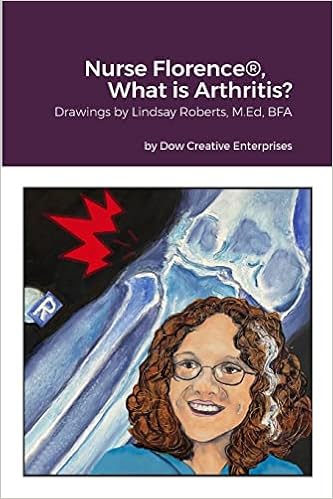
Nurse Florence®, What is Arthritis? by Michael Dow, offers a captivating and educational reading experience that is sure to intrigue young minds, fostering a genuine interest in scientific exploration. The narrative follows Jean, Condi, and Sonia as they engage in an enlightening conversation about their science class when serendipitously, they encounter Nurse Florence in the cafeteria. Curious to understand arthritis and its impact on our bones, the girls turn to Nurse Florence for answers. With great expertise and compassion, Nurse Florence delves into the complexities of arthritis, shedding light on its effects, various treatment approaches, and the demographics most prone to this condition.
Author Dow once again delivers a thought-provoking and highly enlightening literary work. The series succeeds in stimulating young readers to inquire about the intricacies of the human body, demonstrating that science can be both enjoyable and intriguing. Despite its concise length, the book effortlessly imparts a wealth of knowledge. While some vocabulary may prove challenging for younger readers, the author mitigates this concern by including a comprehensive glossary at the book’s conclusion, accompanied by a pronunciation guide at the beginning. Furthermore, the deliberate choice to portray the main characters as girls is commendable, as it addresses the underrepresentation of women in the scientific field.
The illustrations in the book possess a remarkable artistic quality, adding aesthetic appeal to the overall reading experience. The wealth of information provided by Nurse Florence is genuinely fascinating, leaving readers like myself craving further exploration of arthritis. The Nurse Florence series serves as an ideal entry point for young readers, gently nudging them into the fascinating world of science. Undoubtedly, this book would be a valuable addition to educational institutions and libraries alike, inspiring young minds and fostering a love for scientific inquiry. I eagerly anticipate the forthcoming installments in this exceptional series.
Pages: 117 | ISBN : 1312775211
Nurse Florence®, What is Atrial Fibrillation?
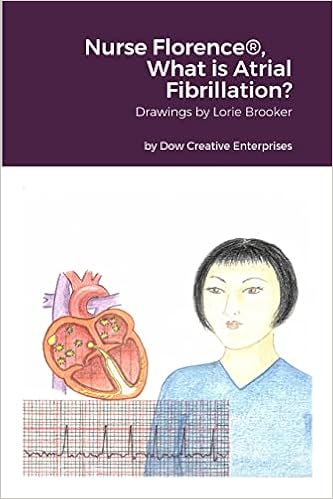
What is Atrial Fibrillation? This question is asked by students in this edition of the Nurse Florence series. A group of students see the school nurse at lunch and ask if they can sit with her; once they are all settled, Nurse Florence asks what they want to learn about today. One girl says that a family friend has just been diagnosed with Atrial Fibrillation and wants to know what that means. This leads to an in-depth discussion about what one is, how it can be caused, what this means for the person with it and things that can be done to prevent getting one. The girls learn a lot of science and medical terminology and have a great discussion on things to do to keep one’s body healthy.
Nurse Florence®, What is Atrial Fibrillation? written by Michael Dow, is written about a fictional nurse, but all the information in the story is based on facts. Dow uses correct medical terminology to explain things, and while this may be daunting at first, there is a glossary to look up the term. As an adult, I learned a great deal from this book, so I am positive that this would benefit children interested in science and medicine. The illustrations done by Lorie Brooker are done in colored pencil drawings. This allows younger children to look at things like blood pumping through the heart without being too graphic for sensitive readers. It is a great way to introduce these concepts in an approachable manner.
For children with an interest in medicine or teachers wanting to expand students’ interest in STEM, Nurse Florence®, What is Atrial Fibrillation? is a fantastic book to introduce to kids. This easy-to-follow children’s book teaches readers about A-fib and helps them understand how it is diagnosed, how it occurs, and what can be done to treat and prevent it.
Pages: 119 | ISBN : 1329376684



 LITERARY TITAN